

What you'll learn
- Define refractive index and use it to calculate the speed of light in a material.
- Use Snell’s law to calculate angles when light crosses a boundary.
- Explain refraction using the wave model of light.
- Apply total internal reflection to optical fibres, including multimode dispersion.
The basic picture: rays, normals and boundaries
When light crosses from one transparent medium into another, for example from air into glass, its speed changes. If it meets the boundary at an angle, this change in speed causes the light to change direction. This change of direction is called refraction.
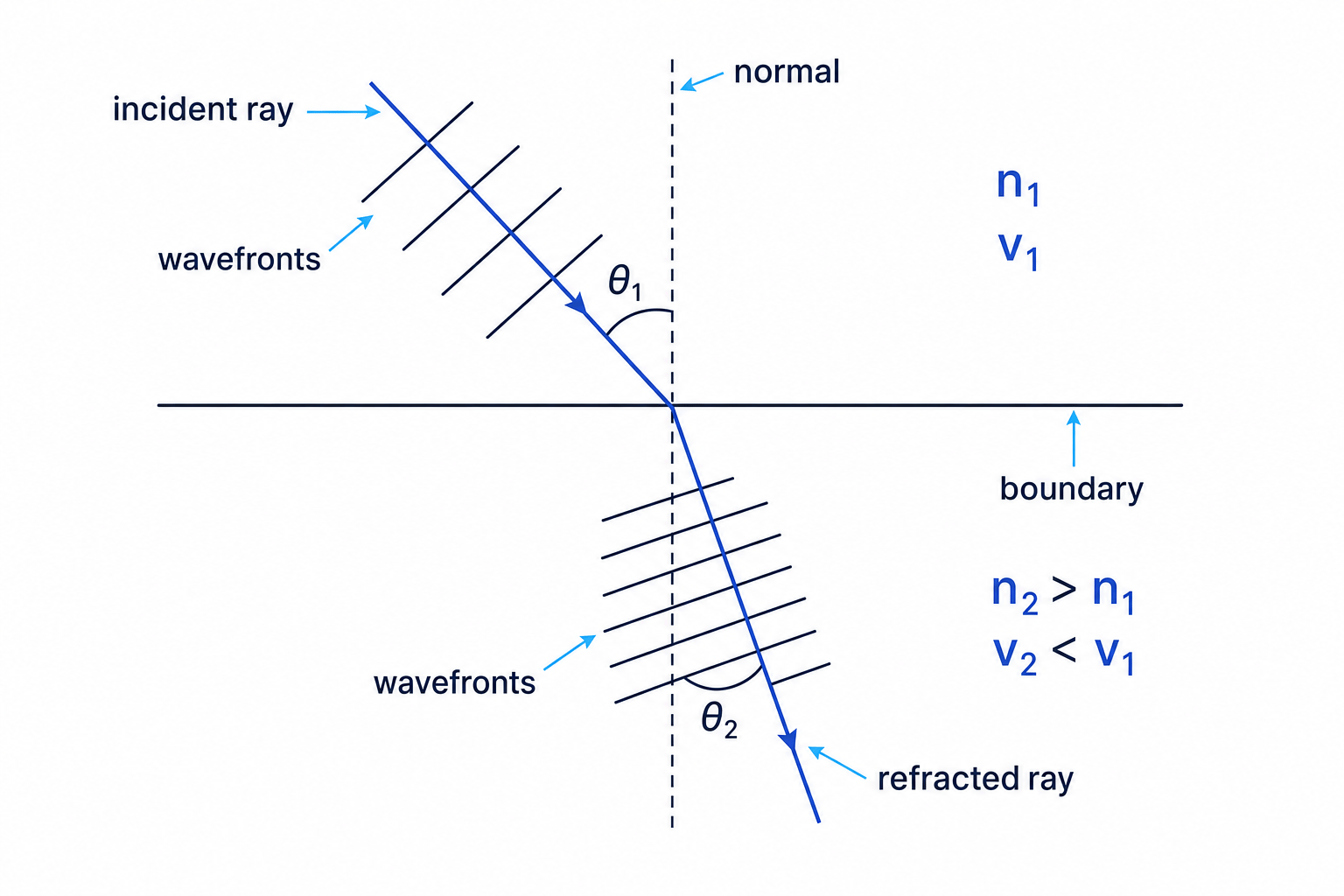
A ray is a line showing the direction in which light energy travels. A boundary is the surface between two media. The normal is an imaginary line drawn at 90 degrees to the boundary at the point where the ray hits.
Angles in refraction
The angle of incidence, θ1\theta_1θ1, is the angle between the incident ray and the normal. The angle of refraction, θ2\theta_2θ2, is the angle between the refracted ray and the normal.
Measuring from the surface
Angles in refraction are measured from the normal, not from the surface. If you use the surface angle by mistake, your answer will often look plausible but be wrong.
Refractive index
Different materials slow light by different amounts. The refractive index tells you how much slower light travels in a medium compared with a vacuum.
Refractive index
The refractive index, nnn, of a medium is defined by
n=cvn = \frac{c}{v}n=vcwhere ccc is the speed of light in a vacuum and vvv is the speed of light in the medium.
The speed of light in a vacuum is approximately 3.00×10⁸ m s−13.00 \times 10^8 \ \text{m s}^{-1}3.00×10⁸ m s−1. Refractive index has no unit because it is a ratio of two speeds.
A larger refractive index means light travels more slowly in that medium. Air has a refractive index close to 1, while glass is often around 1.5.
From n=cvn = \frac{c}{v}n=vc, we can also say that
n1v1=n2v2n_1v_1 = n_2v_2n1v1=n2v2because for any medium, nv=cnv = cnv=c.
Calculating speed in glass
A type of glass has refractive index 1.50. Calculate the speed of light in the glass.
-
Start with the definition of refractive index and rearrange it:
n=cv⇒v=cnn = \frac{c}{v} \Rightarrow v = \frac{c}{n}n=vc⇒v=nc -
Substitute the values, keeping the unit on the speed of light:
v=3.00×10⁸ m s−11.50v = \frac{3.00 \times 10^8 \ \text{m s}^{-1}}{1.50}v=1.503.00×108 m s−1 -
Calculate the speed:
v=2.00×10⁸ m s−1v = 2.00 \times 10^8 \ \text{m s}^{-1}v=2.00×10⁸ m s−1
What changes at a boundary?
When light enters a new medium, its speed and wavelength change, but its frequency stays the same.
Snell’s law
Snell’s law links the angle of the ray to the refractive indices of the two media:
n1sinθ1=n2sinθ2n_1 \sin \theta_1 = n_2 \sin \theta_2n1sinθ1=n2sinθ2Here, n1n_1n1 is the refractive index of the medium the light starts in, and n2n_2n2 is the refractive index of the medium it enters.
If light enters a medium with a larger refractive index, it slows down and bends towards the normal. If it enters a medium with a smaller refractive index, it speeds up and bends away from the normal.
Finding the refracted angle
Light travels from air into glass. The refractive index of air is 1.00 and the refractive index of the glass is 1.52. The angle of incidence is 35.0 degrees. Calculate the angle of refraction.
-
Choose the correct media and substitute into Snell’s law:
1.00sin35.0∘=1.52sinθ21.00 \sin 35.0^\circ = 1.52 \sin \theta_21.00sin35.0∘=1.52sinθ2 -
Rearrange to make sinθ2\sin \theta_2sinθ2 the subject:
sinθ2=1.00sin35.0∘1.52\sin \theta_2 = \frac{1.00 \sin 35.0^\circ}{1.52}sinθ2=1.521.00sin35.0∘ -
Calculate the angle:
θ2=sin−1(0.377)=22.1∘\theta_2 = \sin^{-1}(0.377) = 22.1^\circθ2=sin−1(0.377)=22.1∘
The ray bends towards the normal, so the smaller angle is sensible.
Calculator mode
For A-Level refraction questions, angles are normally in degrees. Check your calculator is in degree mode before using sin\sinsin, cos\coscos, tan\tantan or inverse trigonometric functions.
Snell’s law and the wave model
A wavefront is a line joining points on a wave that are in phase, such as all the crests of a plane wave. Rays are perpendicular to wavefronts.
When a plane wave reaches a boundary at an angle, one side of the wavefront enters the new medium before the other side. If the wave enters a medium where it travels more slowly, that side slows first. The wavefront pivots, so the ray direction changes.
Using the wave model:
sinθ1sinθ2=v1v2\frac{\sin \theta_1}{\sin \theta_2} = \frac{v_1}{v_2}sinθ2sinθ1=v2v1and since n=cvn = \frac{c}{v}n=vc,
v1v2=n2n1\frac{v_1}{v_2} = \frac{n_2}{n_1}v2v1=n1n2so
n1sinθ1=n2sinθ2n_1 \sin \theta_1 = n_2 \sin \theta_2n1sinθ1=n2sinθ2This is why Snell’s law is strong evidence for treating light as a wave.
Explaining bending using wavefronts
A plane wave travels from air into glass at an angle.
-
Compare the refractive indices: glass has a larger refractive index than air, so the wave speed is lower in glass.
-
Decide what happens to the first part of the wavefront to enter the glass: it slows down before the rest of the wavefront.
-
Use the change in wavefront direction: the wavefront pivots, so the ray, which is perpendicular to the wavefront, bends towards the normal.
Measuring refractive index of a material
A common practical method uses a ray box or laser, a rectangular glass or plastic block, paper, a ruler and a protractor.
- Place the block on paper and draw around it.
- Draw a normal to one face.
- Shine a narrow ray at the block at a known angle of incidence, θ1\theta_1θ1.
- Mark the ray path and measure the angle of refraction, θ2\theta_2θ2.
- Repeat for several different incident angles.
- Calculate sinθ1\sin \theta_1sinθ1 and sinθ2\sin \theta_2sinθ2 for each pair.
For light entering the material from air, take nair≈1.00n_{\text{air}} \approx 1.00nair≈1.00. Snell’s law becomes
sinθ1=nmaterialsinθ2\sin \theta_1 = n_{\text{material}} \sin \theta_2sinθ1=nmaterialsinθ2So if you plot sinθ1\sin \theta_1sinθ1 on the y-axis against sinθ2\sin \theta_2sinθ2 on the x-axis, the gradient is the refractive index of the material.
Finding refractive index from a graph
A student plots sinθ1\sin \theta_1sinθ1 against sinθ2\sin \theta_2sinθ2 for light entering a plastic block. A best-fit line has gradient 1.47.
-
Use the graph relationship for air to material:
sinθ1=nmaterialsinθ2\sin \theta_1 = n_{\text{material}} \sin \theta_2sinθ1=nmaterialsinθ2 -
Compare this with the straight-line form y=mxy = mxy=mx: the gradient, mmm, is nmaterialn_{\text{material}}nmaterial.
-
Therefore the refractive index is:
nmaterial=1.47n_{\text{material}} = 1.47nmaterial=1.47
Improving the practical
Use a range of angles, draw thin pencil lines, repeat readings, and estimate uncertainty using steepest and shallowest acceptable best-fit lines. Avoid very small angles because percentage uncertainty in angle measurement becomes large.
Laser safety
If you use a laser, never look directly into the beam or its reflections. Keep the beam low and directed away from people.
Total internal reflection
Usually, some light is reflected and some is refracted at a boundary. But under certain conditions, all the light is reflected back into the original medium. This is called total internal reflection.
Critical angle
The critical angle, θc\theta_cθc, is the angle of incidence in the denser medium for which the angle of refraction is 90 degrees.
Total internal reflection only happens when:
- light travels from a medium with larger refractive index to a medium with smaller refractive index;
- the angle of incidence is greater than the critical angle.
At the critical angle, the refracted ray travels along the boundary, so θ2=90∘\theta_2 = 90^\circθ2=90∘. Starting from Snell’s law:
n1sinθc=n2sin90∘n_1 \sin \theta_c = n_2 \sin 90^\circn1sinθc=n2sin90∘Since sin90∘=1\sin 90^\circ = 1sin90∘=1,
n1sinθc=n2n_1 \sin \theta_c = n_2n1sinθc=n2or
θc=sin−1(n2n1)\theta_c = \sin^{-1}\left(\frac{n_2}{n_1}\right)θc=sin−1(n1n2)Calculating a critical angle
Light travels inside glass of refractive index 1.50 towards an air boundary. Calculate the critical angle.
-
Identify the two media: the light starts in glass, so n1=1.50n_1 = 1.50n1=1.50; it would enter air, so n2=1.00n_2 = 1.00n2=1.00.
-
Substitute into the critical angle equation:
sinθc=n2n1=1.001.50\sin \theta_c = \frac{n_2}{n_1} = \frac{1.00}{1.50}sinθc=n1n2=1.501.00 -
Calculate the angle:
θc=sin−1(0.667)=41.8∘\theta_c = \sin^{-1}(0.667) = 41.8^\circθc=sin−1(0.667)=41.8∘
So total internal reflection occurs for angles of incidence greater than 41.8 degrees.
No critical angle in the wrong direction
If light travels from a smaller refractive index to a larger refractive index, total internal reflection cannot occur. The expression sin−1(n2n1)\sin^{-1}\left(\frac{n_2}{n_1}\right)sin−1(n1n2) only works when n1>n2n_1 > n_2n1>n2.
Optical fibres
An optical fibre has a central core surrounded by cladding. The core has a slightly larger refractive index than the cladding. Light travelling in the core can undergo total internal reflection at the core-cladding boundary, so it stays trapped inside the fibre.
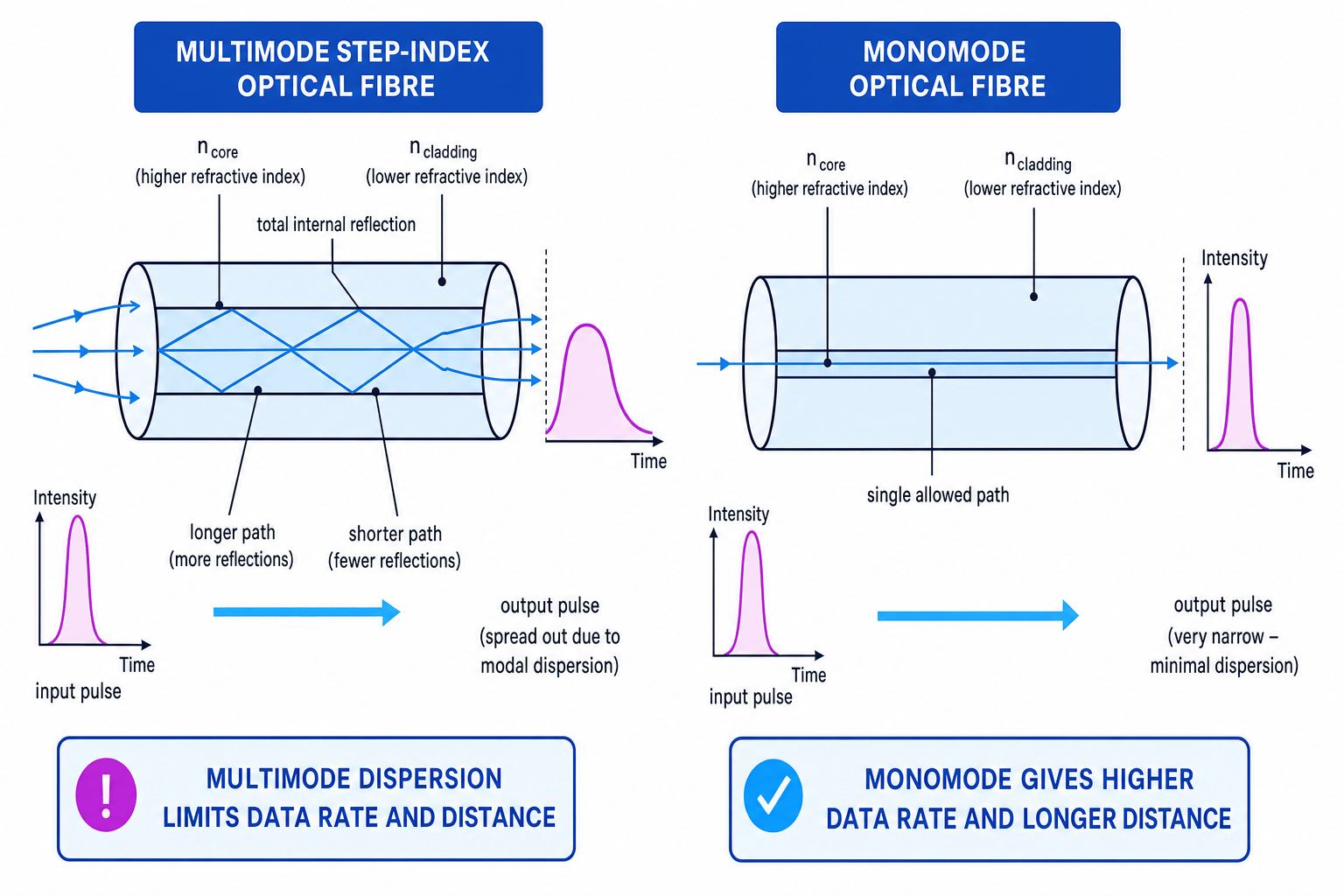
In a multimode optical fibre, light can travel along many different paths, called modes. Some rays take a nearly straight path; others zig-zag and travel a longer distance.
Multimode dispersion
Multimode dispersion is pulse spreading caused by different modes taking different times to travel through the fibre.
Data is sent as pulses of light. If the pulses spread out too much, neighbouring pulses overlap and the detector cannot distinguish separate bits reliably. This limits both the maximum rate of data transfer and the maximum transmission distance.
Estimating pulse spreading in a multimode fibre
Two rays in a fibre travel path lengths that differ by 24.0 m. The refractive index of the core is 1.50. Estimate the time delay between the rays.
-
Calculate the speed of light in the core:
v=cn=3.00×10⁸ m s−11.50=2.00×10⁸ m s−1v = \frac{c}{n} = \frac{3.00 \times 10^8 \ \text{m s}^{-1}}{1.50} = 2.00 \times 10^8 \ \text{m s}^{-1}v=nc=1.503.00×108 m s−1=2.00×10⁸ m s−1 -
Use the extra distance travelled by the longer path:
Δt=Δsv=24.0 m2.00×108 m s−1\Delta t = \frac{\Delta s}{v} = \frac{24.0 \ \text{m}}{2.00 \times 10^8 \ \text{m s}^{-1}}Δt=vΔs=2.00×10⁸ m s−124.0 m -
Calculate the pulse spreading:
Δt=1.20×10⁻⁷ s\Delta t = 1.20 \times 10^{-7} \ \text{s}Δt=1.20×10⁻⁷ s
This delay is 120 ns, which can be enough to cause overlapping pulses at high data rates.
Monomode optical fibres
A monomode optical fibre has a much narrower core, so only one mode is supported. Since there are not many different ray paths, multimode dispersion is greatly reduced.
This allows:
- much greater transmission rates, because pulses stay narrower;
- much longer transmission distances, because pulses can travel further before becoming too spread out;
- improved signal quality, because less timing uncertainty reaches the detector.
Why monomode fibres matter
Multimode fibres are limited by different path lengths. Monomode fibres reduce this problem by allowing essentially one mode, so pulses remain sharper over longer distances.
In the exam
- Always label angles from the normal, then choose n1n_1n1 as the medium the ray is currently in and n2n_2n2 as the medium it enters.
- For total internal reflection, check both conditions: travelling from larger nnn to smaller nnn, and angle of incidence greater than θc\theta_cθc.
- For refractive index practicals, use a graph of sinθ1\sin \theta_1sinθ1 against sinθ2\sin \theta_2sinθ2 and link the gradient to Snell’s law.
Check yourself
- Why does light bend towards the normal when it enters glass from air?
- How would you find the refractive index of a transparent block from experimental angle measurements?
- Why do monomode optical fibres allow higher data transfer rates than multimode fibres?
