

What you'll learn
- How to use Hooke’s law, stress, strain and Young modulus quantitatively.
- How strain energy is found from the area under a force-extension graph.
- How metals, brittle materials and rubber behave differently when stretched.
- How to determine the Young modulus of a metal wire and investigate rubber experimentally.
1. Stretching a solid: force and extension
When a solid is pulled, it may extend. For small loads, many materials behave in a simple, predictable way: doubling the force doubles the extension.
Extension
The extension, Δl\Delta lΔl, is the increase in length of an object compared with its original length. If the original length is lll and the new length is l+Δll + \Delta ll+Δl, then the extension is Δl\Delta lΔl.
Hooke’s law
Hooke’s law states that the force applied to an object is directly proportional to its extension, as long as the limit of proportionality has not been exceeded.
F=kxF = kxF=kxHere, FFF is force in newtons (N), xxx is extension in metres (m), and kkk is the spring constant in newtons per metre (N m⁻¹). The spring constant is the force per unit extension.
Hooke’s law graph
On a force-extension graph, Hooke’s law gives a straight line through the origin. The gradient of this line is the spring constant kkk.
Finding a spring constant
A spring extends by 24 mm when a force of 3.6 N is applied. Find its spring constant.
-
Convert the extension into metres:
x=24 mm=2.4×10⁻² mx = 24\text{ mm} = 2.4 \times 10^{-2}\text{ m}x=24 mm=2.4×10⁻² m -
Rearrange Hooke’s law and substitute:
k=Fx=3.6 N2.4×10−2 mk = \frac{F}{x} = \frac{3.6\text{ N}}{2.4 \times 10^{-2}\text{ m}}k=xF=2.4×10⁻² m3.6 N -
Calculate the gradient value:
k=1.5×10² N m−1k = 1.5 \times 10^2\text{ N m}^{-1}k=1.5×10² N m−1
So the spring constant is 150 N m⁻¹.
Using millimetres directly
Always convert extension into metres before using F=kxF = kxF=kx. If you use millimetres, your spring constant will be wrong by a factor of 1000.
2. Stress, strain and Young modulus
A thin wire and a thick rod can be made of the same material, but they will not extend by the same amount under the same force. To describe the material itself, rather than the size of the sample, we use stress and strain.
Tensile stress
Tensile stress, σ\sigmaσ, is the force applied per unit cross-sectional area:
σ=FA\sigma = \frac{F}{A}σ=AFIt is measured in pascals (Pa), where one pascal is one newton per square metre.
Tensile strain
Tensile strain, ε\varepsilonε, is the extension per unit original length:
ε=Δll\varepsilon = \frac{\Delta l}{l}ε=lΔlStrain has no unit because it is a ratio of two lengths.
The Young modulus, EEE, measures the stiffness of a material in the Hooke’s law region.
E=σεE = \frac{\sigma}{\varepsilon}E=εσA large Young modulus means a material is stiff: it needs a large stress to produce a small strain.
Young modulus from a graph
On a stress-strain graph, the gradient of the straight-line elastic region is the Young modulus EEE.
Calculating the Young modulus of a wire
A metal wire has original length 1.50 m and diameter 0.400 mm. A force of 20.0 N produces an extension of 1.20 mm. Find EEE.
-
Calculate the cross-sectional area using A=πd24A = \frac{\pi d^2}{4}A=4πd2, with d=4.00×10⁻⁴ md = 4.00 \times 10^{-4}\text{ m}d=4.00×10⁻⁴ m:
A=π(4.00×10⁻⁴ m)24=1.26×10⁻⁷ m2A = \frac{\pi (4.00 \times 10^{-4}\text{ m})^2}{4} = 1.26 \times 10^{-7}\text{ m}^2A=4π(4.00×10⁻⁴ m)2=1.26×10⁻⁷ m2 -
Calculate the stress and strain:
σ=20.0 N1.26×10−7 m2=1.59×10⁸ Pa\sigma = \frac{20.0\text{ N}}{1.26 \times 10^{-7}\text{ m}^2} = 1.59 \times 10^8\text{ Pa}σ=1.26×10⁻⁷ m220.0 N=1.59×10⁸ Pa ε=1.20×10⁻³ m1.50 m=8.00×10⁻⁴\varepsilon = \frac{1.20 \times 10^{-3}\text{ m}}{1.50\text{ m}} = 8.00 \times 10^{-4}ε=1.50 m1.20×10−3 m=8.00×10⁻⁴ -
Divide stress by strain:
E=1.59×10⁸ Pa8.00×10−4=1.99×10¹¹ PaE = \frac{1.59 \times 10^8\text{ Pa}}{8.00 \times 10^{-4}} = 1.99 \times 10^{11}\text{ Pa}E=8.00×10−41.59×108 Pa=1.99×10¹¹ Pa
So the Young modulus is about 2.0×10¹¹ Pa2.0 \times 10^{11}\text{ Pa}2.0×10¹¹ Pa.
3. Strain energy and work done
When you stretch a solid, you do work on it. This work is stored as strain energy if the deformation is elastic.
Strain energy
Strain energy is the energy stored in a deformed object due to stretching, compression or bending.
The work done in deforming a solid is equal to the area under the force-extension graph.
If Hooke’s law is obeyed, the graph is a straight line through the origin, so the area is a triangle:
W=12FxW = \frac{1}{2}FxW=21Fxwhere WWW is the work done in joules (J).
Finding strain energy from a force-extension graph
A wire obeys Hooke’s law up to a force of 8.0 N. At this force, its extension is 16 mm. Find the strain energy stored.
-
Convert the extension into metres:
x=16 mm=1.6×10⁻² mx = 16\text{ mm} = 1.6 \times 10^{-2}\text{ m}x=16 mm=1.6×10⁻² m -
Use the triangular area under the graph:
W=12FxW = \frac{1}{2}FxW=21Fx -
Substitute the force and extension:
W=12(8.0 N)(1.6×10⁻² m)=6.4×10⁻² JW = \frac{1}{2}(8.0\text{ N})(1.6 \times 10^{-2}\text{ m}) = 6.4 \times 10^{-2}\text{ J}W=21(8.0 N)(1.6×10⁻² m)=6.4×10⁻² J
The strain energy stored is 0.064 J.
Area means energy
If the force-extension graph is curved, do not use 12Fx\frac{1}{2}Fx21Fx unless Hooke’s law applies. Estimate the area under the curve instead.
4. Elastic and plastic behaviour in metals
A material shows elastic deformation if it returns to its original shape when the force is removed. It shows plastic deformation if it is permanently deformed.
The graph below shows the main regions for a ductile metal such as copper.
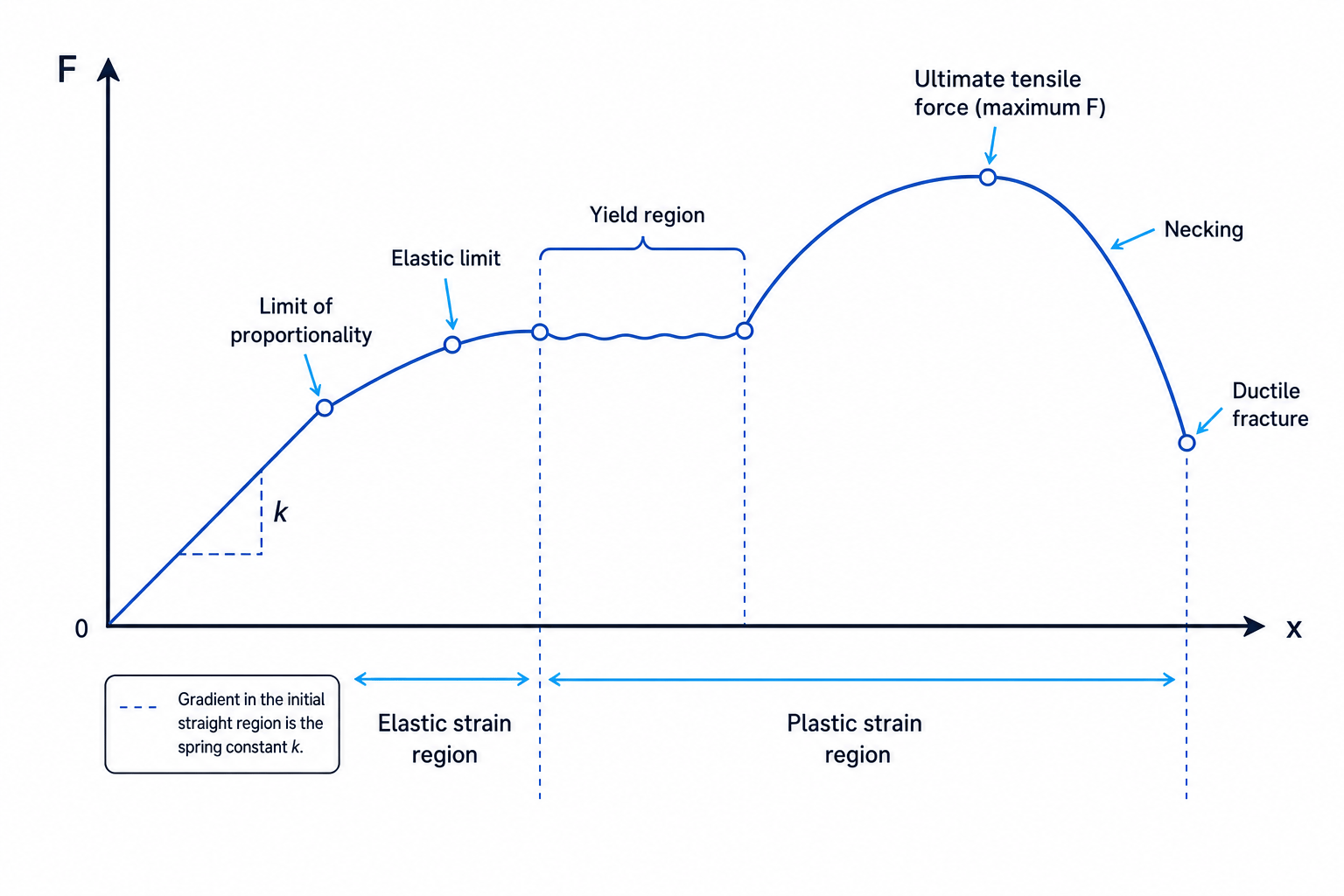
Key regions on the metal graph
- Limit of proportionality: the point beyond which force is no longer directly proportional to extension.
- Elastic limit: beyond this, the material will not return fully to its original length.
- Yield region: a small increase in force causes a large increase in extension.
- Plastic region: permanent deformation occurs.
- Ultimate tensile stress: maximum stress reached by the material.
- Necking: the material becomes narrower in one region.
- Ductile fracture: the material finally breaks after significant plastic deformation.
Dislocations and strengthening metals
A dislocation is a line defect in a crystal structure. Plastic deformation in metals happens largely because dislocations move through the crystal lattice.
Metals can be strengthened by making it harder for dislocations to move. Barriers include:
- foreign atoms, as in alloys
- other dislocations, caused by work hardening
- grain boundaries, made more numerous by having smaller grains
Why barriers strengthen metals
If dislocations cannot move easily, a larger stress is needed to produce plastic deformation.
5. Classes of solid
Solids can be classified by their internal structure.
Crystalline solids
A crystalline solid has atoms arranged in a repeating lattice. Metals are crystalline, often made of many small crystals called grains.
Amorphous solids
An amorphous solid has no long-range repeating structure. Glass is the classic example, and ceramics are treated with this brittle group in this topic.
Polymeric solids
A polymeric solid is made from long chain molecules. Rubber is a polymer with chains that can uncoil and straighten when stretched.
6. Brittle materials and rubber
Different materials have very different force-extension and stress-strain graphs.
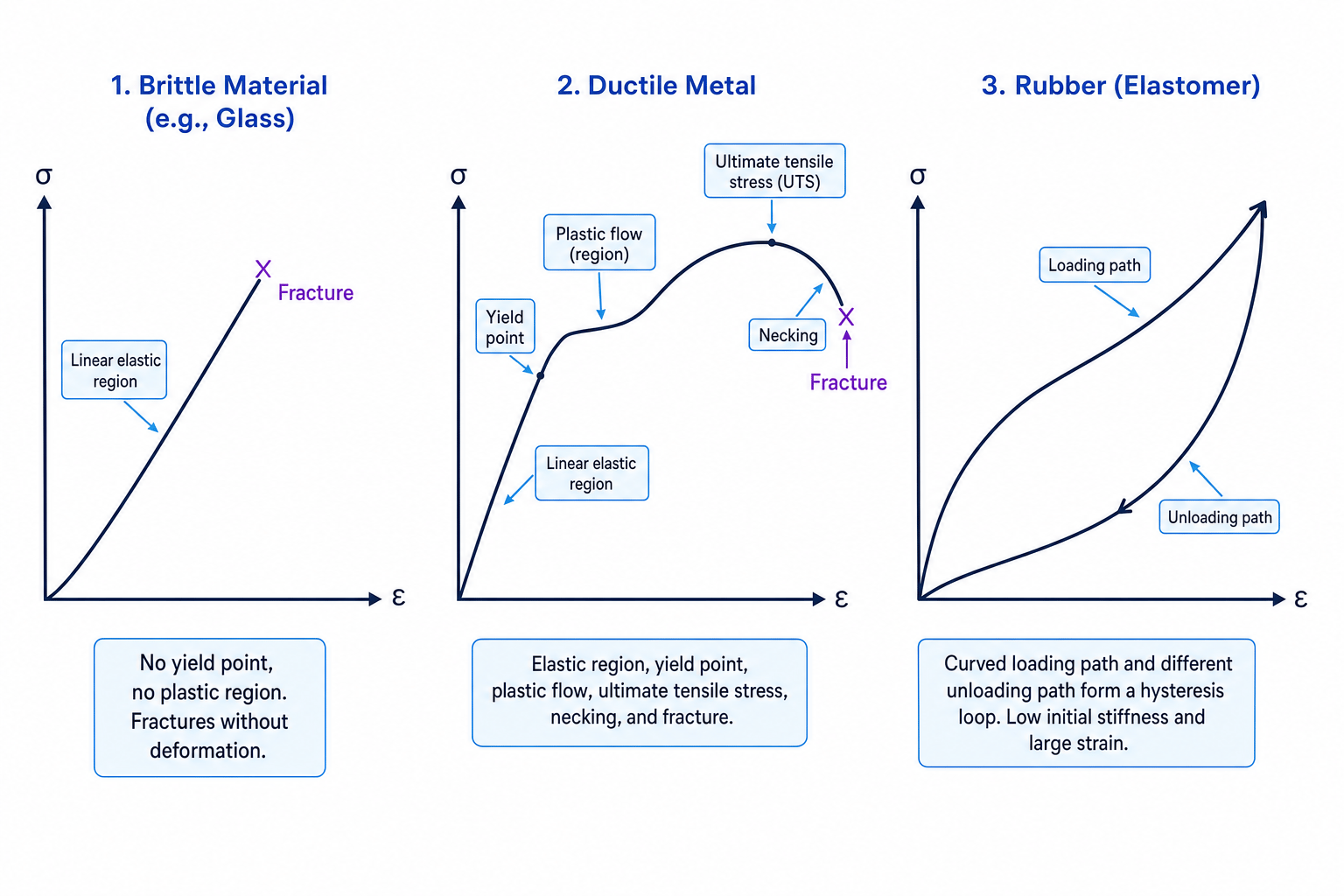
Brittle materials such as glass
A brittle material fractures with little or no plastic deformation. Glass is approximately elastic and obeys Hooke’s law up to fracture.
Brittle fracture often happens by crack propagation. A tiny surface crack concentrates stress at its tip, so the crack grows rapidly.
Breaking stress can be increased by:
- reducing surface imperfections, as in thin glass fibres
- putting the surface under compression, as in toughened glass
- pre-stressing concrete, so tensile cracks are less likely to open
Thinking thick glass is always stronger
Surface flaws often control glass failure. Thin fibres can have a higher breaking stress because they are less likely to contain serious surface cracks.
Rubber
Rubber only approximately obeys Hooke’s law. It has a low Young modulus, so it stretches a lot under relatively small stress.
In rubber, stretching mainly straightens long chain molecules. Thermal motion tends to keep the chains randomly coiled, so the stretch happens against this thermal opposition.
Rubber also shows hysteresis: the unloading curve is different from the loading curve. The area inside the loop on a force-extension graph is energy transferred to the surroundings, mostly as thermal energy.
Rubber hysteresis
For rubber, not all the work done during stretching is recovered during unloading. The missing energy is dissipated, which is why repeatedly flexed rubber can warm up.
7. Practical: Young modulus of a metal wire
In the specified practical, you determine EEE for a metal wire by measuring force, extension, length and diameter.
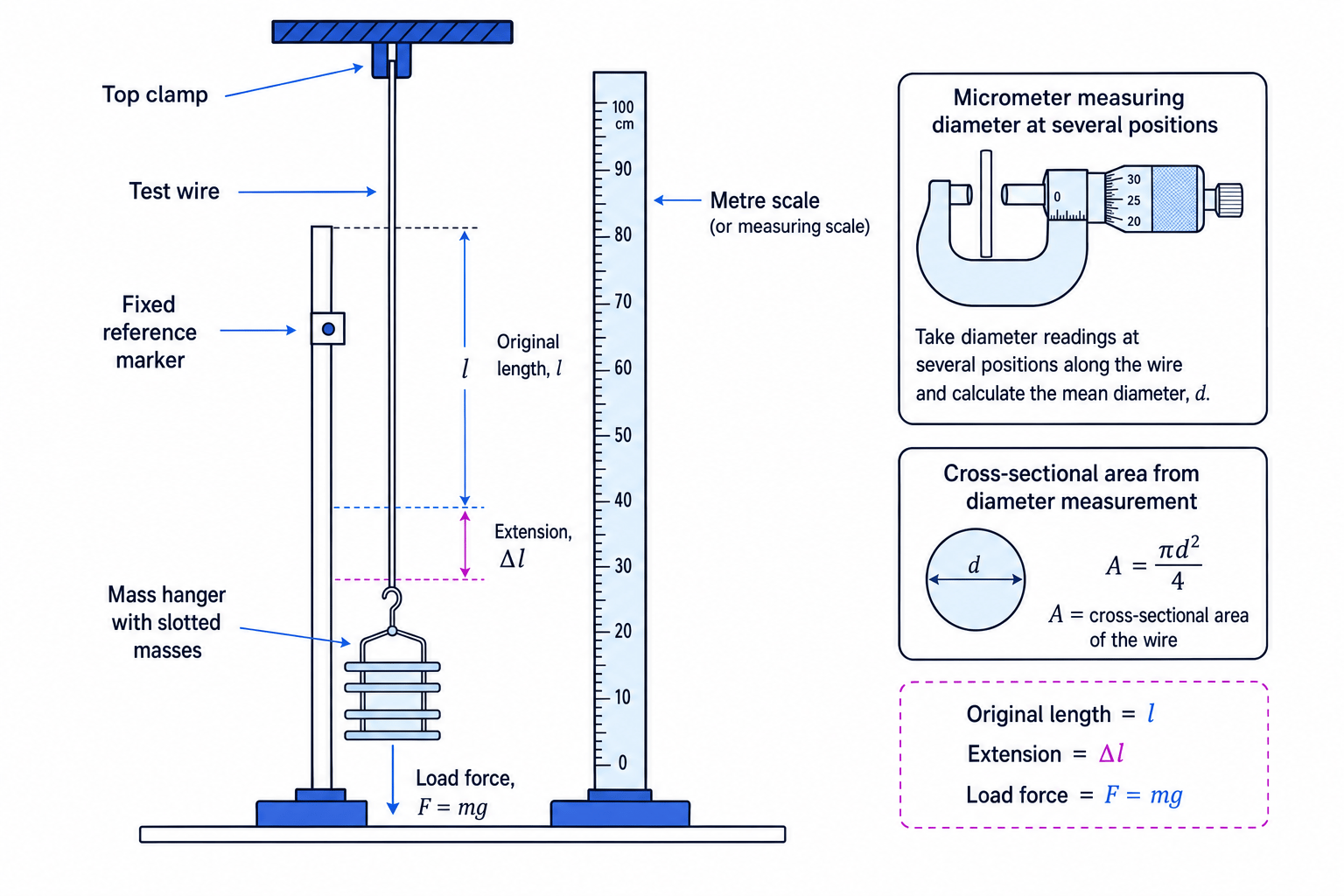
Method outline
- Measure the original length lll of the wire using a metre rule.
- Measure the diameter ddd at several points using a micrometer, checking for zero error.
- Calculate the mean diameter, then the area using A=πd24A = \frac{\pi d^2}{4}A=4πd2.
- Add masses gradually. The load force is F=mgF = mgF=mg.
- Measure the extension Δl\Delta lΔl each time, using a scale, pointer or travelling microscope.
- Plot force against extension, or stress against strain.
For a force-extension graph in the Hooke’s law region:
F=AElΔlF = \frac{AE}{l}\Delta lF=lAEΔlSo if the gradient is GGG:
E=GlAE = \frac{Gl}{A}E=AGlImproving the measurement
Use a long, thin wire because it gives a larger extension, reducing percentage uncertainty. Measure diameter carefully: because AAA depends on d2d^2d2, the percentage uncertainty in area is about twice the percentage uncertainty in diameter.
Safety
Wear eye protection and do not overload the wire. A stretched wire can snap suddenly, and falling masses can damage the bench or injure feet.
8. Practical: force-extension relationship for rubber
For rubber, add masses in small steps and record the extension. Then remove the masses step by step and record the unloading extensions too.
Plot force against extension. You should expect:
- a curved loading graph, not a perfect straight line
- a different unloading curve
- a hysteresis loop, showing energy dissipated as thermal energy
This investigation is a good place to comment on uncertainty: rubber may continue stretching slowly after a load is added, so take readings after a consistent waiting time.
In the exam
- Check whether the question is about a sample or a material: force and extension depend on dimensions, but stress, strain and Young modulus describe the material.
- For graph questions, use the correct feature: gradient gives kkk on a force-extension graph, but EEE on a stress-strain graph.
- For energy, look for area under the force-extension graph; use 12Fx\frac{1}{2}Fx21Fx only for a straight Hooke’s law region.
Check yourself
- Why does measuring the diameter of a wire carefully matter so much in a Young modulus experiment?
- What is the difference between elastic deformation and plastic deformation?
- Why can toughened glass have a higher breaking stress than ordinary glass?
