What you'll learn
- How electric and gravitational fields are similar inverse-square fields.
- How field lines, equipotential surfaces, potential and potential energy connect.
- How to calculate resultant field strength and net potential from point charges or masses.
- When the simpler near-Earth equation ΔUp=mgΔh\Delta U_p = mg\Delta hΔUp=mgΔh is valid.
1. The idea of a field
A field is a region of space where an object experiences a force without needing contact. In this topic, the objects are charges and masses.
Field strength
Electric field strength EEE is the force per unit positive charge on a small positive test charge placed at a point:
E=FqE = \frac{F}{q}E=qFGravitational field strength ggg is the force per unit mass on a small test mass placed at a point:
g=Fmg = \frac{F}{m}g=mFElectric field strength has units newtons per coulomb, N C^-1. Gravitational field strength has units newtons per kilogram, N kg^-1.
A test charge or test mass is imagined to be small enough that it does not noticeably disturb the field it is measuring.
2. Inverse-square forces
Both electric and gravitational forces follow an inverse-square law: doubling the separation reduces the force to one quarter.
For two point charges in free space or air, Coulomb’s law is
F=14πϵ0Q1Q2r2F = \frac{1}{4\pi\epsilon_0}\frac{Q_1Q_2}{r^2}F=4πϵ01r2Q1Q2where ϵ0\epsilon_0ϵ0 is the permittivity of free space, and
14πϵ0≈9.0×10⁹ F−1m\frac{1}{4\pi\epsilon_0} \approx 9.0 \times 10^9\ \text{F}^{-1}\text{m}4πϵ01≈9.0×10⁹ F−1mis often written as kkk for short.
For two point masses, Newton’s law of gravitation is
F=GM1M2r2F = G\frac{M_1M_2}{r^2}F=Gr2M1M2where GGG is the gravitational constant.
Attraction and repulsion
Electric forces can be attractive or repulsive: like charges repel, unlike charges attract. Gravitational forces between masses are always attractive.
For the field due to one point source:
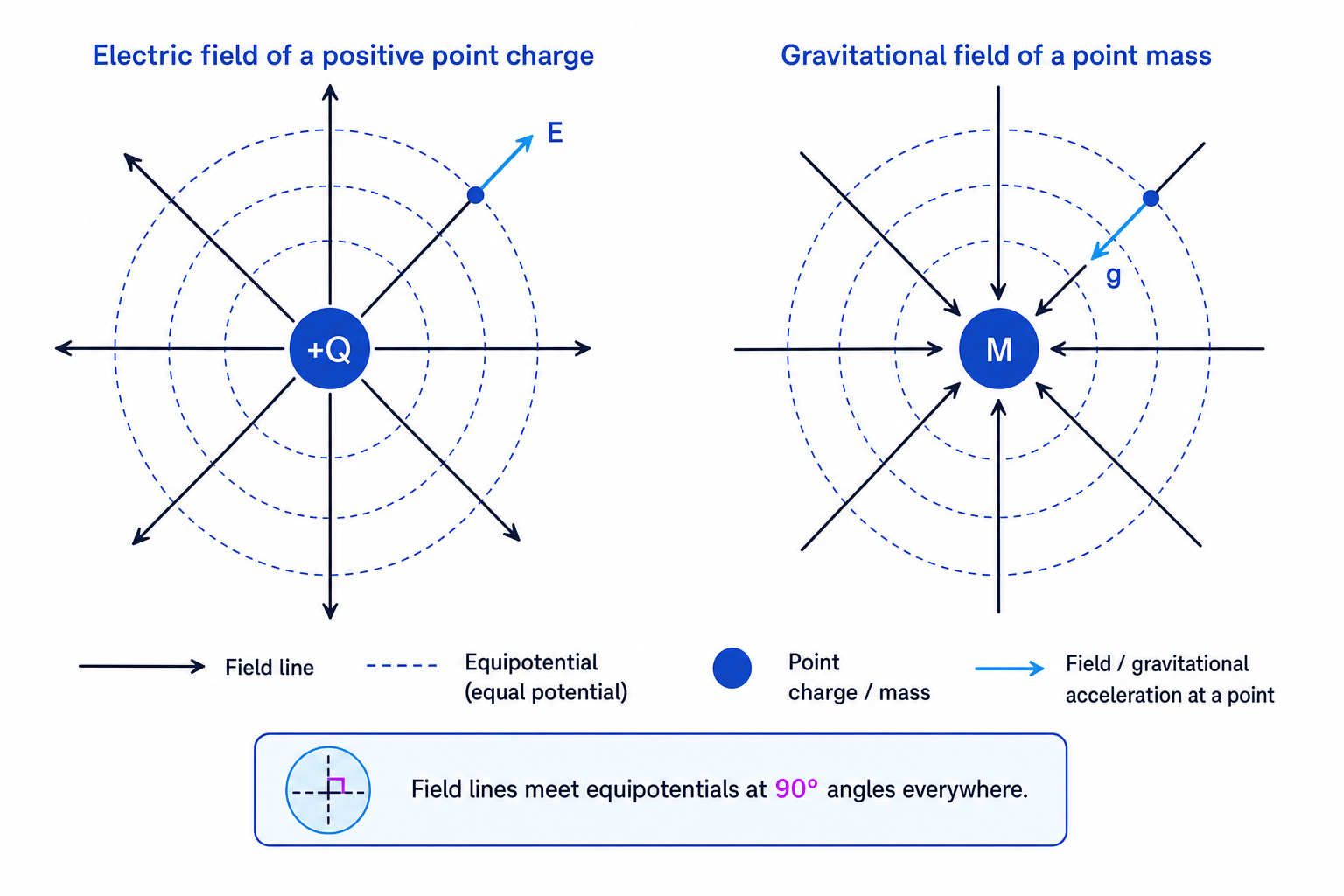
E=14πϵ0Qr2E = \frac{1}{4\pi\epsilon_0}\frac{Q}{r^2}E=4πϵ01r2Q g=GMr2g = \frac{GM}{r^2}g=r2GMFor a positive point charge, the electric field points radially outward. For a negative point charge, it points radially inward. A gravitational field points towards the mass.
Calculating electric field strength and force
A charge Q=+4.0×10⁻⁶ CQ = +4.0 \times 10^{-6}\ \text{C}Q=+4.0×10⁻⁶ C is in air. Find the electric field strength at r=0.20 mr = 0.20\ \text{m}r=0.20 m, then the force on a charge q=+2.0×10⁻⁹ Cq = +2.0 \times 10^{-9}\ \text{C}q=+2.0×10⁻⁹ C placed there.
-
Use the point-charge field equation, because the field is caused by one charge:
E=14πϵ0Qr2E = \frac{1}{4\pi\epsilon_0}\frac{Q}{r^2}E=4πϵ01r2Q -
Substitute values, using 9.0×10⁹ F−1m9.0 \times 10^9\ \text{F}^{-1}\text{m}9.0×10⁹ F−1m for 14πϵ0\frac{1}{4\pi\epsilon_0}4πϵ01:
E=(9.0×10⁹)(4.0×10⁻⁶)(0.20)2=9.0×10⁵ N C−1E = \frac{(9.0 \times 10^9)(4.0 \times 10^{-6})}{(0.20)^2} = 9.0 \times 10^5\ \text{N C}^{-1}E=(0.20)2(9.0×10⁹)(4.0×10⁻⁶)=9.0×10⁵ N C−1 -
Use F=qEF = qEF=qE for the test charge:
F=(2.0×10⁻⁹)(9.0×10⁵)=1.8×10⁻³ NF = (2.0 \times 10^{-9})(9.0 \times 10^5) = 1.8 \times 10^{-3}\ \text{N}F=(2.0×10⁻⁹)(9.0×10⁵)=1.8×10⁻³ N
The force is radially outward because the source charge and test charge are both positive.
3. Spherical bodies act like point masses outside themselves
Outside a spherical body such as the Earth, the gravitational field is essentially the same as if the whole mass were concentrated at the centre.
That means you can use
g=GMr2g = \frac{GM}{r^2}g=r2GMwhere rrr is measured from the centre of the Earth, not from the surface.
Using the Earth as a point mass
Use ME=5.97×1024 kgM_E = 5.97 \times 10^{24}\ \text{kg}ME=5.97×1024 kg and RE=6.37×10⁶ mR_E = 6.37 \times 10^6\ \text{m}RE=6.37×10⁶ m to estimate the gravitational field strength at Earth’s surface and the weight of a 70.0 kg person.
-
At the surface, the distance from Earth’s centre is
r=RE=6.37×10⁶ mr = R_E = 6.37 \times 10^6\ \text{m}r=RE=6.37×10⁶ m -
Calculate the gravitational field strength:
g=GMERE2=(6.67×10⁻¹¹)(5.97×1024)(6.37×10⁶)2=9.82 N kg−1g = \frac{GM_E}{R_E^2} = \frac{(6.67 \times 10^{-11})(5.97 \times 10^{24})}{(6.37 \times 10^6)^2} = 9.82\ \text{N kg}^{-1}g=RE2GME=(6.37×10⁶)2(6.67×10⁻¹¹)(5.97×1024)=9.82 N kg−1 -
Use F=mgF = mgF=mg for the person’s weight:
F=(70.0)(9.82)=687 NF = (70.0)(9.82) = 687\ \text{N}F=(70.0)(9.82)=687 N -
The gravitational potential at the surface is
Vg=−GMERE=−6.25×10⁷ J kg−1V_g = -\frac{GM_E}{R_E} = -6.25 \times 10^7\ \text{J kg}^{-1}Vg=−REGME=−6.25×10⁷ J kg−1 -
The person’s gravitational potential energy, relative to infinity, is
PE=mVg=(70.0)(−6.25×10⁷)=−4.38×10⁹ JPE = mV_g = (70.0)(-6.25 \times 10^7) = -4.38 \times 10^9\ \text{J}PE=mVg=(70.0)(−6.25×10⁷)=−4.38×10⁹ J
Use the correct distance
For inverse-square field equations near a planet, rrr is the distance from the planet’s centre. Using height above the surface by itself is a very common error.
4. Field lines and equipotential surfaces
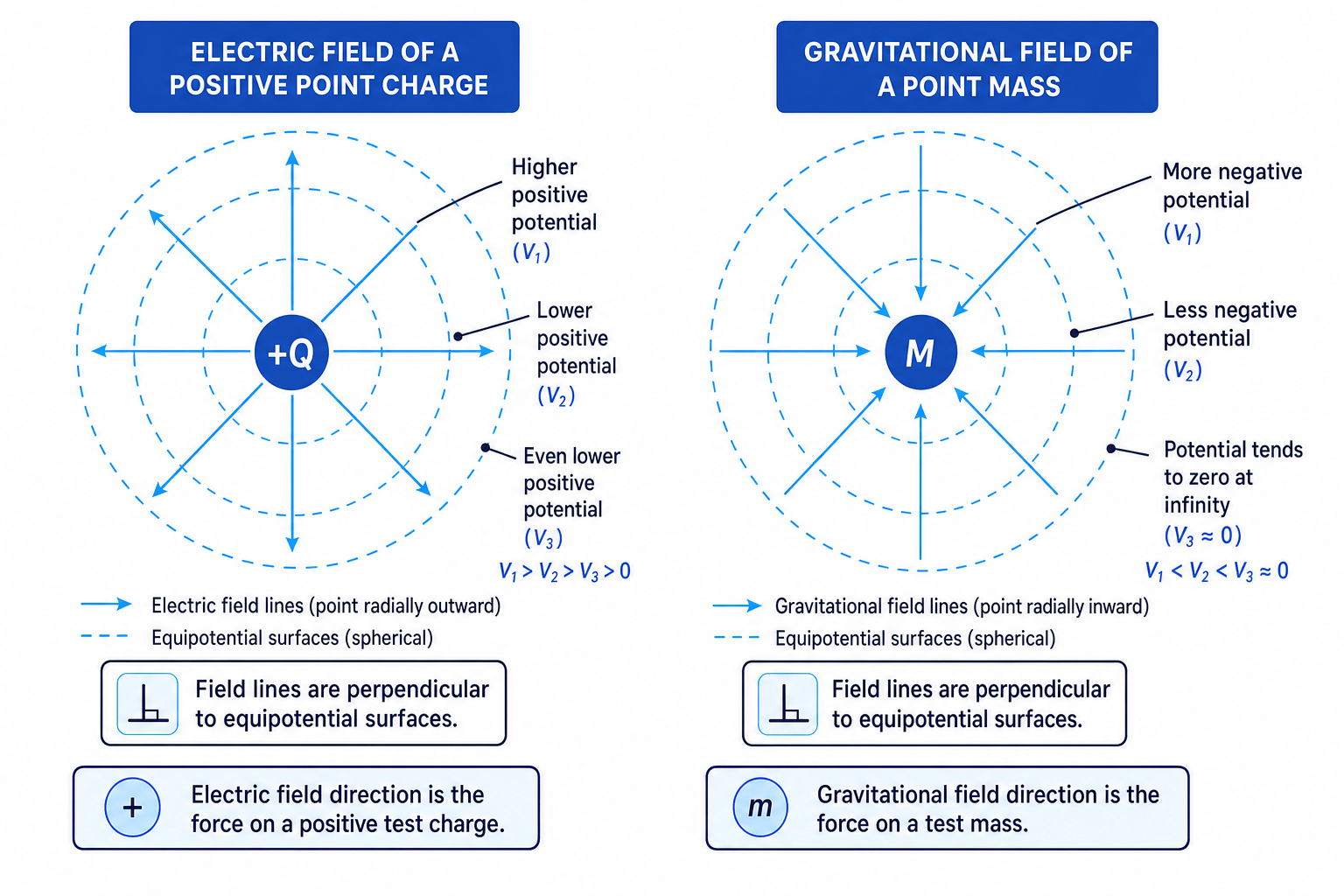
Field lines, or lines of force, show the direction of the field at a point. The arrow shows the direction of the force on a positive test charge in an electric field, or on a test mass in a gravitational field.
For a positive point charge, field lines are radially outward. For a point mass, gravitational field lines are radially inward.
Equipotential surfaces join points of equal potential. For a point charge or point mass, they are spherical, so they appear as circles in a 2D diagram. Field lines always meet equipotential surfaces at right angles.
No work along an equipotential
Moving along an equipotential surface does not change potential, so there is no change in potential energy for that motion.
5. Potential and potential energy
Electric potential VEV_EVE at a point is the work done per unit positive charge in bringing a small positive charge from infinity to that point.
Gravitational potential VgV_gVg at a point is the work done per unit mass in bringing a small mass from infinity to that point.
For point sources:
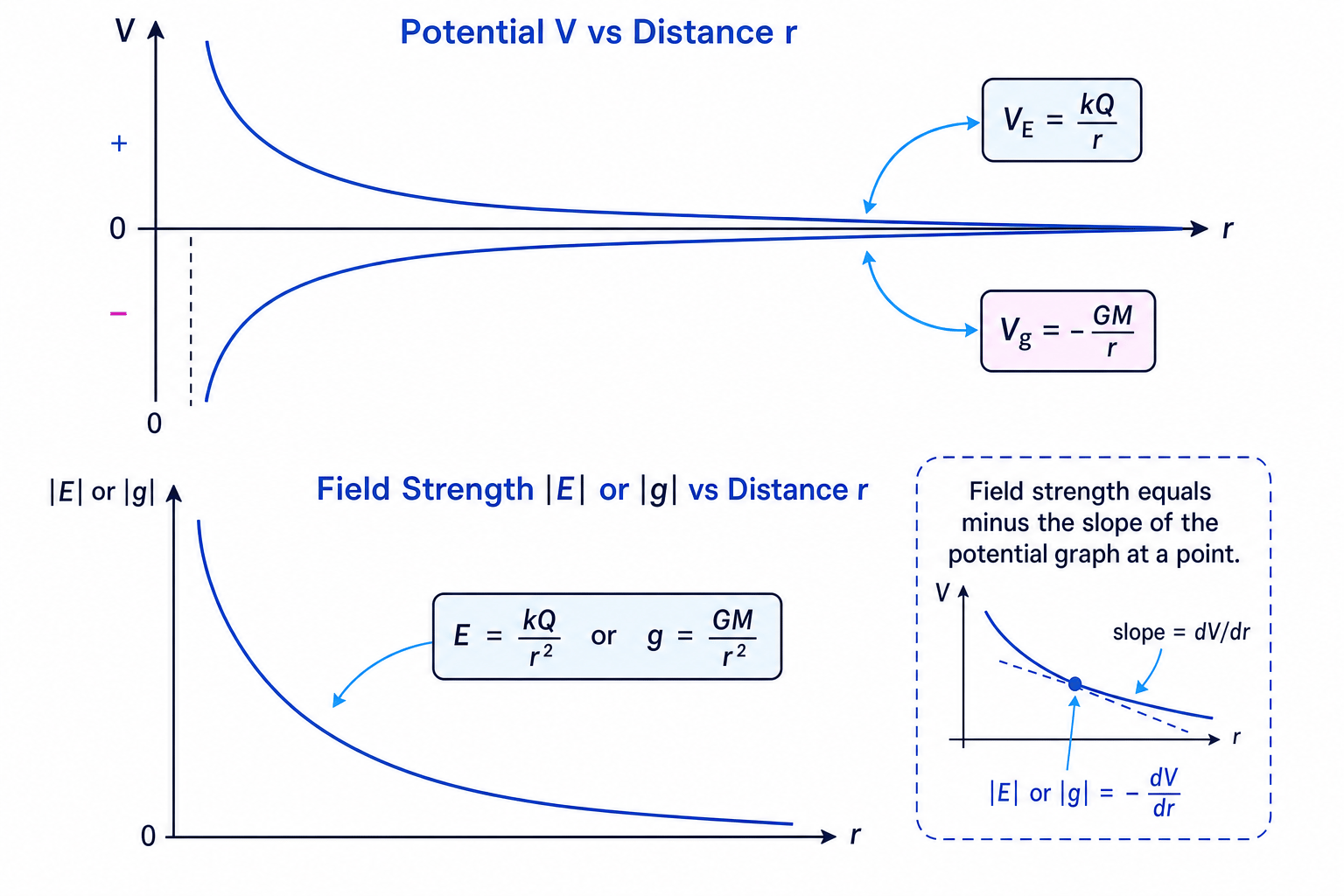
VE=14πϵ0QrV_E = \frac{1}{4\pi\epsilon_0}\frac{Q}{r}VE=4πϵ01rQ PE=14πϵ0Q1Q2rPE = \frac{1}{4\pi\epsilon_0}\frac{Q_1Q_2}{r}PE=4πϵ01rQ1Q2and for gravity:
Vg=−GMrV_g = -\frac{GM}{r}Vg=−rGM PE=−GM1M2rPE = -\frac{GM_1M_2}{r}PE=−rGM1M2Gravitational potential is negative because it is defined as zero at infinity, and gravity is attractive. As you move away from a mass, VgV_gVg increases towards zero.
For any field, not just a point-source field:
ΔPE=qΔVE\Delta PE = q\Delta V_EΔPE=qΔVE ΔPE=mΔVg\Delta PE = m\Delta V_gΔPE=mΔVgUsing electric potential difference
A charge q=+2.0×10⁻⁶ Cq = +2.0 \times 10^{-6}\ \text{C}q=+2.0×10⁻⁶ C moves from a point where VE=120 VV_E = 120\ \text{V}VE=120 V to a point where VE=40 VV_E = 40\ \text{V}VE=40 V. Find its change in potential energy.
-
Calculate the change in electric potential:
ΔVE=40−120=−80 V\Delta V_E = 40 - 120 = -80\ \text{V}ΔVE=40−120=−80 V -
Use the potential energy equation:
ΔPE=qΔVE\Delta PE = q\Delta V_EΔPE=qΔVE -
Substitute the charge:
ΔPE=(2.0×10⁻⁶)(−80)=−1.6×10⁻⁴ J\Delta PE = (2.0 \times 10^{-6})(-80) = -1.6 \times 10^{-4}\ \text{J}ΔPE=(2.0×10⁻⁶)(−80)=−1.6×10⁻⁴ J
The charge has lost potential energy, so the field has done positive work on it.
6. Superposition: adding fields and potentials
When there is more than one point charge or point mass, use superposition.
Potential is scalar, field is vector
Net potential is found by algebraic addition, including signs. Resultant field strength is found by vector addition, so direction matters.
For potentials, just add the separate values:
Vnet=V1+V2+V3+…V_{\text{net}} = V_1 + V_2 + V_3 + \dotsVnet=V1+V2+V3+…For fields, add directions. In one dimension, choose a positive direction. In two dimensions, resolve into components and use Pythagoras’ theorem and trigonometry.
Adding potential and field from two charges
A charge +3.0 nC+3.0\ \text{nC}+3.0 nC is at x=0x = 0x=0 and a charge −3.0 nC-3.0\ \text{nC}−3.0 nC is at x=0.40 mx = 0.40\ \text{m}x=0.40 m. Point P is halfway between them. Find the net potential and resultant electric field at P.
-
Each charge is 0.20 m0.20\ \text{m}0.20 m from P, so the potentials are equal in magnitude but opposite in sign:
V1=(9.0×10⁹)(3.0×10⁻⁹)0.20=+135 VV_1 = \frac{(9.0 \times 10^9)(3.0 \times 10^{-9})}{0.20} = +135\ \text{V}V1=0.20(9.0×10⁹)(3.0×10⁻⁹)=+135 V V2=−135 VV_2 = -135\ \text{V}V2=−135 V -
Add potentials algebraically:
Vnet=+135−135=0 VV_{\text{net}} = +135 - 135 = 0\ \text{V}Vnet=+135−135=0 V -
Now calculate the field magnitude due to either charge:
E=(9.0×10⁹)(3.0×10⁻⁹)(0.20)2=675 N C−1E = \frac{(9.0 \times 10^9)(3.0 \times 10^{-9})}{(0.20)^2} = 675\ \text{N C}^{-1}E=(0.20)2(9.0×10⁹)(3.0×10⁻⁹)=675 N C−1 -
Decide directions: the field from the positive charge points away from it, towards positive xxx. The field from the negative charge points towards it, also towards positive xxx.
-
Add the fields as vectors:
Eresultant=675+675=1.35×10³ N C−1E_{\text{resultant}} = 675 + 675 = 1.35 \times 10^3\ \text{N C}^{-1}Eresultant=675+675=1.35×10³ N C−1
So the potential is zero at P, but the electric field is not zero.
Cancelling the wrong quantity
A zero potential does not necessarily mean a zero field. Potential is scalar; field strength is vector.
7. Field strength from potential graphs
Field strength is linked to the gradient of a potential-distance graph:
E=−slope of the VE-r graphE = -\text{slope of the }V_E\text{-}r\text{ graph}E=−slope of the VE-r graph g=−slope of the Vg-r graphg = -\text{slope of the }V_g\text{-}r\text{ graph}g=−slope of the Vg-r graphFor a curve, draw a tangent at the point and find the tangent’s gradient.
Finding field strength from a potential graph
At a point near Earth, the tangent to a VgV_gVg against rrr graph has gradient +9.8 J kg−1m−1+9.8\ \text{J kg}^{-1}\text{m}^{-1}+9.8 J kg−1m−1. Find the radial gravitational field strength.
-
Use the graph relationship:
g=−slopeg = -\text{slope}g=−slope -
Substitute the tangent gradient:
g=−(+9.8)=−9.8 N kg−1g = -(+9.8) = -9.8\ \text{N kg}^{-1}g=−(+9.8)=−9.8 N kg−1 -
Interpret the sign: positive rrr is outward, so the negative sign means the field points inward, towards Earth’s centre. The magnitude is 9.8 N kg−19.8\ \text{N kg}^{-1}9.8 N kg−1.
Graph checks
For a point source, plotting field strength against 1/r21/r^21/r2 should give a straight line through the origin. Plotting potential against 1/r1/r1/r should also give a straight line, with the sign of the gradient showing the sign of the source.
8. Near Earth: small height changes
Close to Earth’s surface, over distances where the variation of ggg is negligible, you can use
ΔUp=mgΔh\Delta U_p = mg\Delta hΔUp=mgΔhThis is a local approximation. It is excellent for laboratory heights, buildings and small vertical motions, but not for journeys far from Earth where ggg changes significantly.
Using near-Earth gravitational potential energy
A 2.0 kg object is lifted vertically by 1.5 m. Find the increase in gravitational potential energy.
-
Check the model: 1.5 m is tiny compared with Earth’s radius, so take g=9.81 N kg−1g = 9.81\ \text{N kg}^{-1}g=9.81 N kg−1 as constant.
-
Substitute into ΔUp=mgΔh\Delta U_p = mg\Delta hΔUp=mgΔh:
ΔUp=(2.0)(9.81)(1.5)\Delta U_p = (2.0)(9.81)(1.5)ΔUp=(2.0)(9.81)(1.5) -
Calculate the energy change:
ΔUp=29 J\Delta U_p = 29\ \text{J}ΔUp=29 J
The answer is positive because the object has been moved upwards.
9. Why this model matters
The same field ideas are used to predict the motion of planets and satellites. For example, modelling Earth as a spherical mass lets you calculate the gravitational field acting on a satellite. Geostationary satellites are useful for communications and weather monitoring, but real applications also involve evaluating risks such as launch cost, space debris, environmental impact and access to satellite data.
In the exam
- Decide whether you are calculating a scalar quantity, such as potential, or a vector quantity, such as field strength or force.
- Use rrr from the centre of a spherical body or point source, convert prefixes carefully, and keep signs for charge and potential.
- For potential graphs, use the gradient of a tangent and then apply the minus sign; for small height changes near Earth, use ΔUp=mgΔh\Delta U_p = mg\Delta hΔUp=mgΔh only when ggg is effectively constant.
Check yourself
- Why do the electric field lines of a positive point charge point outwards, but gravitational field lines point inwards?
- At a point where the net electric potential is zero, must the electric field strength also be zero?
- Why does the equation ΔUp=mgΔh\Delta U_p = mg\Delta hΔUp=mgΔh stop being reliable for very large height changes?