

What you'll learn
- What potential difference and resistance mean, including their units.
- How to recognise and investigate III–VVV characteristics for a metal wire and a filament lamp.
- How to use V=IRV = IRV=IR, P=IV=I2R=V2RP = IV = I^2R = \frac{V^2}{R}P=IV=I2R=RV2 and R=ρlAR = \frac{\rho l}{A}R=Aρl.
- Why temperature affects resistance, and what makes superconductors special.
Starting point: charge, current and potential difference
Electric circuits are about energy being transferred by moving charge. Charge is measured in coulombs (C). Current III is the rate of flow of charge, measured in amperes (A).
Potential difference is about energy transfer per unit charge.
Potential difference
The potential difference VVV between two points is the work done, or energy transferred, per unit charge moving between those points:
V=WQV = \frac{W}{Q}V=QWThe volt is defined by 1 V=1 J C−11\ \text{V} = 1\ \text{J C}^{-1}1 V=1 J C−1.
So a potential difference of 6.0 V means each coulomb of charge transfers 6.0 J of energy.
Finding a potential difference
A charge of 5.0 C transfers 30 J of energy between two points. Find the potential difference.
-
Use the definition of potential difference as energy transferred per charge:
V=WQV = \frac{W}{Q}V=QW -
Substitute the values with units:
V=30 J5.0 C=6.0 J C−1V = \frac{30\ \text{J}}{5.0\ \text{C}} = 6.0\ \text{J C}^{-1}V=5.0 C30 J=6.0 J C−1 -
Convert joules per coulomb into volts:
V=6.0 VV = 6.0\ \text{V}V=6.0 V
Measuring an III–VVV characteristic
An III–VVV characteristic is a graph showing how the current III through a component changes with the potential difference VVV across it.
To measure it, the ammeter goes in series with the component, and the voltmeter goes in parallel across the component. A variable resistor lets you change the current gradually.
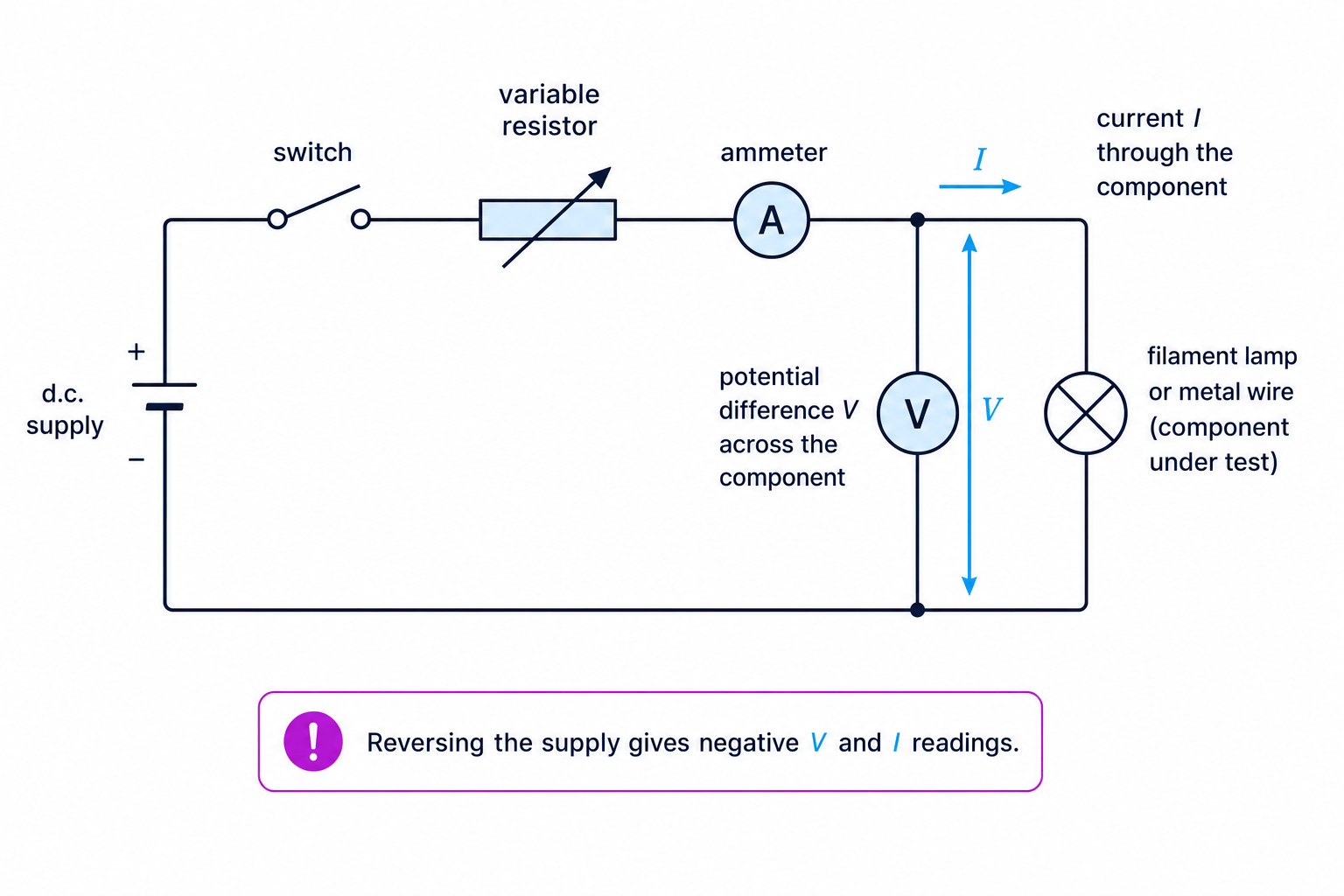
For the specified practical:
- Start with a low current.
- Record pairs of VVV and III readings.
- Reverse the supply connections to obtain negative readings.
- Plot current III on the vertical axis against potential difference VVV on the horizontal axis.
- For a metal wire at constant temperature, keep currents low and switch off between readings to reduce heating.
Resistance and Ohm’s law
Resistance
The resistance RRR of a component is the ratio of the potential difference across it to the current through it:
R=VIR = \frac{V}{I}R=IVSo the same relationship is often written as:
V=IRV = IRV=IRResistance is measured in ohms (Ω), where:
1 Ω=1 V A−11\ \Omega = 1\ \text{V A}^{-1}1 Ω=1 V A−1Ohm’s law says that, for a metallic conductor at constant temperature, the current through it is directly proportional to the potential difference across it. That means its resistance is constant.
Ohm’s law needs constant temperature
A metal wire is only ohmic if its temperature stays constant. If the wire heats up, its resistance changes, so the graph is no longer perfectly straight.
Metal wire and filament lamp graphs
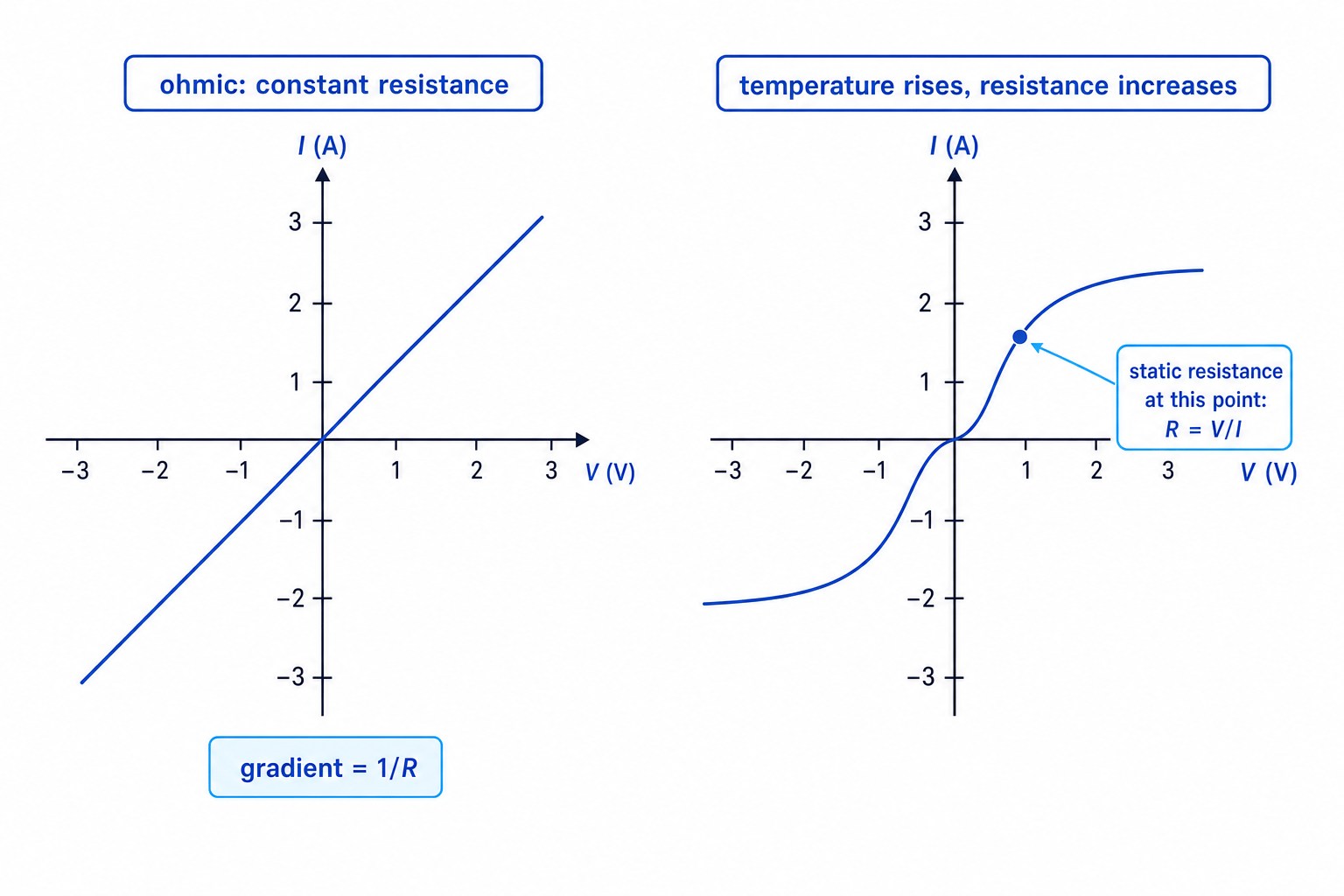
For a metal wire at constant temperature, the III–VVV graph is a straight line through the origin. For a filament lamp, the graph curves because the filament gets hot; as temperature rises, resistance increases, so the graph becomes less steep.
Finding resistance from an I-V graph
A metal wire has current 0.60 A when the potential difference across it is 3.0 V. Find its resistance.
-
Since a pair of VVV and III values is known, use:
R=VIR = \frac{V}{I}R=IV -
Substitute the values:
R=3.0 V0.60 A=5.0 V A−1R = \frac{3.0\ \text{V}}{0.60\ \text{A}} = 5.0\ \text{V A}^{-1}R=0.60 A3.0 V=5.0 V A−1 -
Convert V A−1\text{V A}^{-1}V A−1 into ohms:
R=5.0 ΩR = 5.0\ \OmegaR=5.0 Ω
Using the wrong graph gradient
If the graph is current III against potential difference VVV, the gradient of a straight ohmic graph is 1R\frac{1}{R}R1. If the graph is potential difference VVV against current III, the gradient is RRR.
For a non-ohmic component like a filament lamp, calculate the resistance at a particular point using R=VIR = \frac{V}{I}R=IV for that point. A tangent to the curve shows how rapidly current changes with potential difference, but it is not the same as simply using R=VIR = \frac{V}{I}R=IV.
Electrical power and heating
Power PPP is the rate of energy transfer, measured in watts (W). In a circuit:
P=IV=I2R=V2RP = IV = I^2R = \frac{V^2}{R}P=IV=I2R=RV2These forms are connected using V=IRV = IRV=IR. Choose the version that matches the quantities you are given.
Calculating electrical power
A 47 Ω resistor is connected across a 12.0 V supply. Calculate the power transferred in the resistor.
-
The known quantities are VVV and RRR, so use:
P=V2RP = \frac{V^2}{R}P=RV2 -
Substitute the values:
P=(12.0 V)247 Ω=3.063... WP = \frac{(12.0\ \text{V})^2}{47\ \Omega} = 3.063...\ \text{W}P=47 Ω(12.0 V)2=3.063... W -
Quote the answer to a sensible number of significant figures:
P=3.1 WP = 3.1\ \text{W}P=3.1 W
A filament lamp is a good example of electrical energy being transferred mainly into thermal energy and light. This is why filament lamps are less energy-efficient than LED lamps.
Why metals have resistance
In a metal, some electrons are free electrons: they are not fixed to one atom and can drift through the metal when a potential difference is applied. The metal atoms form a lattice of positive ions.
As free electrons move, they collide with ions in the lattice. These collisions oppose the flow of charge, giving rise to electrical resistance.
When the current heats the metal, the ions vibrate more strongly. Their random vibration energy increases, so the metal’s temperature rises. Greater lattice vibration causes more frequent electron-ion collisions, so the resistance of a metal increases with temperature.
Resistivity: resistance of a material
Resistance depends on both the material and the shape of the conductor. A longer wire has more resistance; a thicker wire has less resistance.
Resistivity
Resistivity ρ\rhoρ is a property of a material that links resistance to length and cross-sectional area:
R=ρlAR = \frac{\rho l}{A}R=Aρlwhere lll is the length of the conductor and AAA is its cross-sectional area. Resistivity is measured in ohm metres, Ω m\Omega\,\text{m}Ωm.
For a cylindrical wire:
A=πd24A = \frac{\pi d^2}{4}A=4πd2where ddd is the diameter.
Specified practical: determining resistivity
To determine the resistivity of a metal wire:
- Measure the length lll between the electrical contacts using a metre ruler.
- Measure the diameter ddd several times using a micrometer, rotating the wire to check for variation.
- Calculate the mean diameter, then calculate A=πd24A = \frac{\pi d^2}{4}A=4πd2.
- Find resistance using a circuit, either from R=VIR = \frac{V}{I}R=IV or from the gradient of a VVV against III graph.
- Calculate ρ=RAl\rho = \frac{RA}{l}ρ=lRA.
Determining resistivity of a wire
A metal wire has length 1.20 m, resistance 6.2 Ω and mean diameter 0.36 mm. Calculate its resistivity.
-
Convert the diameter into metres and calculate the cross-sectional area:
d=0.36 mm=3.6×10⁻⁴ md = 0.36\ \text{mm} = 3.6 \times 10^{-4}\ \text{m}d=0.36 mm=3.6×10⁻⁴ m A=πd24=π(3.6×10⁻⁴ m)24=1.02×10⁻⁷ m2A = \frac{\pi d^2}{4} = \frac{\pi(3.6 \times 10^{-4}\ \text{m})^2}{4} = 1.02 \times 10^{-7}\ \text{m}^2A=4πd2=4π(3.6×10⁻⁴ m)2=1.02×10⁻⁷ m2 -
Rearrange the resistivity equation:
ρ=RAl\rho = \frac{RA}{l}ρ=lRA -
Substitute the values:
ρ=(6.2 Ω)(1.02×10⁻⁷ m2)1.20 m=5.3×10⁻⁷ Ω m\rho = \frac{(6.2\ \Omega)(1.02 \times 10^{-7}\ \text{m}^2)}{1.20\ \text{m}} = 5.3 \times 10^{-7}\ \Omega\,\text{m}ρ=1.20 m(6.2 Ω)(1.02×10⁻⁷ m2)=5.3×10⁻⁷ Ωm
Diameter uncertainty matters
Because A=πd24A = \frac{\pi d^2}{4}A=4πd2, the percentage uncertainty in cross-sectional area is about twice the percentage uncertainty in diameter. Take several diameter readings.
Resistance and temperature
For metals, resistance varies almost linearly with temperature over a wide range. A graph of resistance RRR against temperature is usually close to a straight line with positive gradient.
Specified practical: resistance of a metal wire against temperature
A typical method is:
- Place a coil of metal wire in a water bath with a thermometer or temperature sensor.
- Use a low-current circuit or ohmmeter to measure resistance.
- Heat the water gradually and wait for thermal equilibrium before each reading.
- Record resistance and temperature, then plot RRR against temperature.
- Use a spreadsheet to calculate means, plot the graph and fit a straight line.
The low current is important because otherwise the measuring current itself heats the wire and affects the result.
Superconductivity
Superconductivity
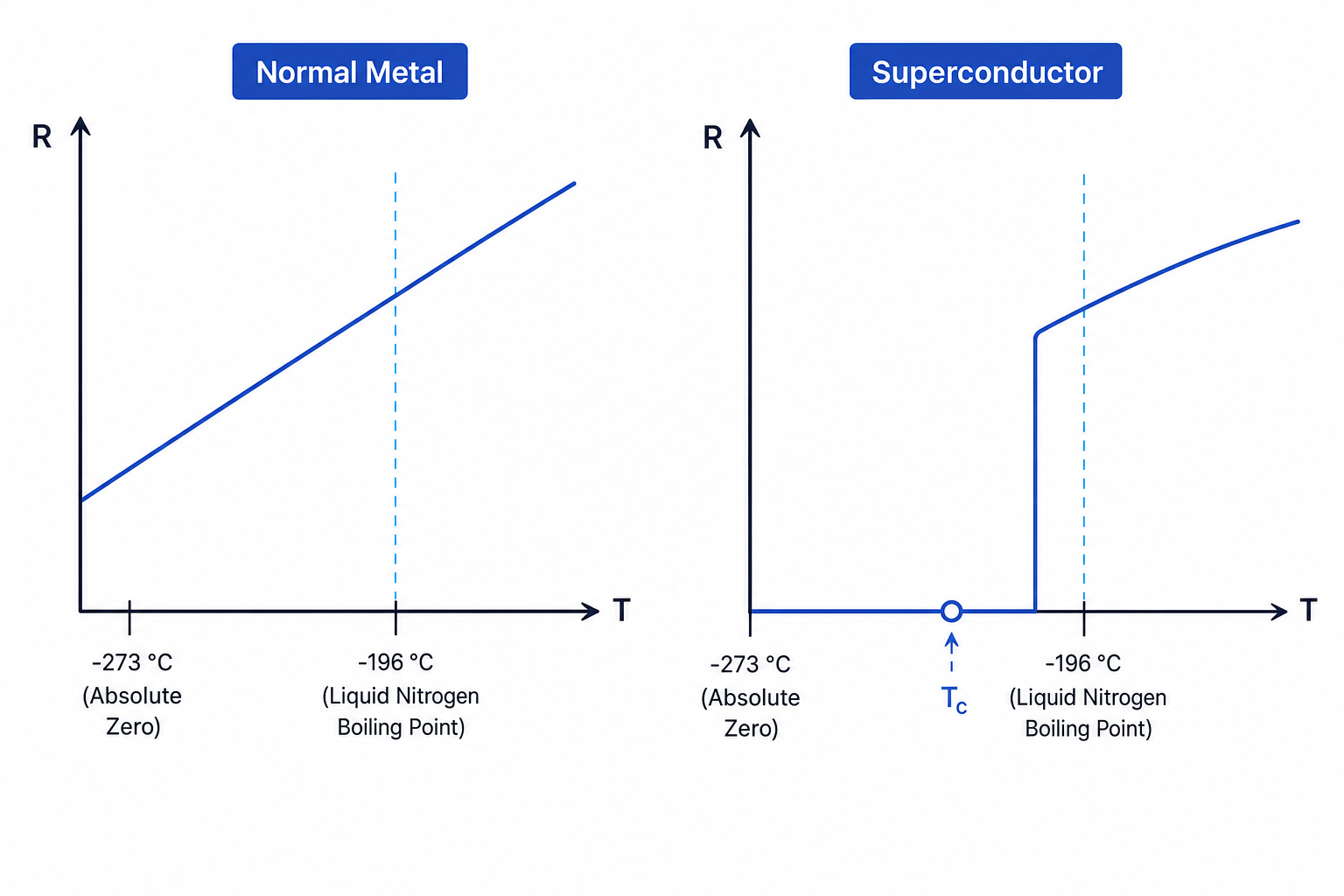
Superconductivity is the state in which a material has zero electrical resistance below its superconducting transition temperature TcT_cTc.
Most metals show superconductivity, but their transition temperatures are usually only a few degrees above absolute zero, about −273∘C-273^{\circ}\text{C}−273∘C. That means they need extremely cold cooling systems.
Some materials are called high temperature superconductors. Their transition temperatures are above the boiling point of nitrogen, about −196∘C-196^{\circ}\text{C}−196∘C. This matters because liquid nitrogen is much easier and cheaper to use than colder coolants such as liquid helium.
Superconductors are useful because large currents can flow with no resistive heating. Uses include:
- MRI scanners, where superconducting coils produce strong magnetic fields.
- Particle accelerators, where superconducting magnets guide and focus charged particles.
In the exam
- Learn definitions in “per unit” language: potential difference is energy per charge; resistance is potential difference per current.
- Check graph axes before using a gradient: III against VVV gives gradient 1R\frac{1}{R}R1 for an ohmic conductor, while VVV against III gives gradient RRR.
- In practical questions, mention correct meter placement, temperature control, repeat readings and conversion to SI units.
- For heating explanations, link electron-ion collisions to increased random vibration energy of ions and a rise in temperature.
Check yourself
- Why does a filament lamp’s III–VVV graph become less steep at higher potential differences?
- If the length of a wire is doubled but its material and cross-sectional area stay the same, what happens to its resistance?
- Why is the boiling point of nitrogen important when discussing high temperature superconductors?
