

What you'll learn
- Why nuclear decay is spontaneous and random, but still predictable statistically.
- How alpha, beta and gamma radiation differ in nature, penetration, ionisation and deflection.
- How to correct count-rate measurements for background radiation.
- How to use half-life, activity, decay constant and exponential decay equations.
Nuclear notation: describing a nucleus
A nucleus is made of protons and neutrons, collectively called nucleons. The two important numbers are:
- Proton number, ZZZ: the number of protons in the nucleus. This determines the element.
- Nucleon number, AAA: the total number of protons and neutrons.
Nuclide notation
A nucleus of element X is written as ZAX{}^A_Z\text{X}ZAX, where AAA is the nucleon number and ZZZ is the proton number.
For example, 614C{}^{14}_6\text{C}614C is carbon with 6 protons and 14 nucleons, so it has 8 neutrons.
In a decay equation, the original unstable nucleus is the parent nucleus. The nucleus produced after decay is the daughter nucleus.
Spontaneous nuclear decay
Some nuclei are unstable. They can become more stable by emitting radiation.
Spontaneous nuclear decay
Nuclear decay is spontaneous: it happens without any external trigger. For a particular isotope, decay is random for an individual nucleus but has a constant probability per unit time for each undecayed nucleus.
This means you cannot predict when one particular nucleus will decay, but you can predict the behaviour of a very large sample. Decay is not significantly affected by temperature, pressure, chemical state or physical state.
Ionising radiation
Ionising radiation has enough energy to remove electrons from atoms, forming ions. Alpha, beta and gamma radiation are all ionising.
Alpha, beta and gamma radiation
The three main types in this topic are:
- Alpha radiation, α\alphaα: a helium nucleus, 24He{}^4_2\text{He}24He, containing 2 protons and 2 neutrons.
- Beta minus radiation, β−\beta^-β−: a fast-moving electron, −10e{}^0_{-1}\text{e}−10e, emitted when a neutron changes into a proton.
- Beta plus radiation, β+\beta^+β+: a fast-moving positron, +10e{}^0_{+1}\text{e}+10e, emitted when a proton changes into a neutron.
- Gamma radiation, γ\gammaγ: a high-energy electromagnetic photon emitted by an excited nucleus.
The comparison below links the nature of each radiation type to its penetration, ionising ability and deflection in an electric field.
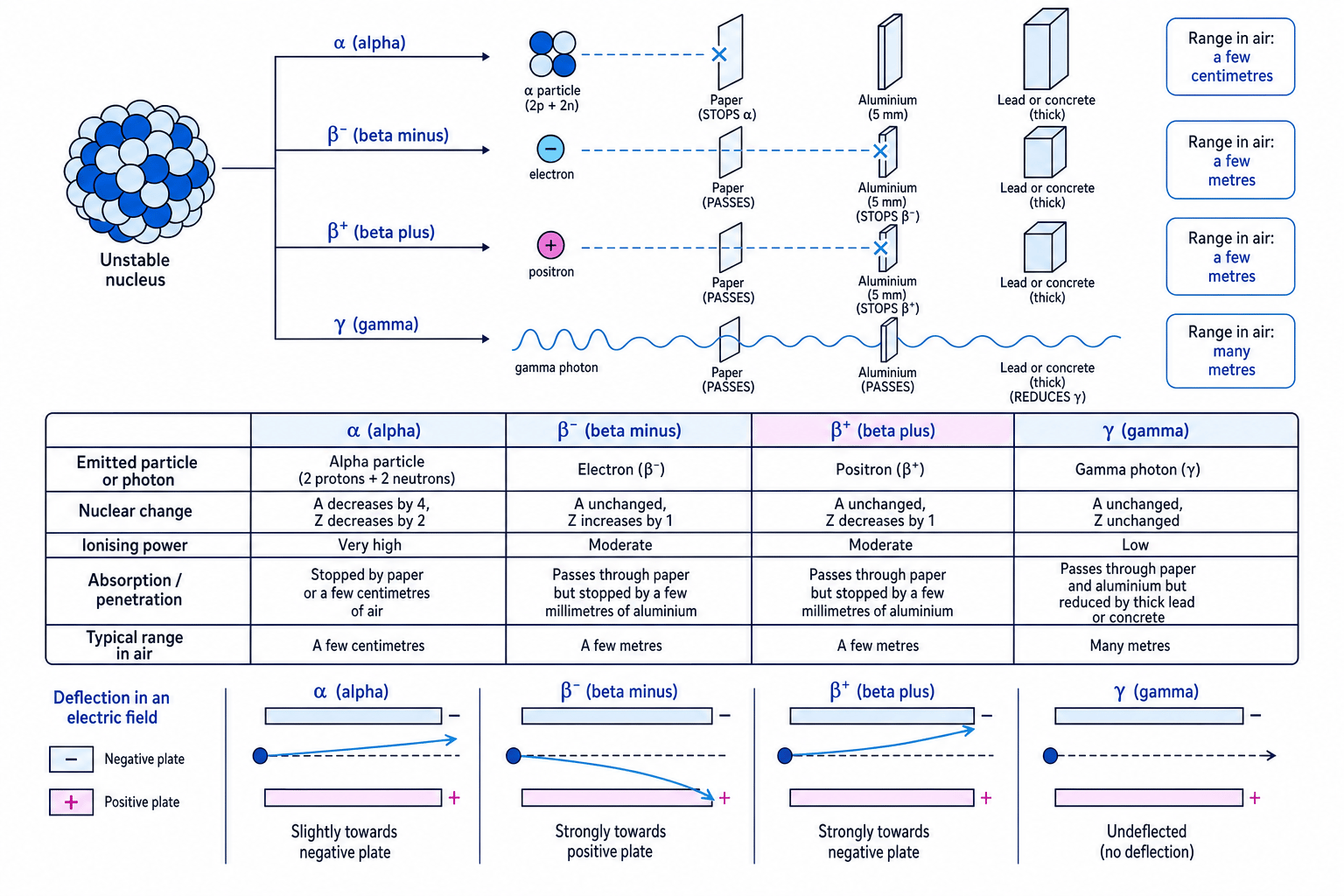
Nature controls penetration
Alpha particles are massive and have charge +2, so they ionise strongly and lose energy quickly. Gamma photons are uncharged, so they ionise weakly and are much more penetrating. Beta particles are intermediate.
Nuclear transformation equations
In nuclear equations, the total nucleon number AAA and proton number ZZZ must balance on both sides.
Common decay equations are:
α:ZAX→Z−2A−4Y+24Heβ−:ZAX→Z+1AY+−10e+νˉβ+:ZAX→Z−1AY++10e+νγ:ZAX∗→ZAX+γ\begin{aligned} \alpha:\quad {}^A_Z\text{X} &\to {}^{A-4}_{Z-2}\text{Y} + {}^4_2\text{He} \\ \beta^-:\quad {}^A_Z\text{X} &\to {}^A_{Z+1}\text{Y} + {}^0_{-1}\text{e} + \bar{\nu} \\ \beta^+:\quad {}^A_Z\text{X} &\to {}^A_{Z-1}\text{Y} + {}^0_{+1}\text{e} + \nu \\ \gamma:\quad {}^A_Z\text{X}^{*} &\to {}^A_Z\text{X} + \gamma \end{aligned}α:ZAXβ−:ZAXβ+:ZAXγ:ZAX∗→Z−2A−4Y+24He→Z+1AY+−10e+νˉ→Z−1AY++10e+ν→ZAX+γHere, ν\nuν is a neutrino and νˉ\bar{\nu}νˉ is an antineutrino. In gamma decay, the star means the nucleus is in an excited state.
Balancing nuclear equations
Add the top numbers to conserve AAA, and add the bottom numbers to conserve ZZZ. Gamma emission changes neither AAA nor ZZZ.
Writing an alpha decay equation
Radium-226 decays by alpha emission. Write the nuclear equation.
-
Alpha emission releases 24He{}^4_2\text{He}24He, so the daughter nucleus has nucleon number 226−4=222226 - 4 = 222226−4=222.
-
The proton number decreases by 2, so the daughter has proton number 88−2=8688 - 2 = 8688−2=86.
-
Element 86 is radon, so the equation is:
Distinguishing alpha, beta and gamma radiation
You can identify radiation experimentally using:
- Absorbers: paper stops alpha; a few millimetres of aluminium stops beta; thick lead or concrete reduces gamma.
- Range in air: alpha travels a few centimetres, beta a few metres, gamma many metres.
- Electric or magnetic fields: charged alpha and beta deflect in opposite directions; gamma is undeflected.
- Cloud chamber tracks: alpha gives short, thick, straight tracks; beta gives thinner, more irregular tracks; gamma mainly produces secondary tracks.
Gamma is reduced, not completely stopped
Do not say “lead stops gamma completely”. Gamma intensity is reduced by shielding, but some photons may still pass through.
Background radiation
Background radiation is ionising radiation always present in the environment, from sources such as cosmic rays, rocks, radon gas and medical sources.
A detector such as a Geiger-Müller tube records a count rate, usually in counts per second. To find the count rate due to your source, subtract the background count rate.
corrected count rate=measured count rate−background count rate\text{corrected count rate} = \text{measured count rate} - \text{background count rate}corrected count rate=measured count rate−background count rateCorrecting a count rate for background
A source gives 1500 counts in 60 s. Background radiation gives 240 counts in 120 s. Find the corrected count rate.
- Convert the source measurement into a rate:
- Convert the background measurement into a rate:
- Subtract the rates:
Subtract rates, not unmatched counts
If the time intervals are different, do not subtract the raw counts directly. Convert both measurements to count rates first.
Because decay is random, counts fluctuate. For a count nnn, the approximate uncertainty is n\sqrt{n}n, so longer counting times reduce the percentage uncertainty.
Half-life, activity and decay constant
Half-life
The half-life, T1/2T_{1/2}T1/2, is the mean time taken for the number of undecayed nuclei, or the activity, to fall to half its original value.
Activity and becquerel
The activity, AAA, is the rate at which nuclei decay. The unit is the becquerel, Bq, where one becquerel means one decay per second.
Activity is related to the number of undecayed nuclei by:
A=λNA = \lambda NA=λNwhere λ\lambdaλ is the decay constant. It is the probability per unit time that an undecayed nucleus will decay, so its unit is s−1\text{s}^{-1}s−1 if time is in seconds.
Activity is not the same as count rate
Activity is the number of decays per second in the source. Count rate is what the detector records, and depends on background, detector efficiency, distance and shielding.
Calculating activity from a decay constant
A sample contains 8.0×10128.0 \times 10^{12}8.0×10¹² undecayed nuclei. Its decay constant is 4.0×10⁻⁸ s−14.0 \times 10^{-8}\ \text{s}^{-1}4.0×10⁻⁸ s−1. Find its activity.
- Choose the activity equation:
- Substitute the values:
- Calculate and give the unit:
Exponential decay law
Radioactive decay follows an exponential pattern because the same fraction of the remaining nuclei decays in each equal time interval.
N=N0e−λtN = N_0 e^{-\lambda t}N=N0e−λtand, because A=λNA = \lambda NA=λN,
A=A0e−λtA = A_0 e^{-\lambda t}A=A0e−λtYou can also use the half-life form:
N=N02xN = \frac{N_0}{2^x}N=2xN0 A=A02xA = \frac{A_0}{2^x}A=2xA0where xxx is the number of half-lives elapsed. It does not have to be a whole number.
The graph below shows the exponential shape and the straight-line form obtained by plotting lnN\ln NlnN against time.
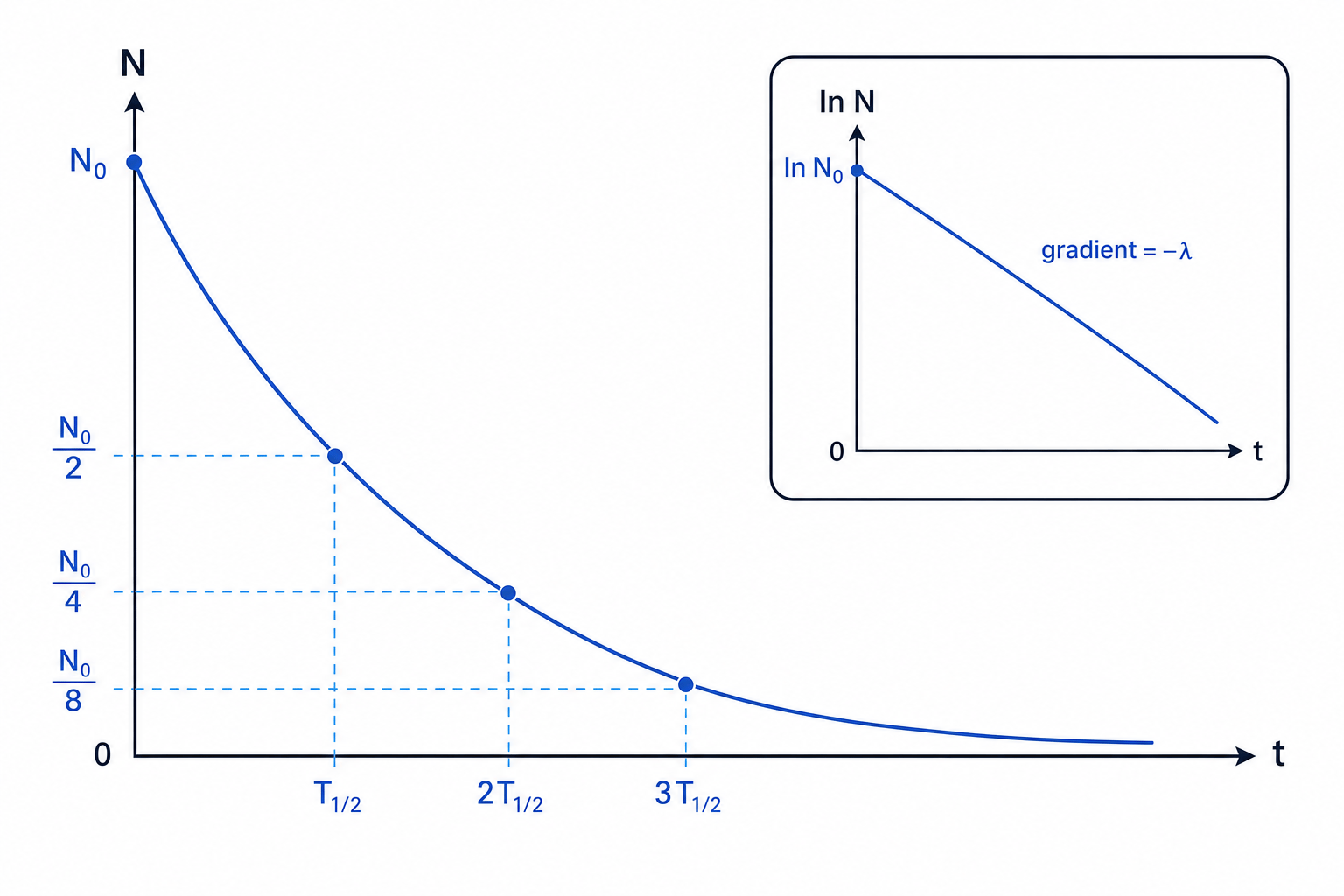
Equal times, equal fractions
In radioactive decay, equal time intervals remove equal fractions, not equal amounts. That is why the graph curves towards zero instead of being a straight line.
Using a non-integer number of half-lives
A sample has initial activity 960 Bq and half-life 4.0 h. Find its activity after 10 h.
- Find the number of half-lives:
- Use the half-life form:
- Calculate the activity:
Deriving the link between half-life and decay constant
At one half-life, t=T1/2t = T_{1/2}t=T1/2 and N=N02N = \frac{N_0}{2}N=2N0.
N02=N0e−λT1/212=e−λT1/2ln2=λT1/2λ=ln2T1/2\begin{aligned} \frac{N_0}{2} &= N_0 e^{-\lambda T_{1/2}} \\ \frac{1}{2} &= e^{-\lambda T_{1/2}} \\ \ln 2 &= \lambda T_{1/2} \\ \lambda &= \frac{\ln 2}{T_{1/2}} \end{aligned}2N021ln2λ=N0e−λT1/2=e−λT1/2=λT1/2=T1/2ln2This same relationship works for activity because activity is proportional to NNN.
Finding half-life from a log graph
A graph of ln(A/Bq)\ln(A / \text{Bq})ln(A/Bq) against time has gradient −3.5×10⁻⁴ s−1-3.5 \times 10^{-4}\ \text{s}^{-1}−3.5×10⁻⁴ s−1. Find the half-life.
- For a log graph of activity against time, the gradient is −λ-\lambda−λ, so:
- Use the half-life relationship:
- Substitute and calculate:
Specified practical work
Dice analogy for radioactive decay
This models random decay without using radioactive material.
- Start with a large number of dice. Each die represents an undecayed nucleus.
- Roll all the dice. Choose one face, such as a 6, to represent “decayed”.
- Remove all dice showing that face. Count and record the remaining dice, NNN.
- Repeat for many rolls and plot NNN against roll number.
- Repeat the experiment or combine class data to reduce random fluctuations.
For one “decay face”, the probability of decay per roll is 16\frac{1}{6}61, so the expected fraction remaining after each roll is 56\frac{5}{6}65. The model predicts:
N=N0(56)rN = N_0\left(\frac{5}{6}\right)^rN=N0(65)rwhere rrr is the number of rolls.
Limits of the dice model
Dice decay happens in discrete rolls, while real nuclear decay is continuous in time. The model is useful because it shows randomness, constant probability and exponential decrease.
Gamma intensity with distance
For a point gamma source, intensity decreases with distance because the radiation spreads out over a larger area. After subtracting background, the count rate is approximately proportional to 1r2\frac{1}{r^2}r21 if absorption in air is negligible.
The practical layout below shows how to vary distance, subtract background and test for an inverse-square relationship.
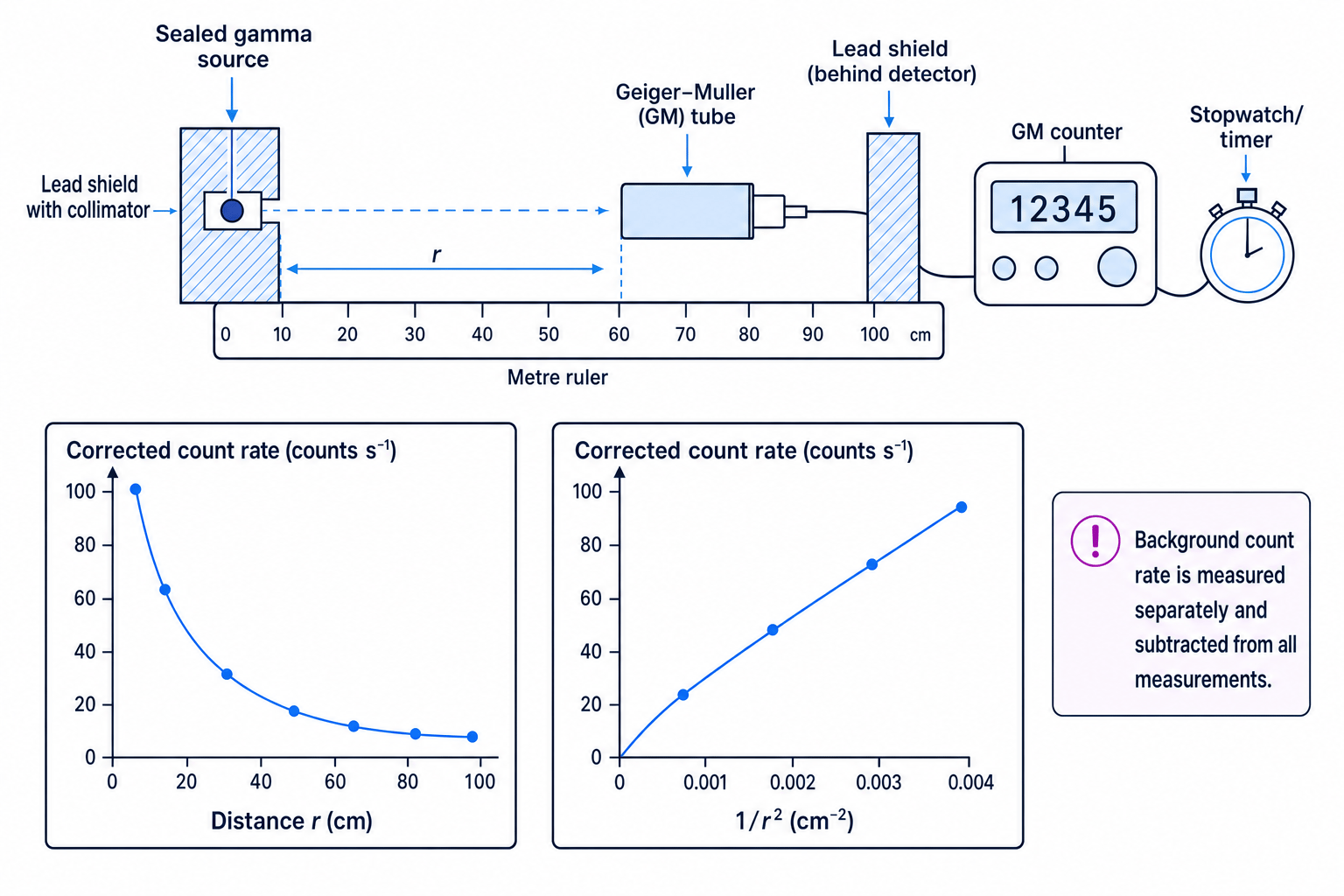
Good practice includes:
- Measure background count rate with no source present, then subtract it from every reading.
- Keep the source, detector and ruler aligned.
- Count for long enough to reduce percentage uncertainty.
- Repeat readings, especially at large distances where count rates are low.
- Plot corrected count rate against 1r2\frac{1}{r^2}r21; a straight line supports an inverse-square relationship.
Radiation safety
Use tongs, maximise distance, minimise exposure time, use suitable shielding, and store sources in their containers when not in use.
In the exam
- Balance nuclear equations by checking both AAA and ZZZ on each side before naming the daughter nucleus.
- For count-rate data, correct for background before using half-life or exponential decay equations.
- Keep time units consistent: if λ\lambdaλ is in s−1\text{s}^{-1}s−1, use time in seconds.
- For graph questions, remember that a plot of lnN\ln NlnN or lnA\ln AlnA against time has gradient −λ-\lambda−λ.
Check yourself
- Why can we predict the half-life of a large sample but not the decay time of one nucleus?
- What changes happen to AAA and ZZZ in alpha, beta minus, beta plus and gamma decay?
- How would you use absorber data and background correction to identify an unknown radiation source?
