

What you'll learn
- How Kepler’s laws and Newton’s gravitation describe planets, satellites and binary stars.
- How orbital data can be used to find the mass of stars, planets and galaxies.
- How Doppler shifts and Hubble’s law connect spectra to motion and cosmic expansion.
- Why dark matter and critical density matter in modern cosmology.
Starting point: gravity makes orbits happen
An orbit is the curved path of one object around another due to gravity. For a small satellite of mass mmm orbiting a much larger central mass MMM, the gravitational force acts towards the centre and provides the centripetal force needed for circular motion.
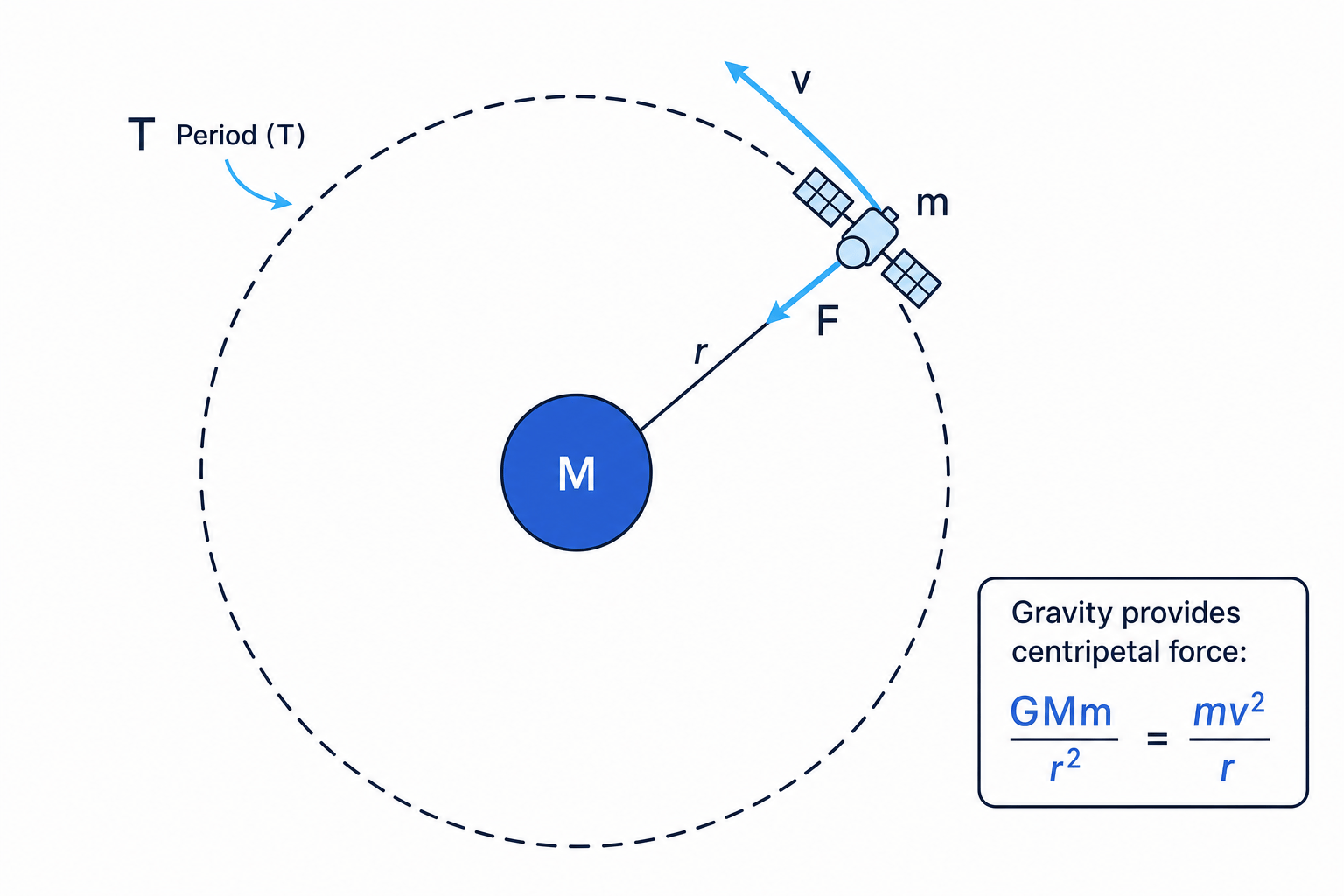
Newton’s law of gravitation
Two point masses, or two spherically symmetric masses treated as if their mass is at their centres, attract with force
F=GM1M2r2F = G\frac{M_1M_2}{r^2}F=Gr2M1M2where GGG is the gravitational constant and rrr is the separation of their centres.
For circular motion,
a=v2ra = \frac{v^2}{r}a=rv2so the required centripetal force is F=mv2/rF = mv^2/rF=mv2/r.
Kepler’s three laws
Kepler described planetary motion before Newton explained it.
First law: elliptical orbits
Planets move in ellipses, with the Sun at one focus. A circle is the special case where the two foci coincide.
Second law: equal areas in equal times
A line from the Sun to a planet sweeps out equal areas in equal time intervals. This means a planet moves faster when it is closer to the Sun.
Third law: period and orbital size
For objects orbiting the same central mass,
T2∝r3T^2 \propto r^3T2∝r3for circular orbits, where TTT is the orbital period and rrr is the orbital radius.
Comparing orbital periods
A planet orbits a star at four times Earth’s orbital radius around the same star. Estimate its orbital period in Earth years.
-
Use Kepler’s third law as a ratio:
T22T12=r23r13\frac{T_2^2}{T_1^2} = \frac{r_2^3}{r_1^3}T12T22=r13r23 -
Substitute r2=4r1r_2 = 4r_1r2=4r1:
T22T12=43=64\frac{T_2^2}{T_1^2} = 4^3 = 64T12T22=43=64 -
Take the square root:
T2T1=8\frac{T_2}{T_1} = 8T1T2=8So the orbital period is 8 Earth years.
Deriving Kepler’s third law for a circular orbit
For a satellite in a circular orbit, gravity provides the centripetal force:
GMmr2=mv2rG\frac{Mm}{r^2} = \frac{mv^2}{r}Gr2Mm=rmv2The satellite mass mmm cancels:
GMr2=v2rG\frac{M}{r^2} = \frac{v^2}{r}Gr2M=rv2so
v2=GMrv^2 = \frac{GM}{r}v2=rGMFor one complete orbit, the distance travelled is the circumference 2πr2\pi r2πr, so
v=2πrTv = \frac{2\pi r}{T}v=T2πrSubstitute this into v2=GM/rv^2 = GM/rv2=GM/r:
(2πrT)2=GMr\left(\frac{2\pi r}{T}\right)^2 = \frac{GM}{r}(T2πr)2=rGMRearranging gives
T2=4π2r3GMT^2 = \frac{4\pi^2r^3}{GM}T2=GM4π2r3This is Kepler’s third law for a circular orbit.
Mass from orbital data
If you know the orbital radius and period of a circular orbit, you can find the central mass using
M=4π2r3GT2M = \frac{4\pi^2r^3}{GT^2}M=GT24π2r3If you know orbital speed instead, use
M=v2rGM = \frac{v^2r}{G}M=Gv2rFinding the mass of a planet from a satellite orbit
A satellite orbits a planet with orbital radius 4.22×10⁷ m4.22 \times 10^7 \text{ m}4.22×10⁷ m and period 8.62×10⁴ s8.62 \times 10^4 \text{ s}8.62×10⁴ s. Calculate the planet’s mass.
-
Choose the period form because rrr and TTT are given:
M=4π2r3GT2M = \frac{4\pi^2r^3}{GT^2}M=GT24π2r3 -
Substitute the values:
M=4π2(4.22×10⁷ m)3(6.67×10⁻¹¹ N m2 kg−2)(8.62×10⁴ s)2M = \frac{4\pi^2(4.22 \times 10^7 \text{ m})^3}{(6.67 \times 10^{-11} \text{ N m}^2\text{ kg}^{-2})(8.62 \times 10^4 \text{ s})^2}M=(6.67×10⁻¹¹ N m2 kg−2)(8.62×10⁴ s)24π2(4.22×10⁷ m)3 -
Calculate:
M=5.99×1024 kgM = 5.99 \times 10^{24} \text{ kg}M=5.99×1024 kgThis is approximately the mass of Earth.
Using the wrong radius
The orbital radius rrr is measured from the centre of the central body to the orbiting object, not from the surface.
Spiral galaxies and dark matter
In a spiral galaxy, stars orbit the galactic centre. If most mass were in the bright visible region, then far from the centre the enclosed mass would be roughly constant, giving
v=GMrv = \sqrt{\frac{GM}{r}}v=rGMso orbital speed should decrease as distance increases.
But observations show that the rotation curves of spiral galaxies stay approximately flat: stars far out move too fast to be held by visible matter alone.
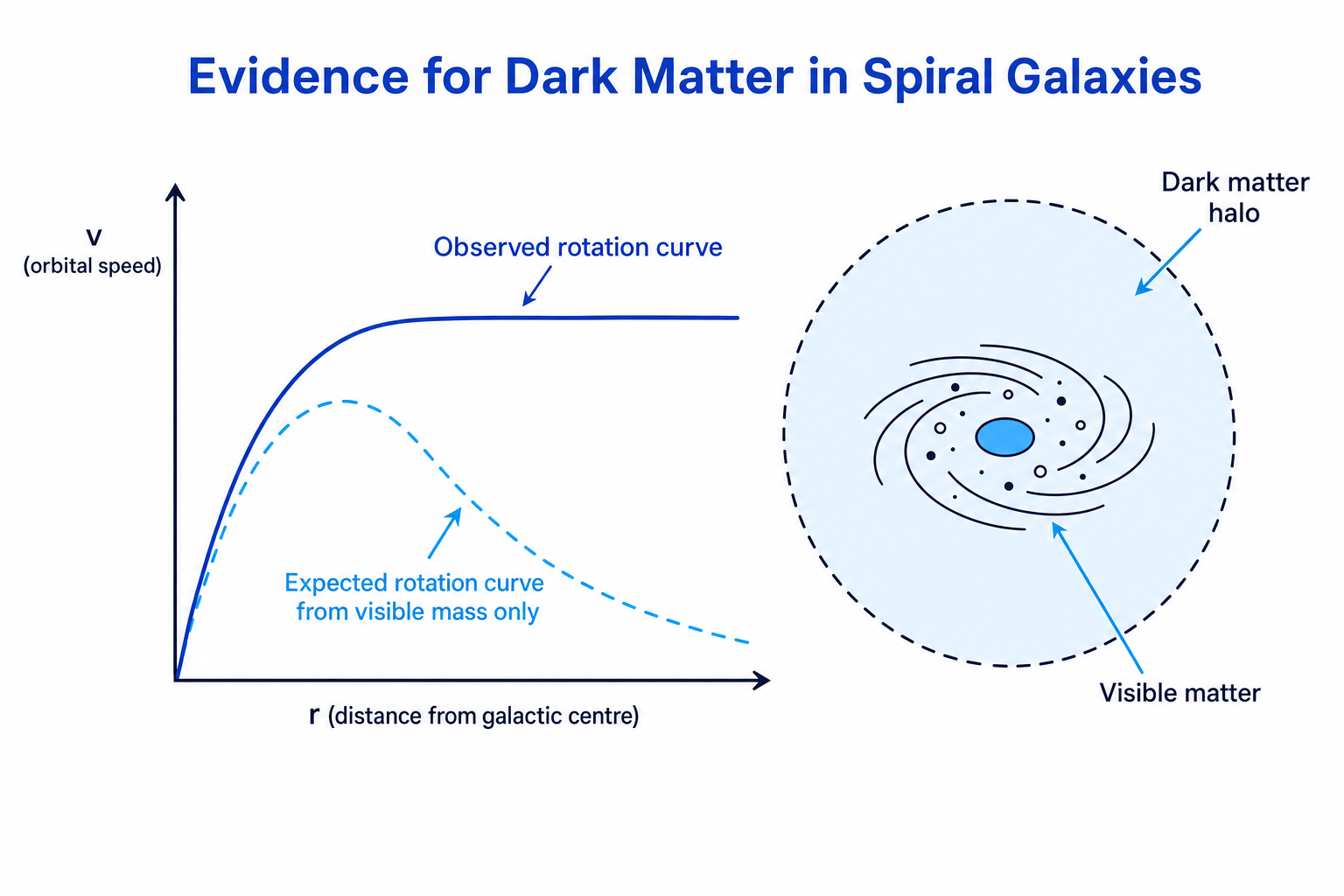
Dark matter
Dark matter is matter that does not emit, absorb or reflect enough electromagnetic radiation to be seen directly, but whose gravitational effects can be observed.
A flat rotation curve implies that the mass enclosed within radius rrr keeps increasing with rrr. This suggests a large, roughly spherical dark matter halo around the visible galaxy.
Estimating unseen mass in a galaxy
At radius 5.0×10²⁰ m5.0 \times 10^{20} \text{ m}5.0×10²⁰ m from a galactic centre, stars orbit at 2.0×10⁵ m s−12.0 \times 10^5 \text{ m s}^{-1}2.0×10⁵ m s−1. Estimate the enclosed mass.
-
Use the circular orbit result:
M=v2rGM = \frac{v^2r}{G}M=Gv2r -
Substitute:
M=(2.0×10⁵ m s−1)2(5.0×10²⁰ m)6.67×10⁻¹¹ N m2 kg−2M = \frac{(2.0 \times 10^5 \text{ m s}^{-1})^2(5.0 \times 10^{20} \text{ m})}{6.67 \times 10^{-11} \text{ N m}^2\text{ kg}^{-2}}M=6.67×10⁻¹¹ N m2 kg−2(2.0×10⁵ m s−1)2(5.0×10²⁰ m) -
Calculate:
M=3.0×1041 kgM = 3.0 \times 10^{41} \text{ kg}M=3.0×1041 kgIf the visible mass is much less than this, the difference is evidence for dark matter.
The Higgs boson and dark matter
The Higgs boson is a particle discovered at CERN in 2012. It is linked to the Higgs field, which is involved in giving many fundamental particles mass.
The Higgs boson itself is not normally considered to be dark matter because it is unstable and decays very quickly. However, some theories suggest dark matter particles may interact with ordinary matter through the Higgs field, sometimes called a “Higgs portal”. Evidence from particle physics can therefore constrain possible dark matter models.
Two-body orbits and the centre of mass
When two stars orbit each other, neither is fixed. Both orbit their common centre of mass, also called the barycentre.
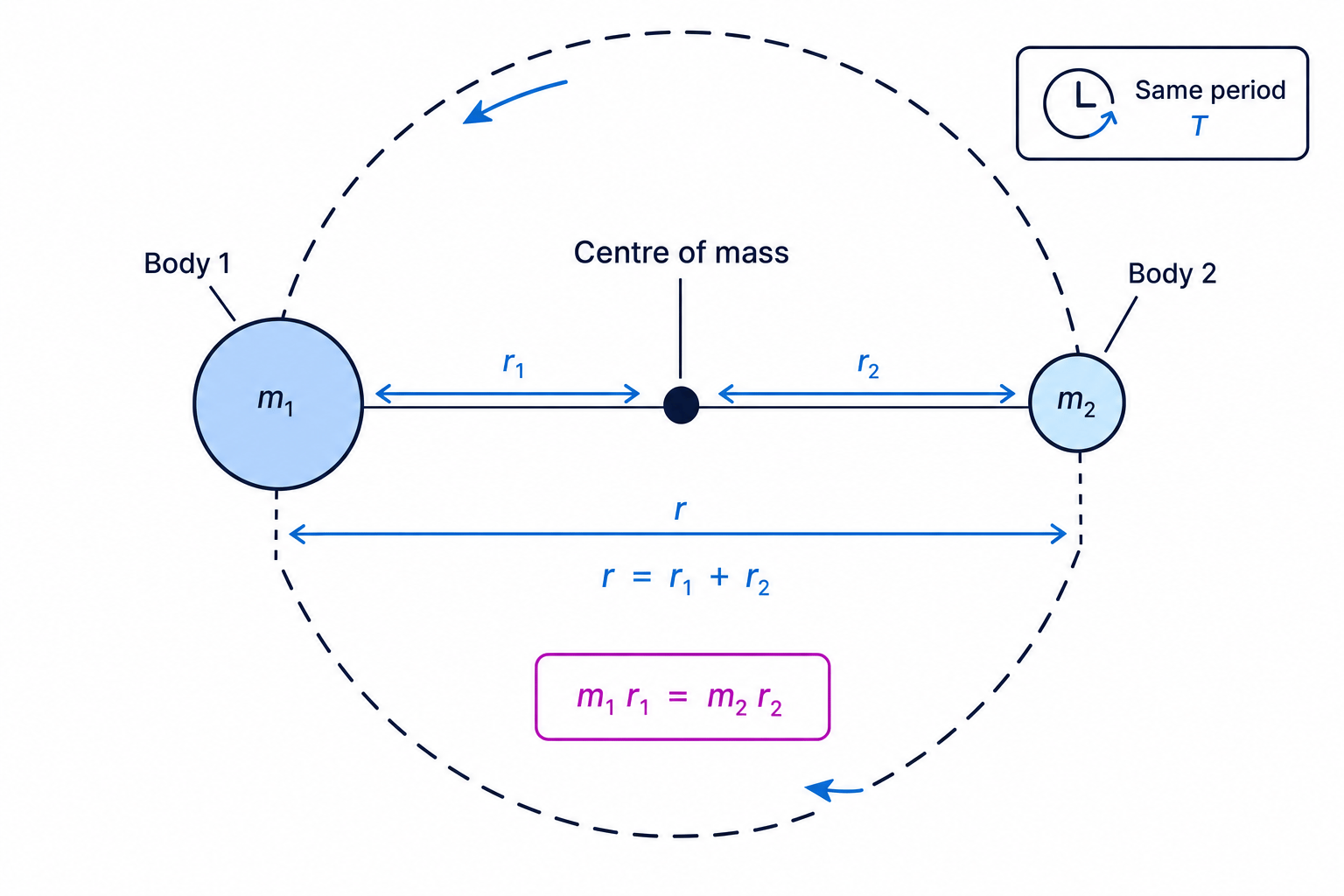
For two spherically symmetric bodies separated by distance rrr,
r=r1+r2r = r_1 + r_2r=r1+r2and the centre of mass condition is
m1r1=m2r2m_1r_1 = m_2r_2m1r1=m2r2So
r1=m2m1+m2rr_1 = \frac{m_2}{m_1 + m_2}rr1=m1+m2m2rand
r2=m1m1+m2rr_2 = \frac{m_1}{m_1 + m_2}rr2=m1+m2m1rTheir mutual orbital period for circular orbits is
T=2πr3G(m1+m2)T = 2\pi\sqrt{\frac{r^3}{G(m_1 + m_2)}}T=2πG(m1+m2)r3Finding a binary centre of mass and period
Two stars have masses 2.0×1030 kg2.0 \times 10^{30} \text{ kg}2.0×1030 kg and 1.0×1030 kg1.0 \times 10^{30} \text{ kg}1.0×1030 kg. Their separation is 3.0×10¹⁰ m3.0 \times 10^{10} \text{ m}3.0×10¹⁰ m. Find the centre of mass distances and orbital period.
-
Find the distance of the first star from the centre of mass:
r1=1.0×10303.0×1030(3.0×10¹⁰ m)=1.0×10¹⁰ mr_1 = \frac{1.0 \times 10^{30}}{3.0 \times 10^{30}}(3.0 \times 10^{10} \text{ m}) = 1.0 \times 10^{10} \text{ m}r1=3.0×10301.0×1030(3.0×10¹⁰ m)=1.0×10¹⁰ m -
Find the second distance:
r2=3.0×10¹⁰ m−1.0×10¹⁰ m=2.0×10¹⁰ mr_2 = 3.0 \times 10^{10} \text{ m} - 1.0 \times 10^{10} \text{ m} = 2.0 \times 10^{10} \text{ m}r2=3.0×10¹⁰ m−1.0×10¹⁰ m=2.0×10¹⁰ m -
Calculate the period:
T=2π(3.0×10¹⁰ m)3(6.67×10⁻¹¹)(3.0×1030 kg)T = 2\pi\sqrt{\frac{(3.0 \times 10^{10} \text{ m})^3}{(6.67 \times 10^{-11})(3.0 \times 10^{30} \text{ kg})}}T=2π(6.67×10⁻¹¹)(3.0×1030 kg)(3.0×10¹⁰ m)3 T=2.3×10⁶ sT = 2.3 \times 10^6 \text{ s}T=2.3×10⁶ sThis is about 27 days.
Doppler shift of spectral lines
A spectral line is a narrow bright or dark line at a particular wavelength, produced by atoms absorbing or emitting specific photon energies.
If a star moves along the line joining it to Earth, its observed wavelengths shift. This line-of-sight component of velocity is called radial velocity.
For speeds much less than the speed of light,
Δλλ=vc\frac{\Delta\lambda}{\lambda} = \frac{v}{c}λΔλ=cvwhere Δλ\Delta\lambdaΔλ is the change in wavelength, λ\lambdaλ is the rest wavelength, vvv is radial velocity, and ccc is the speed of light.
Redshift and blueshift
If the observed wavelength is larger than the rest wavelength, Δλ\Delta\lambdaΔλ is positive and the source is receding. If it is smaller, the source is approaching.
Finding radial velocity from a spectral line
A spectral line with rest wavelength 656.3 nm is observed at 656.9 nm. Find the radial velocity.
-
Find the wavelength shift:
Δλ=656.9 nm−656.3 nm=0.6 nm\Delta\lambda = 656.9 \text{ nm} - 656.3 \text{ nm} = 0.6 \text{ nm}Δλ=656.9 nm−656.3 nm=0.6 nm -
Substitute into the Doppler relationship:
v=cΔλλv = c\frac{\Delta\lambda}{\lambda}v=cλΔλ v=(3.00×10⁸ m s−1)0.6656.3v = (3.00 \times 10^8 \text{ m s}^{-1})\frac{0.6}{656.3}v=(3.00×10⁸ m s−1)656.30.6 -
Calculate and interpret the sign:
v=2.7×10⁵ m s−1v = 2.7 \times 10^5 \text{ m s}^{-1}v=2.7×10⁵ m s−1The wavelength increased, so the star is moving away from Earth.
Masses in an edge-on double system
For a circular binary system viewed edge-on, the maximum radial velocities are the true orbital speeds.
From radial velocity data, measure the velocity amplitudes v1v_1v1 and v2v_2v2, and the period TTT.
Then
r1=v1T2πr_1 = \frac{v_1T}{2\pi}r1=2πv1Tand
r2=v2T2πr_2 = \frac{v_2T}{2\pi}r2=2πv2Tso
r=(v1+v2)T2πr = \frac{(v_1 + v_2)T}{2\pi}r=2π(v1+v2)TThe total mass is
m1+m2=4π2r3GT2m_1 + m_2 = \frac{4\pi^2r^3}{GT^2}m1+m2=GT24π2r3Also, because both bodies orbit the same centre of mass,
m1v1=m2v2m_1v_1 = m_2v_2m1v1=m2v2so the slower body is the more massive one.
Finding masses from radial velocity data
An edge-on binary system has period 1.00×10⁷ s1.00 \times 10^7 \text{ s}1.00×10⁷ s. The radial velocity amplitudes are 3.0×10⁴ m s−13.0 \times 10^4 \text{ m s}^{-1}3.0×10⁴ m s−1 and 6.0×10⁴ m s−16.0 \times 10^4 \text{ m s}^{-1}6.0×10⁴ m s−1. Find the two masses.
-
Find the separation:
r=(3.0×10⁴+6.0×10⁴) m s−1(1.00×10⁷ s)2πr = \frac{(3.0 \times 10^4 + 6.0 \times 10^4)\text{ m s}^{-1}(1.00 \times 10^7 \text{ s})}{2\pi}r=2π(3.0×10⁴+6.0×10⁴) m s−1(1.00×10⁷ s) r=1.43×10¹¹ mr = 1.43 \times 10^{11} \text{ m}r=1.43×10¹¹ m -
Find the total mass:
m1+m2=4π2(1.43×10¹¹ m)3(6.67×10⁻¹¹)(1.00×10⁷ s)2m_1 + m_2 = \frac{4\pi^2(1.43 \times 10^{11} \text{ m})^3}{(6.67 \times 10^{-11})(1.00 \times 10^7 \text{ s})^2}m1+m2=(6.67×10⁻¹¹)(1.00×10⁷ s)24π2(1.43×10¹¹ m)3 m1+m2=1.7×1031 kgm_1 + m_2 = 1.7 \times 10^{31} \text{ kg}m1+m2=1.7×1031 kg -
Use the mass ratio. Since m1v1=m2v2m_1v_1 = m_2v_2m1v1=m2v2, the object with speed 3.0×10⁴ m s−13.0 \times 10^4 \text{ m s}^{-1}3.0×10⁴ m s−1 is twice as massive as the other:
m1=1.2×1031 kgm_1 = 1.2 \times 10^{31} \text{ kg}m1=1.2×1031 kg m2=5.8×1030 kgm_2 = 5.8 \times 10^{30} \text{ kg}m2=5.8×1030 kg
Inclination matters
If the orbit is not edge-on, the measured radial velocity is smaller than the true orbital speed. The simple mass method above only works directly for the edge-on case.
Hubble’s law and the age of the universe
For distant galaxies, Hubble’s law is
v=H0Dv = H_0Dv=H0Dwhere vvv is the galaxy’s recessional velocity, DDD is its distance, and H0H_0H0 is the Hubble constant.
The SI unit of H0H_0H0 is per second, s⁻¹, although astronomers often quote it in kilometres per second per megaparsec.
If a galaxy has moved at approximately constant speed since the Big Bang,
time≈Dv\text{time} \approx \frac{D}{v}time≈vDUsing v=H0Dv = H_0Dv=H0D,
time≈DH0D=1H0\text{time} \approx \frac{D}{H_0D} = \frac{1}{H_0}time≈H0DD=H01So 1/H01/H_01/H0 gives an estimate of the age of the universe.
Estimating the age of the universe from Hubble’s constant
Take H0=70 km s−1 Mpc−1H_0 = 70 \text{ km s}^{-1}\text{ Mpc}^{-1}H0=70 km s−1 Mpc−1. Estimate the age of the universe.
-
Convert to SI units using 1 Mpc =3.09×10²² m= 3.09 \times 10^{22} \text{ m}=3.09×10²² m:
H0=70 000 m s−13.09×10²² mH_0 = \frac{70\,000 \text{ m s}^{-1}}{3.09 \times 10^{22} \text{ m}}H0=3.09×10²² m70000 m s−1 H0=2.27×10⁻¹⁸ s−1H_0 = 2.27 \times 10^{-18} \text{ s}^{-1}H0=2.27×10⁻¹⁸ s−1 -
Take the reciprocal:
1H0=12.27×10⁻¹⁸ s−1=4.41×10¹⁷ s\frac{1}{H_0} = \frac{1}{2.27 \times 10^{-18} \text{ s}^{-1}} = 4.41 \times 10^{17} \text{ s}H01=2.27×10⁻¹⁸ s−11=4.41×10¹⁷ s -
Convert to years:
4.41×10¹⁷ s3.16×107 s yr−1=1.4×10¹⁰ yr\frac{4.41 \times 10^{17} \text{ s}}{3.16 \times 10^7 \text{ s yr}^{-1}} = 1.4 \times 10^{10} \text{ yr}3.16×10⁷ s yr−14.41×10¹⁷ s=1.4×10¹⁰ yrThe estimate is about 14 billion years.
Forgetting Hubble units
Before using 1/H01/H_01/H0, convert H0H_0H0 into s⁻¹. Do not take the reciprocal while it is still in kilometres per second per megaparsec.
Critical density of a flat universe
The critical density is the average density needed for a flat universe in this simple model.
Imagine a small galaxy of mass mmm at the edge of a uniform spherical region of radius RRR and density ρ\rhoρ. The mass inside the sphere is
M=43πR3ρM = \frac{4}{3}\pi R^3\rhoM=34πR3ρUse conservation of energy:
E=12mv2−GMmRE = \frac{1}{2}mv^2 - G\frac{Mm}{R}E=21mv2−GRMmFor the critical case, take total energy as zero:
12mv2=GMmR\frac{1}{2}mv^2 = G\frac{Mm}{R}21mv2=GRMmSubstitute v=H0Rv = H_0Rv=H0R and M=43πR3ρM = \frac{4}{3}\pi R^3\rhoM=34πR3ρ:
12mH02R2=G(43πR3ρ)mR\frac{1}{2}mH_0^2R^2 = G\frac{\left(\frac{4}{3}\pi R^3\rho\right)m}{R}21mH02R2=GR(34πR3ρ)mCancel mR2mR^2mR2:
12H02=43πGρ\frac{1}{2}H_0^2 = \frac{4}{3}\pi G\rho21H02=34πGρso
ρc=3H028πG\rho_c = \frac{3H_0^2}{8\pi G}ρc=8πG3H02Calculating critical density
Use H0=2.27×10⁻¹⁸ s−1H_0 = 2.27 \times 10^{-18} \text{ s}^{-1}H0=2.27×10⁻¹⁸ s−1 to estimate the critical density.
-
Substitute into the equation:
ρc=3H028πG\rho_c = \frac{3H_0^2}{8\pi G}ρc=8πG3H02 -
Calculate:
ρc=3(2.27×10⁻¹⁸ s−1)28π(6.67×10⁻¹¹ N m2 kg−2)\rho_c = \frac{3(2.27 \times 10^{-18} \text{ s}^{-1})^2}{8\pi(6.67 \times 10^{-11} \text{ N m}^2\text{ kg}^{-2})}ρc=8π(6.67×10⁻¹¹ N m2 kg−2)3(2.27×10⁻¹⁸ s−1)2 -
Quote the result:
ρc=9.2×10⁻²⁷ kg m−3\rho_c = 9.2 \times 10^{-27} \text{ kg m}^{-3}ρc=9.2×10⁻²⁷ kg m−3This is extremely small by everyday standards.
In the exam
- For orbit calculations, identify whether you are using vvv, TTT, or both, then choose between M=v2r/GM = v^2r/GM=v2r/G and M=4π2r3/(GT2)M = 4\pi^2r^3/(GT^2)M=4π2r3/(GT2).
- In Doppler questions, use the rest wavelength for λ\lambdaλ and the shift for Δλ\Delta\lambdaΔλ; the sign tells you approach or recession.
- For Hubble questions, convert H0H_0H0 to s⁻¹ before estimating age or critical density.
Check yourself
- Why does a flat galaxy rotation curve imply extra unseen mass?
- In a binary star system, why does the more massive star have the smaller radial velocity amplitude?
- Why is 1/H01/H_01/H0 only an approximation to the age of the universe?
