

What you'll learn
- How centre of gravity and moments explain stability, toppling and muscle forces.
- How impulse and coefficient of restitution describe impacts and bounces.
- How moment of inertia, torque and angular momentum explain spin in sport.
- How projectile motion, Bernoulli’s equation and drag affect balls, athletes and equipment.
Starting point: forces, distances and energy
This option applies familiar mechanics to sporting situations. You will keep using forces in newtons (N), distances in metres (m), time in seconds (s), mass in kilograms (kg), energy in joules (J), and speed in metres per second (m s−1^{-1}−1).
The key habit is to draw a clear diagram: forces, distances, velocities and axes. Most mistakes in this topic come from using the right equation with the wrong direction or the wrong perpendicular distance.
Stability and toppling
Centre of gravity
The centre of gravity is the single point through which the weight of a body may be considered to act. The line of action of the weight is the vertical line through the centre of gravity.
The base of support is the region between the contact points with the ground. An athlete is more stable if:
- the line of action of their weight falls inside the base of support;
- their base of support is wide;
- their centre of gravity is low.
Toppling begins when the line of action of the weight falls outside the base. The body then has a turning effect about the outer contact point, called the pivot.
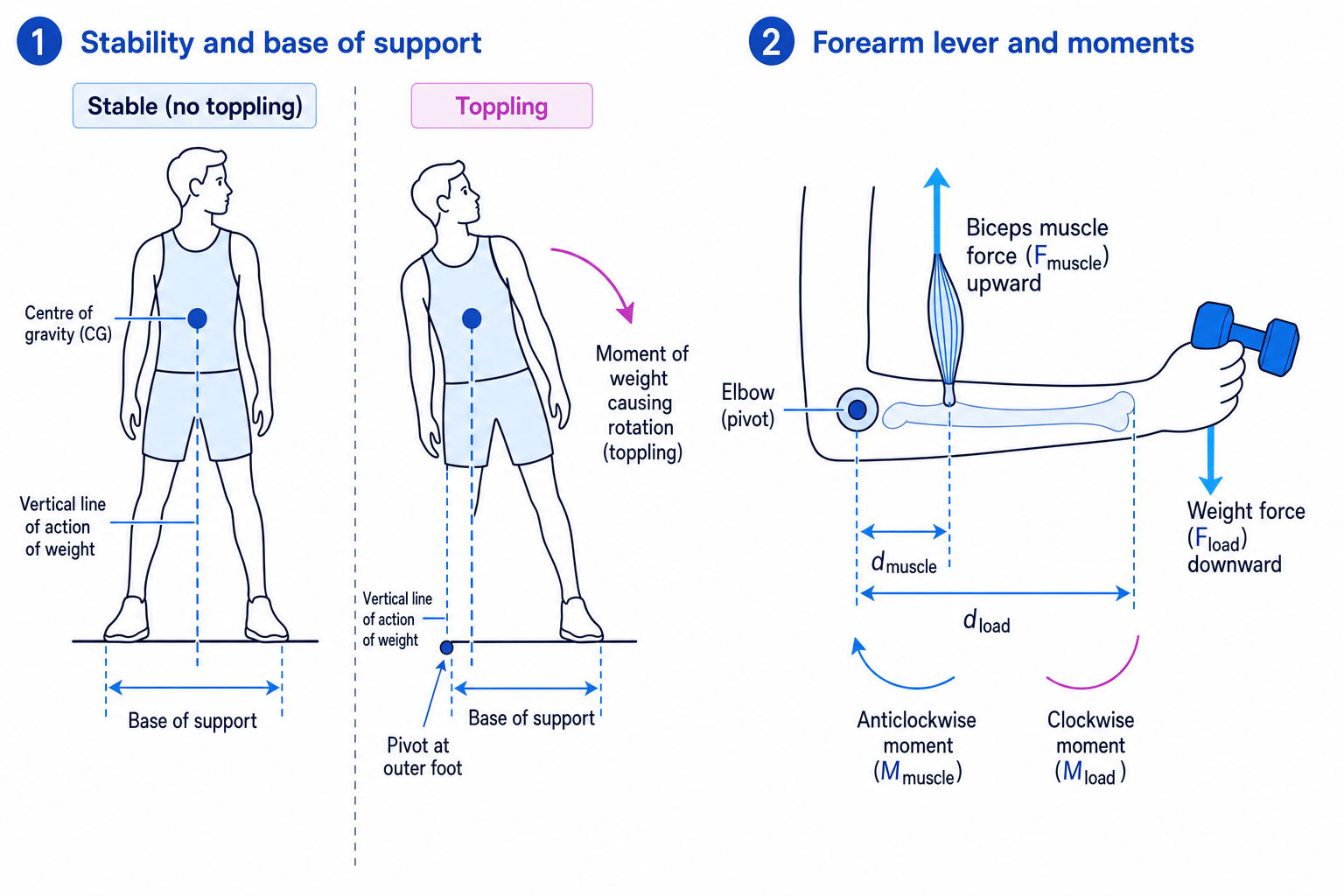
Checking whether an athlete topples
A 65 kg climber leans so that the vertical line through their centre of gravity is 0.08 m outside the outer edge of their foot. Estimate the moment of their weight about the foot.
-
The pivot is the outer edge of the foot, so the perpendicular distance from the pivot to the line of action of weight is d=0.08 md = 0.08\,\text{m}d=0.08m.
-
Calculate the weight using W=mgW = mgW=mg:
- Calculate the moment using M=FdM = FdM=Fd:
The line of action is outside the base, so this moment tends to rotate the climber and cause toppling.
Moments in muscles and sporting equipment
A moment is the turning effect of a force about a pivot. It is calculated using:
M=Fd M = Fd M=Fdwhere ddd is the perpendicular distance from the pivot to the line of action of the force.
Principle of moments
For an object in rotational equilibrium, the total clockwise moment about a pivot equals the total anticlockwise moment about the same pivot.
In the body, muscles often act very close to joints. This gives a small moment arm, so the muscle force may be much larger than the load force. In sailing, a similar idea applies: wind on the sail can produce a heeling moment, while the keel and crew position provide a restoring moment.
Finding a biceps force
A hand holds a 120 N weight. The weight acts 0.32 m from the elbow pivot. The biceps force acts 0.040 m from the elbow. Find the biceps force needed for equilibrium.
- Set anticlockwise moment equal to clockwise moment about the elbow:
- Substitute the values:
- Rearrange and calculate:
The muscle force is much larger than the load because its perpendicular distance from the pivot is much smaller.
Using the length instead of the perpendicular distance
The distance in a moment calculation is not always the length of the limb, mast or lever. It must be the shortest perpendicular distance from the pivot to the force’s line of action.
Impulse in impacts
Momentum is mass multiplied by velocity: p=mvp = mvp=mv. Since velocity has direction, momentum has direction too.
Newton’s second law can be written for a collision as:
Ft=mv−mu Ft = mv - mu Ft=mv−muHere, FFF is the average resultant force, ttt is contact time, mmm is mass, uuu is initial velocity and vvv is final velocity. The quantity FtFtFt is called impulse, measured in newton seconds (N s).
In sport, increasing contact time reduces average force for the same change in momentum. That is why a goalkeeper “gives” with the ball and why mats reduce impact forces.
Calculating the average force on a ball
A 0.16 kg ball approaches a bat at 25 m s−1^{-1}−1 and leaves in the opposite direction at 35 m s−1^{-1}−1. Contact time is 0.0050 s. Take the leaving direction as positive.
-
Assign signs to the velocities: u=−25 m s−1u = -25\,\text{m s}^{-1}u=−25m s−1 and v=+35 m s−1v = +35\,\text{m s}^{-1}v=+35m s−1.
-
Use Ft=mv−muFt = mv - muFt=mv−mu:
- Calculate FFF:
Bounces and coefficient of restitution
Coefficient of restitution
The coefficient of restitution, eee, measures how elastic a collision is:
e=relative speed after collisionrelative speed before collision e = \frac{\text{relative speed after collision}}{\text{relative speed before collision}} e=relative speed before collisionrelative speed after collisionFor a ball dropped vertically onto a fixed floor:
e=hH e = \sqrt{\frac{h}{H}} e=Hhwhere HHH is the drop height and hhh is the bounce height. A value close to 1 means a very bouncy collision; a value close to 0 means much kinetic energy has been transferred to thermal energy, sound and deformation.
Finding the coefficient of restitution from bounce height
A ball is dropped from 1.80 m and rebounds to 1.15 m. Find eee.
-
Identify the heights: H=1.80 mH = 1.80\,\text{m}H=1.80m and h=1.15 mh = 1.15\,\text{m}h=1.15m.
-
Substitute into the bounce-height equation:
- Calculate:
Rotation: moment of inertia, torque and angular momentum
Moment of inertia
The moment of inertia, III, is a measure of how difficult it is to change an object’s angular velocity about a particular axis. It depends on both mass and how far that mass is from the axis. Its unit is kg m2^{2}2.
For spheres:
Isolid sphere=25mr2Ithin spherical shell=23mr2\begin{aligned} I_{\text{solid sphere}} &= \frac{2}{5}mr^2 \\ I_{\text{thin spherical shell}} &= \frac{2}{3}mr^2 \end{aligned}Isolid sphereIthin spherical shell=52mr2=32mr2A shell has more mass further from the centre, so it has a larger moment of inertia than a solid sphere with the same mass and radius.
Angular velocity, ω\omegaω, is the rate of change of angle, in radians per second (rad s−1^{-1}−1). Angular acceleration, α\alphaα, is the rate of change of angular velocity:
α=ω2−ω1t \alpha = \frac{\omega_2 - \omega_1}{t} α=tω2−ω1A torque, τ\tauτ, is the rotational equivalent of a resultant force:
τ=Iα \tau = I\alpha τ=IαAngular momentum, LLL, is:
L=Iω L = I\omega L=Iωand rotational kinetic energy is:
rotational KE=12Iω2 \text{rotational } KE = \frac{1}{2}I\omega^2 rotational KE=21Iω2Spin-up torque and rotational kinetic energy
A thin spherical shell ball has mass 0.058 kg and radius 0.033 m. It is spun from 20 rad s−1^{-1}−1 to 110 rad s−1^{-1}−1 in 0.15 s. Find its moment of inertia, angular acceleration, torque and increase in rotational kinetic energy.
- Use the thin shell equation:
- Calculate angular acceleration:
- Use τ=Iα\tau = I\alphaτ=Iα:
- Calculate the increase in rotational kinetic energy:
Conservation of angular momentum
If the external torque on a rotating system is zero, angular momentum is conserved:
I1ω1=I2ω2 I_1\omega_1 = I_2\omega_2 I1ω1=I2ω2This explains why a diver, skater or gymnast spins faster when they tuck in: their moment of inertia decreases, so their angular velocity increases.
A diver tucking during rotation
A diver has moment of inertia 18 kg m2^{2}2 and angular velocity 1.5 rad s−1^{-1}−1. In a tuck, their moment of inertia becomes 6.0 kg m2^{2}2. Find the new angular velocity.
- Apply conservation of angular momentum:
- Substitute the values:
- Rearrange:
Conserving rotational kinetic energy in a tuck
Angular momentum is conserved only when external torque is negligible. Rotational kinetic energy does not have to stay constant because the athlete can do work using muscles while changing shape.
Energy in sporting motion
Use conservation of energy by choosing the relevant stores:
- linear kinetic energy: 12mv2\frac{1}{2}mv^221mv2;
- rotational kinetic energy: 12Iω2\frac{1}{2}I\omega^221Iω2;
- gravitational potential energy: mghmghmgh;
- elastic potential energy, for a Hooke’s law spring: 12kx2\frac{1}{2}kx^221kx2.
Energy of a rolling ball launched by a spring
A 0.40 kg solid spherical training ball of radius 0.060 m is launched up a ramp by a spring of stiffness 300 N m−1^{-1}−1, compressed by 0.10 m. At a height of 0.20 m, find the speed of the rolling ball. Assume no energy losses and rolling without slipping, so v=rωv = r\omegav=rω.
- Write the energy balance:
- For a solid sphere, substitute I=25mr2I = \frac{2}{5}mr^2I=52mr2 and ω=vr\omega = \frac{v}{r}ω=rv:
- Calculate available kinetic energy:
- Combine linear and rotational kinetic energy:
Projectile motion in sport
A projectile is an object moving through the air under gravity alone, if air resistance is ignored. Split the motion into horizontal and vertical components.
- Horizontal acceleration is zero, so horizontal velocity is constant.
- Vertical acceleration is −g-g−g, where g=9.81 m s−2g = 9.81\,\text{m s}^{-2}g=9.81m s−2.
- Use the usual constant-acceleration equations vertically, such as v=u+atv = u + atv=u+at and s=ut+12at2s = ut + \frac{1}{2}at^2s=ut+21at2.
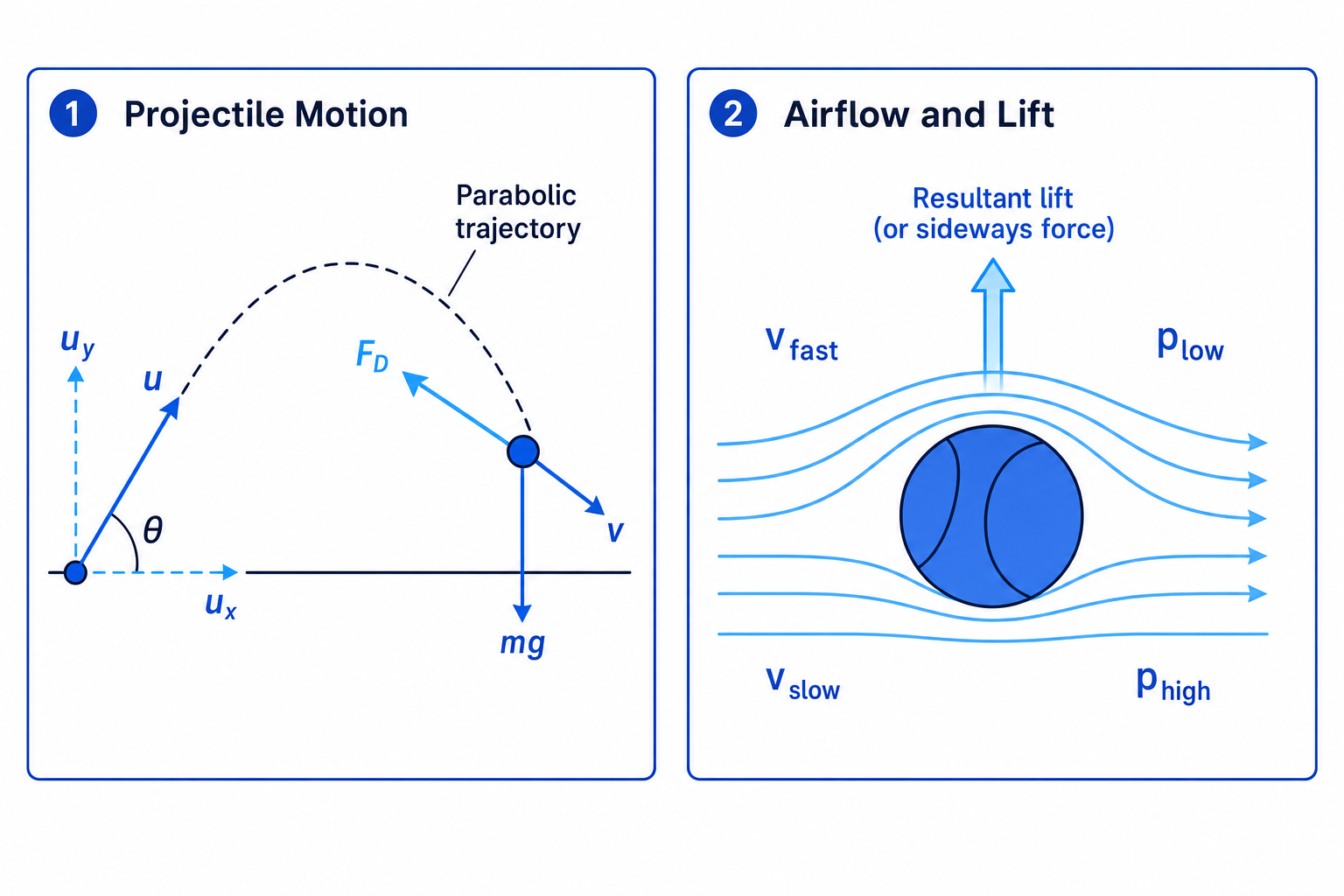
Range of a kicked ball
A ball is kicked at 20 m s−1^{-1}−1 at 35° to the horizontal and lands at the same height. Ignore air resistance. Find its time of flight and range.
- Resolve the initial velocity:
- For landing at the same height, the vertical displacement is zero:
so the non-zero time is:
t=2uyg=2(11.5)9.81 s=2.34 s t = \frac{2u_y}{g} = \frac{2(11.5)}{9.81}\,\text{s} = 2.34\,\text{s} t=g2uy=9.812(11.5)s=2.34s- Use horizontal motion for the range:
Bernoulli lift and drag
Bernoulli’s equation in this option is:
p=p0−12ρv2 p = p_0 - \frac{1}{2}\rho v^2 p=p0−21ρv2where ppp is pressure, p0p_0p0 is a constant for the flow, ρ\rhoρ is fluid density and vvv is flow speed. Faster air corresponds to lower pressure. In sport, pressure differences can help explain lift or sideways forces on balls, sails and aerofoils.
Pressure difference from Bernoulli’s equation
Air of density 1.2 kg m−3^{-3}−3 moves at 18 m s−1^{-1}−1 over one side of a ball and 12 m s−1^{-1}−1 over the other. Estimate the pressure difference.
- The faster side has lower pressure, so use:
- Substitute values:
- Calculate:
The force acts from the higher-pressure side towards the lower-pressure side.
Drag is the resistive force caused by motion through a fluid. Its magnitude is:
FD=12ρv2ACD F_D = \frac{1}{2}\rho v^2AC_D FD=21ρv2ACDwhere AAA is frontal area and CDC_DCD is the dimensionless drag coefficient.
Calculating drag on a cyclist
A cyclist has frontal area 0.45 m2^{2}2, drag coefficient 0.90, and speed 12 m s−1^{-1}−1. Air density is 1.2 kg m−3^{-3}−3. Find the drag force.
- Substitute into FD=12ρv2ACDF_D = \frac{1}{2}\rho v^2AC_DFD=21ρv2ACD:
- Calculate:
- Notice the speed dependence: if the cyclist doubled their speed, the drag force would become four times larger, assuming CDC_DCD stays constant.
Limits of the air-flow equations
Bernoulli’s equation assumes steady, idealised flow, and the drag equation uses an empirical drag coefficient. Real sports flows can be turbulent, so these models are useful approximations rather than perfect descriptions.
Practical and data skills
You may be asked to process real sporting data. Common approaches include:
- using video frames to measure projectile position against time, then plotting horizontal and vertical motion separately;
- plotting bounce height hhh against drop height HHH, where the gradient is e2e^2e2;
- plotting drag force FDF_DFD against v2v^2v2, where the gradient is 12ρACD\frac{1}{2}\rho AC_D21ρACD;
- estimating centre of gravity using balance methods or plumb lines, then discussing uncertainty in position measurements.
Graph strategy
If an equation predicts direct proportionality, plot the dependent variable against the whole changing quantity. For drag, plot FDF_DFD against v2v^2v2, not just against vvv.
In the exam
- Draw a diagram first: mark the pivot, perpendicular distances, velocity directions, centre of gravity or force directions before substituting numbers.
- Use signs carefully in impulse and projectile questions; opposite directions must have opposite signs.
- State assumptions when needed, especially “neglect air resistance”, “no external torque”, “rolling without slipping”, or “steady flow”.
Check yourself
- Why does widening an athlete’s stance make toppling less likely?
- A skater pulls their arms in and spins faster. Which quantity is conserved, and what changes?
- How could you use a graph of bounce height against drop height to find the coefficient of restitution?
