What you'll learn
- How Earth’s temperature depends on energy balance, greenhouse gases and radiation laws.
- How to compare renewable and non-renewable energy sources, in the UK and worldwide.
- How to calculate power from solar panels, wind turbines, hydroelectric schemes and insulation.
- Why fission, fusion and fuel cells matter in low-carbon energy discussions.
Core quantities you need first
Energy is measured in joules (J). Power is the rate of energy transfer, measured in watts (W), where 1 W means 1 J s⁻¹.
Power, intensity and efficiency
Power is P=ΔEΔtP=\frac{\Delta E}{\Delta t}P=ΔtΔE. Intensity is power per unit area, I=PAI=\frac{P}{A}I=AP, measured in W m⁻². Efficiency is the useful output energy or power divided by the total input energy or power.
For this option, most calculations are really about tracking where energy comes from, where it goes, and how quickly it is transferred.
Earth’s energy balance and temperature rise
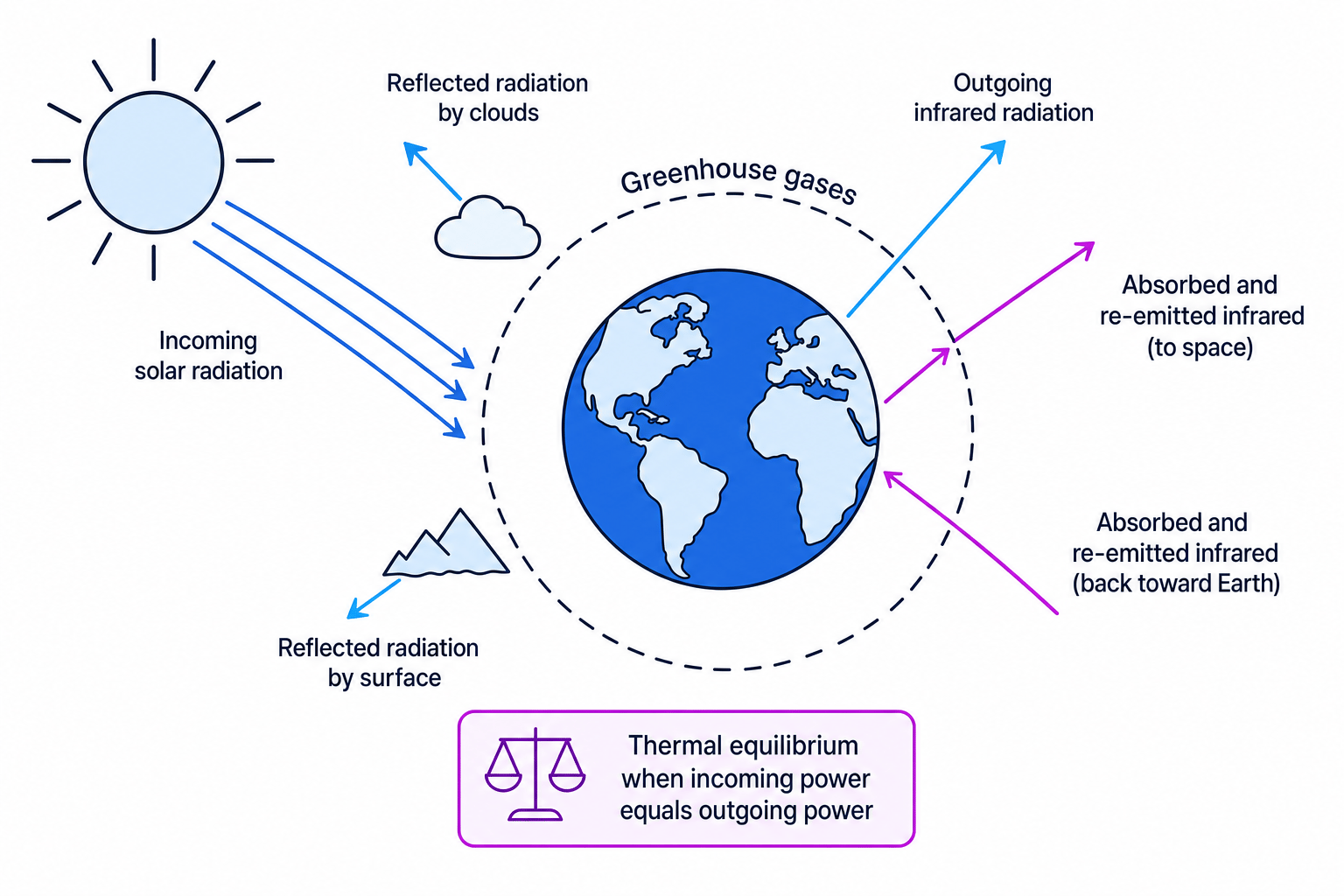
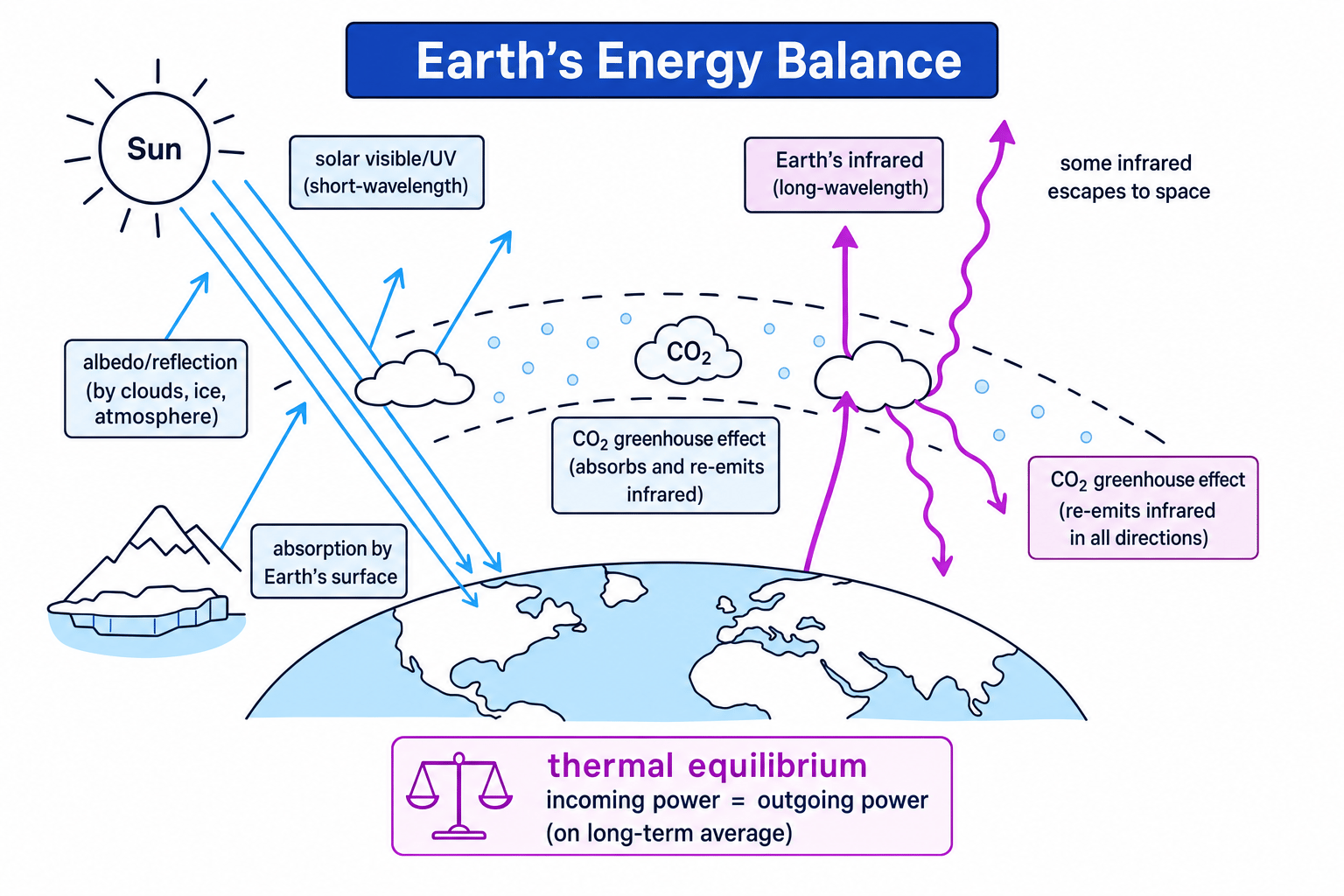
Earth receives electromagnetic radiation from the Sun. On a long-term average, Earth’s temperature is steady only if the power absorbed from the Sun equals the power radiated back into space.
If more carbon dioxide, CO₂, is added to the atmosphere, more outgoing infrared radiation is absorbed and re-emitted by greenhouse gases. This reduces the rate at which energy escapes to space, so Earth warms until a new equilibrium is reached.
Thermal equilibrium
Thermal equilibrium means incoming power equals outgoing power. Increasing greenhouse gas concentration does not “create” energy; it changes the outgoing radiation rate, so the equilibrium temperature changes.
Global energy demand matters because burning fossil fuels to meet that demand releases CO₂. Climate science uses many validated data sources: satellite radiation measurements, temperature records, ice-core CO₂ data and physical models checked against past climate behaviour.
Solar radiation, Wien’s law and Stefan-Boltzmann law
The Sun behaves approximately like a black body, which is an ideal absorber and emitter of thermal radiation. Its surface temperature is about 5800 K, so it emits strongly in the visible and near-infrared parts of the electromagnetic spectrum.
Solar radiation travels through space as electromagnetic waves. In the atmosphere and at Earth’s surface, some shorter-wavelength radiation is absorbed and re-emitted at longer wavelengths, including infrared. Earth itself, being much cooler than the Sun, re-radiates mainly infrared.
The peak wavelength is found using Wien’s law:
λmaxT=constant\lambda_{\max}T=\text{constant}λmaxT=constantwhere the constant is about 2.90×10⁻³ m K2.90 \times 10^{-3}\ \mathrm{m\,K}2.90×10⁻³ mK.
The Stefan-Boltzmann law says that the power radiated per unit area by a black body is proportional to T4T^4T4:
PA=σT4\frac{P}{A}=\sigma T^4AP=σT4where σ=5.67×10⁻⁸ W m−2 K−4\sigma=5.67 \times 10^{-8}\ \mathrm{W\,m^{-2}\,K^{-4}}σ=5.67×10⁻⁸ Wm−2K−4.
Estimating solar wavelength and surface flux
-
Use Wien’s law for a surface temperature of 5800 K:
λmax=2.90×10⁻³ m K5800 K=5.0×10⁻⁷ m\lambda_{\max}=\frac{2.90 \times 10^{-3}\ \mathrm{m\,K}}{5800\ \mathrm{K}}=5.0 \times 10^{-7}\ \mathrm{m}λmax=5800 K2.90×10−3 mK=5.0×10⁻⁷ m -
Interpret the wavelength: 5.0×10⁻⁷ m5.0 \times 10^{-7}\ \mathrm{m}5.0×10⁻⁷ m is 500 nm, in the visible region, which explains why sunlight is strongly visible.
-
Use Stefan-Boltzmann law to estimate the power radiated per square metre of the Sun’s surface:
PA=(5.67×10⁻⁸ W m−2 K−4)(5800 K)4=6.4×10⁷ W m−2\frac{P}{A}=(5.67 \times 10^{-8}\ \mathrm{W\,m^{-2}\,K^{-4}})(5800\ \mathrm{K})^4=6.4 \times 10^7\ \mathrm{W\,m^{-2}}AP=(5.67×10⁻⁸ Wm−2K−4)(5800 K)4=6.4×10⁷ Wm−2
Using Celsius in radiation laws
Wien’s law and Stefan-Boltzmann law need absolute temperature in kelvin (K), not degrees Celsius.
Sea level rise: density and Archimedes’ principle
The density equation is:
ρ=mV\rho=\frac{m}{V}ρ=Vmwhere ρ\rhoρ is density in kg m⁻³, mmm is mass in kg and VVV is volume in m³.
Archimedes’ principle states that the upthrust on a body in a fluid is equal to the weight of fluid displaced.
For a floating iceberg, the ice already displaces its own weight of seawater. When it melts, it produces roughly the same volume of water as the volume it had displaced, so floating sea ice does not significantly raise sea level in this model.
Ice on land is different: when it melts, extra water enters the ocean.
Estimating sea-level rise from land ice
-
Convert melted land ice of mass 2.0×10¹⁵ kg2.0 \times 10^{15}\ \mathrm{kg}2.0×10¹⁵ kg into water volume, using water density 1000 kg m−31000\ \mathrm{kg\,m^{-3}}1000 kgm−3:
V=mρ=2.0×10¹⁵ kg1000 kg m−3=2.0×10¹² m3V=\frac{m}{\rho}=\frac{2.0 \times 10^{15}\ \mathrm{kg}}{1000\ \mathrm{kg\,m^{-3}}}=2.0 \times 10^{12}\ \mathrm{m^3}V=ρm=1000 kgm−32.0×10¹⁵ kg=2.0×10¹² m3 -
Spread this volume over ocean area 3.6×10¹⁴ m23.6 \times 10^{14}\ \mathrm{m^2}3.6×10¹⁴ m2:
h=VA=2.0×10¹² m33.6×1014 m2=5.6×10⁻³ mh=\frac{V}{A}=\frac{2.0 \times 10^{12}\ \mathrm{m^3}}{3.6 \times 10^{14}\ \mathrm{m^2}}=5.6 \times 10^{-3}\ \mathrm{m}h=AV=3.6×10¹⁴ m22.0×1012 m3=5.6×10⁻³ m -
Convert the result: 5.6×10⁻³ m5.6 \times 10^{-3}\ \mathrm{m}5.6×10⁻³ m is 5.6 mm, so this amount of land ice would raise mean sea level by about 5.6 mm.
Melting icebergs
Do not say “all melting ice raises sea level”. Land ice raises sea level; floating icebergs are already displacing seawater.
Renewable and non-renewable energy sources
Renewable and non-renewable energy
A renewable energy source is replenished on a human timescale, such as solar, wind, tidal, wave, hydroelectric, biomass and geothermal energy. A non-renewable source is depleted when used, such as coal, oil, natural gas and nuclear fuels like uranium.
In the UK, offshore wind has developed strongly because the UK has windy coastal waters. Solar is useful but variable with weather, season and day-night cycles. Large hydroelectric power is limited by geography, but pumped storage is valuable for rapid response. Tidal power is predictable, but barrages can be expensive and environmentally disruptive.
Internationally, energy choices depend strongly on geography, infrastructure, politics and cost. Hydroelectricity is important in mountainous or high-rainfall regions. Solar power is especially attractive in sunny regions. Coal, oil and gas remain widely used because of established infrastructure and high energy density, but they produce greenhouse gases.
Solar power and photovoltaic cells
The Sun’s main energy production mechanism is the main branch of the proton-proton chain, where hydrogen nuclei ultimately fuse into helium. A simplified overall reaction is:
4 11H→ 24He+2e++2νe+energy4\,^{1}_{1}\mathrm{H}\rightarrow\,^{4}_{2}\mathrm{He}+2e^+ +2\nu_e+\text{energy}411H→24He+2e++2νe+energyA photovoltaic cell, or PV cell, is a semiconductor device that converts light energy directly into electrical energy.
For a point source radiating equally in all directions, intensity follows the inverse square law:
I=P4πr2I=\frac{P}{4\pi r^2}I=4πr2PEstimating photovoltaic output
-
Estimate the solar intensity at Earth using solar power 3.85×1026 W3.85 \times 10^{26}\ \mathrm{W}3.85×1026 W and Earth-Sun distance 1.50×10¹¹ m1.50 \times 10^{11}\ \mathrm{m}1.50×10¹¹ m:
I=3.85×1026 W4π(1.50×10¹¹ m)2=1.36×10³ W m−2I=\frac{3.85 \times 10^{26}\ \mathrm{W}}{4\pi(1.50 \times 10^{11}\ \mathrm{m})^2}=1.36 \times 10^3\ \mathrm{W\,m^{-2}}I=4π(1.50×10¹¹ m)23.85×1026 W=1.36×10³ Wm−2 -
Find the input power to a panel of area 1.6 m21.6\ \mathrm{m^2}1.6 m2:
Pin=IA=(1.36×10³ W m−2)(1.6 m2)=2.18×10³ WP_{\text{in}}=IA=(1.36 \times 10^3\ \mathrm{W\,m^{-2}})(1.6\ \mathrm{m^2})=2.18 \times 10^3\ \mathrm{W}Pin=IA=(1.36×10³ Wm−2)(1.6 m2)=2.18×10³ W -
Apply an efficiency of 20%:
Pout=0.20Pin=0.20(2.18×10³ W)=4.4×10² WP_{\text{out}}=0.20P_{\text{in}}=0.20(2.18 \times 10^3\ \mathrm{W})=4.4 \times 10^2\ \mathrm{W}Pout=0.20Pin=0.20(2.18×10³ W)=4.4×10² W
In practice, ground-level output is reduced by clouds, atmospheric absorption, panel angle, dirt, temperature and electrical losses.
Wind power
The power available from a flowing fluid is:
Pavailable=12Aρv3P_{\text{available}}=\frac{1}{2}A\rho v^3Pavailable=21Aρv3where AAA is the swept area of the turbine blades, ρ\rhoρ is air density and vvv is wind speed.
Efficiency depends on blade design, generator losses, turbulence, wind speed variation, siting, maintenance and the Betz limit: no wind turbine can extract all the kinetic energy from the air.
Calculating wind turbine power
-
Calculate swept area for blade radius 30 m:
A=πr2=π(30 m)2=2.83×10³ m2A=\pi r^2=\pi(30\ \mathrm{m})^2=2.83 \times 10^3\ \mathrm{m^2}A=πr2=π(30 m)2=2.83×10³ m2 -
Calculate available wind power for air density 1.2 kg m−31.2\ \mathrm{kg\,m^{-3}}1.2 kgm−3 and wind speed 12 m s−112\ \mathrm{m\,s^{-1}}12 ms−1:
Pavailable=12(2.83×10³ m2)(1.2 kg m−3)(12 m s−1)3=2.9×10⁶ WP_{\text{available}}=\frac{1}{2}(2.83 \times 10^3\ \mathrm{m^2})(1.2\ \mathrm{kg\,m^{-3}})(12\ \mathrm{m\,s^{-1}})^3=2.9 \times 10^6\ \mathrm{W}Pavailable=21(2.83×10³ m2)(1.2 kgm−3)(12 ms−1)3=2.9×10⁶ W -
Apply a turbine efficiency of 35%:
Pout=0.35(2.9×10⁶ W)=1.0×10⁶ WP_{\text{out}}=0.35(2.9 \times 10^6\ \mathrm{W})=1.0 \times 10^6\ \mathrm{W}Pout=0.35(2.9×10⁶ W)=1.0×10⁶ W
Wind speed matters a lot
Wind power depends on v3v^3v3, so doubling wind speed increases available power by a factor of eight, before efficiency losses.
Tidal, hydroelectric and pumped storage schemes
Tidal barrages, hydroelectric dams and pumped storage all use gravitational potential energy:
Ep=mghE_p=mghEp=mghWater loses gravitational potential energy, gains kinetic energy, turns turbines and drives generators.
A tidal barrage traps water at high tide and releases it through turbines when there is a height difference. A hydroelectric scheme uses water stored at height. Pumped storage uses spare electrical energy to pump water uphill, then releases it later at peak demand, so it is an energy store rather than a net energy source.
Calculating hydroelectric power
-
Use mass flow rate from volume flow rate Q=40 m3 s−1Q=40\ \mathrm{m^3\,s^{-1}}Q=40 m3s−1:
ΔmΔt=ρQ=(1000 kg m−3)(40 m3 s−1)=4.0×10⁴ kg s−1\frac{\Delta m}{\Delta t}=\rho Q=(1000\ \mathrm{kg\,m^{-3}})(40\ \mathrm{m^3\,s^{-1}})=4.0 \times 10^4\ \mathrm{kg\,s^{-1}}ΔtΔm=ρQ=(1000 kgm−3)(40 m3s−1)=4.0×10⁴ kgs−1 -
Calculate useful output power for height 80 m and efficiency 90%:
P=ηΔmΔtgh=0.90(4.0×10⁴ kg s−1)(9.81 m s−2)(80 m)=2.8×10⁷ WP=\eta\frac{\Delta m}{\Delta t}gh =0.90(4.0 \times 10^4\ \mathrm{kg\,s^{-1}})(9.81\ \mathrm{m\,s^{-2}})(80\ \mathrm{m}) =2.8 \times 10^7\ \mathrm{W}P=ηΔtΔmgh=0.90(4.0×10⁴ kgs−1)(9.81 ms−2)(80 m)=2.8×10⁷ W -
Compare with wind: this 28 MW output is roughly the same as 28 wind turbines each producing 1.0 MW at that moment.
Nuclear fission and fusion
In nuclear fission, a heavy nucleus such as uranium-235 absorbs a neutron and splits into smaller nuclei, releasing energy and more neutrons. These neutrons can continue a chain reaction.
Enrichment means increasing the proportion of fissile uranium-235 in nuclear fuel. Natural uranium contains only a small percentage of uranium-235.
Breeding means converting fertile material into fissile material. For example, uranium-238 can absorb neutrons and eventually form plutonium-239, which can be used as reactor fuel.
Fusion combines light nuclei, such as isotopes of hydrogen, into heavier nuclei. Sustained fusion power is difficult because the plasma must be extremely hot, dense enough, and confined long enough.
Fusion triple product
The fusion triple product is nTτnT\taunTτ, where nnn is particle number density, TTT is plasma temperature and τ\tauτ is confinement time. A high enough triple product is needed for useful sustained fusion.
Fusion challenges include plasma instability, huge input energy, neutron damage to materials, tritium supply and achieving net electrical output reliably.
Fuel cells
A fuel cell converts chemical energy directly into electrical energy while fuel and oxidant are supplied continuously. In a hydrogen fuel cell, hydrogen is supplied at the anode and oxygen at the cathode. The overall reaction is:
2H2+O2→2H2O2H_2+O_2\rightarrow 2H_2O2H2+O2→2H2OElectrons pass through the external circuit, providing useful electrical power.
Fuel cells produce no CO₂ at the point of use if hydrogen is the fuel. Their overall greenhouse gas benefit depends on how the hydrogen is produced: hydrogen from renewable electrolysis is much lower carbon than hydrogen produced from natural gas without carbon capture.
Thermal conduction and insulation
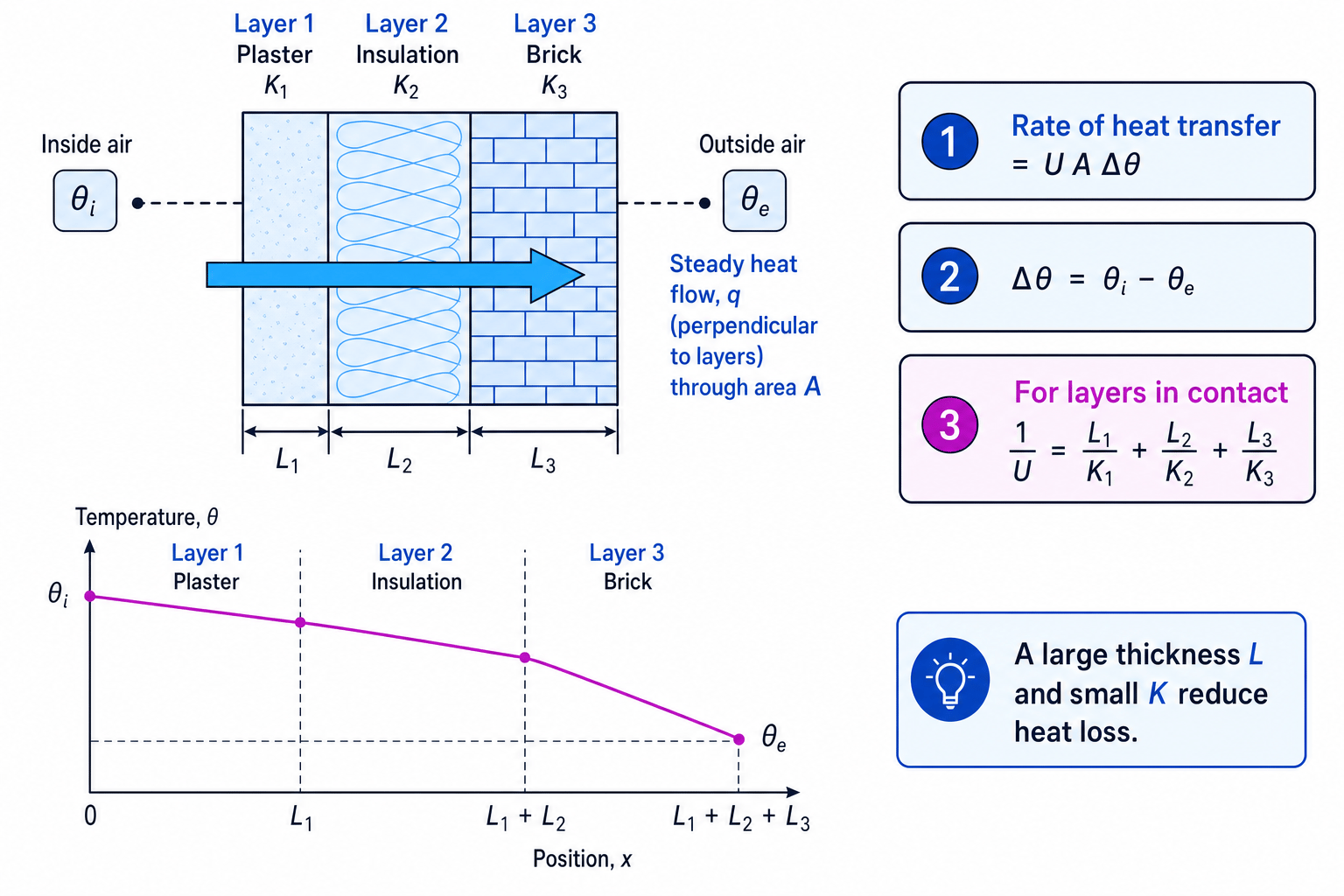
Thermal conduction is energy transfer through a material due to a temperature difference. For a flat slab:
ΔQΔt=−AKΔθΔx\frac{\Delta Q}{\Delta t}=-AK\frac{\Delta \theta}{\Delta x}ΔtΔQ=−AKΔxΔθHere ΔQΔt\frac{\Delta Q}{\Delta t}ΔtΔQ is rate of energy transfer, AAA is area, KKK is thermal conductivity, Δθ\Delta \thetaΔθ is temperature difference and Δx\Delta xΔx is thickness. The minus sign shows that heat flows from higher temperature to lower temperature.
Calculating heat loss through one layer
-
Use the magnitude of the conduction equation because the question asks for the rate of heat loss:
∣ΔQΔt∣=AKΔθΔx\left|\frac{\Delta Q}{\Delta t}\right|=AK\frac{\Delta \theta}{\Delta x}ΔtΔQ=AKΔxΔθ -
Substitute A=12 m2A=12\ \mathrm{m^2}A=12 m2, K=0.040 W m−1 K−1K=0.040\ \mathrm{W\,m^{-1}\,K^{-1}}K=0.040 Wm−1K−1, Δθ=18 K\Delta \theta=18\ \mathrm{K}Δθ=18 K and Δx=0.20 m\Delta x=0.20\ \mathrm{m}Δx=0.20 m:
∣ΔQΔt∣=(12 m2)(0.040 W m−1 K−1)18 K0.20 m=43 W\left|\frac{\Delta Q}{\Delta t}\right|=(12\ \mathrm{m^2})(0.040\ \mathrm{W\,m^{-1}\,K^{-1}})\frac{18\ \mathrm{K}}{0.20\ \mathrm{m}}=43\ \mathrm{W}ΔtΔQ=(12 m2)(0.040 Wm−1K−1)0.20 m18 K=43 W -
Interpret the result: the insulation still loses energy, but only at about 43 J every second.
For buildings, heat loss through parallel surfaces is often written using a U-value:
ΔQΔt=UAΔθ\frac{\Delta Q}{\Delta t}=UA\Delta \thetaΔtΔQ=UAΔθA lower U-value means better insulation. For layers in contact, ignoring surface resistances:
1U=x1K1+x2K2+x3K3+⋯\frac{1}{U}=\frac{x_1}{K_1}+\frac{x_2}{K_2}+\frac{x_3}{K_3}+\cdotsU1=K1x1+K2x2+K3x3+⋯Calculating heat loss through layered insulation
-
Add the layer terms for plaster, insulation and brick:
1U=0.012 m0.50 W m−1 K−1+0.080 m0.040 W m−1 K−1+0.100 m0.77 W m−1 K−1=2.15 m2 K W−1\frac{1}{U}=\frac{0.012\ \mathrm{m}}{0.50\ \mathrm{W\,m^{-1}\,K^{-1}}} +\frac{0.080\ \mathrm{m}}{0.040\ \mathrm{W\,m^{-1}\,K^{-1}}} +\frac{0.100\ \mathrm{m}}{0.77\ \mathrm{W\,m^{-1}\,K^{-1}}} =2.15\ \mathrm{m^2\,K\,W^{-1}}U1=0.50 Wm−1K−10.012 m+0.040 Wm−1K−10.080 m+0.77 Wm−1K−10.100 m=2.15 m2KW−1 -
Invert to find the U-value:
U=12.15 m2 K W−1=0.465 W m−2 K−1U=\frac{1}{2.15\ \mathrm{m^2\,K\,W^{-1}}}=0.465\ \mathrm{W\,m^{-2}\,K^{-1}}U=2.15 m2KW−11=0.465 Wm−2K−1 -
Calculate heat loss through area 50 m250\ \mathrm{m^2}50 m2 with temperature difference 20 K:
ΔQΔt=UAΔθ=(0.465 W m−2 K−1)(50 m2)(20 K)=4.7×10² W\frac{\Delta Q}{\Delta t}=UA\Delta \theta =(0.465\ \mathrm{W\,m^{-2}\,K^{-1}})(50\ \mathrm{m^2})(20\ \mathrm{K}) =4.7 \times 10^2\ \mathrm{W}ΔtΔQ=UAΔθ=(0.465 Wm−2K−1)(50 m2)(20 K)=4.7×10² W
Investigating insulation practically
To measure thermal conductivity, use steady-state heating, measure heater power, temperatures, area and thickness, then plot heat transfer rate per area against temperature gradient. The gradient gives KKK.
Adding U-values for layers
For layers in contact through the same area, do not add U-values directly. Add the terms x/Kx/Kx/K, then invert to find UUU.
In the exam
- Start every energy question by identifying the energy store or power flow: solar intensity, kinetic energy of wind, gravitational potential energy of water, or heat conduction.
- Check units carefully: temperatures for radiation laws must be in K, areas in m², densities in kg m⁻³ and powers in W.
- For evaluation questions, compare more than “renewable versus non-renewable”: discuss intermittency, reliability, lifecycle CO₂, geography, cost, environmental impact and storage.
Check yourself
- Why does melting land ice raise sea level, while melting floating icebergs does not in the simple Archimedes model?
- If wind speed doubles, what happens to the available wind power before efficiency losses?
- In a layered wall, how can you tell which layer has the greatest effect on reducing heat loss?