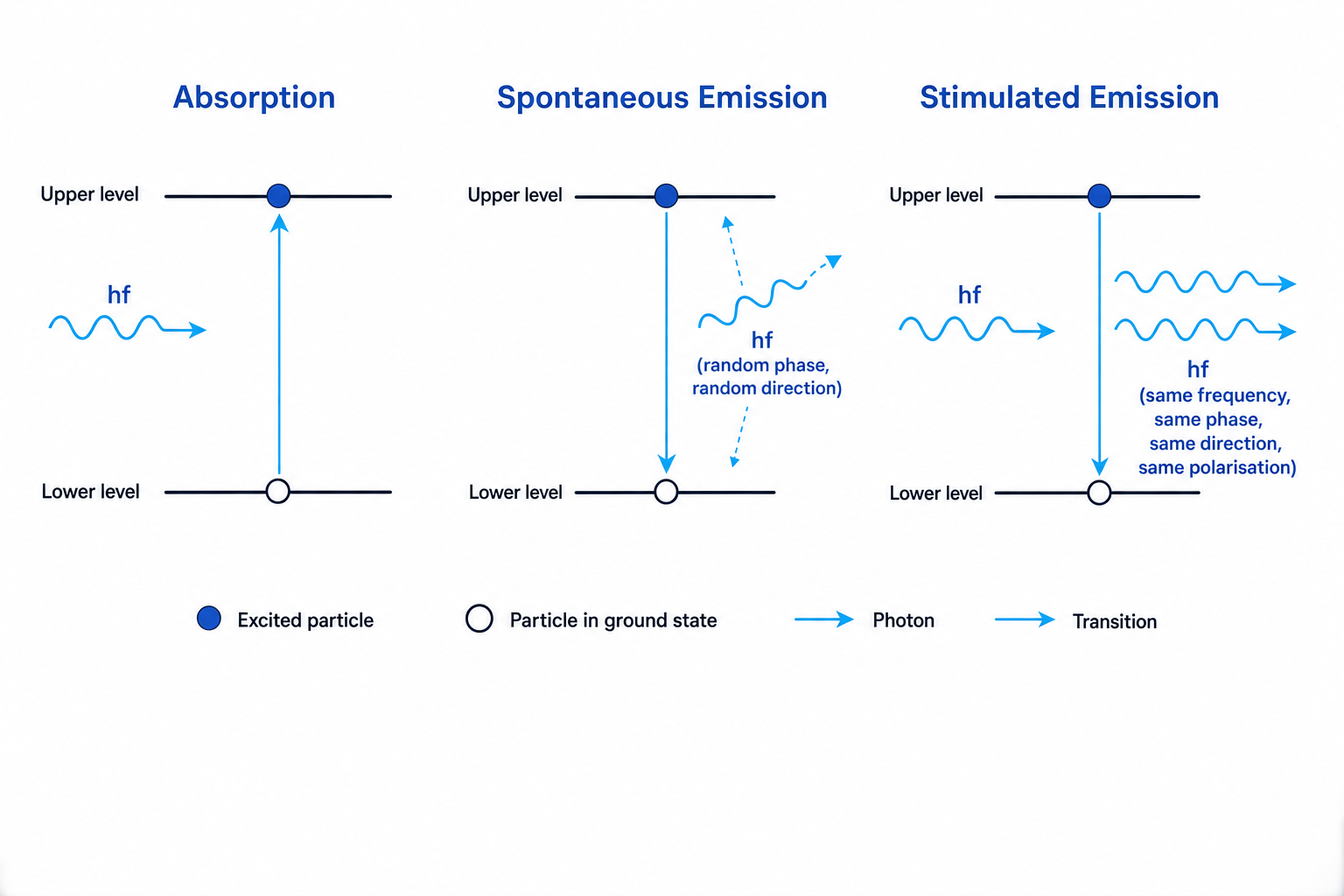
What you'll learn
- How stimulated emission produces coherent light.
- Why a population inversion is essential for laser action.
- How 3-level and 4-level systems achieve population inversion.
- The structure, benefits, risks, and uses of lasers, especially semiconductor lasers.
Starting point: photons and energy levels
A photon is a discrete packet of electromagnetic radiation. Light does not exchange energy continuously with atoms; it is emitted or absorbed in photon-sized amounts.
An energy level is one of the allowed energies an electron, atom, ion, molecule, or semiconductor carrier can have. The lowest energy level is the ground state. A higher energy level is an excited state.
If a particle drops from a higher energy level to a lower one, it can emit a photon. The photon energy equals the energy difference:
ΔE=Eupper−Elower=hf=hcλ\Delta E = E_{\text{upper}} - E_{\text{lower}} = hf = \frac{hc}{\lambda}ΔE=Eupper−Elower=hf=λhcwhere hhh is the Planck constant, fff is frequency, ccc is the speed of light in a vacuum, and λ\lambdaλ is wavelength.
Calculating a laser wavelength
A laser transition has energy gap ΔE=3.14×10⁻¹⁹ J\Delta E = 3.14 \times 10^{-19}\ \text{J}ΔE=3.14×10⁻¹⁹ J. Calculate the wavelength of the emitted light.
-
Combine the photon-energy equation with the wave equation: ΔE=hf\Delta E = hfΔE=hf and c=fλc = f\lambdac=fλ, so λ=hcΔE\lambda = \frac{hc}{\Delta E}λ=ΔEhc.
-
Substitute the constants and the energy gap:
λ=(6.63×10⁻³⁴ J s)(3.00×10⁸ m s−1)3.14×10⁻¹⁹ J=6.33×10⁻⁷ m\lambda = \frac{(6.63 \times 10^{-34}\ \text{J s})(3.00 \times 10^{8}\ \text{m s}^{-1})}{3.14 \times 10^{-19}\ \text{J}} = 6.33 \times 10^{-7}\ \text{m}λ=3.14×10⁻¹⁹ J(6.63×10⁻³⁴ J s)(3.00×10⁸ m s−1)=6.33×10⁻⁷ m -
Convert to a more suitable unit: 6.33×10⁻⁷ m=633 nm6.33 \times 10^{-7}\ \text{m} = 633\ \text{nm}6.33×10⁻⁷ m=633 nm, which is red visible light.
Absorption, spontaneous emission, and stimulated emission
There are three key processes you need to distinguish.
Absorption happens when a photon with exactly the right energy is absorbed, raising a particle from a lower energy level to a higher one.
Spontaneous emission happens when an excited particle drops to a lower level without being triggered. The emitted photon has a random direction and phase.
Stimulated emission happens when an incoming photon causes an excited particle to drop to a lower level. The emitted photon is identical to the incoming photon in frequency, direction, phase, and polarisation.
Coherence
Phase describes where a wave is in its oscillation cycle. Coherent waves have a constant phase difference. Laser light is coherent because stimulated emission produces photons that match the stimulating photons.
Stimulated emission is the laser process
In stimulated emission, one photon enters and two matching photons leave. Repeating this many times causes light amplification.
Coherent does not just mean one colour
Coherent light has a fixed phase relationship. Laser light is often also very nearly monochromatic, meaning it has a very narrow range of wavelengths, but that is not the full meaning of coherence.
Population inversion
In a normal material at ordinary temperatures, there are more particles in lower energy levels than in higher ones. So an incoming photon is more likely to be absorbed than to cause stimulated emission.
For a laser to amplify light, stimulated emission must dominate absorption. That requires a population inversion.
Population inversion
A population inversion means there are more particles in the upper laser level than in the lower laser level. In the usual notation this is written as N2>N1N_2 > N_1N2>N1.
Deciding whether there is optical gain
For a particular transition, the upper laser level contains 2.4×10¹⁸ m−32.4 \times 10^{18}\ \text{m}^{-3}2.4×10¹⁸ m−3 particles and the lower laser level contains 1.5×10¹⁸ m−31.5 \times 10^{18}\ \text{m}^{-3}1.5×10¹⁸ m−3 particles. Decide whether the material can amplify light on this transition.
-
Compare the populations of the upper and lower laser levels: optical gain needs Nupper>NlowerN_{\text{upper}} > N_{\text{lower}}Nupper>Nlower.
-
Calculate the population difference:
ΔN=2.4×10¹⁸ m−3−1.5×10¹⁸ m−3=9.0×10¹⁷ m−3\Delta N = 2.4 \times 10^{18}\ \text{m}^{-3} - 1.5 \times 10^{18}\ \text{m}^{-3} = 9.0 \times 10^{17}\ \text{m}^{-3}ΔN=2.4×10¹⁸ m−3−1.5×10¹⁸ m−3=9.0×10¹⁷ m−3 -
The difference is positive, so stimulated emission is more likely than absorption overall. The material can provide optical gain if mirror and other losses are small enough.
Why a two-level system usually cannot work
A two-level system has just a lower level and an upper level involved. Pumping raises particles from the lower level to the upper level by absorption.
The problem is that the same photons that pump particles upward can also stimulate particles to come back down. As the upper level fills, downward stimulated emission becomes more likely. At best, the two levels tend towards equal populations, not a true inversion.
Two levels are not enough
A normal two-level laser cannot maintain N2>N1N_2 > N_1N2>N1, so it cannot usually produce sustained laser action.
Pumping: supplying energy to make inversion possible
Pumping is the process of supplying energy to the laser medium to move particles into excited states. The pump may be electrical, optical, chemical, or another energy source.
The purpose of pumping is not just to “make photons”. Its purpose is to create and maintain a population inversion.
A metastable state is an excited state with a relatively long lifetime. Particles can build up there, which helps produce population inversion. A non-radiative transition is a drop between energy levels where the energy is transferred to the material as internal energy rather than emitted as the laser photon.
Three-level and four-level laser systems
The diagrams below show why extra energy levels make laser action practical.
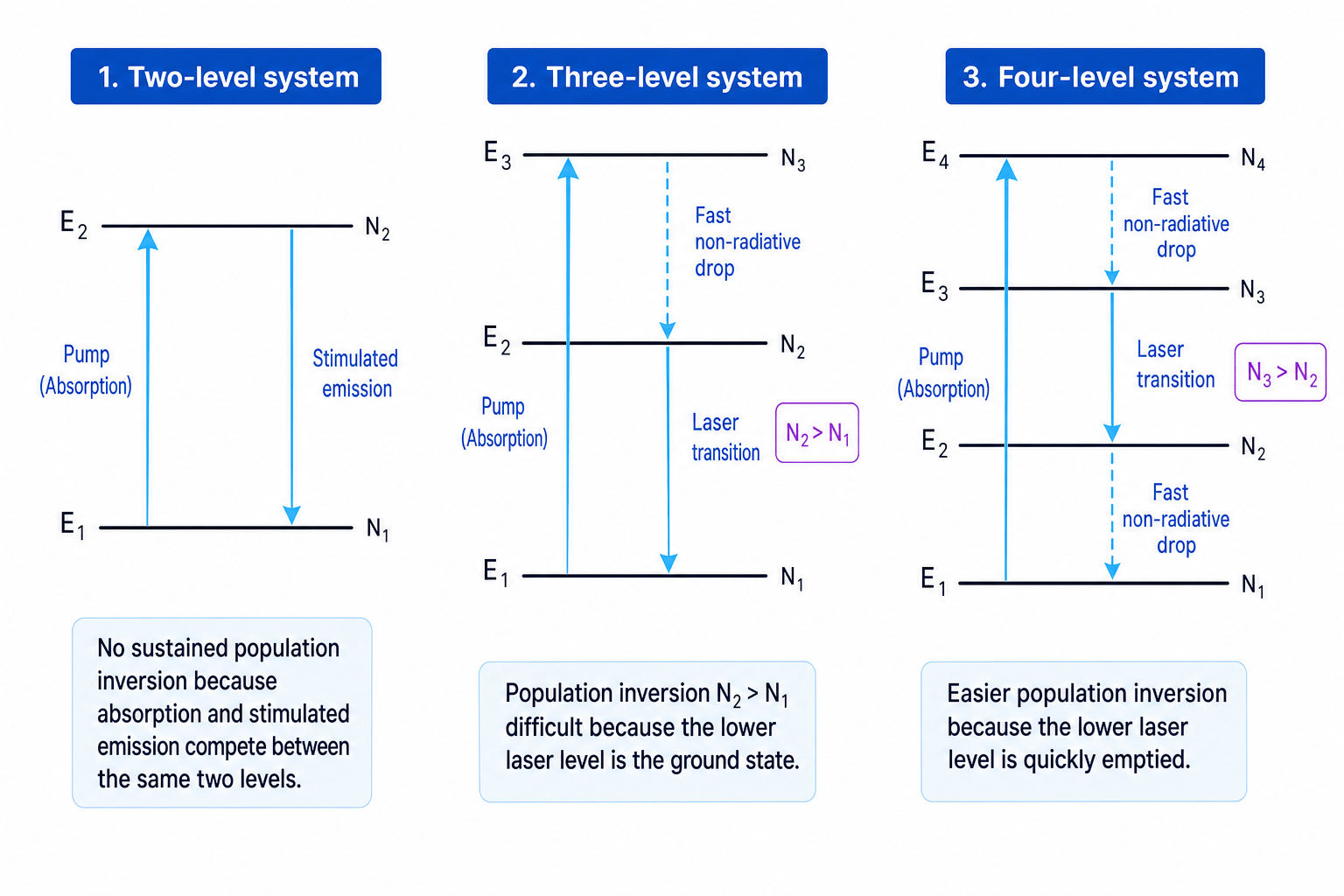
Three-level system
In a three-level laser, particles are pumped from the ground state to a high excited state. They then quickly fall by a non-radiative transition to a metastable level. The laser transition is from this metastable level back down to the ground state.
This can produce a population inversion, but it is difficult because the lower laser level is the ground state. Since the ground state is normally heavily populated, a large fraction of the particles must be pumped out of it.
Four-level system
In a four-level laser, pumping raises particles to a high level. They quickly fall to a metastable upper laser level. The laser transition then takes particles to a lower laser level, which is quickly emptied by another non-radiative transition.
This is easier because the lower laser level does not stay populated. Therefore it is much easier to maintain the required upper-level population being greater than the lower-level population.
Three-level versus four-level
A four-level laser usually has a lower threshold because the lower laser level is rapidly emptied. The threshold is the minimum pump power needed for laser gain to exceed losses.
Structure of a typical laser
A typical laser has an amplifying medium between two mirrors. The amplifying medium is the material where stimulated emission occurs. The two mirrors form an optical cavity, meaning photons are reflected back and forth through the medium many times.
One mirror is highly reflecting. The other is partially transmitting, so some of the amplified light escapes as the laser output.
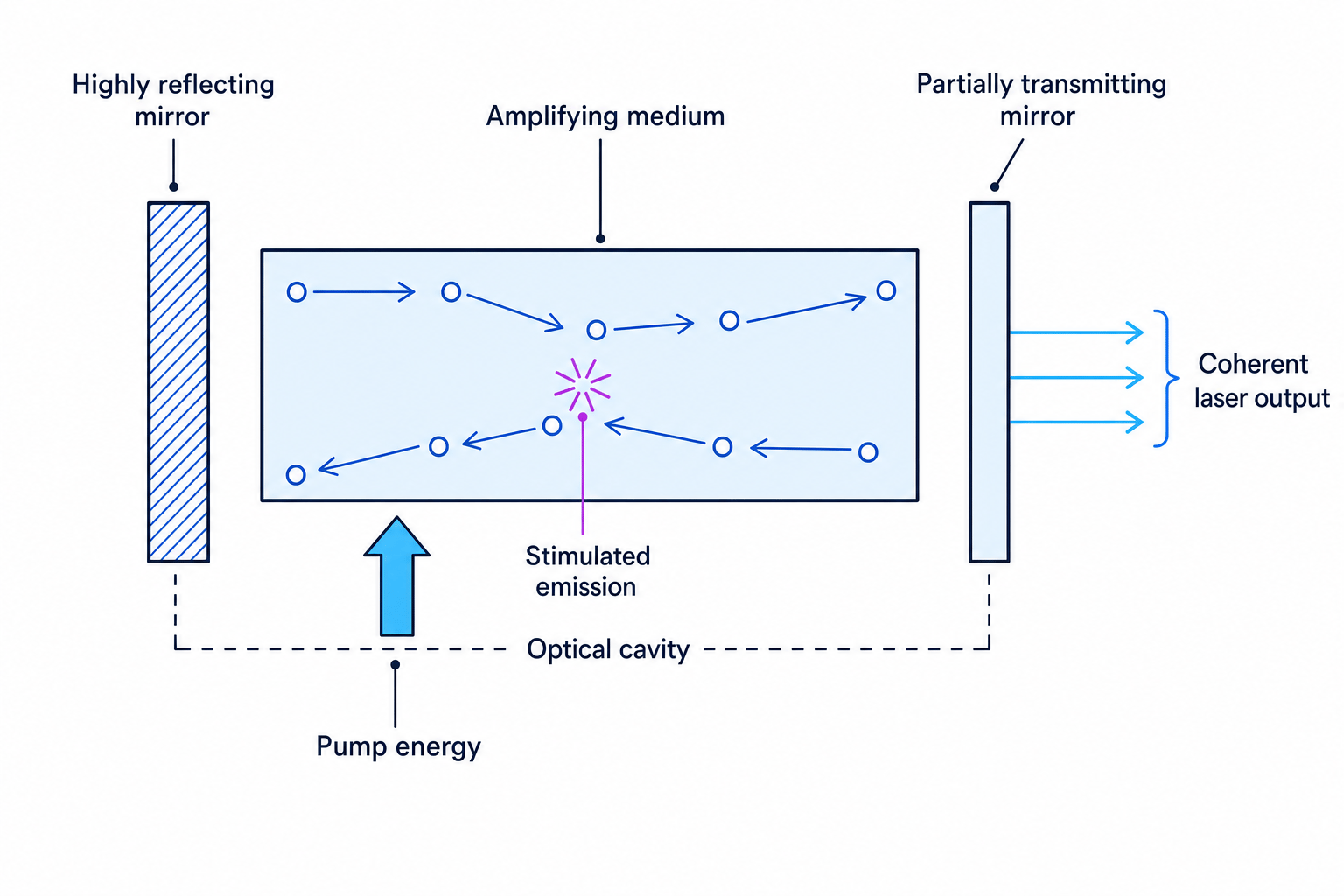
The sequence is:
- Pump energy creates a population inversion in the amplifying medium.
- A photon travelling along the cavity stimulates emission from excited particles.
- The mirrors reflect photons back through the medium, causing more stimulated emission.
- The partially transmitting mirror allows a narrow coherent output beam to leave.
The beam is often collimated, meaning its rays are nearly parallel, so it spreads out only slowly.
The mirrors do not create the photon energy
The energy of each laser photon comes from the energy-level transition. The mirrors provide feedback so photons pass through the amplifying medium repeatedly and the light is amplified.
Laser safety
Even a low-power laser can be dangerous to the eye because the beam is narrow and the eye can focus it onto a small area of the retina. Never view a laser beam directly.
Semiconductor lasers
A semiconductor is a material whose electrical conductivity is between that of a conductor and an insulator. A semiconductor laser, often called a laser diode, is pumped by an electric current through a junction. Electrons and holes recombine and emit photons; stimulated emission then produces laser light.
Semiconductor lasers are important because they are:
- small;
- cheap to manufacture;
- far more efficient than many other laser types;
- easy to switch on and off rapidly;
- suitable for electronic control.
They are used in CD and DVD players, barcode scanners, laser printers, and telecommunications through optical fibres.
Estimating laser diode efficiency
A semiconductor laser operates at a potential difference of 2.1 V with a current of 40 mA. It emits 25 mW of optical power. Calculate its efficiency.
-
Convert the current and output power into SI units: 40 mA=0.040 A40\ \text{mA} = 0.040\ \text{A}40 mA=0.040 A and 25 mW=0.025 W25\ \text{mW} = 0.025\ \text{W}25 mW=0.025 W.
-
Calculate the electrical input power using P=VIP = VIP=VI:
Pin=2.1 V×0.040 A=0.084 WP_{\text{in}} = 2.1\ \text{V} \times 0.040\ \text{A} = 0.084\ \text{W}Pin=2.1 V×0.040 A=0.084 W -
Calculate the efficiency:
η=PoutPin=0.025 W0.084 W=0.30\eta = \frac{P_{\text{out}}}{P_{\text{in}}} = \frac{0.025\ \text{W}}{0.084\ \text{W}} = 0.30η=PinPout=0.084 W0.025 W=0.30The efficiency is about 30%.
A common practical graph is optical output power against diode current. Below threshold, output is weak and mostly spontaneous emission. Above threshold, laser output rises much more strongly as stimulated emission dominates.
In the exam
- Link stimulated emission to coherence: the emitted photon has the same frequency, phase, direction, and polarisation as the stimulating photon.
- For population inversion questions, compare the upper and lower laser levels and state N2>N1N_2 > N_1N2>N1 clearly.
- For level diagrams, identify the pump transition, the metastable upper laser level, and any fast non-radiative transitions.
- For semiconductor lasers, remember the specification advantages: small, cheap, efficient, and used in CDs, DVDs, and telecommunications.
Check yourself
- Why does stimulated emission produce coherent light whereas spontaneous emission does not?
- Why is a population inversion not usually possible in a two-level system?
- In a four-level laser, why does rapidly emptying the lower laser level make laser action easier?