

What you'll learn
- Describe motion using displacement, speed, velocity and acceleration.
- Use displacement-time, speed-time and velocity-time graphs quantitatively.
- Derive and apply the constant-acceleration equations for straight-line motion.
- Explain freefall, terminal velocity, and projectile motion using independent components.
What kinematics is
Kinematics is the description of motion without asking what force caused it. In this topic, you mainly deal with rectilinear motion, which means motion along a straight line, and projectile motion, where an object moves freely under gravity after being launched.
A scalar has size only. A vector has size and direction.
Core motion quantities
- Distance is the total path length travelled. It is a scalar, measured in metres (m).
- Displacement, sss, is the change in position from start to finish in a stated direction. It is a vector, measured in metres (m).
- Mean speed is total distance divided by total time.
- Velocity is the rate of change of displacement. It is a vector, measured in metres per second (m s⁻¹).
- Mean velocity is displacement divided by time.
- Acceleration, aaa, is the rate of change of velocity, measured in metres per second squared (m s⁻²):
Instantaneous means “at one instant”. A speedometer gives instantaneous speed; a light gate can measure instantaneous speed by timing how long a card of known length blocks the beam.
Mean speed and mean velocity
A cyclist travels 120 m east, then 40 m west, in a total time of 20.0 s.
- The total distance is 120 m+40 m=160 m120\,\text{m}+40\,\text{m}=160\,\text{m}120m+40m=160m, so the mean speed is:
-
The displacement is 120 m−40 m=80 m120\,\text{m}-40\,\text{m}=80\,\text{m}120m−40m=80m east.
-
The mean velocity is:
Distance is not displacement
If an object turns around, its distance keeps increasing, but its displacement may decrease or even become zero.
Motion graphs
Graphs let you turn motion into gradients and areas. Always check what is on each axis before choosing a method.
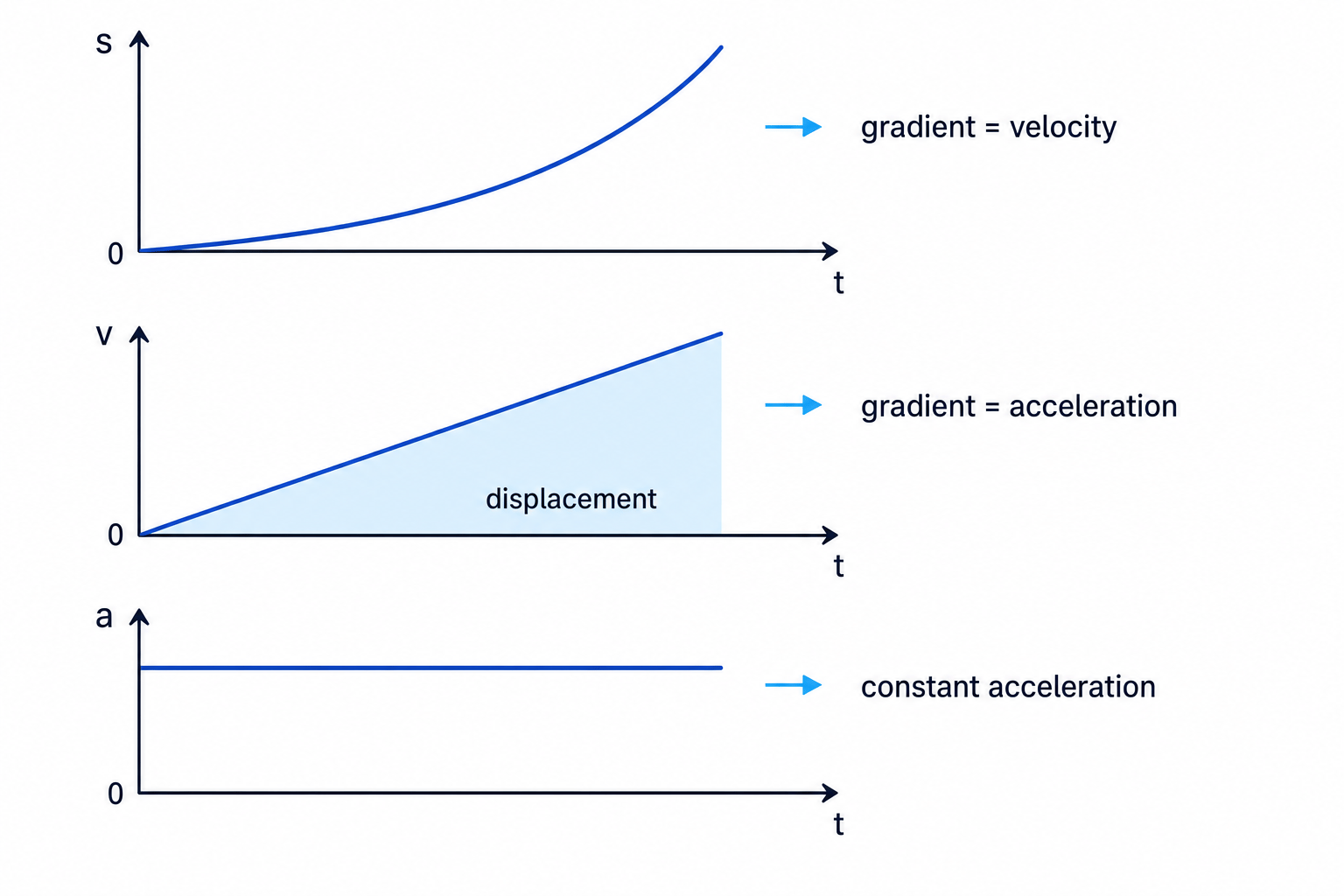
The graphs below show the links between displacement, velocity and acceleration for motion with constant positive acceleration.
Displacement-time graphs
On a displacement-time graph, the gradient gives velocity:
gradient=ΔsΔt=v\text{gradient}=\frac{\Delta s}{\Delta t}=vgradient=ΔtΔs=vA straight line means constant velocity. A curve means changing velocity. For non-uniform motion, draw a tangent to the curve at the instant you care about; the tangent’s gradient is the instantaneous velocity.
Speed-time and velocity-time graphs
On a velocity-time graph, the gradient gives acceleration:
gradient=ΔvΔt=a\text{gradient}=\frac{\Delta v}{\Delta t}=agradient=ΔtΔv=aThe area under a velocity-time graph gives displacement. Area below the time axis counts as negative displacement.
A speed-time graph cannot show direction, so its area gives distance travelled, not displacement. For curved graphs, estimate area using trapezia or count squares carefully.
Gradient and area links
Gradient takes you “forward” through the quantities: displacement-time to velocity, then velocity-time to acceleration. Area under a velocity-time graph takes you back to displacement.
Using a velocity-time graph
A train’s velocity increases uniformly from 4.0 m s⁻¹ to 16.0 m s⁻¹ in 6.0 s. Find its acceleration and displacement.
- The acceleration is the gradient of the velocity-time graph:
- The displacement is the trapezium area under the graph:
- The velocity is always positive, so the displacement is 60 m in the positive direction.
Uniformly accelerated motion
Uniform acceleration means constant acceleration. The velocity-time graph is a straight line, so the standard equations can be derived from gradient and area.
Let:
- uuu be initial velocity
- vvv be final velocity
- aaa be acceleration
- sss be displacement
- ttt be time
From the velocity-time graph:
- Gradient gives a=v−uta=\frac{v-u}{t}a=tv−u, so:
- Area under the graph is a trapezium, so:
- Combining these gives the other constant-acceleration equations:
Only for constant acceleration
These equations apply to straight-line motion with constant acceleration. If acceleration changes, use graph gradients/areas or a smaller time interval model instead.
Stopping under constant deceleration
A car travelling at 27 m s⁻¹ brakes uniformly at −6.0 m s−2-6.0\,\text{m s}^{-2}−6.0m s−2. Calculate the braking distance.
- Time is not needed, so choose:
- Substitute v=0 m s−1v=0\,\text{m s}^{-1}v=0m s−1, u=27 m s−1u=27\,\text{m s}^{-1}u=27m s−1 and a=−6.0 m s−2a=-6.0\,\text{m s}^{-2}a=−6.0m s−2:
- Rearrange for sss:
Stopping-distance data
For speed-limit or road-safety data, convert speeds to m s⁻¹ before using equations. With the same braking acceleration, braking distance is proportional to u2u^2u2, so a small speed increase can produce a much larger stopping distance.
Falling in a gravitational field
Near Earth’s surface, an object in freefall has acceleration ggg, about 9.81 m s−29.81\,\text{m s}^{-2}9.81m s−2 downward. If upward is chosen as positive, then a falling object has a=−ga=-ga=−g.
Without air resistance, all objects fall with the same acceleration, regardless of mass. With air resistance, the motion changes because drag increases as speed increases.
Terminal velocity is the constant velocity reached when the resistive force equals the weight, so the resultant force is zero and acceleration is zero.
Explaining terminal velocity
A skydiver jumps from rest and eventually reaches terminal velocity before opening the parachute.
-
Just after jumping, speed is small, so air resistance is small. Weight is larger than drag, giving a downward resultant force and downward acceleration.
-
As speed increases, air resistance increases. The resultant force decreases, so the acceleration decreases.
-
At terminal velocity, air resistance equals weight. The resultant force is zero, so velocity remains constant.
Specified practical: measuring ggg by freefall
A common method uses an electromagnet, a steel ball and an electronic timer. Electronic timing is much better than a hand stopwatch because human reaction time would be a large source of uncertainty.
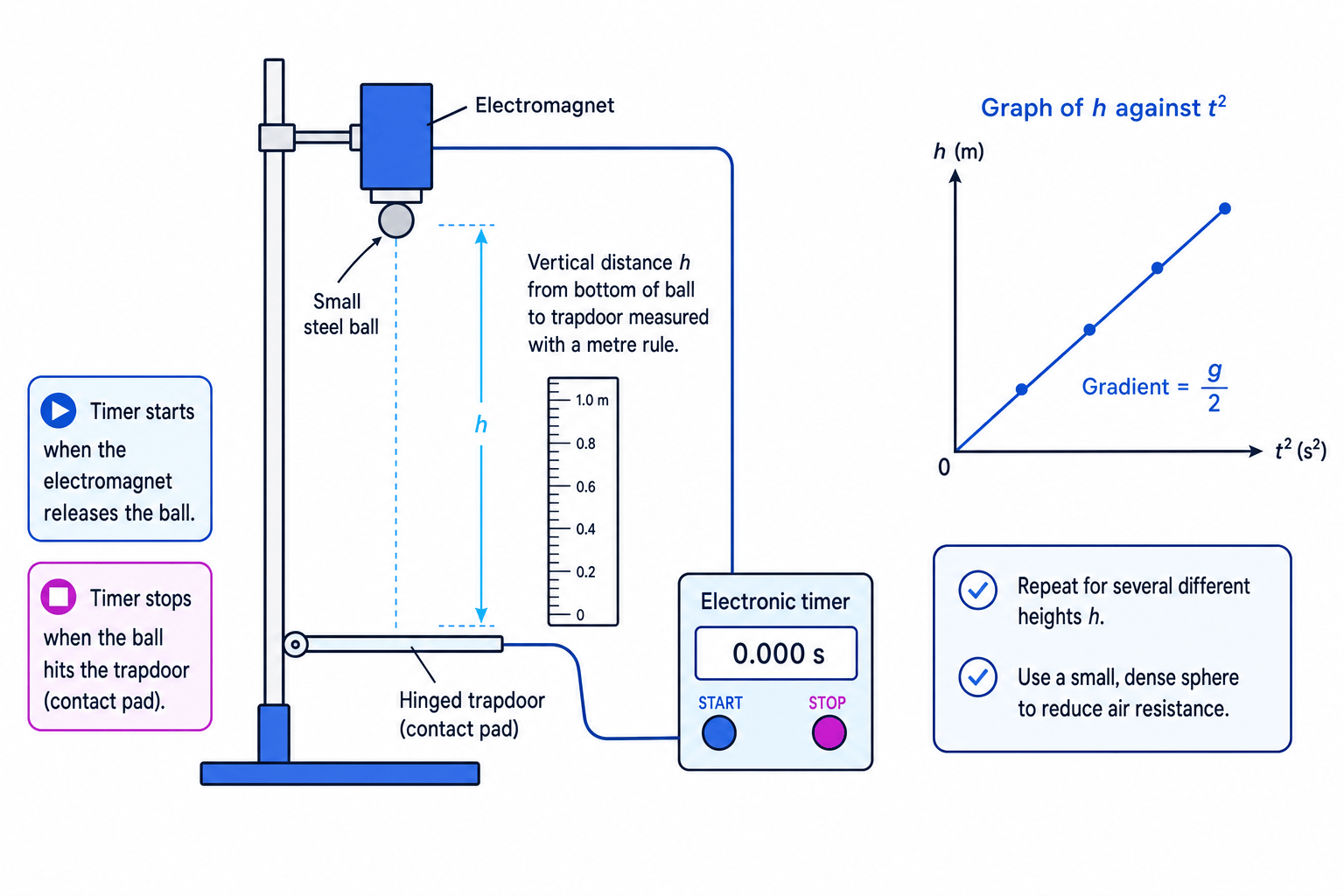
Measure the height hhh from the bottom of the ball to the contact pad. Release the ball from rest; the timer starts when the electromagnet releases it and stops when the ball hits the pad.
For freefall from rest:
h=12gt2h=\frac{1}{2}gt^2h=21gt2So a graph of hhh against t2t^2t2 should be a straight line through the origin, with:
gradient=g2\text{gradient}=\frac{g}{2}gradient=2gTo improve the investigation, repeat each height, use a small dense ball to reduce air resistance, measure height carefully with a metre rule, and use a best-fit line rather than one pair of raw readings.
Finding g from a freefall graph
A best-fit line on a graph of hhh against t2t^2t2 passes through (0.0200 s2, 0.098 m)(0.0200\,\text{s}^2,\ 0.098\,\text{m})(0.0200s2, 0.098m) and (0.100 s2, 0.490 m)(0.100\,\text{s}^2,\ 0.490\,\text{m})(0.100s2, 0.490m).
- Calculate the gradient:
- Use gradient=g2\text{gradient}=\frac{g}{2}gradient=2g:
- This is close to 9.81 m s−29.81\,\text{m s}^{-2}9.81m s−2, so the result is reasonable; remaining differences could come from air resistance, timing delay or measuring hhh incorrectly.
Graph quality check
If the hhh against t2t^2t2 graph has a clear non-zero intercept, suspect a systematic error such as a timing offset or measuring height from the wrong point.
Projectile motion
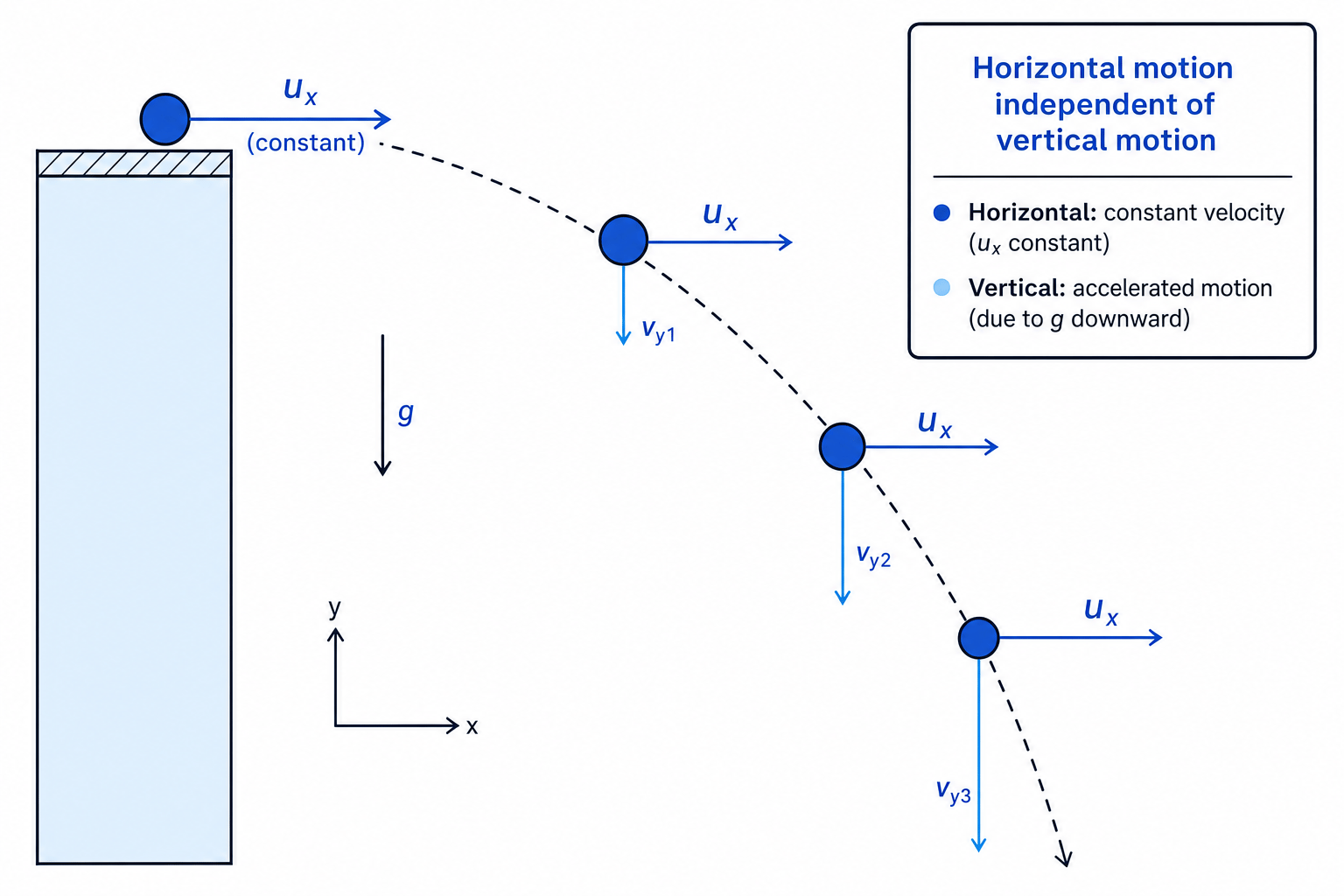
A projectile moving freely under gravity has two independent components of motion:
- horizontal motion: constant velocity, if air resistance is neglected
- vertical motion: uniform acceleration due to gravity
The same time ttt applies to both components, but the equations are used separately in each direction.
For horizontal motion:
ax=0,x=uxta_x=0,\qquad x=u_x tax=0,x=uxtFor vertical motion, if upward is positive:
ay=−ga_y=-gay=−gThe path is curved because the object has uniform velocity in one direction and uniform acceleration in the perpendicular direction.
Horizontal launch from a cliff
A ball is launched horizontally at 8.0 m s⁻¹ from a cliff 20 m high. Ignore air resistance. Find the time to hit the ground and the horizontal range.
- Use vertical motion to find time. With upward positive, sy=−20 ms_y=-20\,\text{m}sy=−20m, uy=0 m s−1u_y=0\,\text{m s}^{-1}uy=0m s−1 and ay=−9.81 m s−2a_y=-9.81\,\text{m s}^{-2}ay=−9.81m s−2:
- Solve for ttt:
- Use horizontal motion to find range:
Mixing components
Do not put the horizontal velocity into a vertical equation. Resolve first, then use one set of equations horizontally and another vertically.
In the exam
- Define your positive direction before substituting values; signs matter for velocity and acceleration.
- For graphs, use gradients for rates of change and areas under velocity-time graphs for displacement.
- For constant-acceleration questions, list uuu, vvv, aaa, sss and ttt with units, then choose the equation missing the unwanted quantity.
- For practical questions, describe the measurement method, repeat readings, uncertainty reduction, and how the graph gradient gives the final value.
Check yourself
- A displacement-time graph becomes steeper with time. What does that tell you about the object’s velocity?
- Why does plotting hhh against t2t^2t2 help you measure ggg in the freefall practical?
- In projectile motion, which quantity links the horizontal and vertical calculations?
