

What you'll learn
- Use free-body diagrams to model forces acting on one object.
- Apply Newton’s laws, especially ∑F=ma\sum F = ma∑F=ma, when mass is constant.
- Use momentum and rate of change of momentum to analyse impacts.
- Solve one-dimensional elastic and inelastic collision problems.
Before we start: vectors, signs and units
A scalar has size only, such as mass or time. A vector has size and direction, such as force, velocity, acceleration and momentum.
For dynamics questions, choose a positive direction before you calculate. Any vector in the opposite direction is negative. This is especially important in momentum questions where objects may move in opposite directions.
Force
A force is a push or pull interaction that can change an object’s motion or shape. Force is a vector and is measured in newtons (N), where 1 N=1 kg m s−21\,\text{N} = 1\,\text{kg m s}^{-2}1N=1kg m s−2.
Newton’s third law
Newton’s third law is about pairs of forces between two interacting objects.
Newton’s third law
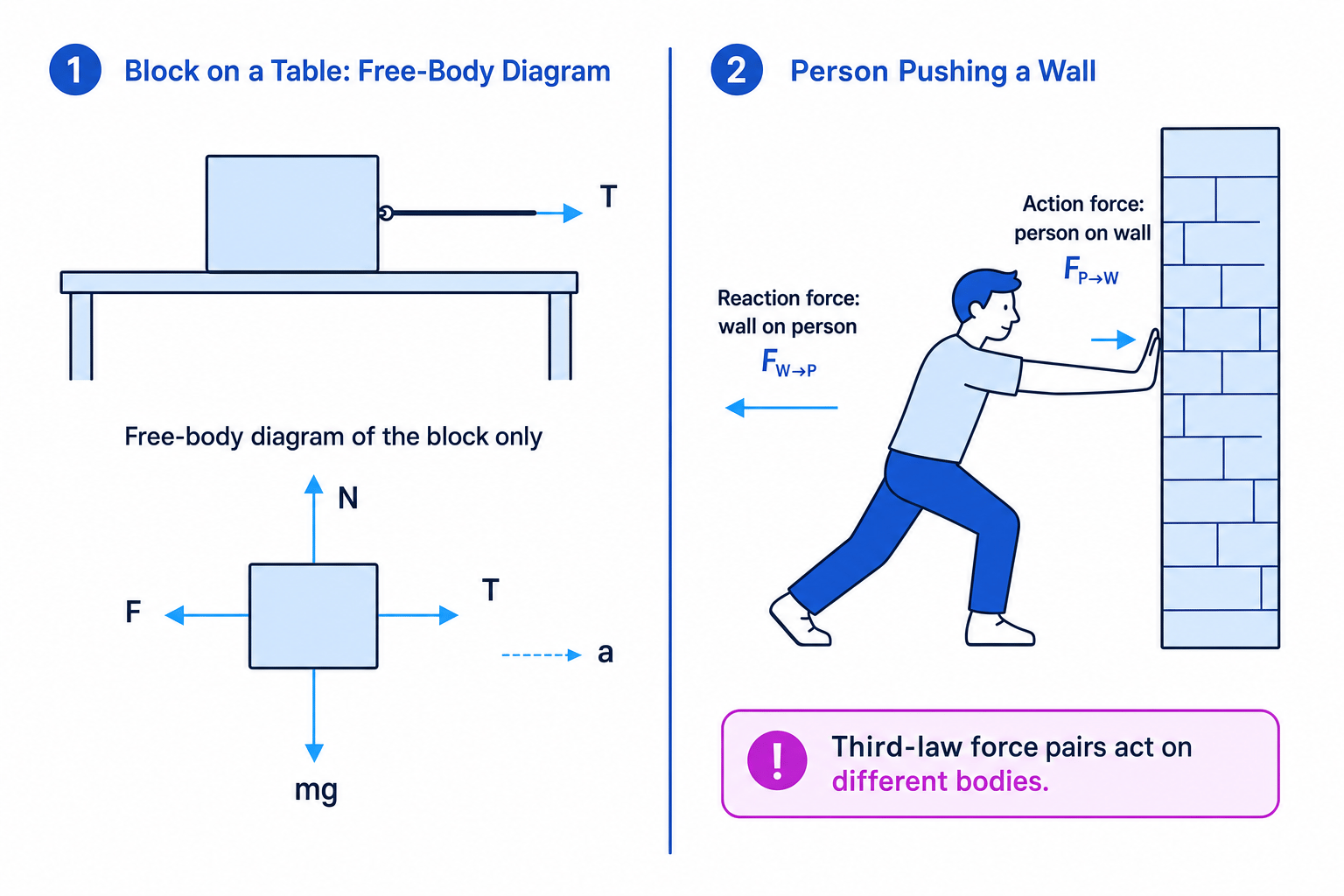
If object A exerts a force on object B, then object B exerts an equal and opposite force on object A. The two forces act on different objects.
This is why third-law force pairs do not cancel each other out: they are not acting on the same body.
The diagram below shows both a free-body diagram for a pulled block and a third-law pair for a person pushing a wall.
Identifying a third-law pair
A book rests on a table. The table exerts an upward normal contact force of 12 N on the book. Identify the third-law pair.
- Name the given force carefully: it is the table on the book, acting upward.
- Swap the two objects to get the partner force: the book on the table.
- Reverse the direction but keep the magnitude the same: the book exerts a downward force of 12 N on the table.
Forces that look equal are not always a third-law pair
The weight of a book and the normal contact force on the book may be equal when the book is at rest, but they are not a Newton’s third-law pair because they both act on the same object: the book.
Free-body diagrams
A free-body diagram shows all the external forces acting on one chosen object. You treat the object as a particle, meaning its size and shape are ignored because only the forces and motion of the whole object matter.
Common forces include:
- Weight, mgmgmg: the gravitational force on a mass, acting vertically downward.
- Normal contact force, NNN: a support force acting perpendicular to a surface.
- Friction: a contact force opposing sliding or attempted sliding.
- Tension: a pulling force in a string, rope or cable.
One object at a time
A free-body diagram only shows forces acting on the chosen object. Do not include forces that the object exerts on other things, and do not draw “acceleration” as a force.
Resultant force and Newton’s second law
The resultant force is the vector sum of all forces acting on an object. In one dimension, this means adding forces with signs.
For constant mass, Newton’s second law is:
∑F=ma\sum F = ma∑F=mawhere ∑F\sum F∑F is the resultant force in newtons, mmm is mass in kilograms, and aaa is acceleration in metres per second squared.
If ∑F=0\sum F = 0∑F=0, the acceleration is zero. That does not necessarily mean the object is stationary; it could be moving at constant velocity.
Calculating acceleration from a free-body diagram
A 2.0 kg box is pulled horizontally with a tension of 8.0 N. Friction is 2.0 N in the opposite direction. Find the acceleration.
- Choose right as positive and find the horizontal resultant force: ∑F=8.0 N−2.0 N=6.0 N\sum F = 8.0\,\text{N} - 2.0\,\text{N} = 6.0\,\text{N}∑F=8.0N−2.0N=6.0N
- Apply Newton’s second law: a=∑Fm=6.0 N2.0 kg=3.0 m s−2a = \frac{\sum F}{m} = \frac{6.0\,\text{N}}{2.0\,\text{kg}} = 3.0\,\text{m s}^{-2}a=m∑F=2.0kg6.0N=3.0m s−2
- The answer is positive, so the acceleration is 3.0 m s⁻² to the right.
Specified practical: investigating Newton’s second law
You need to know how to investigate the relationship between resultant force and acceleration.
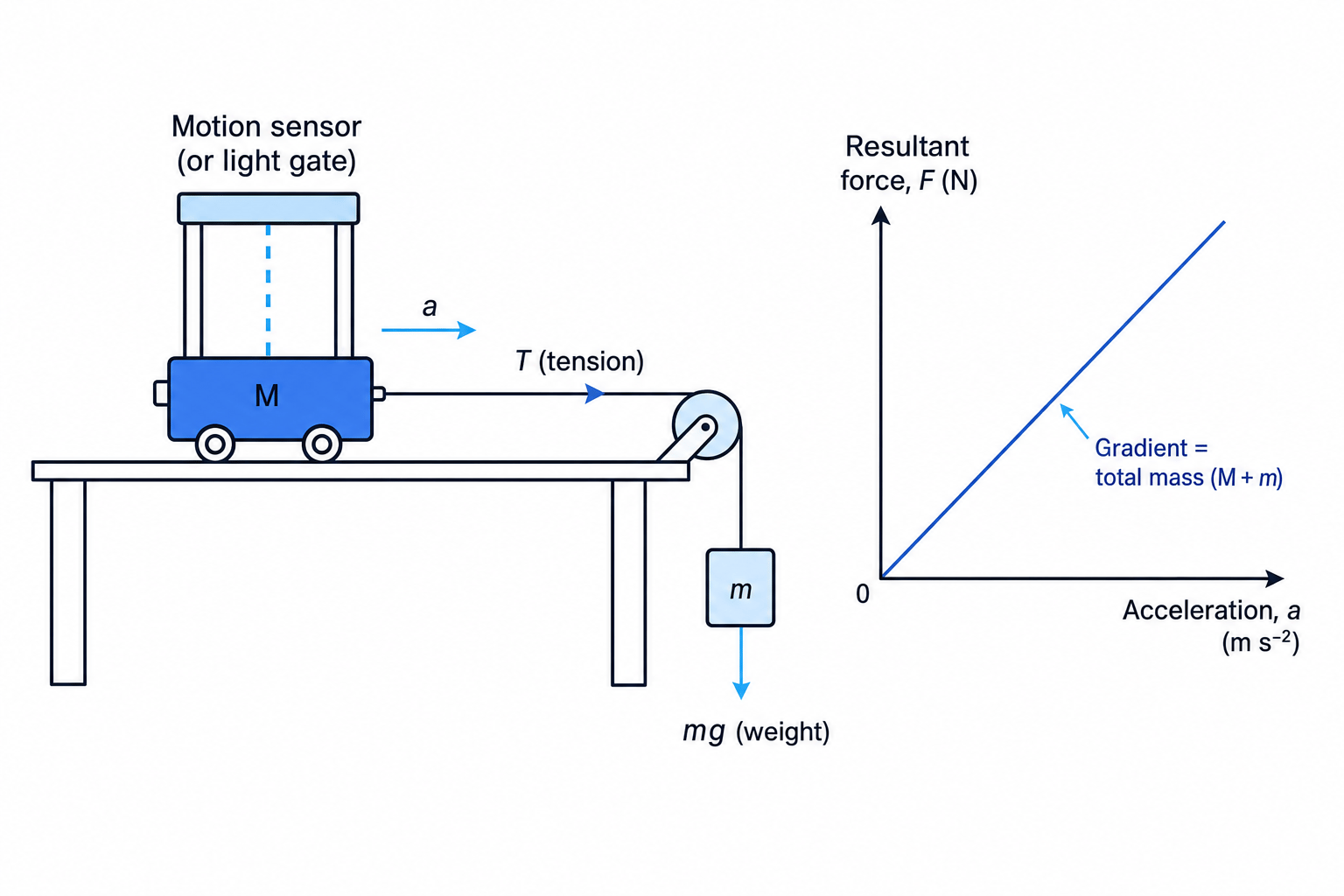
A typical setup uses a low-friction trolley connected by a string over a pulley to a hanging mass. The hanging mass provides the driving force. The acceleration can be measured using a light gate, motion sensor or ticker timer.
A good method is:
- Keep the total mass of the system constant.
- Transfer slotted masses from the trolley to the hanger to increase the driving force without changing the total mass.
- Release the trolley without pushing it.
- Measure the acceleration several times for each driving force.
- Plot resultant force on the vertical axis against acceleration on the horizontal axis.
If friction is negligible, the resultant force on the whole system is approximately the weight of the hanging mass. A straight line through the origin supports ∑F=ma\sum F = ma∑F=ma. For a graph of force against acceleration, the gradient should be the total mass.
Finding mass from a force-acceleration graph
A student plots resultant force against acceleration. A point on the best-fit line is a=1.60 m s−2a = 1.60\,\text{m s}^{-2}a=1.60m s−2 and F=0.96 NF = 0.96\,\text{N}F=0.96N. Find the experimental total mass.
- For a force-against-acceleration graph, the gradient is: gradient=Fa\text{gradient} = \frac{F}{a}gradient=aF
- Substitute the values from the graph: gradient=0.96 N1.60 m s−2=0.60 kg\text{gradient} = \frac{0.96\,\text{N}}{1.60\,\text{m s}^{-2}} = 0.60\,\text{kg}gradient=1.60m s−20.96N=0.60kg
- So the experimental total mass is 0.60 kg.
Practical data quality
Repeat acceleration readings, use a best-fit line rather than one pair of points, and record uncertainties in masses, distances and times. A non-zero intercept often suggests friction or a zero error.
Linear momentum
Linear momentum
Linear momentum is the product of mass and velocity:
p=mvp = mvp=mvMomentum is a vector and is measured in kg m s⁻¹, which is equivalent to N s.
Because velocity is a vector, momentum can be positive or negative depending on your chosen direction.
Calculating momentum with direction
A 0.150 kg ball moves left at 12 m s⁻¹. Take right as positive. Find its momentum.
- Convert the direction into a sign: left is negative, so v=−12 m s−1v = -12\,\text{m s}^{-1}v=−12m s−1.
- Use p=mvp = mvp=mv: p=0.150 kg×(−12 m s−1)=−1.8 kg m s−1p = 0.150\,\text{kg} \times (-12\,\text{m s}^{-1}) = -1.8\,\text{kg m s}^{-1}p=0.150kg×(−12m s−1)=−1.8kg m s−1
- The negative sign means the momentum is 1.8 kg m s⁻¹ to the left.
Force as rate of change of momentum
A rate of change means change per unit time. Force can be described as the rate of change of momentum:
F=ΔpΔtF = \frac{\Delta p}{\Delta t}F=ΔtΔpFor constant mass:
F=ΔpΔt=mΔvΔt=maF = \frac{\Delta p}{\Delta t} = \frac{m\Delta v}{\Delta t} = maF=ΔtΔp=ΔtmΔv=maThis is the deeper reason behind ∑F=ma\sum F = ma∑F=ma.
Comparing impact forces with and without an airbag
A 75 kg passenger moving at 13 m s⁻¹ is brought to rest. Compare the average force if the stopping time is 0.10 s without an airbag and 0.50 s with an airbag.
- Calculate the change in momentum: Δp=m(v−u)=75 kg(0−13 m s−1)=−975 kg m s−1\Delta p = m(v-u) = 75\,\text{kg}(0 - 13\,\text{m s}^{-1}) = -975\,\text{kg m s}^{-1}Δp=m(v−u)=75kg(0−13m s−1)=−975kg m s−1
- Find the magnitude of the average force without an airbag: F=975 kg m s−10.10 s=9.8×10³ NF = \frac{975\,\text{kg m s}^{-1}}{0.10\,\text{s}} = 9.8 \times 10^3\,\text{N}F=0.10s975kg m s−1=9.8×10³N
- Find the magnitude with an airbag: F=975 kg m s−10.50 s=2.0×10³ NF = \frac{975\,\text{kg m s}^{-1}}{0.50\,\text{s}} = 2.0 \times 10^3\,\text{N}F=0.50s975kg m s−1=2.0×10³N
- Increasing the stopping time by a factor of five reduces the average force by a factor of five.
Crumple zones and airbags
Crumple zones and airbags do not reduce the change in momentum much; they increase the collision time, so the average force on passengers is smaller.
Conservation of momentum
Principle of conservation of momentum
In a closed system with no external resultant force, the total momentum before an interaction equals the total momentum after the interaction.
For a one-dimensional collision:
m1u1+m2u2=m1v1+m2v2m_1u_1 + m_2u_2 = m_1v_1 + m_2v_2m1u1+m2u2=m1v1+m2v2where uuu means velocity before the collision and vvv means velocity after the collision.
An elastic collision has no loss of kinetic energy. An inelastic collision has a loss of kinetic energy, usually transferred to thermal energy, sound and deformation. Momentum is still conserved if there is no external resultant force.
Solving an inelastic collision
A 0.50 kg trolley moving at 3.0 m s⁻¹ collides with a stationary 0.30 kg trolley. They stick together. Find their common velocity and the kinetic energy lost.
- Apply conservation of momentum: (0.50 kg)(3.0 m s−1)+(0.30 kg)(0)=(0.80 kg)v(0.50\,\text{kg})(3.0\,\text{m s}^{-1}) + (0.30\,\text{kg})(0) = (0.80\,\text{kg})v(0.50kg)(3.0m s−1)+(0.30kg)(0)=(0.80kg)v
- Solve for the common velocity: v=1.50 kg m s−10.80 kg=1.875 m s−1v = \frac{1.50\,\text{kg m s}^{-1}}{0.80\,\text{kg}} = 1.875\,\text{m s}^{-1}v=0.80kg1.50kg m s−1=1.875m s−1 So v≈1.9 m s−1v \approx 1.9\,\text{m s}^{-1}v≈1.9m s−1.
- Compare kinetic energies: Ek before=12(0.50 kg)(3.0 m s−1)2=2.25 JE_{\text{k before}} = \frac{1}{2}(0.50\,\text{kg})(3.0\,\text{m s}^{-1})^2 = 2.25\,\text{J}Ek before=21(0.50kg)(3.0m s−1)2=2.25J Ek after=12(0.80 kg)(1.875 m s−1)2=1.41 JE_{\text{k after}} = \frac{1}{2}(0.80\,\text{kg})(1.875\,\text{m s}^{-1})^2 = 1.41\,\text{J}Ek after=21(0.80kg)(1.875m s−1)2=1.41J
- The kinetic energy lost is: 2.25 J−1.41 J=0.84 J2.25\,\text{J} - 1.41\,\text{J} = 0.84\,\text{J}2.25J−1.41J=0.84J
Checking whether a collision is elastic
A 0.30 kg trolley moving at 2.0 m s⁻¹ collides with a stationary 0.20 kg trolley. After the collision, the 0.30 kg trolley moves at 0.40 m s⁻¹ in the same direction. Find the velocity of the 0.20 kg trolley and decide whether the collision is elastic.
- Use momentum conservation: (0.30)(2.0)=(0.30)(0.40)+(0.20)v(0.30)(2.0) = (0.30)(0.40) + (0.20)v(0.30)(2.0)=(0.30)(0.40)+(0.20)v
- Solve for the unknown velocity: 0.60=0.12+0.20v0.60 = 0.12 + 0.20v0.60=0.12+0.20v v=2.4 m s−1v = 2.4\,\text{m s}^{-1}v=2.4m s−1
- Compare kinetic energy before and after: Ek before=12(0.30)(2.0)2=0.60 JE_{\text{k before}} = \frac{1}{2}(0.30)(2.0)^2 = 0.60\,\text{J}Ek before=21(0.30)(2.0)2=0.60J Ek after=12(0.30)(0.40)2+12(0.20)(2.4)2=0.600 JE_{\text{k after}} = \frac{1}{2}(0.30)(0.40)^2 + \frac{1}{2}(0.20)(2.4)^2 = 0.600\,\text{J}Ek after=21(0.30)(0.40)2+21(0.20)(2.4)2=0.600J
- The kinetic energy is unchanged, so the collision is elastic.
Conserving kinetic energy in every collision
Momentum is conserved in any collision where there is no external resultant force. Kinetic energy is conserved only in elastic collisions.
In the exam
- Choose a positive direction before writing momentum or force equations.
- Draw a free-body diagram before applying ∑F=ma\sum F = ma∑F=ma; include only forces acting on the chosen object.
- For collisions, conserve momentum first, then use kinetic energy only if the question says or implies the collision is elastic.
- Keep units throughout and round final answers to a sensible number of significant figures.
Check yourself
- Why do Newton’s third-law force pairs not cancel each other out?
- How would you use a force-against-acceleration graph to find mass?
- In a collision, how can momentum be conserved even when kinetic energy is lost?
