

What you'll learn
- Use the six essential SI base units, prefixes, and derived units confidently.
- Check whether equations are homogeneous by comparing units.
- Distinguish scalars from vectors, add perpendicular vectors, and resolve vectors into components.
- Apply density, moments, centre of gravity, and equilibrium to simple calculations and practical work.
Measurement language: quantities and units
A physical quantity is something measurable, such as mass, time, force or density. Every measured value needs a number and a unit: for example, a mass of 2.50 kg or a time of 0.84 s.
Base SI units
A base SI unit is a fundamental unit from which other units can be built. In this Eduqas topic, the six essential base units are metre (m), kilogram (kg), second (s), ampere (A), mole (mol), and kelvin (K).
The six essential base SI units here are:
- metre (m) for length
- kilogram (kg) for mass
- second (s) for time
- ampere (A) for electric current
- mole (mol) for amount of substance
- kelvin (K) for thermodynamic temperature
The candela (cd) is also an SI base unit, but it is not needed in this topic.
Derived units in base units
A derived unit is made by combining base units. For example:
- force is measured in newtons (N), where 1 N=1 kg m s−21\ \text{N} = 1\ \text{kg}\ \text{m}\ \text{s}^{-2}1 N=1 kg m s−2
- density is measured in kilograms per cubic metre, kg m−3\text{kg}\ \text{m}^{-3}kg m−3
- pressure is measured in pascals (Pa), where 1 Pa=1 kg m−1 s−21\ \text{Pa} = 1\ \text{kg}\ \text{m}^{-1}\ \text{s}^{-2}1 Pa=1 kg m−1 s−2
Prefixes are powers of ten attached to units. Common ones are pico (p) = 10−1210^{-12}10−12, nano (n) = 10−910^{-9}10−9, micro (µ) = 10−610^{-6}10−6, milli (m) = 10−310^{-3}10−3, kilo (k) = 10310^{3}103, mega (M) = 10610^{6}106, and giga (G) = 10910^{9}109.
Converting a cubic centimetre volume
- A volume of 18.0 cm318.0\ \text{cm}^318.0 cm3 means 18.018.018.0 lots of (10−2 m)3\left(10^{-2}\ \text{m}\right)^3(10−2 m)3, because centi means 10−210^{-2}10−2.
- Cube the length conversion: (10−2 m)3=10−6 m3\left(10^{-2}\ \text{m}\right)^3 = 10^{-6}\ \text{m}^3(10−2 m)3=10−6 m3.
- So 18.0 cm3=18.0×10⁻⁶ m3=1.80×10⁻⁵ m318.0\ \text{cm}^3 = 18.0 \times 10^{-6}\ \text{m}^3 = 1.80 \times 10^{-5}\ \text{m}^318.0 cm3=18.0×10⁻⁶ m3=1.80×10⁻⁵ m3.
Forgetting to cube the prefix
When converting areas or volumes, the prefix is squared or cubed too. For example, 1 cm31\ \text{cm}^31 cm3 is not 10−2 m310^{-2}\ \text{m}^310−2 m3; it is 10−6 m310^{-6}\ \text{m}^310−6 m3.
Checking equations for homogeneity
An equation is homogeneous if every term being added or equated has the same base units. Homogeneity is a powerful check: if the units do not match, the equation cannot be correct.
Homogeneity
You may only add or subtract quantities with the same units. Both sides of a valid physics equation must reduce to the same base SI units.
Checking a motion equation
Check whether v=u+atv = u + atv=u+at is homogeneous, where vvv and uuu are velocities, aaa is acceleration, and ttt is time.
- The units of velocity are m s−1\text{m}\ \text{s}^{-1}m s−1, so both vvv and uuu have units m s−1\text{m}\ \text{s}^{-1}m s−1.
- The units of atatat are (m s−2)(s)=m s−1\left(\text{m}\ \text{s}^{-2}\right)\left(\text{s}\right) = \text{m}\ \text{s}^{-1}(m s−2)(s)=m s−1.
- Both terms on the right-hand side have units m s−1\text{m}\ \text{s}^{-1}m s−1, matching the left-hand side, so the equation is homogeneous.
Homogeneity does not prove an equation is correct: a missing numerical factor such as 2 or 12\frac{1}{2}21 would not usually show up from units alone.
Scalars and vectors
A scalar quantity has magnitude only. Examples include speed, time, mass, density, energy and pressure.
A vector quantity has magnitude and direction. Examples include displacement, velocity, acceleration, force, weight and momentum.
The paired ideas matter:
- speed is scalar; velocity is vector
- distance is scalar; displacement is vector
- mass is scalar; weight is vector because it is a force
Adding and subtracting vectors
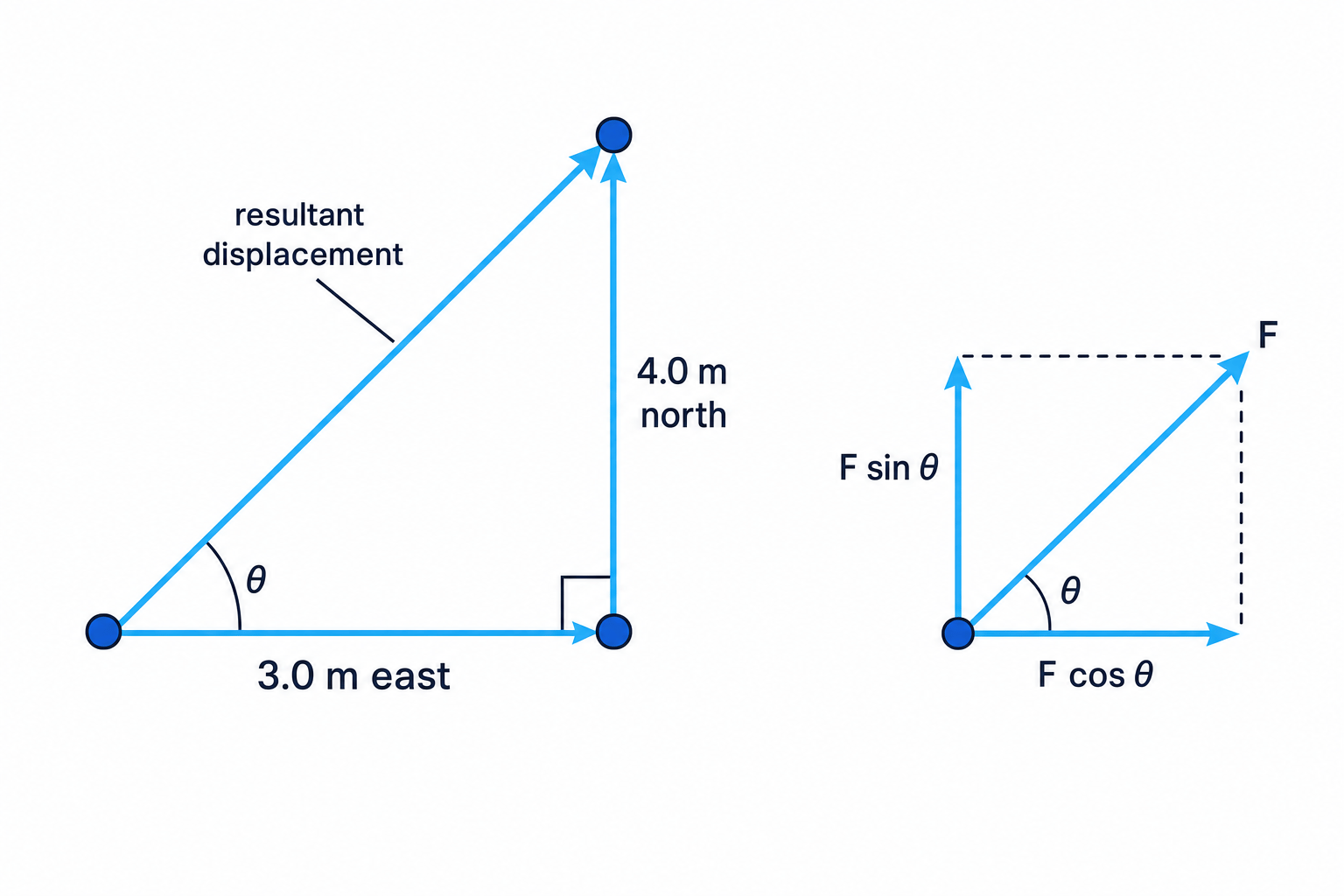
Coplanar vectors lie in the same plane, meaning you can draw them on a flat page. Vectors are added tip-to-tail. To subtract a vector, add a vector of the same size in the opposite direction.
In this topic, mathematical vector calculations are limited to two perpendicular vectors. That means you can use Pythagoras and basic trigonometry.
Adding two perpendicular displacements
A student walks 3.0 m east, then 4.0 m north. Find the resultant displacement.
- The east and north displacements are perpendicular, so use Pythagoras: R=(3.0 m)2+(4.0 m)2=5.0 mR = \sqrt{\left(3.0\ \text{m}\right)^2 + \left(4.0\ \text{m}\right)^2} = 5.0\ \text{m}R=(3.0 m)2+(4.0 m)2=5.0 m.
- Find the direction using the angle from east: tanθ=4.03.0\tan\theta = \frac{4.0}{3.0}tanθ=3.04.0, so θ=53.1∘\theta = 53.1^\circθ=53.1∘.
- The resultant displacement is 5.0 m5.0\ \text{m}5.0 m at about 53∘53^\circ53∘ north of east.
Resolving a vector into perpendicular components
To resolve a vector means to split it into perpendicular components, usually horizontal and vertical. The components together have the same overall effect as the original vector.
If a vector FFF makes an angle θ\thetaθ above the horizontal:
- horizontal component: FcosθF\cos\thetaFcosθ
- vertical component: FsinθF\sin\thetaFsinθ
Resolving a force into components
A force of 12 N acts at 35∘35^\circ35∘ above the horizontal. Find its horizontal and vertical components.
- The horizontal component is adjacent to the angle, so use cosine: Fx=12 Ncos35∘=9.83 NF_x = 12\ \text{N}\cos35^\circ = 9.83\ \text{N}Fx=12 Ncos35∘=9.83 N.
- The vertical component is opposite the angle, so use sine: Fy=12 Nsin35∘=6.88 NF_y = 12\ \text{N}\sin35^\circ = 6.88\ \text{N}Fy=12 Nsin35∘=6.88 N.
- To a sensible number of significant figures, the components are 9.8 N horizontally and 6.9 N vertically.
Sine or cosine?
The component next to the angle uses cosine; the component opposite the angle uses sine. If the angle is measured from the vertical instead, the horizontal and vertical choices swap.
Density
Density
Density, symbol ρ\rhoρ, is mass per unit volume. It tells you how much mass is packed into a given volume.
The density equation is:
ρ=mV\rho = \frac{m}{V}ρ=Vmwhere ρ\rhoρ is density in kilograms per cubic metre, mmm is mass in kilograms, and VVV is volume in cubic metres.
Calculating the density of a regular solid
A cuboid has mass 0.156 kg and dimensions 5.00 cm by 3.00 cm by 2.00 cm. Calculate its density.
- Convert the dimensions into metres: 5.00 cm=5.00×10⁻² m5.00\ \text{cm} = 5.00 \times 10^{-2}\ \text{m}5.00 cm=5.00×10⁻² m, 3.00 cm=3.00×10⁻² m3.00\ \text{cm} = 3.00 \times 10^{-2}\ \text{m}3.00 cm=3.00×10⁻² m, and 2.00 cm=2.00×10⁻² m2.00\ \text{cm} = 2.00 \times 10^{-2}\ \text{m}2.00 cm=2.00×10⁻² m.
- Calculate the volume: V=(5.00×10⁻² m)(3.00×10⁻² m)(2.00×10⁻² m)=3.00×10⁻⁵ m3V = \left(5.00 \times 10^{-2}\ \text{m}\right)\left(3.00 \times 10^{-2}\ \text{m}\right)\left(2.00 \times 10^{-2}\ \text{m}\right) = 3.00 \times 10^{-5}\ \text{m}^3V=(5.00×10⁻² m)(3.00×10⁻² m)(2.00×10⁻² m)=3.00×10⁻⁵ m3.
- Use ρ=mV\rho = \frac{m}{V}ρ=Vm: ρ=0.156 kg3.00×10−5 m3=5.20×10³ kg m−3\rho = \frac{0.156\ \text{kg}}{3.00 \times 10^{-5}\ \text{m}^3} = 5.20 \times 10^{3}\ \text{kg}\ \text{m}^{-3}ρ=3.00×10⁻⁵ m30.156 kg=5.20×10³ kg m−3.
Practical: measuring the density of solids
For a regular solid, measure the mass using a balance, then measure dimensions using a ruler, vernier calipers or micrometer. Take repeated measurements at different positions and use a mean value before calculating volume.
For an irregular solid, use displacement:
- Measure its mass with a balance.
- Record the initial water volume in a measuring cylinder.
- Submerge the solid fully, avoiding trapped air bubbles.
- Record the final water volume.
- The solid’s volume is the change in water volume.
Good practical technique includes reading scales at eye level, interpolating between scale divisions, recording units, repeating measurements, and estimating uncertainty from instrument resolution. For a product such as volume from three lengths, fractional uncertainties add approximately.
Turning effects and moments
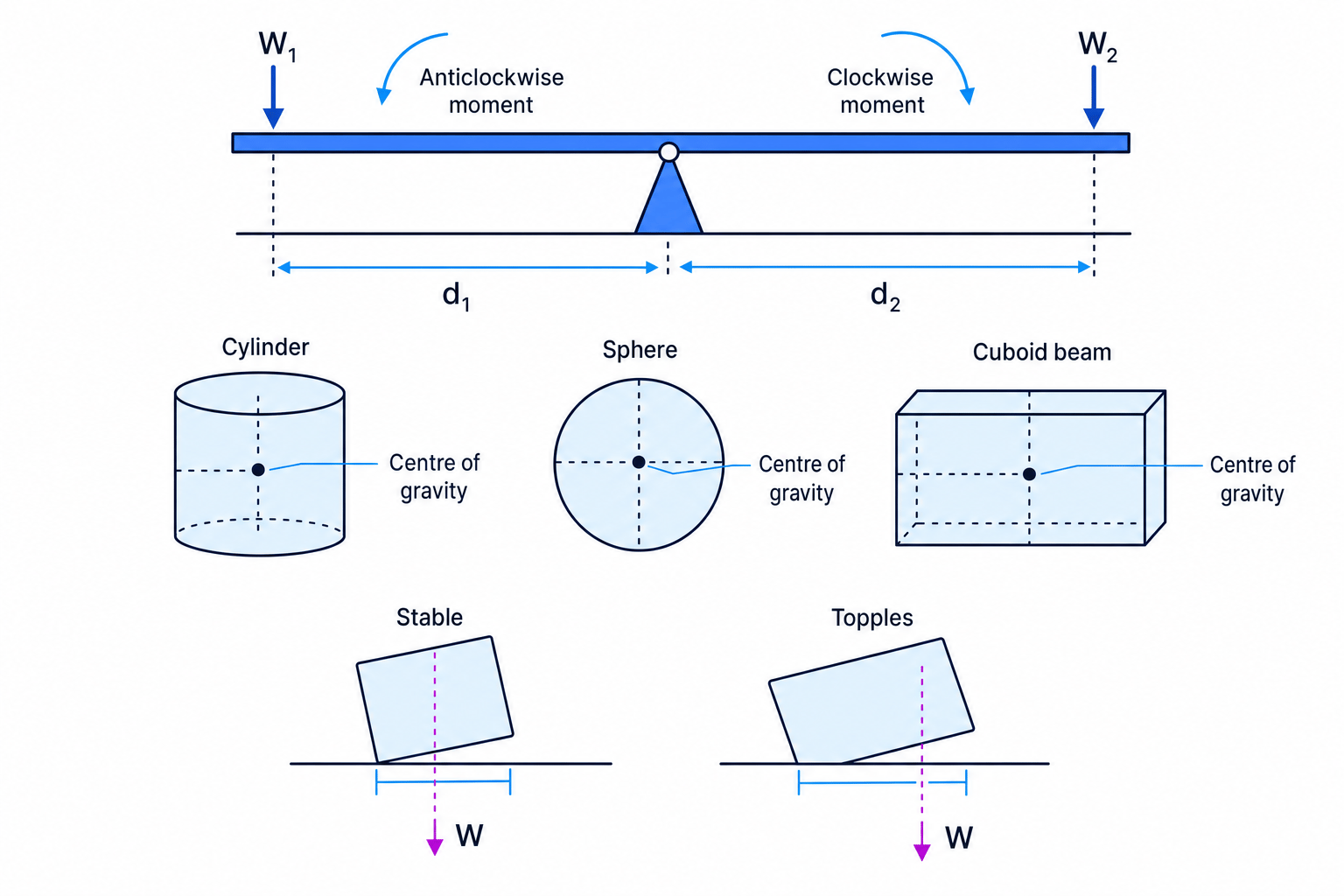
The turning effect of a force is called its moment. A force produces a moment about a pivot if its line of action does not pass through the pivot.
Moment of a force
The moment of a force about a pivot is M=FdM = FdM=Fd, where FFF is the force and ddd is the perpendicular distance from the pivot to the force’s line of action. The unit is newton metre (N m).
Equilibrium and the principle of moments
For a body in equilibrium, the resultant force is zero and the net moment is zero. For rotational equilibrium, the total clockwise moment equals the total anticlockwise moment about the pivot.
Determining an unknown mass using moments
A 0.200 kg mass hangs 0.300 m to the left of a pivot. An unknown mass hangs 0.120 m to the right. The ruler balances horizontally and its own weight acts through the pivot. Find the unknown mass and the upward force from the pivot.
- Set anticlockwise moment equal to clockwise moment: (0.200 kg)g(0.300 m)=mg(0.120 m)\left(0.200\ \text{kg}\right)g\left(0.300\ \text{m}\right) = m g\left(0.120\ \text{m}\right)(0.200 kg)g(0.300 m)=mg(0.120 m).
- Cancel ggg because both forces are weights: m=(0.200 kg)(0.300 m)0.120 m=0.500 kgm = \frac{\left(0.200\ \text{kg}\right)\left(0.300\ \text{m}\right)}{0.120\ \text{m}} = 0.500\ \text{kg}m=0.120 m(0.200 kg)(0.300 m)=0.500 kg.
- Use vertical force equilibrium for the pivot reaction: R=(0.200 kg+0.500 kg)(9.81 m s−2)=6.87 NR = \left(0.200\ \text{kg} + 0.500\ \text{kg}\right)\left(9.81\ \text{m}\ \text{s}^{-2}\right) = 6.87\ \text{N}R=(0.200 kg+0.500 kg)(9.81 m s−2)=6.87 N upward.
Using the wrong distance for a moment
The distance in M=FdM = FdM=Fd is the perpendicular distance from the pivot to the line of action of the force, not necessarily the length of the object.
Practical: finding an unknown mass with moments
A standard method is:
- Balance a metre ruler on a knife-edge to find its centre of gravity.
- Put the pivot at this point so the ruler’s own weight has no moment about the pivot.
- Hang a known mass on one side and the unknown mass on the other.
- Adjust positions until the ruler is horizontal.
- Measure distances from the pivot to the lines of action of the weights.
- Use m1gd1=m2gd2m_1gd_1 = m_2gd_2m1gd1=m2gd2 and repeat with different distances to calculate a mean unknown mass.
Main uncertainties come from measuring distances, judging when the ruler is exactly horizontal, and possible friction at the pivot. Keep masses close to the bench while adjusting to reduce the risk of falling masses.
Centre of gravity and stability
The centre of gravity is the point through which the object’s weight can be considered to act. For uniform objects:
- a sphere has its centre of gravity at its geometric centre
- a cylinder has its centre of gravity at the centre of its axis
- a cuboid or uniform beam has its centre of gravity at its geometric centre
An object is stable if the vertical line of action of its weight falls within its base. It topples when that line falls outside the base. A wider base and a lower centre of gravity both increase stability.
In the exam
- Convert all measurements to SI units before substituting, especially prefixes, centimetres cubed, and grams.
- For vector questions, draw the perpendicular components and label the final direction, not just the magnitude.
- For moments, choose a pivot, use perpendicular distances, and apply clockwise moment equals anticlockwise moment only when the object is in equilibrium.
- If a body is in equilibrium, remember both conditions: resultant force zero and net moment zero.
Check yourself
- What are the six essential base SI units in this topic, and which quantity does each measure?
- A force acts at an angle above the horizontal: how do you decide which component uses sine and which uses cosine?
- How would you measure the density of an irregular solid while reducing uncertainty?
