

What you'll learn
- How work done links forces, distances and energy transfer.
- How to use conservation of energy with kinetic, gravitational and elastic energy.
- How the work-energy relationship connects resultant force to changes in speed.
- How power, dissipative forces and efficiency describe real machines and systems.
1. Starting point: energy, systems and transfers
In physics, energy is a quantity that lets us track changes in a system. A system is the object or group of objects you choose to study, such as a falling ball, a spring and trolley, or a power station.
Energy is measured in joules (J). Energy can be stored in different ways, such as:
- a moving object’s kinetic energy store
- an object’s gravitational potential energy store
- a stretched or compressed spring’s elastic potential energy store
- the surroundings’ thermal energy store
Energy is not used up or destroyed. Instead, it is transferred between stores.
Conservation of energy
The principle of conservation of energy says that the total energy of a closed system remains constant: energy can be transferred or transformed, but it cannot be created or destroyed.
In real situations, energy often spreads out into the surroundings by heating or sound. That makes it less useful, but it is still energy.
2. Work done by a constant force
When a force causes an object to move, energy is transferred. This energy transfer is called work done.
Work done
For a constant force acting in the direction of motion:
W=FxW = FxW=Fxwhere WWW is work done in joules (J), FFF is force in newtons (N), and xxx is distance moved in metres (m).
One joule is the work done when a force of one newton moves an object one metre in the direction of the force.
If the force is constant and parallel to the motion, this is straightforward: multiply force by distance.
Calculating work done by a horizontal force
A student pushes a box with a constant force of 45 N. The box moves 3.2 m along the floor in the direction of the force. Calculate the work done.
-
Use the constant-force work equation:
W=FxW = FxW=Fx -
Substitute the force and distance, including units:
W=45 N×3.2 mW = 45\,\text{N} \times 3.2\,\text{m}W=45N×3.2m -
Calculate the work done:
W=144 JW = 144\,\text{J}W=144J
So the student transfers 144 J of energy to the box and its surroundings.
Forgetting the direction
A force only does work according to the displacement in the direction of that force. A large force perpendicular to the motion does no work on the object’s motion in that direction.
3. Work done when the force is at an angle
Often the force is not along the line of motion. For example, you might pull a suitcase with a handle at an angle.
Only the component of the force parallel to the displacement does work.
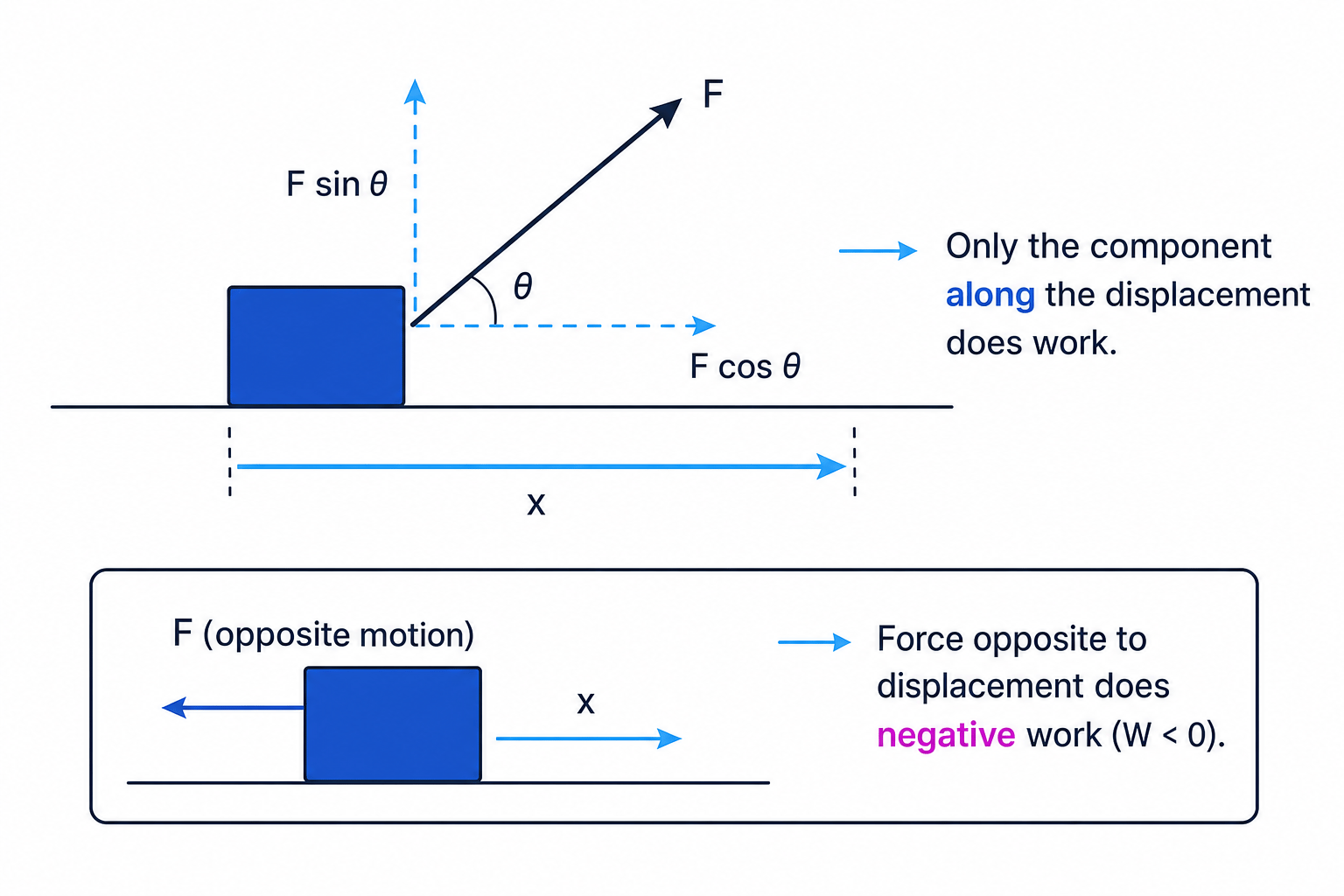
For a constant force at an angle:
work done=Fxcosθ\text{work done} = Fx \cos \thetawork done=Fxcosθwhere θ\thetaθ is the angle between the force and the displacement.
Calculating work done by an angled force
A rope pulls a crate with a force of 80 N at 30 degrees above the horizontal. The crate moves 5.0 m horizontally. Calculate the work done by the rope.
-
Use the angled-force work equation:
W=FxcosθW = Fx \cos \thetaW=Fxcosθ -
Substitute the values:
W=80 N×5.0 m×cos30∘W = 80\,\text{N} \times 5.0\,\text{m} \times \cos 30^\circW=80N×5.0m×cos30∘ -
Evaluate the cosine component:
W=400 J×0.866W = 400\,\text{J} \times 0.866W=400J×0.866 -
Give the answer to a sensible number of significant figures:
W≈3.5×10² JW \approx 3.5 \times 10^2\,\text{J}W≈3.5×10²J
So the rope does about 350 J of work on the crate.
Quick angle check
If θ=0∘\theta = 0^\circθ=0∘, then cosθ=1\cos \theta = 1cosθ=1, so W=FxW = FxW=Fx. If θ=90∘\theta = 90^\circθ=90∘, then cosθ=0\cos \theta = 0cosθ=0, so no work is done in the direction of motion.
4. Main energy stores you need
Kinetic energy
Kinetic energy is energy stored by a moving object.
Ek=12mv2E_k = \frac{1}{2}mv^2Ek=21mv2where mmm is mass in kilograms (kg) and vvv is speed in metres per second (m s−1^{-1}−1).
Gravitational potential energy
Gravitational potential energy is energy stored because an object has been raised in a gravitational field.
ΔEp=mgΔh\Delta E_p = mg\Delta hΔEp=mgΔhwhere mmm is mass in kilograms (kg), ggg is gravitational field strength in newtons per kilogram (N kg−1^{-1}−1), and Δh\Delta hΔh is change in height in metres (m).
Near the Earth’s surface, you usually use g=9.8 N kg−1g = 9.8\,\text{N kg}^{-1}g=9.8N kg−1 unless told otherwise.
Elastic potential energy
Elastic potential energy is energy stored when an object, such as a spring, is stretched or compressed.
Ee=12kx2E_e = \frac{1}{2}kx^2Ee=21kx2where kkk is the spring constant in newtons per metre (N m−1^{-1}−1) and xxx is extension or compression in metres (m).
This equation applies when the spring obeys Hooke’s law.
Elastic equation limit
The equation Ee=12kx2E_e = \frac{1}{2}kx^2Ee=21kx2 only applies while the spring behaves elastically, so force is proportional to extension. Beyond the elastic limit, this simple model no longer works.
Using conservation of energy to find speed
A 0.60 kg ball is dropped from rest through a height of 1.8 m. Ignore air resistance. Calculate its speed just before impact.
-
Apply conservation of energy: the loss in gravitational potential energy becomes kinetic energy.
mgΔh=12mv2mg\Delta h = \frac{1}{2}mv^2mgΔh=21mv2 -
Cancel the mass, because it appears on both sides:
gΔh=12v2g\Delta h = \frac{1}{2}v^2gΔh=21v2 -
Rearrange for speed:
v=2gΔhv = \sqrt{2g\Delta h}v=2gΔh -
Substitute values:
v=2×9.8 m s−2×1.8 mv = \sqrt{2 \times 9.8\,\text{m s}^{-2} \times 1.8\,\text{m}}v=2×9.8m s−2×1.8m -
Calculate:
v=5.9 m s−1v = 5.9\,\text{m s}^{-1}v=5.9m s−1
So the ball’s speed is about 5.9 m s−1^{-1}−1.
5. The work-energy relationship
Work done by the resultant force changes an object’s kinetic energy.
Work-energy relationship
For a constant resultant force acting along the motion:
Fx=12mv2−12mu2Fx = \frac{1}{2}mv^2 - \frac{1}{2}mu^2Fx=21mv2−21mu2where uuu is initial speed and vvv is final speed.
The right-hand side is “final kinetic energy minus initial kinetic energy”. So:
- positive work increases kinetic energy
- negative work decreases kinetic energy
- zero resultant work means kinetic energy stays the same
Finding a force from a change in speed
A 1200 kg car speeds up from 4.0 m s−1^{-1}−1 to 12 m s−1^{-1}−1 over a distance of 80 m. Find the constant resultant force.
-
Use the work-energy relationship:
Fx=12mv2−12mu2Fx = \frac{1}{2}mv^2 - \frac{1}{2}mu^2Fx=21mv2−21mu2 -
Substitute the data:
F×80 m=12(1200 kg)(12 m s−1)2−12(1200 kg)(4.0 m s−1)2F \times 80\,\text{m} = \frac{1}{2}(1200\,\text{kg})(12\,\text{m s}^{-1})^2 - \frac{1}{2}(1200\,\text{kg})(4.0\,\text{m s}^{-1})^2F×80m=21(1200kg)(12m s−1)2−21(1200kg)(4.0m s−1)2 -
Calculate the change in kinetic energy:
F×80 m=86400 J−9600 J=76800 JF \times 80\,\text{m} = 86400\,\text{J} - 9600\,\text{J} = 76800\,\text{J}F×80m=86400J−9600J=76800J -
Divide by distance:
F=76800 J80 m=960 NF = \frac{76800\,\text{J}}{80\,\text{m}} = 960\,\text{N}F=80m76800J=960N
The constant resultant force is 960 N.
6. Power: the rate of energy transfer
Power tells you how quickly energy is transferred.
Power
Power is the rate of energy transfer:
P=EtP = \frac{E}{t}P=tEor, if the energy transfer is work done,
P=WtP = \frac{W}{t}P=tWPower is measured in watts (W), where one watt is one joule per second.
A powerful motor does not necessarily transfer more total energy than a less powerful motor. It transfers energy faster.
Calculating power from energy transfer
A lift motor transfers 2.4 ×\times× 105^{5}5 J of useful energy in 12 s. Calculate its useful power output.
-
Use the power equation:
P=EtP = \frac{E}{t}P=tE -
Substitute the energy and time:
P=2.4×10⁵ J12 sP = \frac{2.4 \times 10^5\,\text{J}}{12\,\text{s}}P=12s2.4×105J -
Calculate:
P=2.0×10⁴ WP = 2.0 \times 10^4\,\text{W}P=2.0×10⁴W
So the useful power output is 20 kW.
7. Dissipative forces and efficiency
A dissipative force is a force that transfers energy from the system to the surroundings, often by heating. Friction and drag are the key examples.
For example, when a car moves through air, drag transfers energy from the car’s kinetic energy store or fuel store to the thermal energy stores of the air, tyres and road. This reduces the energy available for useful motion.
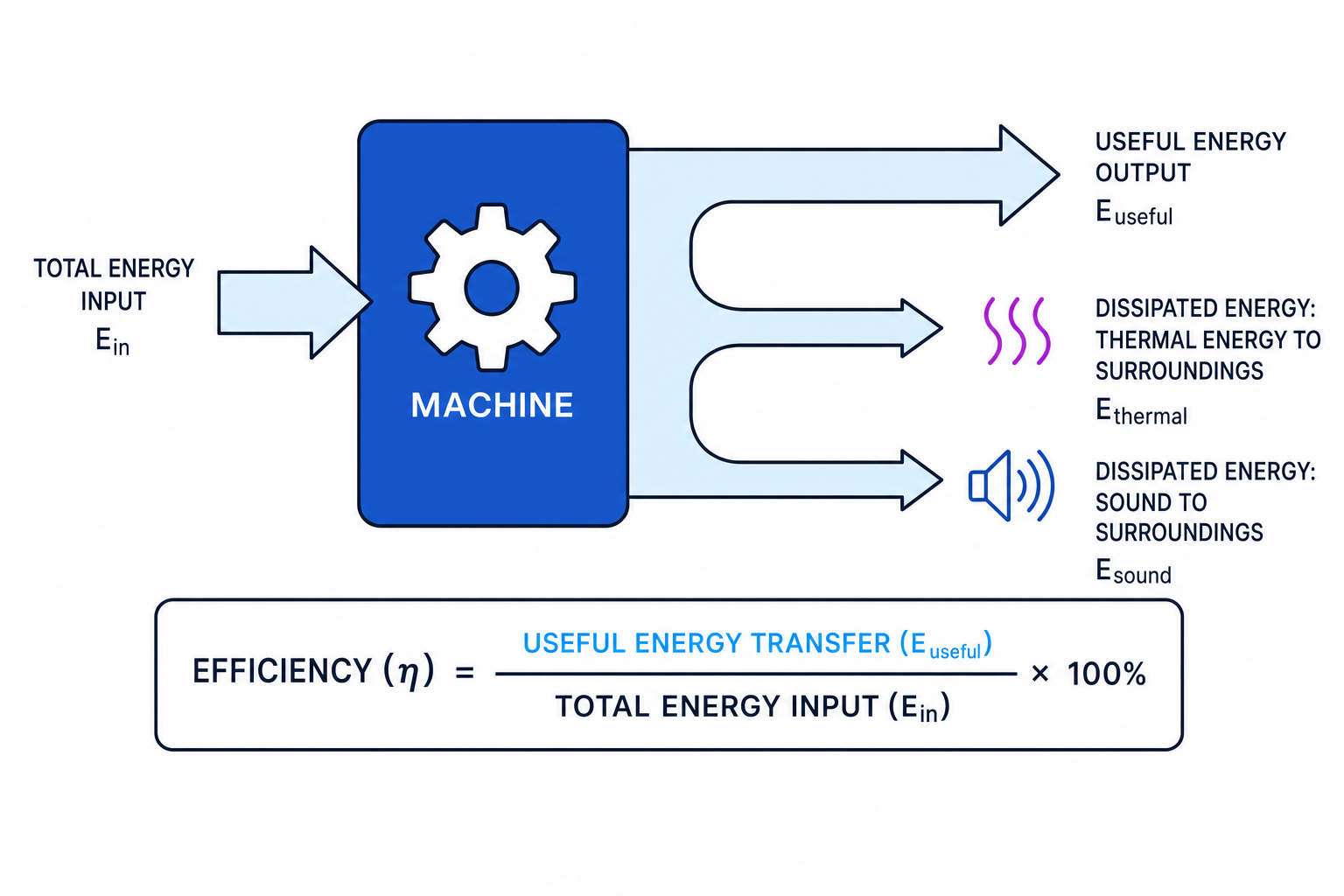
Efficiency compares useful energy output with total energy input.
efficiency=useful energy transfertotal energy input×100%\text{efficiency} = \frac{\text{useful energy transfer}}{\text{total energy input}} \times 100\%efficiency=total energy inputuseful energy transfer×100%Calculating efficiency
A motor takes in 850 J of electrical energy. It transfers 620 J as useful kinetic energy to a load. Calculate its efficiency.
-
Use the efficiency equation:
efficiency=useful energy transfertotal energy input×100%\text{efficiency} = \frac{\text{useful energy transfer}}{\text{total energy input}} \times 100\%efficiency=total energy inputuseful energy transfer×100% -
Substitute the values:
efficiency=620 J850 J×100%\text{efficiency} = \frac{620\,\text{J}}{850\,\text{J}} \times 100\%efficiency=850J620J×100% -
Calculate:
efficiency=72.9%\text{efficiency} = 72.9\%efficiency=72.9%
The motor’s efficiency is about 73%.
Saying energy is lost
Energy is not destroyed. In exams, say energy is dissipated or transferred to the surroundings, usually as thermal energy or sound.
8. Practical and data-analysis links
You can investigate energy transfers by measuring force, distance, time, mass and height.
For example, to find the work done lifting a mass:
- measure mass using a balance
- calculate weight using W=mgW = mgW=mg
- measure height gain using a ruler or metre rule
- calculate gravitational potential energy gained using ΔEp=mgΔh\Delta E_p = mg\Delta hΔEp=mgΔh
For power, measure the time taken for the transfer and use P=E/tP = E/tP=E/t.
Uncertainty sense-check
The largest percentage uncertainty often comes from timing short intervals or measuring small distances. Repeating measurements and using larger distances or longer times usually reduces percentage uncertainty.
If a force is constant, work is simply force times distance. If a force changes during the motion, the constant-force equation is not enough; the work done is found from the area under a force-distance graph.
In the exam
- Identify the energy store or transfer first: kinetic, gravitational potential, elastic potential, work done, or dissipated energy.
- Check directions: for angled forces use FxcosθFx\cos\thetaFxcosθ, and for opposing forces expect negative work or a decrease in kinetic energy.
- Carry units through calculations, then round to a sensible number of significant figures based on the data given.
Check yourself
- Why does a force at 90 degrees to the displacement do no work on the object?
- A spring is compressed twice as far. What happens to the elastic potential energy stored?
- How can a system obey conservation of energy but still have an efficiency below 100%?
