

What you'll learn
- How to describe circular motion using period, frequency, radians and angular velocity.
- How angular motion connects to linear speed using v=ωrv = \omega rv=ωr.
- Why an object moving at constant speed in a circle is still accelerating.
- How to use centripetal acceleration and force equations in calculations and practical contexts.
Starting point: vectors and resultant force
A scalar has magnitude only. A vector has magnitude and direction. Speed is a scalar, but velocity is a vector because it includes direction.
Acceleration is the rate of change of velocity. So even if an object keeps the same speed, it can accelerate if its direction changes.
The resultant force is the single overall force that has the same effect as all the real forces acting on an object combined. By Newton’s second law, a non-zero resultant force causes acceleration.
Period and frequency
Circular motion repeats. One complete trip around the circle is one revolution or one cycle.
Period and frequency
The period of rotation, TTT, is the time for one complete revolution, measured in seconds (s). The frequency, fff, is the number of revolutions per second, measured in hertz (Hz). They are related by f=1Tf = \frac{1}{T}f=T1.
Finding period and frequency
A motor completes 48 revolutions in 12.0 s. Find its frequency and period.
-
The frequency is the number of revolutions per second:
f=4812.0 s=4.00 Hzf = \frac{48}{12.0\ \text{s}} = 4.00\ \text{Hz}f=12.0 s48=4.00 Hz. -
The period is the reciprocal of frequency:
T=14.00 Hz=0.250 sT = \frac{1}{4.00\ \text{Hz}} = 0.250\ \text{s}T=4.00 Hz1=0.250 s. -
Check the pair is consistent:
fT=4.00 s−1×0.250 s=1.00fT = 4.00\ \text{s}^{-1} \times 0.250\ \text{s} = 1.00fT=4.00 s−1×0.250 s=1.00.
Radians: the natural angle unit for circles
At A Level, circular motion uses angles measured in radians, not degrees. The key idea is that an angle can be defined by the arc length it cuts out on a circle.
The radian
One radian is the angle at the centre of a circle when the arc length is equal to the radius. More generally, for arc length sss and radius rrr, the angle in radians is θ=sr\theta = \frac{s}{r}θ=rs, so s=rθs = r\thetas=rθ.
The diagram shows why radians fit naturally with circular motion: angle is directly linked to distance travelled around the circle.
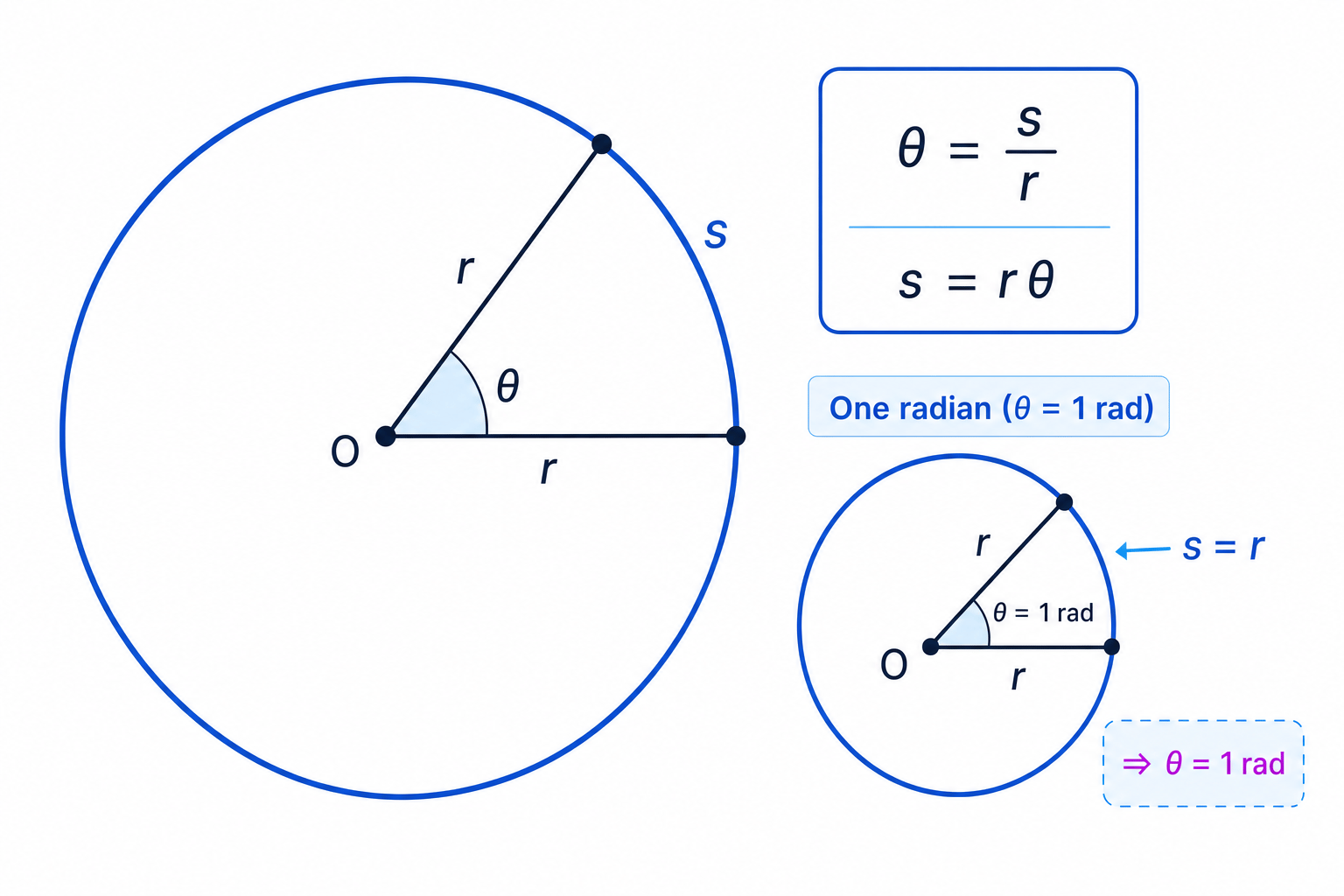
A full circle has circumference 2πr2\pi r2πr, so a full turn is:
θ=2πrr=2π rad\theta = \frac{2\pi r}{r} = 2\pi\ \text{rad}θ=r2πr=2π radRadians are dimensionless
Because θ=sr\theta = \frac{s}{r}θ=rs is length divided by length, radians are technically dimensionless. Still, write rad in answers to show clearly that you are using radians.
Using radians to find angular displacement
A point on the rim of a wheel of radius 0.18 m moves through an arc length of 0.72 m. Find the angular displacement in radians.
-
Use the radian definition:
θ=sr\theta = \frac{s}{r}θ=rs. -
Substitute the arc length and radius:
θ=0.72 m0.18 m=4.0 rad\theta = \frac{0.72\ \text{m}}{0.18\ \text{m}} = 4.0\ \text{rad}θ=0.18 m0.72 m=4.0 rad. -
Compare with a full turn if useful:
4.02π=0.64\frac{4.0}{2\pi} = 0.642π4.0=0.64, so the point has moved about 0.64 of a revolution.
Using degrees in circular motion formulae
Equations such as s=rθs = r\thetas=rθ, v=ωrv = \omega rv=ωr and ω=2πT\omega = \frac{2\pi}{T}ω=T2π assume angles are in radians. Do not put degrees directly into these equations.
Angular velocity
Angular displacement is the angle swept out by the radius joining the centre of the circle to the object. The symbol is usually θ\thetaθ.
Angular velocity
Angular velocity, ω\omegaω, is the rate of change of angular displacement: ω=ΔθΔt\omega = \frac{\Delta \theta}{\Delta t}ω=ΔtΔθ. Its unit is radians per second, written rad s−1\text{rad s}^{-1}rad s−1.
For steady circular motion, one complete revolution is 2π rad2\pi\ \text{rad}2π rad, so:
ω=2πT=2πf\omega = \frac{2\pi}{T} = 2\pi fω=T2π=2πfThe same symbol ω\omegaω is also used in simple harmonic motion (SHM). In SHM, it is often called angular frequency: it is the rate at which the phase angle changes, equivalent to the angular velocity of a matching reference circle.
Connecting angular velocity to linear speed
The linear speed, vvv, is the speed along the circular path. Since arc length is s=rθs = r\thetas=rθ:
v=ΔsΔt=rΔθΔt=ωrv = \frac{\Delta s}{\Delta t} = \frac{r\Delta \theta}{\Delta t} = \omega rv=ΔtΔs=ΔtrΔθ=ωrSo the further you are from the centre, the greater your linear speed for the same angular velocity.
Finding angular velocity and speed
A centrifuge spins at 1200 revolutions per minute. A sample is 0.24 m from the centre. Find ω\omegaω and vvv.
-
Convert revolutions per minute to hertz:
f=120060.0 s=20.0 Hzf = \frac{1200}{60.0\ \text{s}} = 20.0\ \text{Hz}f=60.0 s1200=20.0 Hz. -
Find the angular velocity:
ω=2πf=2π×20.0 s−1=126 rad s−1\omega = 2\pi f = 2\pi \times 20.0\ \text{s}^{-1} = 126\ \text{rad s}^{-1}ω=2πf=2π×20.0 s−1=126 rad s−1. -
Use v=ωrv = \omega rv=ωr:
v=126 s−1×0.24 m=30 m s−1v = 126\ \text{s}^{-1} \times 0.24\ \text{m} = 30\ \text{m s}^{-1}v=126 s−1×0.24 m=30 m s−1.
Centripetal acceleration and centripetal force
If an object moves at constant speed in a circle, its velocity is constantly changing direction. Therefore it has an acceleration.
Centripetal acceleration and force
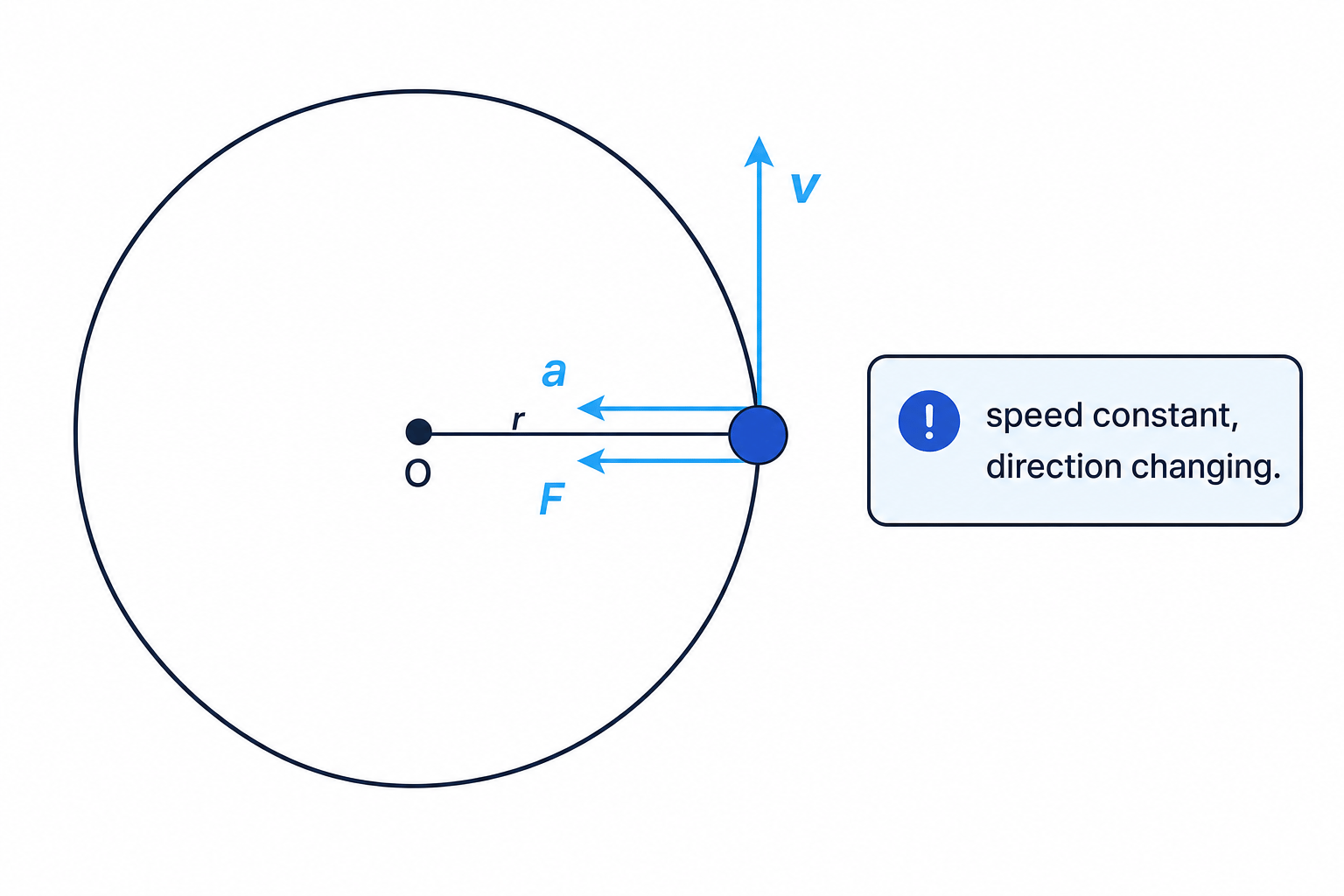
Centripetal means centre-seeking. In uniform circular motion, the acceleration is directed towards the centre of the circle, and the resultant force towards the centre is called the centripetal force.
The diagram shows the key directions: velocity is tangential, while acceleration and resultant force point inwards.
Constant speed does not mean zero acceleration
In circular motion, the speed can stay constant while the velocity changes because its direction changes. The acceleration is towards the centre, not in the direction of motion.
For a small time interval, the velocity vector turns through the same small angle as the radius. This leads to:
a=v2ra = \frac{v^2}{r}a=rv2Using v=ωrv = \omega rv=ωr, this can also be written as:
a=ω2ra = \omega^2 ra=ω2rThen using Newton’s second law, F=maF = maF=ma, the centripetal force equations are:
v=ωr,a=ω2r,a=v2r,F=mv2r,F=mω2rv = \omega r, \quad a = \omega^2 r, \quad a = \frac{v^2}{r}, \quad F = \frac{mv^2}{r}, \quad F = m\omega^2 rv=ωr,a=ω2r,a=rv2,F=rmv2,F=mω2rHere rrr is radius in metres, mmm is mass in kilograms, vvv is speed in metres per second, aaa is acceleration in metres per second squared, and FFF is force in newtons.
Calculating centripetal acceleration and force
A 0.150 kg object moves in a horizontal circle of radius 0.80 m with period 1.20 s. Find its centripetal acceleration and centripetal force.
-
Find the angular velocity:
ω=2πT=2π1.20 s=5.24 rad s−1\omega = \frac{2\pi}{T} = \frac{2\pi}{1.20\ \text{s}} = 5.24\ \text{rad s}^{-1}ω=T2π=1.20 s2π=5.24 rad s−1. -
Find the centripetal acceleration using a=ω2ra = \omega^2 ra=ω2r:
a=(5.24 s−1)2×0.80 m=22.0 m s−2a = \left(5.24\ \text{s}^{-1}\right)^2 \times 0.80\ \text{m} = 22.0\ \text{m s}^{-2}a=(5.24 s−1)2×0.80 m=22.0 m s−2. -
Calculate the centripetal force using F=maF = maF=ma:
F=0.150 kg×22.0 m s−2=3.30 NF = 0.150\ \text{kg} \times 22.0\ \text{m s}^{-2} = 3.30\ \text{N}F=0.150 kg×22.0 m s−2=3.30 N. -
Check with the direct equation:
F=mω2r=0.150 kg×(5.24 s−1)2×0.80 m=3.30 NF = m\omega^2 r = 0.150\ \text{kg} \times \left(5.24\ \text{s}^{-1}\right)^2 \times 0.80\ \text{m} = 3.30\ \text{N}F=mω2r=0.150 kg×(5.24 s−1)2×0.80 m=3.30 N.
Centripetal force is not an extra force
Do not draw “centripetal force” as an additional real force. The centripetal force is the inward resultant of real forces such as tension, friction, weight or normal contact force.
Uniform circular motion only
These equations apply when the object has constant speed and fixed radius. If the speed is changing, there is also tangential acceleration, so the resultant force is not purely towards the centre.
Practical and data-analysis links
A common practical context is a bung or mass moving in a horizontal circle on a string. You measure the radius, time many revolutions, and calculate TTT, fff and ω\omegaω.
Timing many revolutions reduces percentage uncertainty. For example, timing 20 revolutions gives a smaller percentage uncertainty in TTT than timing just one revolution.
If the centripetal force is provided by a hanging mass, the tension can be estimated using F=MgF = MgF=Mg, provided the hanging mass is stationary. To test F=mω2rF = m\omega^2 rF=mω2r, keep mmm and rrr constant and plot FFF against ω2\omega^2ω2. A straight line through the origin supports the model, with gradient mrmrmr.
Interpreting a centripetal-force graph
A rotating mass has m=0.050 kgm = 0.050\ \text{kg}m=0.050 kg and r=0.80 mr = 0.80\ \text{m}r=0.80 m. A graph of FFF against ω2\omega^2ω2 has gradient 0.038 kg m0.038\ \text{kg m}0.038 kg m. Compare this with the expected gradient.
-
From F=mω2rF = m\omega^2 rF=mω2r, the gradient of a graph of FFF against ω2\omega^2ω2 should be mrmrmr.
-
Calculate the expected gradient:
mr=0.050 kg×0.80 m=0.040 kg mmr = 0.050\ \text{kg} \times 0.80\ \text{m} = 0.040\ \text{kg m}mr=0.050 kg×0.80 m=0.040 kg m. -
Compare with the measured gradient:
0.040−0.0380.040×100%=5.0%\frac{0.040 - 0.038}{0.040} \times 100\% = 5.0\%0.0400.040−0.038×100%=5.0%, so the result is close if the experimental uncertainties are of that order.
In the exam
- Convert first: revolutions per minute to hertz, and degrees to radians if an angle calculation is involved.
- Draw the real forces, then identify which components give the inward resultant force.
- Choose the equation that matches the data given: use a=v2ra = \frac{v^2}{r}a=rv2 if you know vvv, or a=ω2ra = \omega^2 ra=ω2r if you know ω\omegaω.
- Watch proportionality carefully: for fixed radius, F∝v2F \propto v^2F∝v2; for fixed angular velocity, F∝rF \propto rF∝r.
- Carry units through calculations and round final answers to a sensible number of significant figures.
Check yourself
- Why can an object moving at constant speed in a circle still have acceleration?
- How are TTT, fff and ω\omegaω related for one complete revolution?
- If the speed of an object doubles while its radius stays the same, what happens to the centripetal force?
