

What you'll learn:
- What the de Broglie hypothesis is and how it bridges the gap between waves and particles.
- How to calculate the de Broglie wavelength of a moving particle.
- How low-energy electron diffraction proves that particles can behave like waves.
- How to derive and use the equation linking accelerating voltage to an electron's wavelength.
1. The de Broglie Hypothesis
Earlier in your physics journey, you learned that light—a wave—can sometimes behave as a stream of particles called photons (like in the photoelectric effect). In 1924, a physicist named Louis de Broglie asked a brilliant reverse question: If waves can act like particles, can particles act like waves?
He proposed that all matter has both wave and particle properties. This is known as wave-particle duality.
de Broglie wavelength ()
The wavelength associated with a moving particle. It depends on the particle's momentum and is linked by Planck's constant.
To find the wavelength of a particle, you use the de Broglie equation:
λ=hp \lambda = \frac{h}{p} λ=phBecause momentum ppp is equal to mass mmm multiplied by velocity vvv, you will often see it written like this:
λ=hmv \lambda = \frac{h}{mv} λ=mvhWhere:
- λ\lambdaλ is the de Broglie wavelength in metres (m)
- hhh is Planck's constant (6.63×10⁻³⁴ J s6.63 \times 10^{-34} \text{ J s}6.63×10⁻³⁴ J s)
- ppp is the momentum of the particle in kg m s−1\text{kg m s}^{-1}kg m s−1
- mmm is the mass of the particle in kilograms (kg)
- vvv is the velocity of the particle in metres per second (m s−1\text{m s}^{-1}m s−1)
The Ultimate Bridge
The de Broglie equation bridges two worlds. On the left side is wavelength (λ\lambdaλ), a purely wave property. On the right side is momentum (ppp), a purely particle property. Planck's constant (hhh) is the translator between the two!
If everything has a wavelength, why don't we see everyday objects diffracting around corners? Because Planck's constant hhh is incredibly small. For a macroscopic object like a football, its large mass makes its wavelength unimaginably tiny—so small that its wave properties are entirely unnoticeable. However, for an incredibly light particle like an electron, the wavelength becomes large enough to measure.
Worked Example: The wavelength of a moving electron
Calculate the de Broglie wavelength of an electron travelling at 4.0×10⁶ m s−14.0 \times 10^6 \text{ m s}^{-1}4.0×10⁶ m s−1. (Mass of an electron me=9.11×10⁻³¹ kgm_e = 9.11 \times 10^{-31} \text{ kg}me=9.11×10⁻³¹ kg)
- State the given values: v=4.0×10⁶ m s−1v = 4.0 \times 10^6 \text{ m s}^{-1}v=4.0×10⁶ m s−1 m=9.11×10⁻³¹ kgm = 9.11 \times 10^{-31} \text{ kg}m=9.11×10⁻³¹ kg h=6.63×10⁻³⁴ J sh = 6.63 \times 10^{-34} \text{ J s}h=6.63×10⁻³⁴ J s
- Write down the de Broglie equation:
- Substitute the values and calculate:
- State your final answer to appropriate significant figures: λ=1.8×10⁻¹⁰ m\lambda = 1.8 \times 10^{-10} \text{ m}λ=1.8×10⁻¹⁰ m (to 2 s.f., matching the given velocity)
2. Evidence for Wave-Particle Duality: Electron Diffraction
Saying an electron is a wave is a bold claim. To prove it, we need an experiment showing an electron doing something only a wave can do.
Diffraction—the spreading out of waves as they pass through a gap or around an obstacle—is a unique property of waves. However, significant diffraction only occurs when the size of the gap is roughly equal to the wavelength.
As we saw in the worked example, an electron's wavelength is roughly 10−10 m10^{-10} \text{ m}10−10 m. We cannot physically manufacture a slit that small. But nature can! The gaps between carbon atoms in a graphite crystal are approximately 10−10 m10^{-10} \text{ m}10−10 m apart.
The Experiment
If we fire a beam of electrons through a very thin slice of polycrystalline graphite, the electrons will diffract as they pass through the atomic gaps.
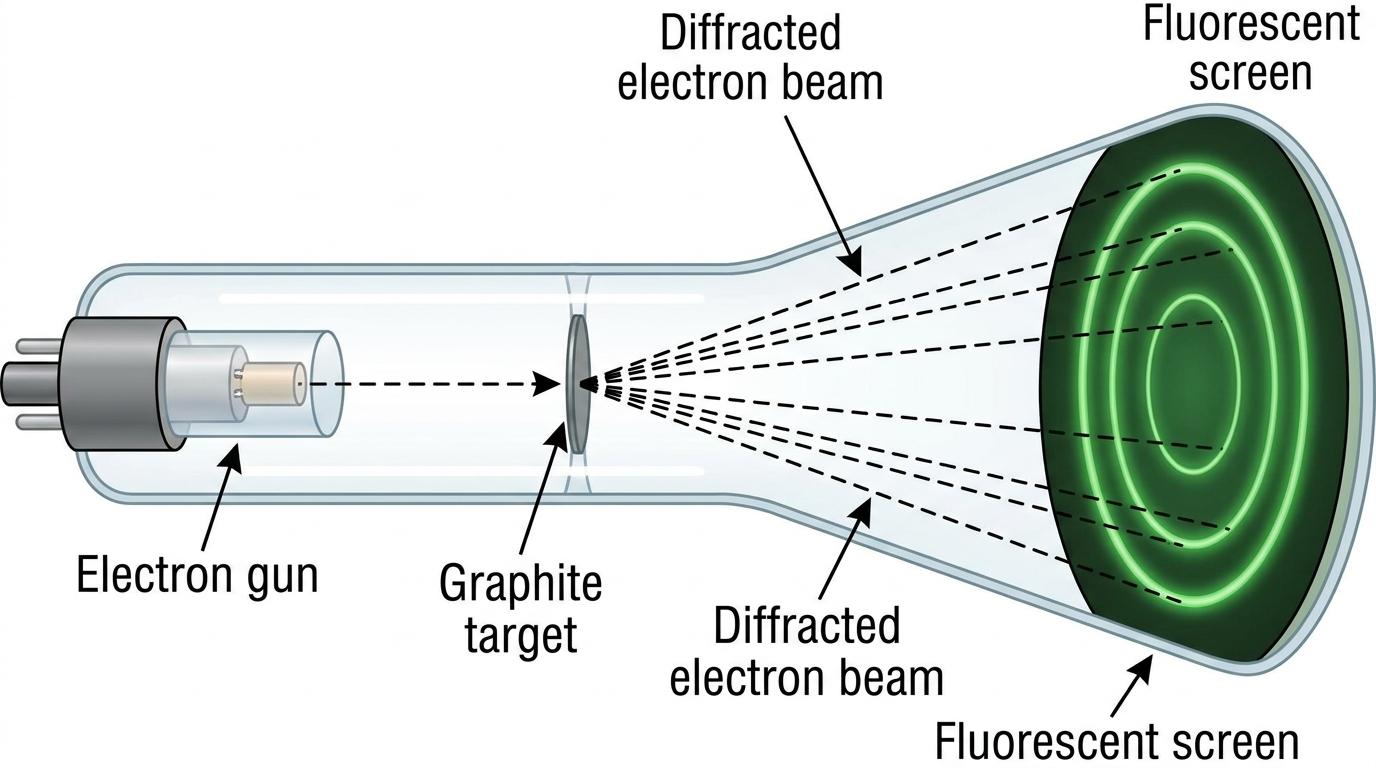
Graphite is "polycrystalline", meaning it is made up of many tiny, randomly oriented crystals. Because the crystal layers are tilted at all possible angles, the diffracted beams spread out in all directions, creating a pattern of concentric circular rings on a fluorescent screen. If electrons were purely particles, we would just see a single bright dot in the centre where they fired straight through!
Water waves through a gap
Think of water ripples passing through a gap in a harbour wall and spreading out into a semi-circle. The electrons are doing exactly the same thing as they pass between the graphite atoms, proving they have a wave nature.
The effect of changing electron speed
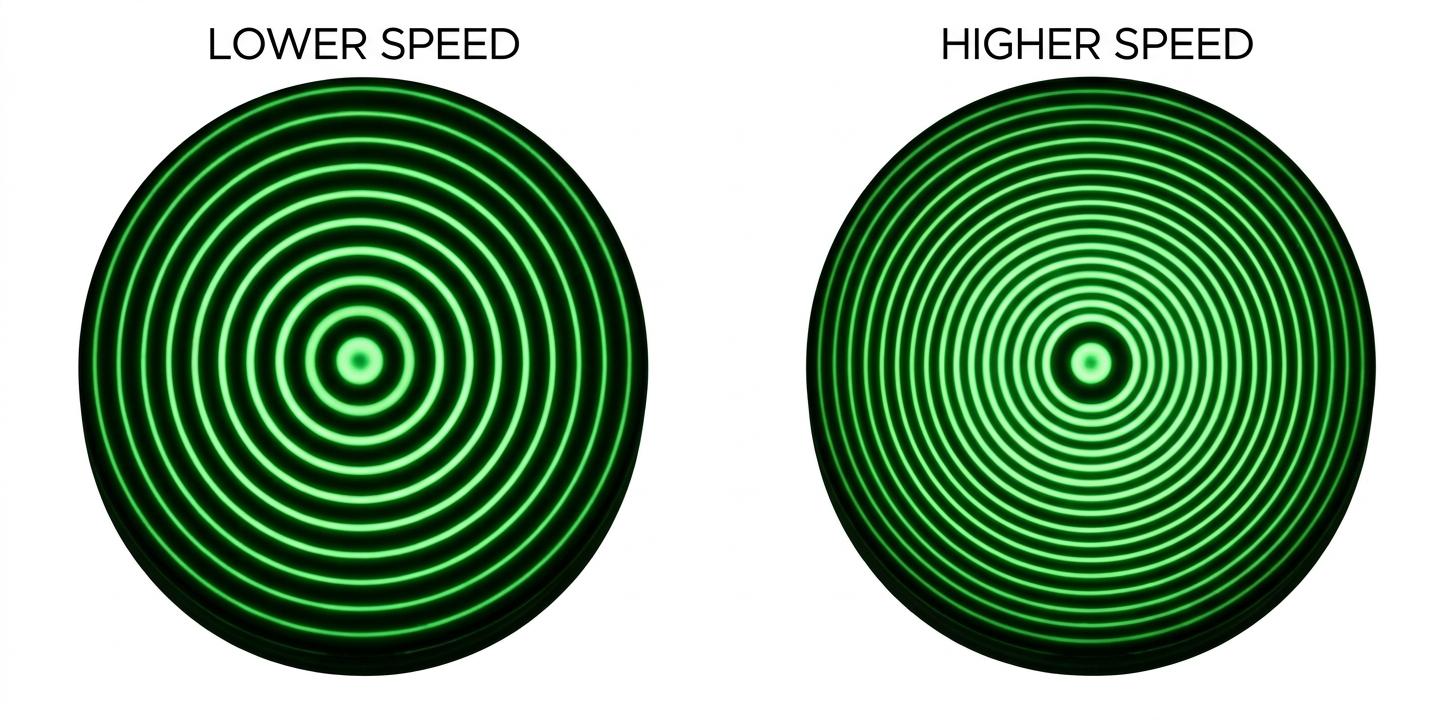
Exam questions frequently ask you to describe what happens to the diffraction pattern if you increase the speed of the electrons. This is a brilliant test of your conceptual understanding.
Let's break down the logic step-by-step:
- If the electron speed vvv increases, its momentum ppp also increases (since p=mvp = mvp=mv).
- According to the de Broglie equation (λ=hp\lambda = \frac{h}{p}λ=ph), momentum is inversely proportional to wavelength. So, an increase in momentum means the wavelength λ\lambdaλ decreases.
- A smaller wavelength means the electrons diffract less as they pass through the same graphite gaps.
- Therefore, the diffraction angle decreases, and the concentric rings on the screen squash closer together (the diameter of the rings decreases).
Confusing ring spacing with wavelength
Students often write "the rings get further apart because the speed is higher". This is incorrect! Always trace the logic back to the wavelength. Faster particles →\rightarrow→ smaller wavelength →\rightarrow→ smaller diffraction angle →\rightarrow→ rings are closer together.
3. Linking Accelerating Voltage to Wavelength
In the lab, we don't dial in the speed of an electron directly. Instead, we accelerate them from rest using a high potential difference (voltage). You need to be able to derive and use a formula that links this accelerating voltage directly to the de Broglie wavelength.
The Derivation
When an electron (charge eee) is accelerated through a potential difference (VVV), the electrical work done on it is transferred into kinetic energy (EkE_kEk).
Step 1: State the kinetic energy gained.
Ek=eV E_k = eV Ek=eVStep 2: Relate kinetic energy to momentum. We know Ek=12mv2E_k = \frac{1}{2}mv^2Ek=21mv2. If we multiply the top and bottom by mmm, we get:
Ek=m2v22m E_k = \frac{m^2v^2}{2m} Ek=2mm2v2Since p=mvp = mvp=mv, then p2=m2v2p^2 = m^2v^2p2=m2v2. Substitute this in:
Ek=p22m E_k = \frac{p^2}{2m} Ek=2mp2Step 3: Rearrange to make momentum ppp the subject.
p2=2mEk p^2 = 2mE_k p2=2mEk p=2mEk p = \sqrt{2mE_k} p=2mEkSince Ek=eVE_k = eVEk=eV, we can swap it in:
p=2meV p = \sqrt{2meV} p=2meVStep 4: Substitute this expression for momentum into the de Broglie equation.
λ=hp \lambda = \frac{h}{p} λ=ph λ=h2meV \lambda = \frac{h}{\sqrt{2meV}} λ=2meVhWatch out for V and v!
In these equations, a capital VVV stands for potential difference (voltage), while a lowercase vvv stands for velocity. Be very careful with your handwriting so you don't confuse them during an exam!
Worked Example: Wavelength from an accelerating voltage
An electron is accelerated from rest through a potential difference of 2500 V. Calculate its de Broglie wavelength. (Mass of an electron me=9.11×10⁻³¹ kgm_e = 9.11 \times 10^{-31} \text{ kg}me=9.11×10⁻³¹ kg, Elementary charge e=1.60×10⁻¹⁹ Ce = 1.60 \times 10^{-19} \text{ C}e=1.60×10⁻¹⁹ C)
- State the formula: You can either calculate velocity first, or use the direct formula we just derived:
- Substitute the known values into the denominator: Denominator = 2×9.11×10−31×1.60×10−19×2500\sqrt{2 \times 9.11 \times 10^{-31} \times 1.60 \times 10^{-19} \times 2500}2×9.11×10−31×1.60×10−19×2500 Denominator = 7.288×10−46\sqrt{7.288 \times 10^{-46}}7.288×10−46 Denominator = 2.6996...×10−23 kg m s−12.6996... \times 10^{-23} \text{ kg m s}^{-1}2.6996...×10−23 kg m s−1 (This is the momentum!)
- Calculate the wavelength:
- State the final answer: λ=2.46×10⁻¹¹ m\lambda = 2.46 \times 10^{-11} \text{ m}λ=2.46×10⁻¹¹ m (to 3 s.f.)
In the exam
- Check your unit prefixes: Accelerating voltages are frequently given in kilovolts (kV). You must convert this to volts (1 kV=1000 V1 \text{ kV} = 1000 \text{ V}1 kV=1000 V) before putting it into the 2meV\sqrt{2meV}2meV equation.
- Learn the Ek=p22mE_k = \frac{p^2}{2m}Ek=2mp2 trick: Being able to quickly swap between kinetic energy and momentum without having to calculate the velocity vvv in an intermediate step saves loads of time and prevents rounding errors.
- Remember the proportionality: The formula λ=h2meV\lambda = \frac{h}{\sqrt{2meV}}λ=2meVh shows that λ∝1V\lambda \propto \frac{1}{\sqrt{V}}λ∝V1. If an exam question says the accelerating voltage is quadrupled, the wavelength will halve!
Check yourself
- What equation links a particle's wave property to its particle property?
- Why do we use polycrystalline graphite to observe electron diffraction instead of a standard laboratory diffraction grating?
- If the accelerating voltage in an electron gun is decreased, what happens to the diameter of the diffraction rings on the screen? (Trace the logic steps!)
