The discovery of photoelectricity (A-level only)
Welcome to one of the most exciting turning points in physics! Up until the late 19th century, physicists thought they had light completely figured out. It was a wave, described perfectly by classical electromagnetism. But then, a few stubborn experiments refused to fit the rules.
In this topic, you will learn:
- What the ultraviolet catastrophe was and how it broke classical physics.
- How Max Planck saved the day by introducing quanta.
- Why classical wave theory completely failed to explain the photoelectric effect.
- How Albert Einstein used the photon model to explain photoelectricity, changing our understanding of light forever.
Let's dive into the mysteries that forced physicists to rewrite the rulebook.
The Ultraviolet Catastrophe
To understand why quantum physics was invented, we first need to look at glowing hot objects.
Black-body
A black-body is an idealised object that absorbs all electromagnetic radiation that shines on it. When it heats up, it also emits radiation perfectly across all wavelengths. The radiation it emits is called black-body radiation.
When you heat a piece of metal, it glows red, then yellow, then white. This happens because the peak wavelength of the radiation it emits gets shorter as the temperature increases.
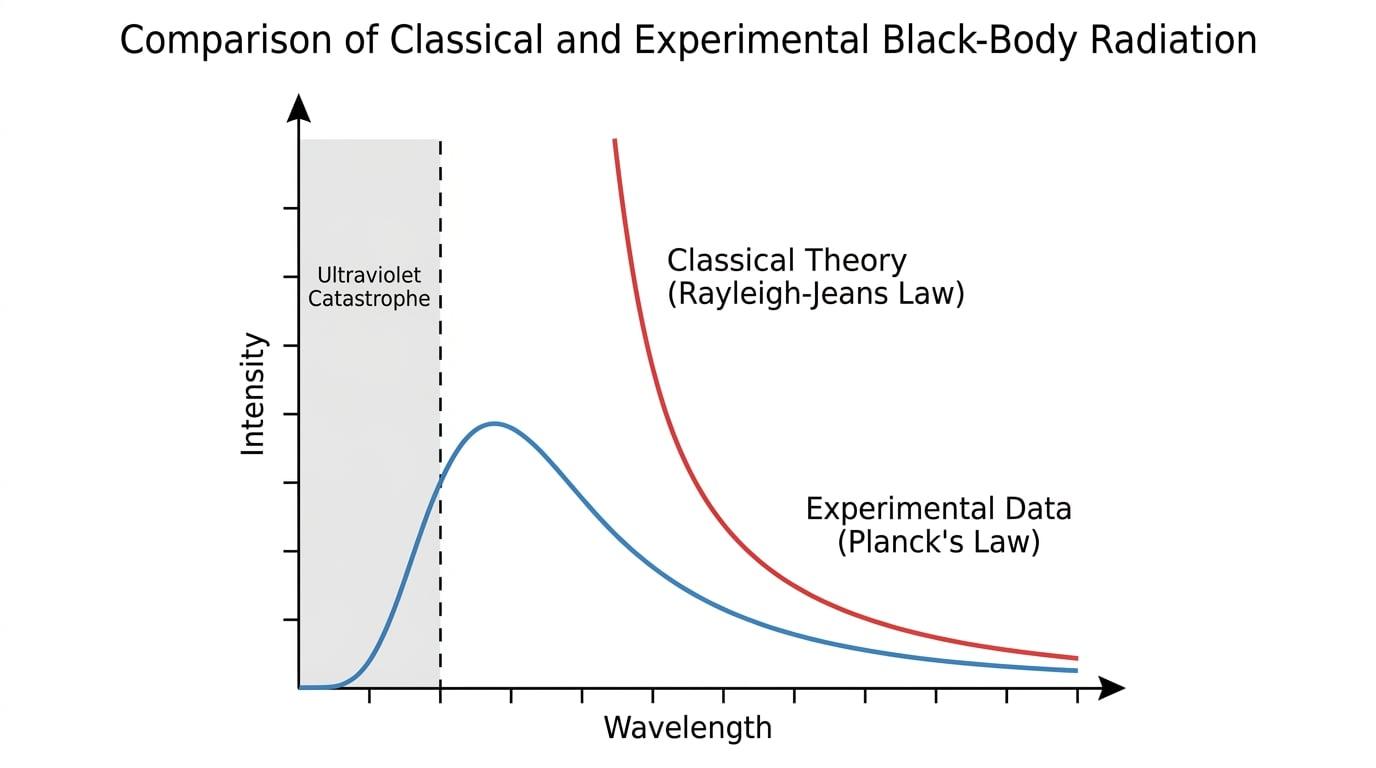
Late 19th-century physicists tried to use classical wave theory to predict how much energy a black body should emit at each wavelength. Their mathematical models worked perfectly for long wavelengths (infrared and red light). However, the classical theory predicted that as the wavelength got shorter (towards the ultraviolet region), the intensity of the radiation should increase towards infinity!
If this were true, opening a warm oven would blast you with lethal doses of infinite ultraviolet and X-ray radiation. Thankfully, experimental data showed something entirely different: the intensity peaks at a certain wavelength and then drops back down to zero for very short wavelengths.
This massive disagreement between the classical prediction and experimental reality became known as the ultraviolet catastrophe.
Planck's Radical Solution: Quanta
In the year 1900, a physicist named Max Planck found a mathematical trick that perfectly matched the experimental curve and solved the catastrophe. But to do it, he had to make an assumption that seemed completely crazy at the time.
Classical physics assumed that energy was continuous—like a ramp, where you can stand at any height. Planck proposed that the atoms vibrating inside the black body could only emit or absorb energy in discrete, indivisible "packets" or "chunks". He called these packets quanta (singular: quantum).
Planck proposed that the energy EEE of each quantum is directly proportional to the frequency fff of the radiation:
E=hf E = hf E=hfHere, hhh is Planck's constant (6.63×10⁻³⁴ J s6.63 \times 10^{-34}\text{ J s}6.63×10⁻³⁴ J s).
By forcing energy to be released in these specific chunks, Planck's math naturally suppressed the emission of high-frequency (short wavelength) ultraviolet radiation, perfectly matching the experimental curve. The ultraviolet catastrophe was solved!
The Birth of Quantum Theory
Planck's idea was that energy is quantised. It cannot be divided infinitely. It must be transferred in discrete chunks (E=hfE=hfE=hf).
The Photoelectric Effect: Wave Theory Fails Again
Planck thought his "quanta" idea was just a mathematical trick for vibrating atoms. But soon after, another phenomenon emerged that classical physics couldn't explain: the photoelectric effect.
When you shine certain frequencies of light onto a metal surface, electrons are emitted. These are called photoelectrons. Classical wave theory made three very specific predictions about how this should work. Let's look at what wave theory predicted, versus what actually happened in the lab.
1. The Threshold Frequency
- Classical Wave Theory prediction: Any frequency of light should cause electrons to be emitted, as long as you shine it on the metal for long enough. The wave's energy would just slowly build up in the electron until it had enough to escape.
- Experimental reality: There is a minimum frequency required to emit electrons, called the threshold frequency (f0f_0f0). If you shine light below this frequency (e.g., red light on zinc), no electrons are ever emitted, no matter how bright the light is or how long you wait.
2. Time Delay
- Classical Wave Theory prediction: If the light is very dim, it should take time for the wave energy to "pool" together and provide enough energy for an electron to escape.
- Experimental reality: Emission is instantaneous (as long as the frequency is above the threshold). Even with the dimmest possible light, an electron is emitted the exact moment the light hits the metal.
3. Kinetic Energy of Photoelectrons
- Classical Wave Theory prediction: The maximum kinetic energy of the emitted electrons should depend on the intensity (brightness) of the light. Brighter light means a taller wave with more energy, so the electrons should fly out faster.
- Experimental reality: The maximum kinetic energy depends strictly on the frequency of the light. Increasing the intensity only increases the number of electrons emitted per second, but does not make them move any faster.
Confusing intensity and frequency
In classical physics, higher intensity means more energy. In quantum physics, a higher intensity beam just means more photons per second. It does not mean the photons themselves have more energy. Only increasing the frequency increases the energy of individual photons.
Einstein's Photon Model
In 1905, Albert Einstein provided the brilliant solution. He took Planck's idea of "quanta" and took it a step further.
Einstein proposed that it wasn't just the atoms inside a black body that were quantised. He argued that electromagnetic radiation itself travels through space as discrete packets of energy. He called these light quanta photons.
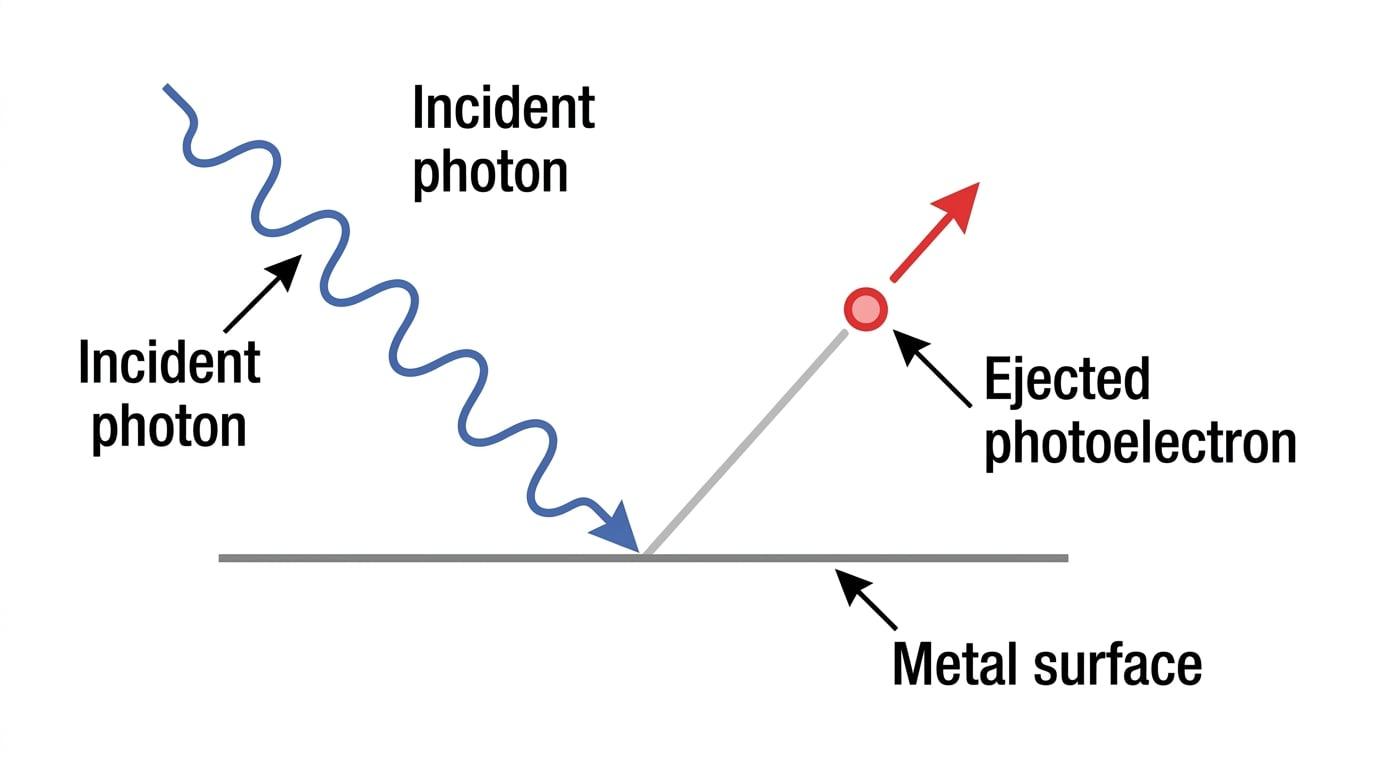
Einstein proposed a one-to-one interaction: one single photon interacts with one single electron. The photon transfers all of its energy (hfhfhf) to that specific electron instantly.
This elegantly explained every single failure of the classical wave theory:
- Threshold frequency explained: An electron requires a certain amount of energy to break free from the metal, known as the work function (ϕ\phiϕ). Since one electron can only absorb one photon, that single photon must carry enough energy to pay the "exit toll". If hf<ϕhf < \phihf<ϕ, the electron cannot escape. It doesn't matter how many billions of low-energy photons hit the metal (intensity); none of them individually have enough energy.
- Instant emission explained: Because it's a particle-like collision, the energy transfer is instant. There is no waiting for wave energy to "build up".
- Kinetic energy explained: Any energy the photon has left over after paying the work function becomes the kinetic energy (EkE_kEk) of the electron. Since hf=ϕ+Ekhf = \phi + E_khf=ϕ+Ek, the maximum kinetic energy depends entirely on the frequency of the incoming photon, not on how many photons there are (the intensity).
Einstein's breakthrough
Classical physics treated light as a continuous wave. Einstein successfully proved that light must behave as a stream of particles (photons) to explain the photoelectric effect.
Explaining the failure of wave theory
Question: Ultraviolet light is shone onto a negatively charged zinc plate, causing it to discharge instantly. When visible light is shone onto the same plate, it does not discharge, regardless of how bright the visible light is.
Explain how Einstein's photon model accounts for these observations, and why classical wave theory cannot explain them. (6 marks)
Answer:
- According to the photon model, light travels as discrete packets of energy called photons.
- The energy of a photon is proportional to its frequency (E=hfE=hfE=hf). Ultraviolet light has a higher frequency than visible light, so its photons carry more energy.
- In the photoelectric effect, there is a one-to-one interaction between a photon and an electron.
- An electron requires a minimum amount of energy to escape the metal, called the work function. The UV photons have enough energy to overcome this work function, but visible light photons do not.
- Classical wave theory incorrectly predicts that any frequency of light should eventually cause emission, because wave energy is continuous and should build up over time.
- The instant discharge with UV light, and lack of discharge with bright visible light, proves that energy does not build up, contradicting the wave model and confirming the photon model.
In the exam
- When asked why wave theory fails, clearly state what wave theory predicts vs what actually happens. Use phrases like "Wave theory suggests energy should accumulate over time, but emission is instantaneous."
- Always explicitly mention the one-to-one interaction between a single photon and a single electron when explaining Einstein's theory. Examiners look for this specific phrase!
- Be careful with your vocabulary: refer to light as having "photons" and the metal as having "electrons". Do not accidentally say a photon is emitted from the metal!
Check yourself
- Can you describe the 'ultraviolet catastrophe' in one sentence?
- What is the difference between Planck's idea of quanta and Einstein's idea of a photon?
- Why does increasing the intensity of light below the threshold frequency still fail to eject photoelectrons?
- According to classical wave theory, what should happen to the kinetic energy of an emitted electron if you make the light much brighter?