

Welcome to the non-optical universe! While optical telescopes give us stunning pictures of the visible cosmos, there is a whole universe of invisible electromagnetic radiation out there. Pulsars blast out radio waves, cold nebulae glow in the infrared, and supermassive black holes fire out extreme X-rays.
What you'll learn in this topic:
- How a radio telescope's structure differs from an optical telescope.
- Why we build different telescopes in very specific locations (from deep valleys to outer space).
- How to compare the resolving power and collecting power of non-optical telescopes against optical ones.
- The unique engineering required to focus infrared and X-ray radiation.
1. Comparing Telescopes: The Two Golden Rules
Whenever you are asked to compare telescopes in an exam, the question almost always boils down to two key properties. Keep these at the front of your mind:
- Resolving Power: This is determined by the Rayleigh criterion, θ≈λD\theta \approx \frac{\lambda}{D}θ≈Dλ. A smaller angle θ\thetaθ means better resolving power. Because different types of telescopes observe vastly different wavelengths (λ\lambdaλ), their minimum angular resolutions are drastically different.
- Collecting Power: This is a measure of how much energy the telescope gathers. It is proportional to the area of the objective (the dish or mirror), so P∝D2P \propto D^2P∝D2, where DDD is the diameter.
2. Radio Telescopes: Structure and Use
Radio waves have the longest wavelengths in the electromagnetic spectrum (from about 1 mm1 \text{ mm}1 mm up to several metres). This single fact changes everything about how a radio telescope is built compared to an optical telescope.
Structure
An optical telescope uses a highly polished, heavily-coated solid glass mirror. A radio telescope, however, consists of a parabolic dish that reflects radio waves to a focal point. At this focal point, instead of a secondary mirror or an eyepiece, there is an aerial (or antenna) that detects the radio waves and sends the signal to a computer.
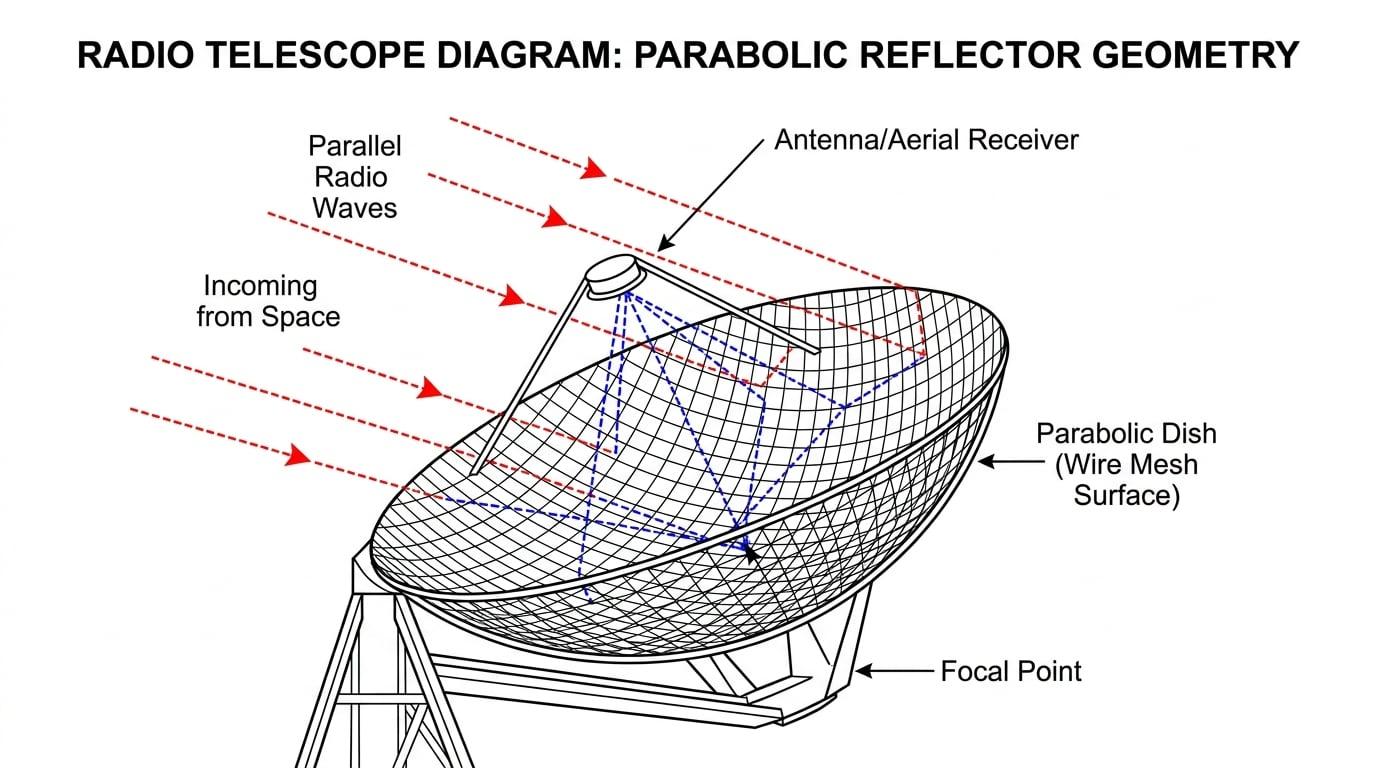
Crucially, the dish does not need to be a solid piece of metal. It is usually made of a wire mesh.
The Wire Mesh Rule
Electromagnetic waves will reflect off a mesh as long as the gaps in the mesh are smaller than about λ10\frac{\lambda}{10}10λ. Because radio wavelengths are so large, the gaps in the wire mesh can be quite wide (often several centimetres).
This makes radio dishes incredibly light for their size, meaning they can be built much larger than optical mirrors.
Calculating the mesh spacing
An astronomer wants to build a single dish radio telescope to detect the famous "hydrogen line" from distant galaxies, which has a frequency of 1.42×10⁹ Hz1.42 \times 10^9 \text{ Hz}1.42×10⁹ Hz. Calculate the maximum acceptable gap size between the wires in the mesh.
- First, find the wavelength of the radio waves using the wave equation c=fλc = f \lambdac=fλ. Rearrange for wavelength: λ=cfλ=3.00×1081.42×109λ≈0.211 m\begin{aligned} \lambda &= \frac{c}{f} \\ \lambda &= \frac{3.00 \times 10^8}{1.42 \times 10^9} \\ \lambda &\approx 0.211 \text{ m} \end{aligned}λλλ=fc=1.42×1093.00×108≈0.211 m
- Determine the maximum gap size, which must be less than λ10\frac{\lambda}{10}10λ: Max gap=0.21110Max gap≈0.021 m\begin{aligned} \text{Max gap} &= \frac{0.211}{10} \\ \text{Max gap} &\approx 0.021 \text{ m} \end{aligned}Max gapMax gap=100.211≈0.021 m
- State the final answer: The maximum gap size is approximately 2.1 cm2.1 \text{ cm}2.1 cm.
Positioning
Optical telescopes are placed on high mountains to avoid atmospheric turbulence and light pollution. Radio telescopes are different:
- The atmosphere does not severely distort or absorb radio waves (there is a large "radio window" in the atmosphere).
- Therefore, radio telescopes can be built closer to sea level.
- However, they must be completely isolated from human-made radio interference (like mobile phone masts, radar, and TV broadcasts). For this reason, they are often built in remote areas or inside valleys, where the surrounding hills block out terrestrial signals.
Comparing Powers
Comparing Optical and Radio
- Collecting Power: Radio telescopes win easily. Because wire mesh is cheap and light, a typical radio dish might have a diameter of 100 m100 \text{ m}100 m, compared to an optical mirror's 2 m2 \text{ m}2 m to 10 m10 \text{ m}10 m. Since P∝D2P \propto D^2P∝D2, the collecting power of a radio telescope is vastly superior.
- Resolving Power: Optical telescopes win easily. A radio wave might have a wavelength 10610^6106 times longer than visible light. Even with a massive dish diameter DDD, the Rayleigh criterion θ≈λD\theta \approx \frac{\lambda}{D}θ≈Dλ means the resolving angle for a radio telescope is far larger (worse) than for a modest optical telescope.
Bigger resolving power isn't better
Be very careful with terminology! "High resolving power" or "better resolving power" means the telescope can distinguish very fine details. This corresponds to a smaller minimum angular resolution (θ\thetaθ). Do not say a radio telescope has a "bigger resolving power" when you mean its minimum angle is larger!
3. Infrared (IR) Telescopes
Infrared telescopes detect radiation from cooler objects in the universe, such as dust clouds, brown dwarfs, and newly forming stars.
Structure
IR telescopes are structurally very similar to optical telescopes—they usually use a Cassegrain reflector setup. However, there is a major problem: everything that has a temperature emits infrared radiation. If the telescope itself is warm, it will emit its own infrared radiation, completely swamping out the faint signals from space!
To fix this, the mirrors and detectors of an IR telescope must be cryogenically cooled (often down to a few Kelvin using liquid helium).
Positioning
Water vapour in the Earth's atmosphere strongly absorbs infrared radiation. Therefore, to get a clear view, IR telescopes must be placed in very high, dry locations (like the Mauna Kea volcano in Hawaii, or aboard high-altitude aeroplanes) or, ideally, put into outer space (like the James Webb Space Telescope).
4. Ultraviolet (UV) Telescopes
Ultraviolet telescopes look at extremely hot phenomena, such as young, massive O-type stars and the violent matter falling into black holes.
Structure
Like IR telescopes, UV telescopes also use a Cassegrain reflecting mirror design. Because UV wavelengths are very short (shorter than visible light), the mirrors must be polished to an incredible degree of smoothness. Even microscopic imperfections will scatter the tiny UV waves and ruin the image.
Positioning
The Earth's ozone layer absorbs almost all incoming ultraviolet radiation. This is great for our skin, but terrible for astronomy. Because of this total atmospheric absorption, UV telescopes must be placed in space.
Resolving power of UV telescopes
Because UV light has a shorter wavelength (λ\lambdaλ) than visible light, a UV telescope has a much smaller minimum angular resolution (θ\thetaθ) than an optical telescope of the exact same diameter. Therefore, UV telescopes inherently have better resolving power.
5. X-Ray Telescopes
X-rays are generated by the most extreme, high-energy events in the universe, such as supernovae remnants and active galactic nuclei.
Structure
You cannot use a normal Cassegrain mirror to focus X-rays. Because X-rays have extremely high energy and very short wavelengths, they will just pass straight through a standard solid mirror, or be absorbed by it.
Instead, astronomers use grazing incidence mirrors (often called Wolter telescopes).
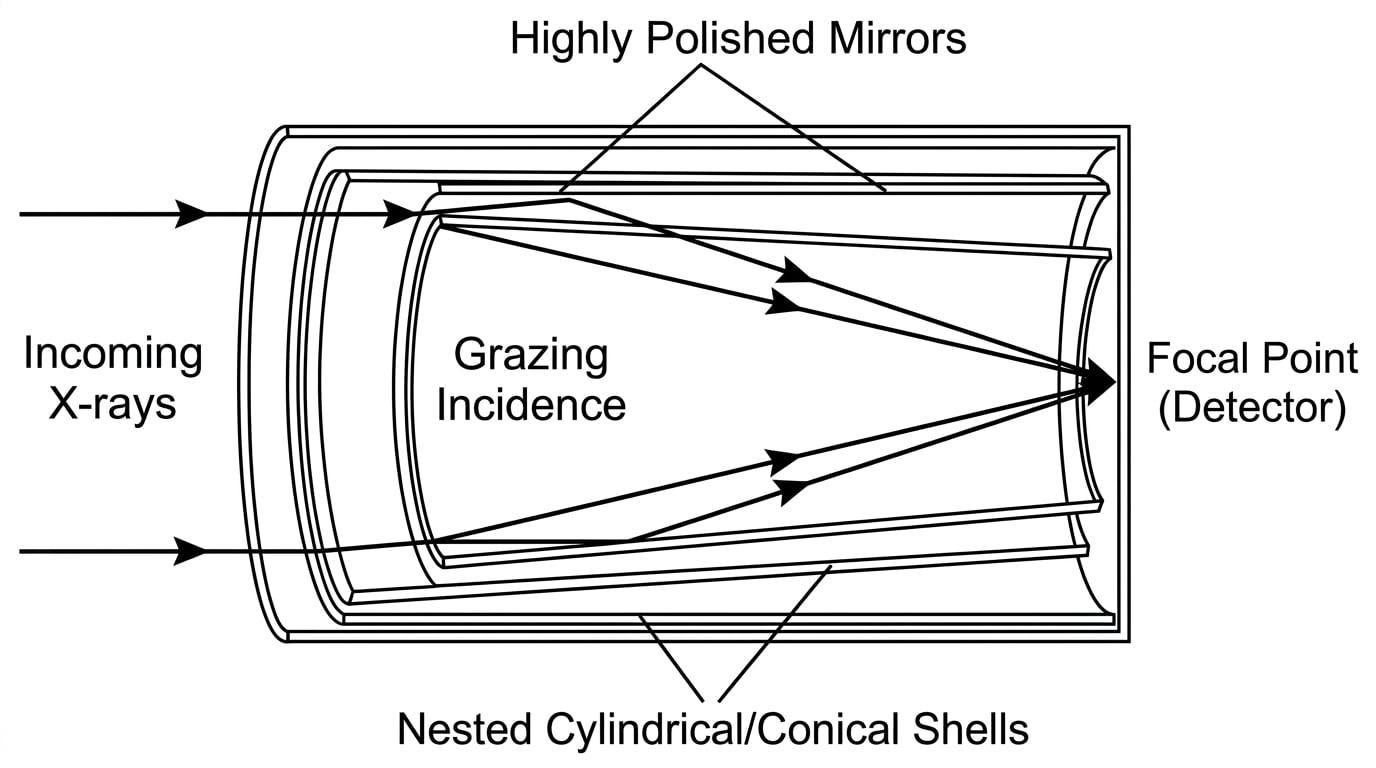
These are nested, highly polished metal cylinders. Incoming X-rays strike the interior walls of these cylinders at an incredibly shallow angle (less than 1∘1^\circ1∘). Just like skipping a flat stone across the surface of a pond, the X-rays "graze" the surface and are gently deflected to a focal point.
Positioning
The atmosphere absorbs all incoming X-rays. Just like UV telescopes, X-ray telescopes must be positioned in outer space.
Comparing the resolving power of X-ray and Optical
A space-based optical telescope has a mirror diameter of 2.4 m2.4 \text{ m}2.4 m and observes light at a wavelength of 500 nm500 \text{ nm}500 nm. A space-based X-ray telescope has an effective diameter of 1.2 m1.2 \text{ m}1.2 m and observes X-rays at a wavelength of 2.0 nm2.0 \text{ nm}2.0 nm. Compare their minimum angular resolutions.
- Calculate the minimum angular resolution for the optical telescope: θoptical=λDθoptical=500×10−92.4θoptical≈2.08×10⁻⁷ rad\begin{aligned} \theta_{\text{optical}} &= \frac{\lambda}{D} \\ \theta_{\text{optical}} &= \frac{500 \times 10^{-9}}{2.4} \\ \theta_{\text{optical}} &\approx 2.08 \times 10^{-7} \text{ rad} \end{aligned}θopticalθopticalθoptical=Dλ=2.4500×10⁻⁹≈2.08×10⁻⁷ rad
- Calculate the minimum angular resolution for the X-ray telescope: θx-ray=λDθx-ray=2.0×10−91.2θx-ray≈1.67×10⁻⁹ rad\begin{aligned} \theta_{\text{x-ray}} &= \frac{\lambda}{D} \\ \theta_{\text{x-ray}} &= \frac{2.0 \times 10^{-9}}{1.2} \\ \theta_{\text{x-ray}} &\approx 1.67 \times 10^{-9} \text{ rad} \end{aligned}θx-rayθx-rayθx-ray=Dλ=1.22.0×10−9≈1.67×10⁻⁹ rad
- Conclude the comparison: The X-ray telescope has a significantly smaller minimum angular resolution (by a factor of roughly 125). This means its theoretical resolving power is far superior, despite having a smaller diameter, due to the extremely short wavelength of X-rays.
In the exam
- State the equation first: If asked to compare telescopes, explicitly write down P∝D2P \propto D^2P∝D2 for collecting power and θ≈λD\theta \approx \frac{\lambda}{D}θ≈Dλ for resolving power before making your point. The examiners will look for these to award the first marks.
- Be specific about positioning: Don't just say "put it in space to avoid the atmosphere". Name the specific atmospheric blocker. Say "water vapour absorbs IR" or "the ozone layer absorbs UV".
- Remember the mesh condition: If asked why a radio dish isn't solid, mention that long radio wavelengths will reflect off a mesh provided the gaps are smaller than λ10\frac{\lambda}{10}10λ. State that this reduces weight and cost, allowing for a much larger diameter DDD.
- Learn the grazing incidence phrase: For X-ray telescope structure, the exact phrase "grazing incidence mirrors" will earn the marks. Explain that normal mirrors would absorb or transmit the X-rays.
Check yourself
- Why can a radio telescope dish be made of wire mesh instead of a solid surface?
- Why does a typical radio telescope have a much larger resolving angle than an optical telescope?
- What unique structural feature is required for an infrared telescope, and why?
- Why must X-ray telescopes rely on "grazing incidence" rather than standard curved mirrors?
- Which of the non-optical telescopes discussed must be positioned in space?
