Welcome to the A-level specific content for telescopes! If you have ever wondered why space agencies and universities spend billions to build telescopes with mirrors the size of tennis courts, this is the topic for you.
What you'll learn:
- Why diffraction limits the detail a telescope can see, and how the Rayleigh criterion defines this limit.
- How a telescope's collecting power depends on its diameter.
- Why astronomers use CCDs instead of the human eye to capture images, comparing them in terms of quantum efficiency, resolution, and convenience.
1. Minimum Angular Resolution and the Rayleigh Criterion
When you look at two distant stars that are very close together in the sky, they might look like a single blurry blob. A telescope's ability to tell them apart as two distinct objects is called its resolving power or resolution.
You might think that making perfect, flawless lenses or mirrors would allow us to zoom in infinitely. Unfortunately, physics gets in the way. Because light acts as a wave, it diffracts when it passes through the circular aperture (opening) of a telescope.
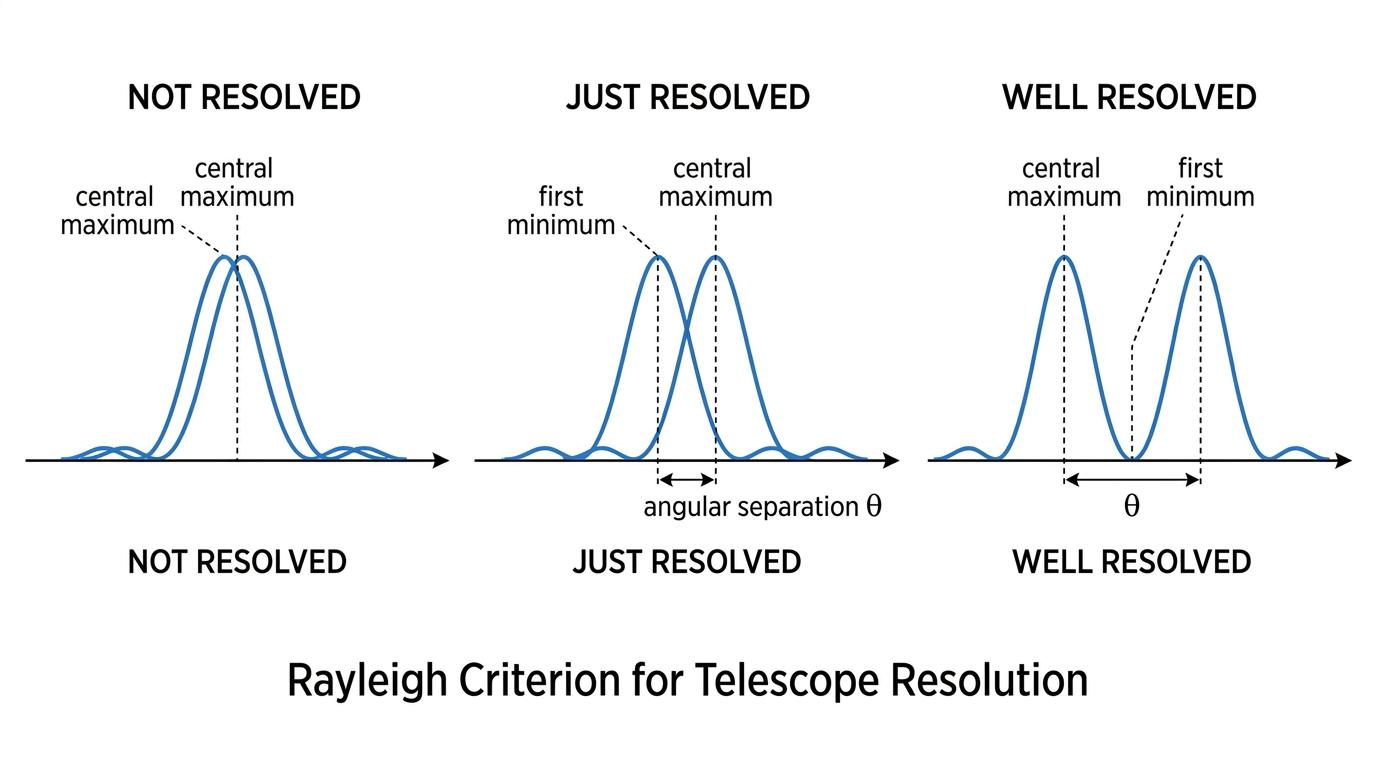
Instead of focusing light into a single infinitely small point, the telescope focuses light into a central bright spot surrounded by faint rings. This pattern is called an Airy disc. If two stars are close together, their Airy discs overlap.
The Rayleigh Criterion
Two point sources are said to be just resolved when the central maximum of one diffraction pattern coincides perfectly with the first minimum of the other diffraction pattern.
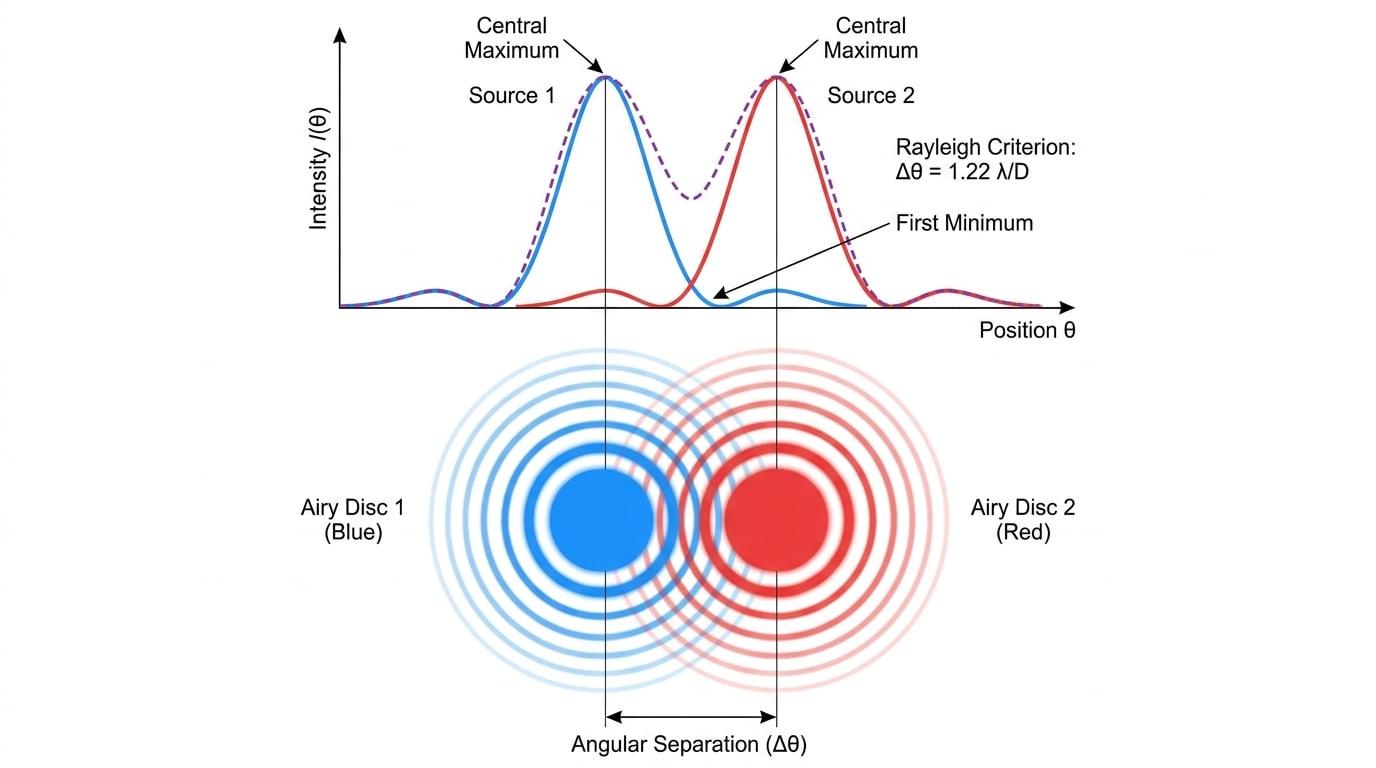
If the stars are any closer together than this, their bright central spots merge, and you can no longer tell them apart. We measure this separation as an angle in the sky, called the minimum angular resolution, θ\thetaθ.
The formula for the minimum angular resolution is given by the Rayleigh criterion equation:
θ≈λD \theta \approx \frac{\lambda}{D} θ≈DλWhere:
- θ\thetaθ is the minimum angular resolution, measured in radians (rad).
- λ\lambdaλ is the wavelength of the light being observed, measured in metres (m).
- DDD is the diameter of the telescope's objective lens or mirror, measured in metres (m).
Smaller is better for resolution
A smaller value for θ\thetaθ means the telescope can resolve objects that are closer together. To get a smaller θ\thetaθ (better resolution), you need to observe at a shorter wavelength λ\lambdaλ, or build a telescope with a larger diameter DDD. This is a primary advantage of large-diameter telescopes!
Forgetting radians
In astronomy questions, angles are almost always incredibly small. Remember that θ\thetaθ in this formula is always in radians (rad), not degrees. AQA examiners frequently test your ability to convert between radians and degrees or arcseconds, but the output of λD\frac{\lambda}{D}Dλ is strictly in radians.
Worked Example: Calculating Angular Resolution
Let's look at how AQA might test your understanding of the Rayleigh criterion.
Resolving binary stars
A binary star system consists of two stars. An astronomer uses an optical telescope with an objective mirror of diameter 2.4 m2.4\text{ m}2.4 m to observe the system. The average wavelength of light from the stars is 550 nm550\text{ nm}550 nm.
Calculate the minimum angular resolution of the telescope.
- Identify the given values and convert to SI units: Diameter, D=2.4 mD = 2.4\text{ m}D=2.4 m. Wavelength, λ=550×10−9 m\lambda = 550 \times 10^{-9}\text{ m}λ=550×10−9 m.
- State the Rayleigh criterion formula:
- Substitute the values into the equation:
- Calculate the final answer and state the correct unit:
2. Collecting Power
The second major advantage of a large diameter telescope is its collecting power.
Stars are incredibly far away, so the amount of light energy reaching Earth from them is tiny. To see faint, distant objects (like distant galaxies), a telescope needs to capture as much light as possible.
The collecting power of a telescope is a measure of the rate at which useful light energy is collected by the objective. It is directly proportional to the area of the objective mirror or lens.
Since the objective is circular, its area AAA is given by A=π(D2)2A = \pi \left( \frac{D}{2} \right)^2A=π(2D)2. Therefore, the area is proportional to the square of the diameter:
Collecting Power∝D2 \text{Collecting Power} \propto D^2 Collecting Power∝D2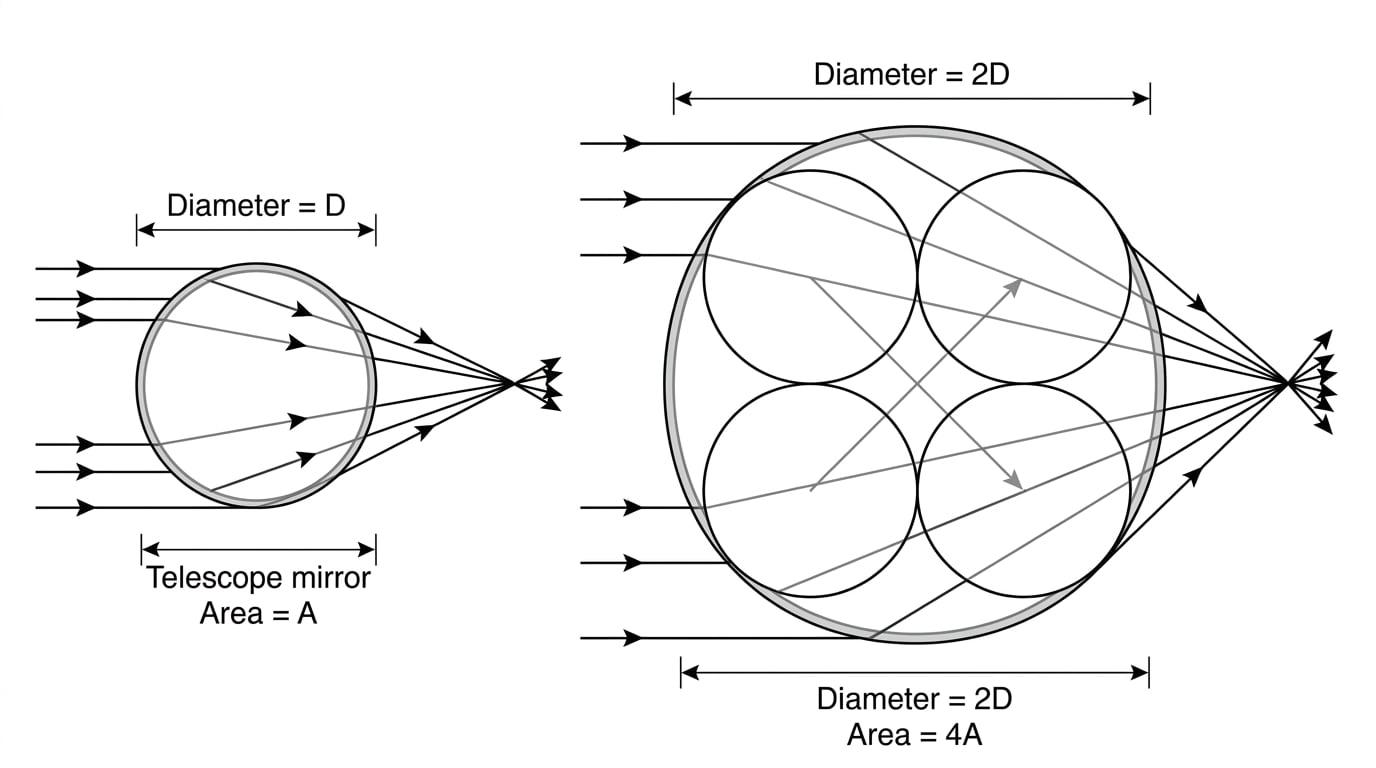
If you double the diameter of a telescope, you don't just double the collecting power; you increase it by a factor of four (22=42^2 = 422=4). If you make the diameter 10 times larger, it collects 100 times more light!
Comparing collecting powers
Astronomers are comparing an older telescope with a diameter of 1.5 m1.5\text{ m}1.5 m to a newly built telescope with a diameter of 6.0 m6.0\text{ m}6.0 m.
Calculate the ratio of the collecting power of the new telescope to the older telescope.
- Recall the relationship: Collecting Power ∝D2\propto D^2∝D2
- Set up the ratio:
- Substitute the diameters:
- Calculate the final value:
The new telescope has 16 times the collecting power of the older one.
3. Detectors: The Eye vs the CCD
Historically, astronomers looked directly through the eyepieces of their telescopes. Today, virtually all professional optical telescopes use a CCD (Charge-Coupled Device) to detect light.
Note: You do not need to know how the internal structure of a CCD works, nor how it shifts charge. You only need to compare it to the human eye.
We compare detectors across three main categories:
1. Quantum Efficiency (QE)
Quantum efficiency is the percentage of incident photons that are actually detected by the sensor.
- The Human Eye: Has a low quantum efficiency of roughly 1% to 2%. For every 100 photons hitting your retina, only 1 or 2 trigger a nerve impulse.
- A CCD: Has a very high quantum efficiency, typically around 80% or even higher. It is incredibly sensitive, meaning it can detect much fainter objects than the eye using the same telescope.
2. Resolution
- The Human Eye: Resolution is limited by the physical distance between the light-detecting cells (rods and cones) on the retina.
- A CCD: Resolution is dictated by the size of its pixels. Modern CCD pixels are extremely small (often a few micrometres across), allowing for a significantly higher spatial resolution than the eye, capturing much finer details in distant galaxies.
3. Convenience of Use
- The Human Eye: Cannot store an image. What you see is fleeting, and drawing an observation by hand relies on memory and interpretation, which can be subjective. Furthermore, the eye cannot "integrate" (build up) light over time.
- A CCD: Creates a digital image that can be permanently stored, copied, and shared globally. Most importantly, a CCD can be left exposed to the sky for hours. Because it integrates light over a long exposure time, it can capture objects that are millions of times too faint to ever be seen by the human eye, even through the same telescope. It is also sensitive to a wider range of wavelengths (including some infrared and ultraviolet) compared to the strictly visible range of the eye.
Don't confuse resolving power with CCD resolution
Be careful with the word "resolution". The resolving power of the telescope is dictated by the Rayleigh criterion (θ≈λD\theta \approx \frac{\lambda}{D}θ≈Dλ). The resolution of the detector (CCD) is dictated by its pixel size. To get the best possible image, astronomers need both a large diameter telescope AND a high-resolution CCD.
In the exam
When tackling questions on large diameter telescopes, keep these common traps in mind:
- Wavelengths in nanometres: AQA often gives λ\lambdaλ in nanometres (nm\text{nm}nm). Always convert this to metres (×10−9 m\times 10^{-9}\text{ m}×10−9 m) before using the Rayleigh criterion formula.
- Squaring the diameter: When asked about how much fainter an object a telescope can see, remember to square the ratio of the diameters. A 3 m3\text{ m}3 m telescope captures 999 times more light than a 1 m1\text{ m}1 m telescope, not 333 times.
- Comparing detectors: If asked to compare a CCD to the eye, clearly structure your answer around the three specific spec points: Quantum Efficiency, Resolution, and Convenience. Stating percentages for QE (≈80%\approx 80\%≈80% vs ≈1%\approx 1\%≈1%) is a great way to secure marks.
Check yourself
- Can you define the Rayleigh criterion in terms of diffraction maxima and minima?
- If a telescope's mirror diameter is tripled, what happens to its minimum angular resolution and its collecting power?
- What are the units of θ\thetaθ in the Rayleigh criterion equation?
- Can you state three reasons why modern astronomers use a CCD rather than looking directly through an eyepiece?