Reflecting telescopes (A-level only)
Welcome to the design of modern astronomical telescopes! While early telescopes used lenses, almost all large modern telescopes (like the Hubble and James Webb Space Telescopes) use mirrors.
In this section, you will learn:
- How the Cassegrain arrangement works.
- How to draw accurate ray diagrams for a reflecting telescope.
- What spherical and chromatic aberration are, and how they ruin images.
- The relative merits of reflectors versus refractors.
The Cassegrain Arrangement
A reflecting telescope uses a mirror as its objective to collect light from distant objects. AQA specifically requires you to know the Cassegrain arrangement.
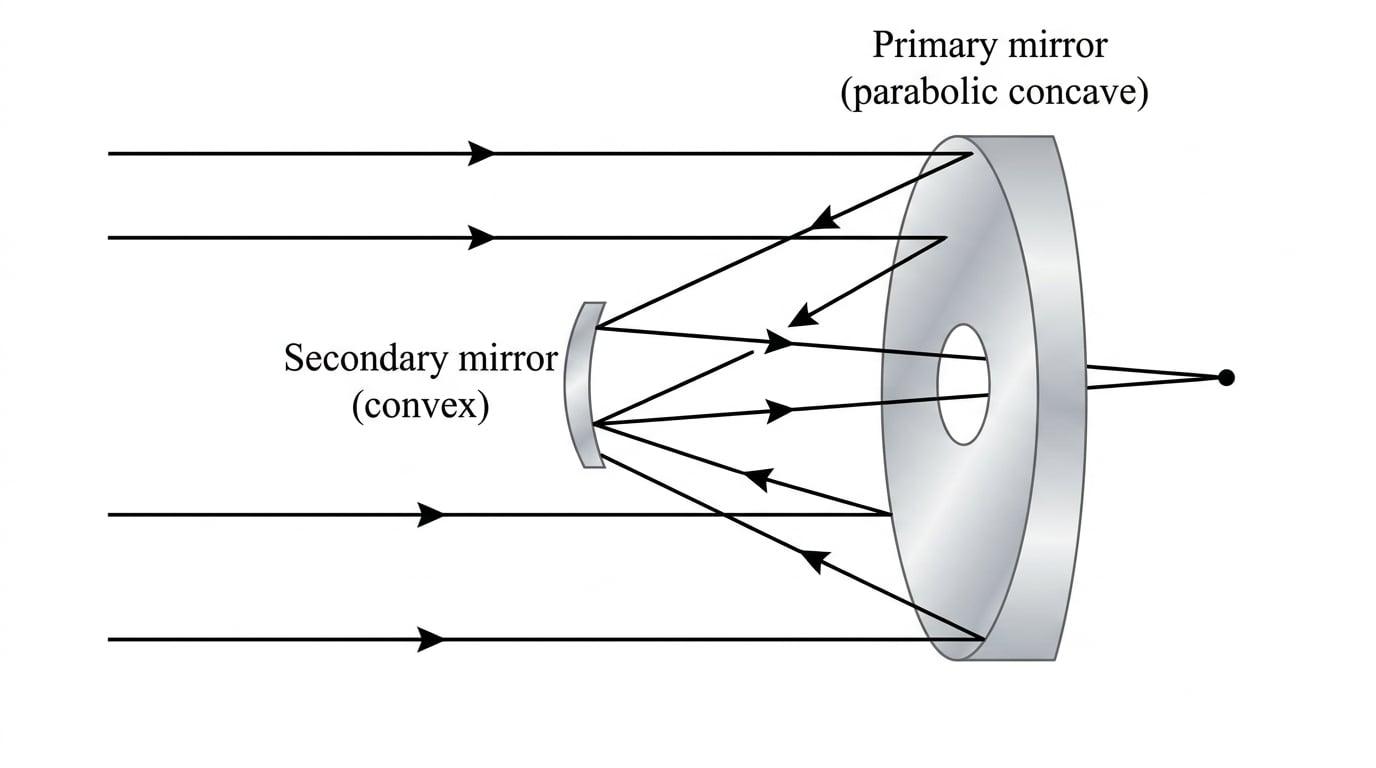
The Cassegrain telescope consists of two main mirrors:
- The Primary Mirror: A large, parabolic concave mirror. It collects incoming parallel light rays from a distant star and reflects them inwards. Notice that it has a hole in the centre.
- The Secondary Mirror: A small, convex mirror placed in front of the primary mirror's focal point.
Incoming light from infinity is parallel. The primary mirror reflects these rays so they converge. Before they can reach a focus, the secondary convex mirror intercepts them and reflects them back down the tube, through the hole in the primary mirror, to the eyepiece.
Drawing the secondary mirror incorrectly
When drawing this ray diagram in an exam, the most common mistakes are:
- Drawing the secondary mirror as flat or concave. It must be convex.
- Crossing the rays before they hit the secondary mirror. The rays should only cross after they have reflected off the secondary mirror and passed through the central hole.
- Forgetting to draw arrows on your rays to show the direction of light.
Why is the secondary mirror convex?
A convex secondary mirror diverges the rays slightly, which pushes the focal point further back (through the hole). This creates a very long effective focal length inside a short, compact telescope tube!
Optical Aberrations
To understand why astronomers prefer mirrors over lenses, we need to look at the flaws inherent in optical components. These flaws are called aberrations, and they cause images to become blurred or distorted.
Chromatic Aberration
Refracting telescopes (which use lenses) suffer from chromatic aberration.
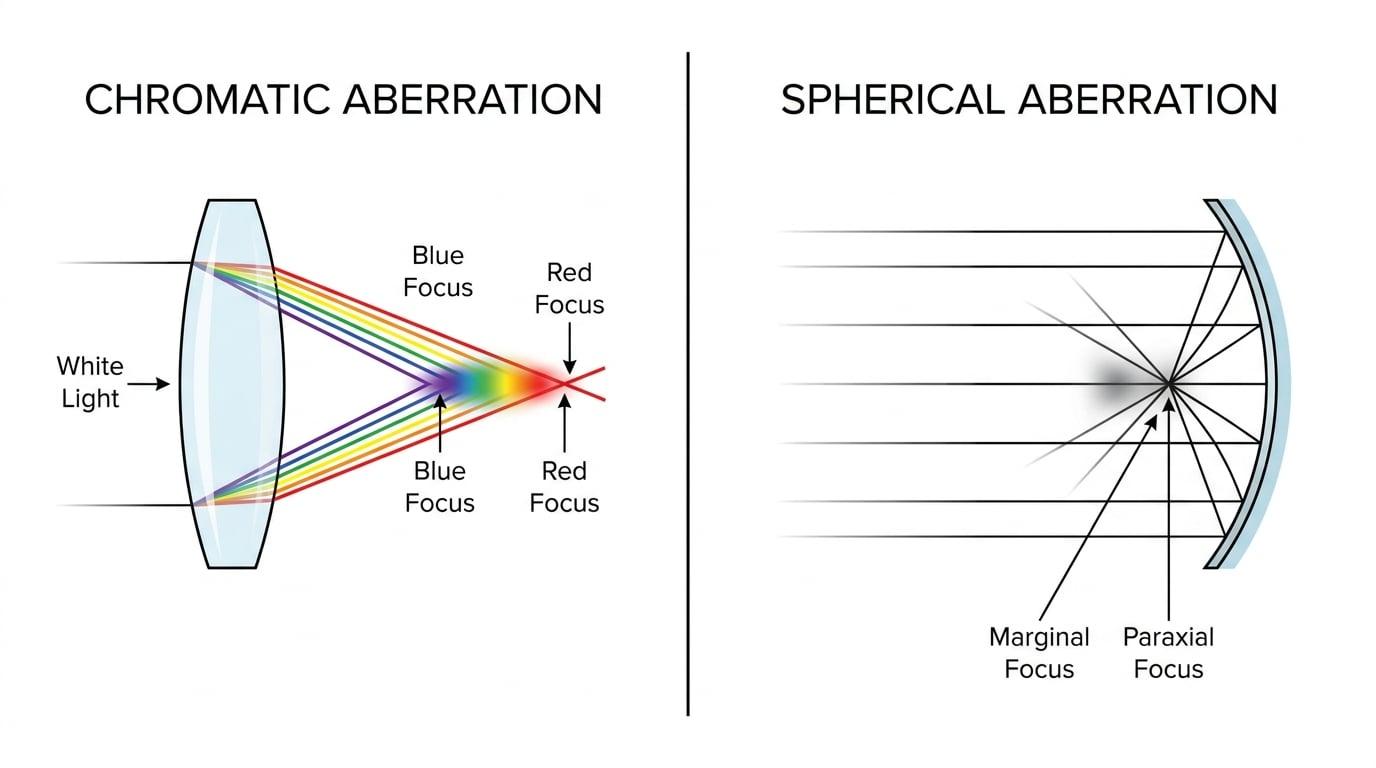
Glass bends (refracts) different wavelengths of light by different amounts. Because refractive index depends on wavelength, blue light (shorter wavelength) is slowed down more by the glass and is refracted more strongly than red light (longer wavelength).
As a result, a single convex lens has a different principal focus for every colour. Blue light focuses closer to the lens than red light. This creates an image with blurred, multi-coloured fringes around the edges.
Chromatic Aberration
The blurring and colour-fringing of an image caused by a lens refracting different wavelengths of light by different amounts, resulting in different focal lengths for different colours.
Spherical Aberration
Both lenses and mirrors can suffer from spherical aberration if they are perfectly spherical in shape.
If a mirror is shaped like a slice of a sphere, rays striking the outer edges of the mirror (marginal rays) are focused closer to the mirror than rays striking near the principal axis (paraxial rays). Because the rays do not all meet at a single focal point, the resulting image is blurry.
Fixing the flaws
To fix chromatic aberration: Use mirrors! The law of reflection (angle of incidence=angle of reflection\text{angle of incidence} = \text{angle of reflection}angle of incidence=angle of reflection) is completely independent of wavelength. Mirrors reflect all colours perfectly together. Reflecting telescopes have zero primary chromatic aberration.
To fix spherical aberration: Do not use a spherical mirror. Use a parabolic mirror. A parabola is geometrically perfect for bringing all parallel rays to exactly the same focal point, regardless of where they hit the mirror.
Reflectors vs Refractors: Relative Merits
Exam questions frequently ask you to compare reflectors and refractors. Reflectors dominate modern astronomy for several critical reasons.
Advantages of Reflectors (Mirrors)
- No chromatic aberration: Mirrors do not suffer from chromatic aberration, so the images are free of coloured fringes.
- No spherical aberration: By using a parabolic primary mirror, spherical aberration is entirely eliminated.
- Support and weight: Large glass lenses are incredibly heavy and can only be supported at their edges (otherwise you'd block the light). Large lenses sag under their own weight, distorting the image. Mirrors can be supported uniformly from behind, allowing us to build much larger telescopes (which collect more light and have better resolving power).
- Manufacturing: A lens requires two perfectly polished surfaces and perfectly flawless glass inside. A mirror only needs one perfectly polished surface, and the glass behind it doesn't need to be perfectly transparent.
Advantages of Refractors (Lenses)
- No secondary mirror block: In a Cassegrain reflector, the secondary mirror blocks some incoming light and its supporting struts cause diffraction spikes (those cross-shapes you see on stars in Hubble photos). Refractors have an unobstructed light path.
- Maintenance: Refractors are sealed tubes, so dust and moisture cannot get inside, and the lenses rarely need realigning. Exposed mirrors in reflectors can tarnish over time and need periodic recoating.
Worked Example
Exam-style question: Evaluating telescope designs
A student is designing a new telescope for an observatory. State and explain three reasons why the student should choose to build a reflecting telescope rather than a refracting telescope of the same diameter. (3 marks)
- Reason 1: Aberrations. State that reflectors do not suffer from chromatic aberration. Lenses refract different wavelengths by different amounts, but mirrors reflect all wavelengths at the same angle.
- Reason 2: Support. State that large mirrors can be supported from behind. Because lenses must let light pass through, they can only be supported by their edges and will sag under their own weight, ruining the image.
- Reason 3: Manufacturing. State that mirrors are easier and cheaper to manufacture. A mirror only requires one perfectly shaped surface and the glass quality underneath doesn't have to be optically flawless, whereas a lens requires two perfect surfaces and perfectly transparent glass.
In the exam
- If asked to draw a Cassegrain ray diagram, always use a ruler. The incoming rays must be parallel to the principal axis.
- Ensure your primary mirror is labelled specifically as parabolic concave and the secondary as convex.
- When defining chromatic aberration, be specific: state that different wavelengths (or colours) of light are refracted by different amounts, leading to different focal points.
- If a question asks about the "relative merits" of telescopes, remember that "merits" means you must discuss both the advantages of reflectors and their disadvantages (like diffraction from the secondary mirror struts).
Check yourself
- Can you sketch the Cassegrain ray diagram from memory, correctly showing the crossing point of the rays?
- Why does a parabolic mirror cure spherical aberration?
- Why do refractors suffer from chromatic aberration, but reflectors do not?
- Give one advantage a refracting telescope has over a reflecting telescope.