Welcome to rotational dynamics! If you have already mastered standard linear mechanics (like Newton's laws and the SUVAT equations), you are in a great position. Rotational motion uses almost exactly the same mathematical logic, just with a new set of variables.
In this topic, you will learn:
- How to define and calculate angular displacement, angular velocity, and angular acceleration.
- How to interpret graphs of rotational motion.
- How to use the rotational equivalent of the SUVAT equations for uniform angular acceleration.
- The powerful analogy between translational (linear) and rotational dynamics.
The Language of Rotation
To describe a spinning object—like a wheel, a CD, or a motor—we need to measure how much it has turned and how fast it is turning.
Angular Displacement (θ\thetaθ)
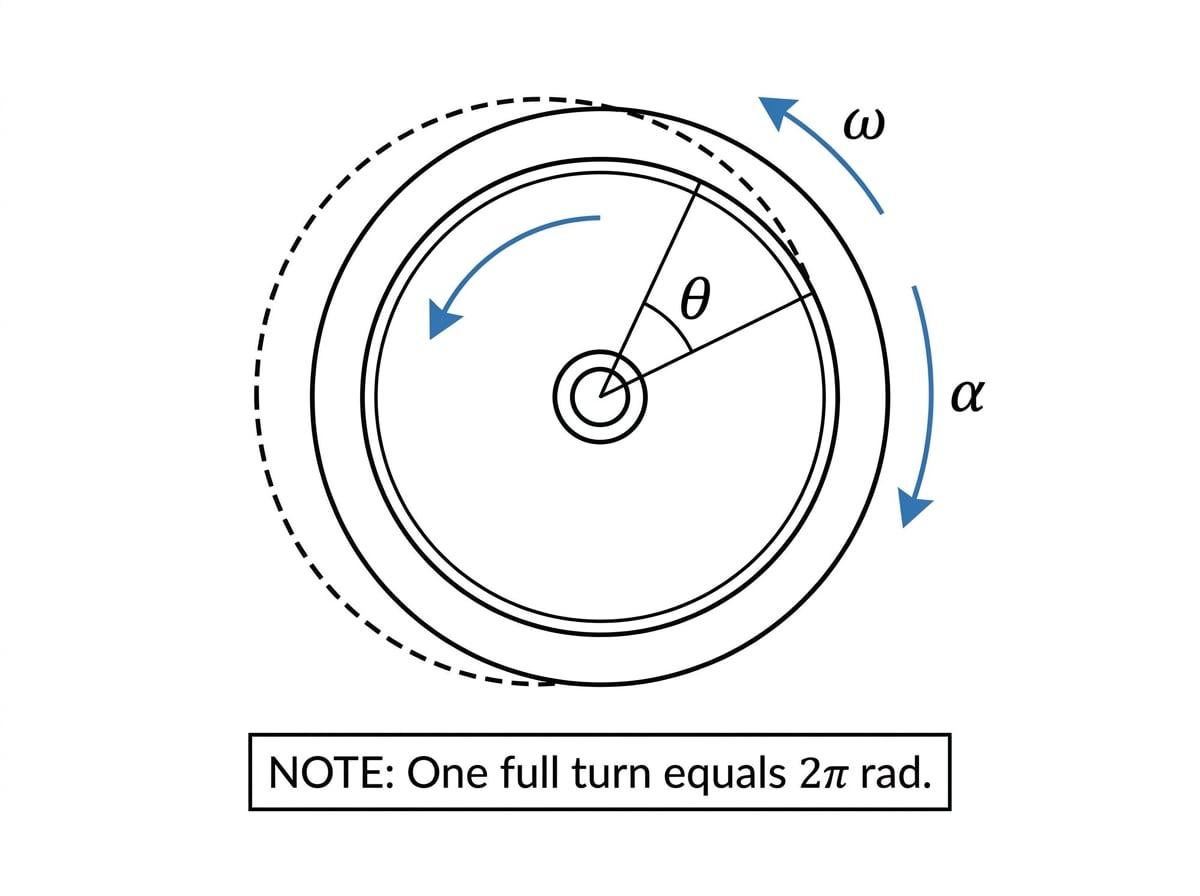
When an object rotates, every point on the object moves through the same angle. This angle is the angular displacement, given the symbol θ\thetaθ. In A-Level Physics, we almost always measure θ\thetaθ in radians (rad) rather than degrees. Remember that one full circle is 2π rad2\pi \text{ rad}2π rad.
Angular Speed and Velocity (ω\omegaω)
Angular speed is the rate at which the angular displacement changes. It tells you how fast the object is spinning. Its symbol is the lowercase Greek letter omega (ω\omegaω), and its unit is radians per second (rad s−1\text{rad s}^{-1}rad s−1).
If we also care about the direction of rotation (e.g., clockwise or anticlockwise), we call it angular velocity. We calculate average angular velocity using:
ω=ΔθΔt\omega = \frac{\Delta \theta}{\Delta t}ω=ΔtΔθ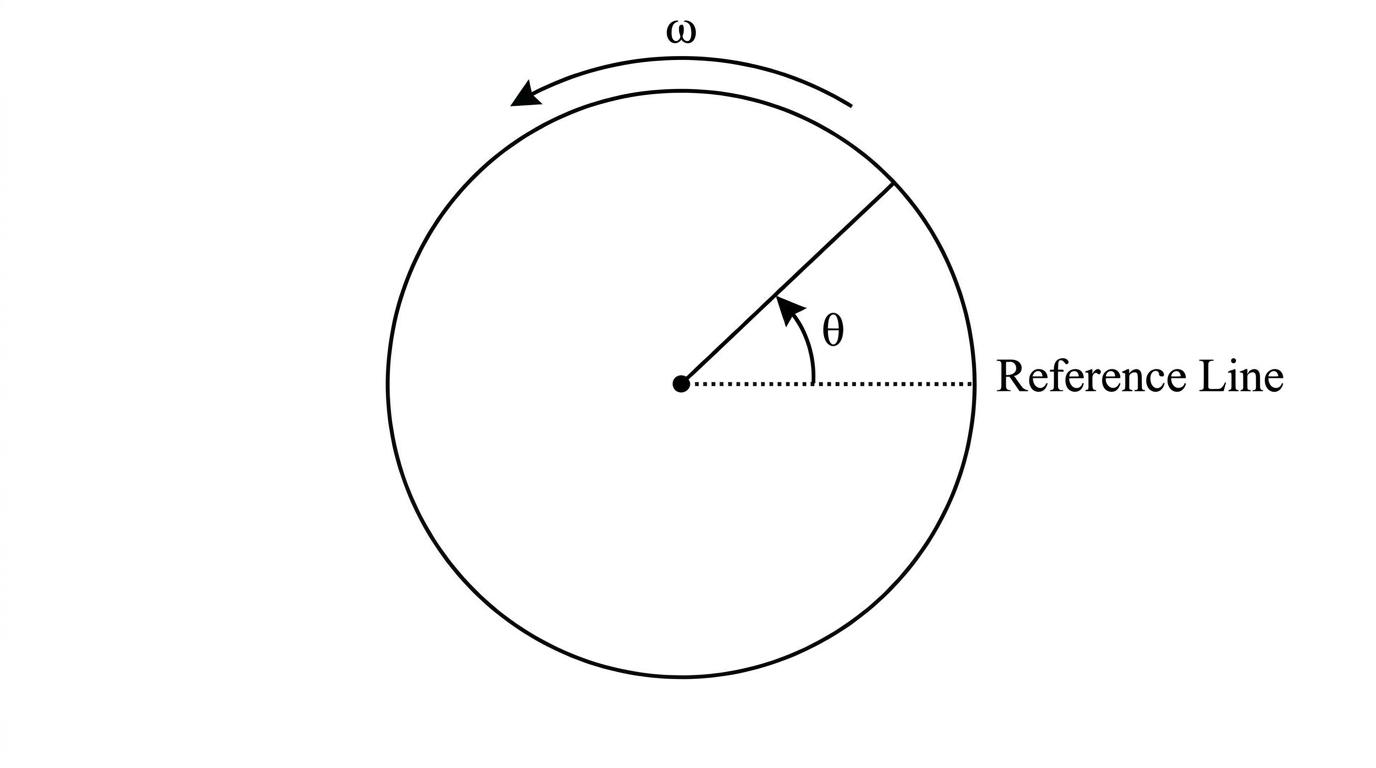
Angular Acceleration (α\alphaα)
Just as an object speeding up in a straight line has a linear acceleration, a spinning object that is spinning faster and faster has an angular acceleration. Its symbol is the lowercase Greek letter alpha (α\alphaα).
Angular Acceleration
Angular acceleration is the rate of change of angular velocity. It is measured in radians per second squared (rad s−2\text{rad s}^{-2}rad s−2).
α=ΔωΔt\alpha = \frac{\Delta \omega}{\Delta t}α=ΔtΔωThe Linear-Rotational Analogy
You do not need to memorize a completely new way of doing physics for rotational motion. Every concept in linear (translational) kinematics has a direct twin in rotational kinematics.
Translational vs. Rotational Twins
Whenever you are stuck on a rotational problem, think about how you would solve it if it were moving in a straight line, and swap the variables:
- Displacement: Linear s→s \quad \rightarrow \quads→ Angular θ\thetaθ
- Initial Velocity: Linear u→u \quad \rightarrow \quadu→ Angular ω1\omega_1ω1
- Final Velocity: Linear v→v \quad \rightarrow \quadv→ Angular ω2\omega_2ω2
- Acceleration: Linear a→a \quad \rightarrow \quada→ Angular α\alphaα
- Time: Time ttt remains exactly the same!
Graphical Representation
Just like velocity-time graphs in linear motion, we can draw angular velocity-time (ω\omegaω-ttt) graphs.
- The gradient of the line represents the angular acceleration (α\alphaα).
- The area under the line represents the angular displacement (θ\thetaθ).
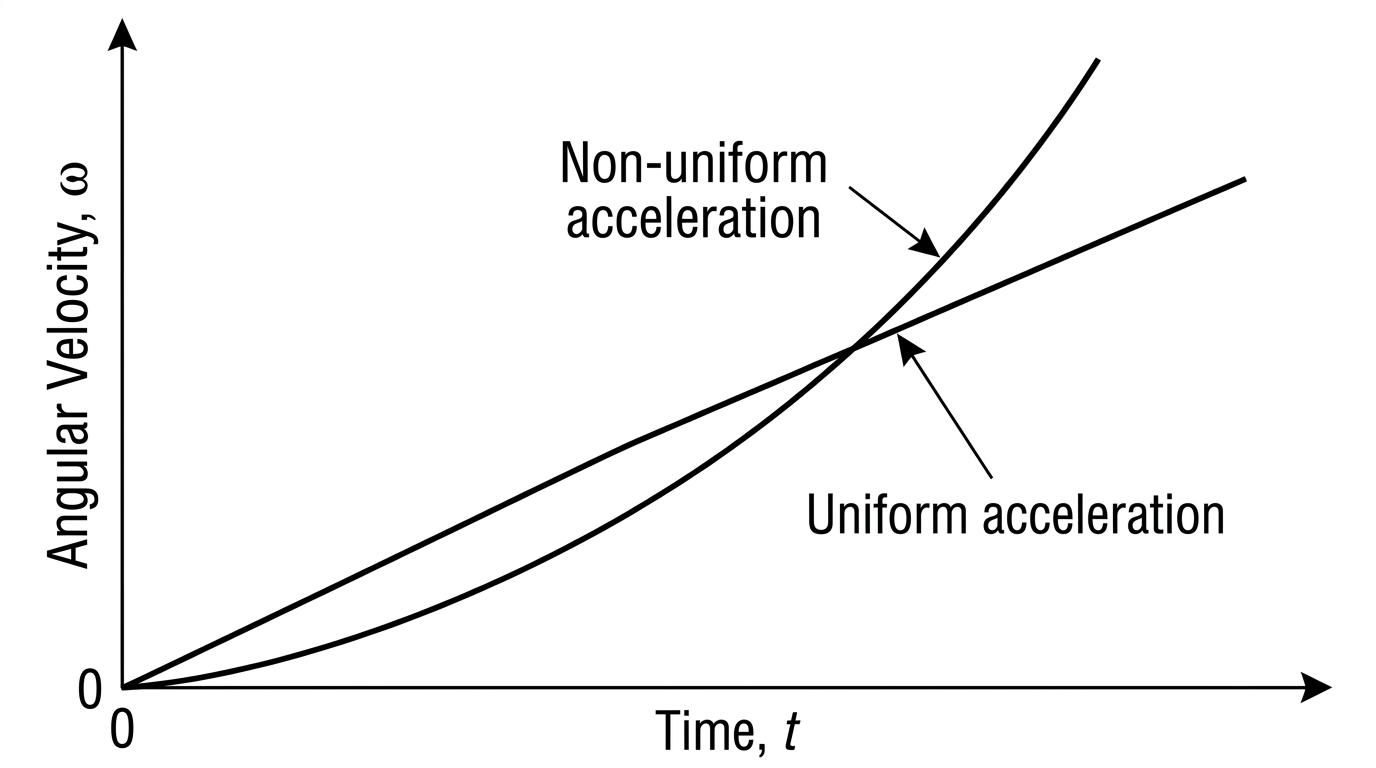
If the angular acceleration is uniform (constant), the graph will be a straight line with a constant gradient. If the angular acceleration is non-uniform (changing), the graph will be a curve. To find the instantaneous acceleration at a specific time on a curve, you would draw a tangent and calculate its gradient.
Rotational Equations of Motion
Because of the perfect analogy between linear and rotational motion, we can take the standard linear SUVAT equations and swap in our rotational variables. This gives us four equations for rotational motion:
ω2=ω1+αtθ=(ω1+ω22)tθ=ω1t+αt22ω22=ω12+2αθ\begin{aligned} \omega_2 &= \omega_1 + \alpha t \\ \theta &= \left( \frac{\omega_1 + \omega_2}{2} \right) t \\ \theta &= \omega_1 t + \frac{\alpha t^2}{2} \\ \omega_2^2 &= \omega_1^2 + 2\alpha\theta \end{aligned}ω2θθω22=ω1+αt=(2ω1+ω2)t=ω1t+2αt2=ω12+2αθWatch out for changing acceleration!
Just like the linear SUVAT equations, these four rotational equations only apply when angular acceleration (α\alphaα) is uniform. If the angular acceleration is changing (a curved ω\omegaω-ttt graph), you cannot use these formulas and must use graphical methods instead.
Revolutions per minute (rpm)
A very common exam trap is giving you the initial or final velocity in "revolutions per minute" (rpm) or "revolutions per second" (rev/s). You must convert these to rad s−1\text{rad s}^{-1}rad s−1 before plugging them into the equations.
- To convert revolutions to radians: multiply by 2π2\pi2π.
- To convert minutes to seconds: divide by 60.
- So, 60 rpm60 \text{ rpm}60 rpm is 60×2π60=2π rad s−1\frac{60 \times 2\pi}{60} = 2\pi \text{ rad s}^{-1}6060×2π=2π rad s−1.
Let's look at a typical exam-style calculation. Notice how we lay out the knowns and unknowns exactly as we would for a linear mechanics question.
Worked Example: Decelerating a centrifuge
A laboratory centrifuge is spinning at an initial angular velocity of 350 rad s−1350 \text{ rad s}^{-1}350 rad s−1. When switched off, it experiences a constant angular deceleration and comes to rest after 25 seconds.
Calculate the angular acceleration of the centrifuge, and the total angular displacement it turns through before stopping.
- List your knowns and unknowns: We know the initial angular velocity ω1=350 rad s−1\omega_1 = 350 \text{ rad s}^{-1}ω1=350 rad s−1. It comes to rest, so the final angular velocity ω2=0 rad s−1\omega_2 = 0 \text{ rad s}^{-1}ω2=0 rad s−1. The time taken is t=25 st = 25 \text{ s}t=25 s. We want to find angular acceleration α\alphaα and angular displacement θ\thetaθ.
- Select the correct equation for α\alphaα: We have ω1\omega_1ω1, ω2\omega_2ω2, and ttt. We want α\alphaα. The matching equation is:
- Substitute and solve for α\alphaα:
The negative sign confirms it is decelerating.
4. Select the correct equation for θ\thetaθ: We can use a few options now, but it is safest to use the given values to avoid carrying through any mistakes:
θ=(ω1+ω22)t \theta = \left( \frac{\omega_1 + \omega_2}{2} \right) t θ=(2ω1+ω2)t- Substitute and solve for θ\thetaθ:
(If the question asked for the number of complete revolutions, you would divide 4375 by 2π2\pi2π).
In the exam
- Always write down your equivalent "SUVAT" variables (θ\thetaθ, ω1\omega_1ω1, ω2\omega_2ω2, α\alphaα, ttt) down the side of your page before doing any calculations.
- Check your units immediately. If you see rpm, convert it to rad s−1\text{rad s}^{-1}rad s−1 before you do anything else.
- If the question gives a graph of ω\omegaω against ttt, check if the line is straight. If it curves, do not use the equations; you must find gradients (for α\alphaα) or count squares/estimate area (for θ\thetaθ) directly from the graph.
- Pay attention to the wording "comes to rest" (ω2=0\omega_2 = 0ω2=0) or "starts from rest" (ω1=0\omega_1 = 0ω1=0).
Check yourself
- Can you state the units for angular displacement, angular velocity, and angular acceleration?
- If a rotating object completes 5 full revolutions, what is its angular displacement in radians?
- Which features of an angular velocity-time graph represent angular acceleration and angular displacement?
- Can you write down the four rotational equations of motion from memory?