

Welcome to rotational dynamics! You already know that if you want to make an object accelerate in a straight line, you have to push it with a force. But what if you want to make an object spin faster?
In this section, we'll look at the rotational equivalents of force and acceleration.
What you'll learn:
- What torque is and how to calculate it from an applied force.
- How to use the rotational equivalent of Newton's second law (T=IαT = I\alphaT=Iα).
- How to handle real-world scenarios where friction opposes the rotation.
1. What is Torque?
Think about opening a heavy door. You intuitively push near the handle, far away from the hinges. If you try pushing right next to the hinges, the door is much harder to open. You are applying the same force, but creating a very different turning effect.
In rotational dynamics, this turning effect is called torque.
Torque ()
Torque is the measure of a force's ability to cause an object to rotate about an axis. It is calculated as the product of the force and the perpendicular distance from the axis of rotation:
T=Fr T = F r T=FrWhere:
- TTT is the torque in newton-metres (N m\text{N m}N m)
- FFF is the applied force in newtons (N\text{N}N)
- rrr is the perpendicular distance from the axis to the line of action of the force in metres (m\text{m}m)
You might be thinking, "Isn't this just a moment?" You'd be exactly right! In A-Level Physics, we tend to use the word "moment" when talking about static situations (like balanced beams), and "torque" when dealing with rotating objects (like engines, wheels, and flywheels).
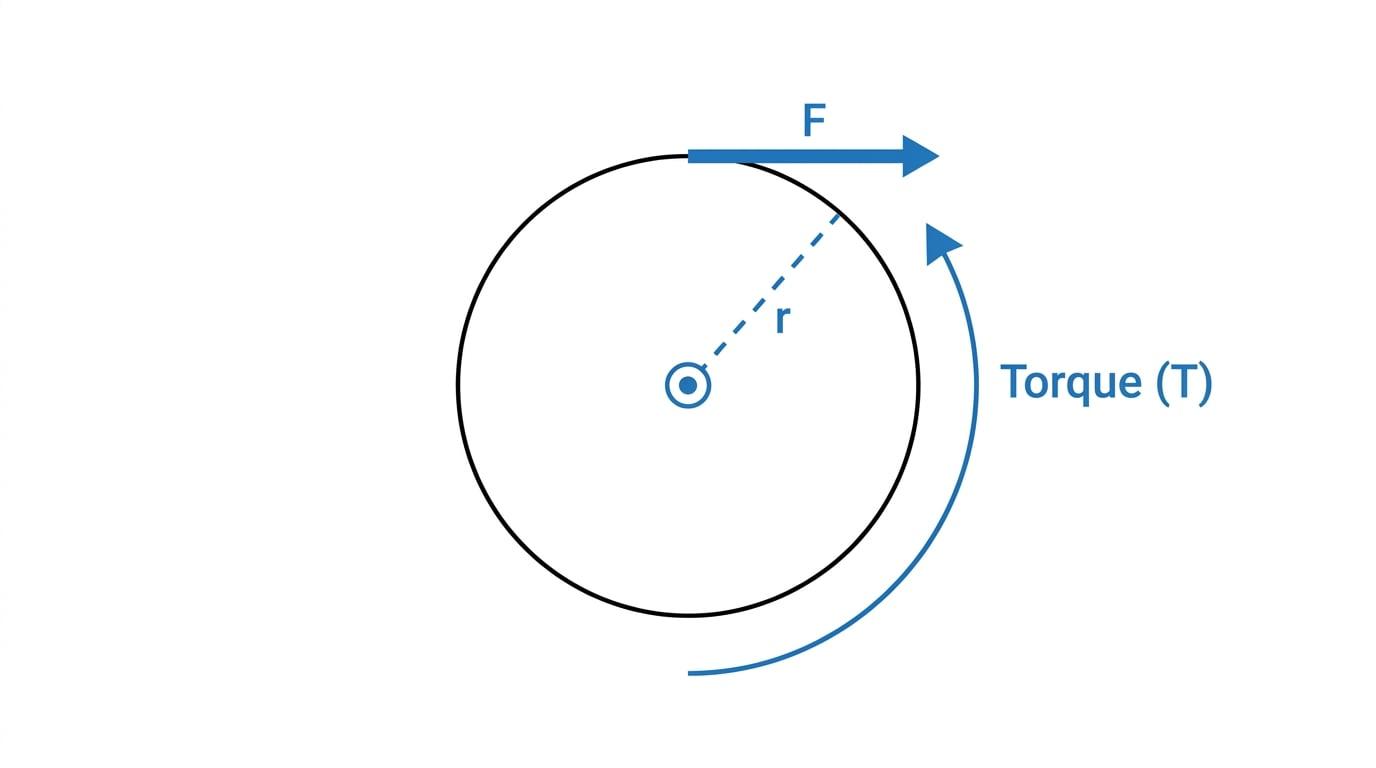
If the force applied isn't perfectly tangential (at a right angle to the radius), you must find the component of the force that is perpendicular to the radius before multiplying by rrr.
Calculating applied torque
A student pulls on a rope wrapped around the rim of a solid cylindrical flywheel. The flywheel has a radius of 0.40 m. The student applies a steady tangential tension of 65 N. Calculate the torque applied to the flywheel.
- Identify the given values: the force F=65 NF = 65 \text{ N}F=65 N and the perpendicular distance r=0.40 mr = 0.40 \text{ m}r=0.40 m.
- State the torque formula:
- Substitute the values and calculate the result:
2. Newton's Second Law for Rotation
In linear mechanics, Newton's second law states that a resultant force causes a proportional linear acceleration (F=maF = m aF=ma). The mass mmm is the "reluctance" of the object to change its linear velocity.
For rotating objects, the exact same principle applies, but we swap our linear variables for their rotational cousins.
Linear vs Rotational Dynamics
If you understand F=maF = m aF=ma, you already understand rotational dynamics!
- Force (FFF) becomes Torque (TTT)
- Mass (mmm) becomes Moment of Inertia (III)
- Linear Acceleration (aaa) becomes Angular Acceleration (α\alphaα)
When you apply a resultant torque to a rigid body, it will experience an angular acceleration. The greater the moment of inertia (the "rotational mass"), the harder it is to spin up, so the angular acceleration will be smaller.
Newton's Second Law for Rotation
The angular acceleration of a rotating rigid body is directly proportional to the resultant torque applied to it, and inversely proportional to its moment of inertia.
T=Iα T = I \alpha T=IαWhere:
- TTT is the resultant torque in N m\text{N m}N m
- III is the moment of inertia in kg m2\text{kg m}^2kg m2
- α\alphaα is the angular acceleration in rad s−2\text{rad s}^{-2}rad s−2
Symbol Clash
Be very careful with the letter TTT in exam questions! In mechanics, TTT can mean Torque, Tension (a force), or Time period. Always look at the context of the question and the units to figure out which TTT is being used. If a rope is pulling a wheel, the tension TTT creates a torque TTT. It can help to write the word "Torque" out in your working to avoid confusing yourself!
Combining the equations
In most AQA exam questions, you won't be handed the torque directly. You will be given a physical setup (like a falling mass pulling a string wrapped around a drum) and asked to find the angular acceleration. This means you have to use T=FrT = F rT=Fr to find the torque first, and then substitute that into T=IαT = I \alphaT=Iα.
Spinning up a grinding wheel
A solid circular grinding wheel has a moment of inertia of 0.030 kg m20.030 \text{ kg m}^20.030 kg m2 and a radius of 0.15 m. A motor applies a constant tangential driving force of 12 N to the edge of the wheel. Assuming there is no friction, calculate the angular acceleration of the wheel.
- First, calculate the driving torque using the force and radius:
- Rearrange Newton's second law for rotation to make angular acceleration the subject:
- Substitute your torque and the given moment of inertia to find α\alphaα:
3. Dealing with Frictional Torque
In the real world, bearings aren't perfectly smooth. As a wheel spins, friction in the axle creates a turning effect that opposes the rotation. We call this frictional torque.
Because T=IαT = I \alphaT=Iα depends on the resultant torque, you must subtract the frictional torque from the driving torque before you calculate the angular acceleration.
Resultant Torque=Driving Torque−Frictional Torque \text{Resultant Torque} = \text{Driving Torque} - \text{Frictional Torque} Resultant Torque=Driving Torque−Frictional TorqueIf the motor is turned off (so the driving torque is zero), the frictional torque becomes the only torque acting on the system. Because it acts in the opposite direction to the rotation, it provides a decelerating torque, bringing the wheel to a stop.
Forgetting to find the resultant
A classic exam trap is providing a driving force and a frictional torque in the same question. Students often calculate the driving torque and immediately plug it into T=IαT = I \alphaT=Iα, completely ignoring the friction. Always check the question text carefully for mentions of "bearing friction" or "frictional torque".
Acceleration with friction
A flywheel with a moment of inertia of 1.5 kg m21.5 \text{ kg m}^21.5 kg m2 and a radius of 0.50 m is pulled by a belt with a constant tangential force of 40 N. The bearings exert a constant frictional torque of 3.5 N m3.5 \text{ N m}3.5 N m. Calculate the angular acceleration of the flywheel.
- Calculate the driving torque provided by the belt:
- Calculate the resultant torque by subtracting the frictional torque:
- Use the resultant torque to find the angular acceleration:
In the exam
- Check your units for rrr: Exam questions love to give the radius of a pulley or shaft in centimetres or millimetres. Always convert rrr to metres before calculating torque, or your answer will be off by a factor of 100 or 1000!
- Look for the word "tangential": The formula T=FrT = F rT=Fr assumes the force is tangential. If the question gives you a force acting at a different angle, you must resolve it to find the component acting at 90 degrees to the radius.
- Link to kinematics: Once you have found α\alphaα using T=IαT = I \alphaT=Iα, AQA questions will frequently ask you to use the rotational kinematic equations (like ω2=ω1+αt\omega_2 = \omega_1 + \alpha tω2=ω1+αt) to find out how fast the object is spinning after a certain time. Keep your unrounded α\alphaα value stored in your calculator for the next part of the question.
Check yourself
- What are the SI units for torque?
- If you apply the same tangential force to two wheels, but Wheel B has twice the radius of Wheel A, how do the applied torques compare?
- How would you calculate the resultant torque on a system if a motor applies a driving torque but the axle bearings have a constant frictional torque?
- If the resultant torque acting on a spinning flywheel drops to zero, what happens to its angular velocity?
