Rotational kinetic energy (A-level only)
Welcome to rotational dynamics! You already know how to calculate the kinetic energy of an object moving in a straight line. In this topic, we will look at objects that are spinning in place.
Here is what you will learn:
- How to calculate the rotational kinetic energy of a spinning object.
- What flywheels are and the factors that affect how much energy they can store.
- How flywheels are used in the real world to smooth out fluctuating torque and store energy in vehicles and machinery.
From linear to rotational energy
Think back to standard linear mechanics. The kinetic energy of an object moving in a straight line depends on its mass and its velocity.
When an object is spinning on an axis, every particle in that object is moving, so the object possesses kinetic energy. To find the total energy, we swap our linear variables for their rotational equivalents:
- Mass is replaced by the moment of inertia.
- Linear velocity is replaced by angular speed.
Rotational Kinetic Energy
The energy possessed by a rotating object is given by the formula:
Ek=12Iω2 E_k = \frac{1}{2} I \omega^2 Ek=21Iω2- EkE_kEk is the rotational kinetic energy, measured in joules (J\text{J}J).
- III is the moment of inertia, measured in kilogram metres squared (kg m2\text{kg m}^2kg m2).
- ω\omegaω is the angular speed, measured in radians per second (rad s−1\text{rad s}^{-1}rad s−1).
Just like linear kinetic energy, rotational kinetic energy is a scalar quantity (it has no direction).
Let's look at how to use this formula in a straightforward calculation.
Calculating basic rotational kinetic energy
A solid steel cylinder is rotating on a fixed central axis at an angular speed of 120 rad s−1120 \text{ rad s}^{-1}120 rad s−1. The moment of inertia of the cylinder is 4.5 kg m24.5 \text{ kg m}^24.5 kg m2. Calculate its rotational kinetic energy.
- Identify the known variables from the question: I=4.5 kg m2I = 4.5 \text{ kg m}^2I=4.5 kg m2 and ω=120 rad s−1\omega = 120 \text{ rad s}^{-1}ω=120 rad s−1.
- State the formula for rotational kinetic energy:
- Substitute the values into the equation:
- Calculate the final answer, ensuring you include the correct unit:
Flywheels and energy storage
A flywheel is simply a heavy wheel or disc designed specifically to store rotational kinetic energy. Once you spin a flywheel up to speed, it "holds" that energy. If you connect it to a load, it can release that energy to do work, slowing down as it does so.
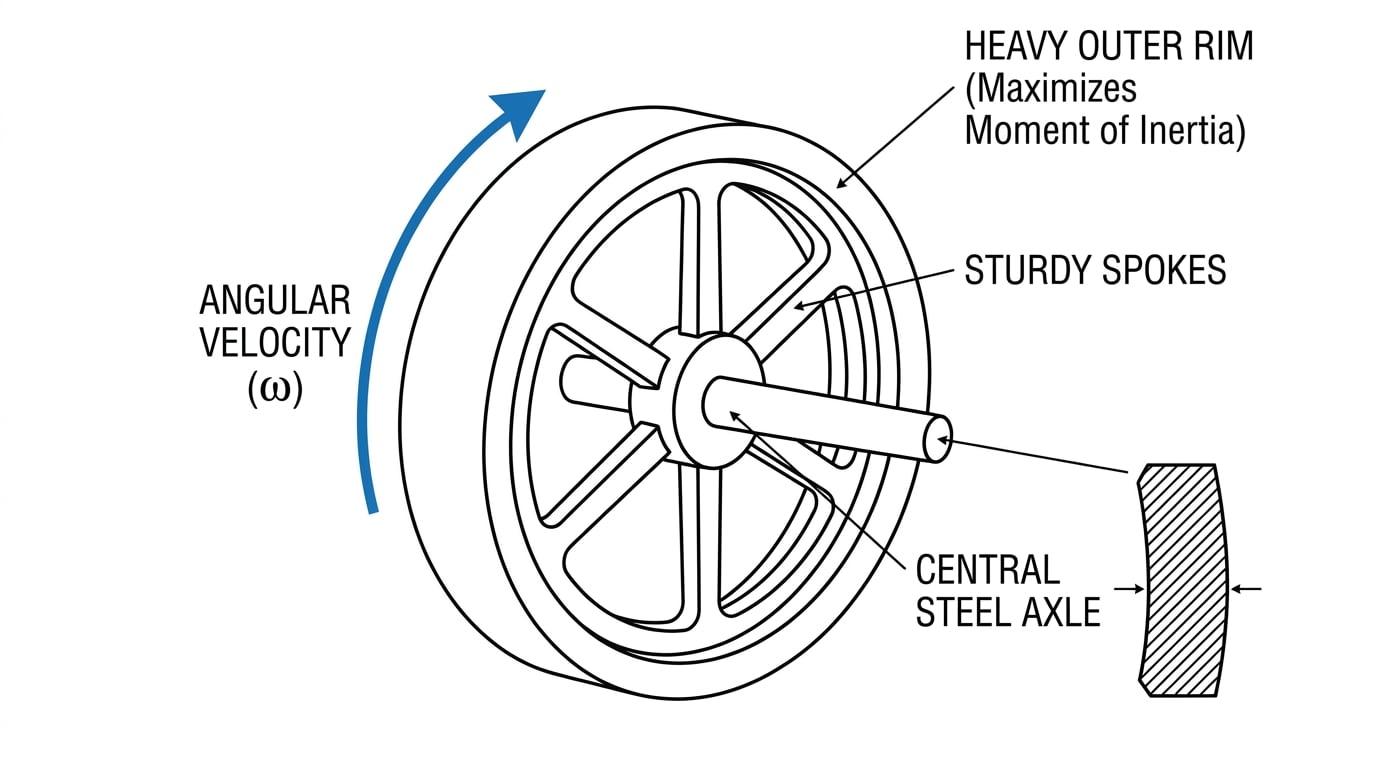
If you are an engineer trying to design a flywheel to store as much energy as possible, you need to look at the factors in our formula: Ek=12Iω2E_k = \frac{1}{2} I \omega^2Ek=21Iω2.
Factor 1: Moment of Inertia (III)
To increase the energy capacity, you can increase the moment of inertia. You can do this in two ways:
- Increase the mass: A heavier flywheel stores more energy.
- Change the mass distribution: Moment of inertia depends on the distance of the mass from the axis of rotation squared (r2r^2r2). Instead of a solid disc, flywheels are often designed as a heavy outer rim connected by lightweight spokes. Pushing the mass to the outside dramatically increases III without making the whole object prohibitively heavy.
Factor 2: Angular speed (ω\omegaω)
Because angular speed is squared in the formula, increasing ω\omegaω is the most effective way to store more energy. Spinning a flywheel twice as fast will quadruple the stored energy!
The limitation: Material strength
You cannot keep spinning a flywheel faster forever. As angular speed increases, the centrifugal forces trying to rip the flywheel apart increase massively. If a flywheel spins too fast, the material will fracture and explode outward like shrapnel. Therefore, modern high-performance flywheels are often made of advanced carbon-fibre composites, which have an incredibly high tensile strength-to-weight ratio, allowing them to spin much faster than heavier solid steel wheels.
Designing a flywheel
To maximise the energy storage of a flywheel, you want the majority of its mass concentrated at the outer rim (large III) and you want it spinning as fast as the tensile strength of the material will safely allow (large ω\omegaω).
Real-world uses of flywheels
The AQA specification expects you to understand three specific applications of flywheels. In all of these, the flywheel acts as an energy buffer: it absorbs mechanical energy when there is a surplus, and releases it when there is a deficit.
1. Smoothing torque and speed
In engines (like a four-stroke internal combustion engine), power is not produced smoothly. The engine only generates power during the "power stroke" (an explosion in the cylinder), followed by three non-power strokes where the engine actually needs energy to keep turning.
Without a flywheel, the engine's rotation would be violently jerky. By attaching a heavy flywheel to the crankshaft, the sudden burst of energy from the power stroke speeds the flywheel up slightly (storing the excess energy). During the non-power strokes, the flywheel's momentum keeps the crankshaft turning, releasing the stored energy and slowing down slightly.
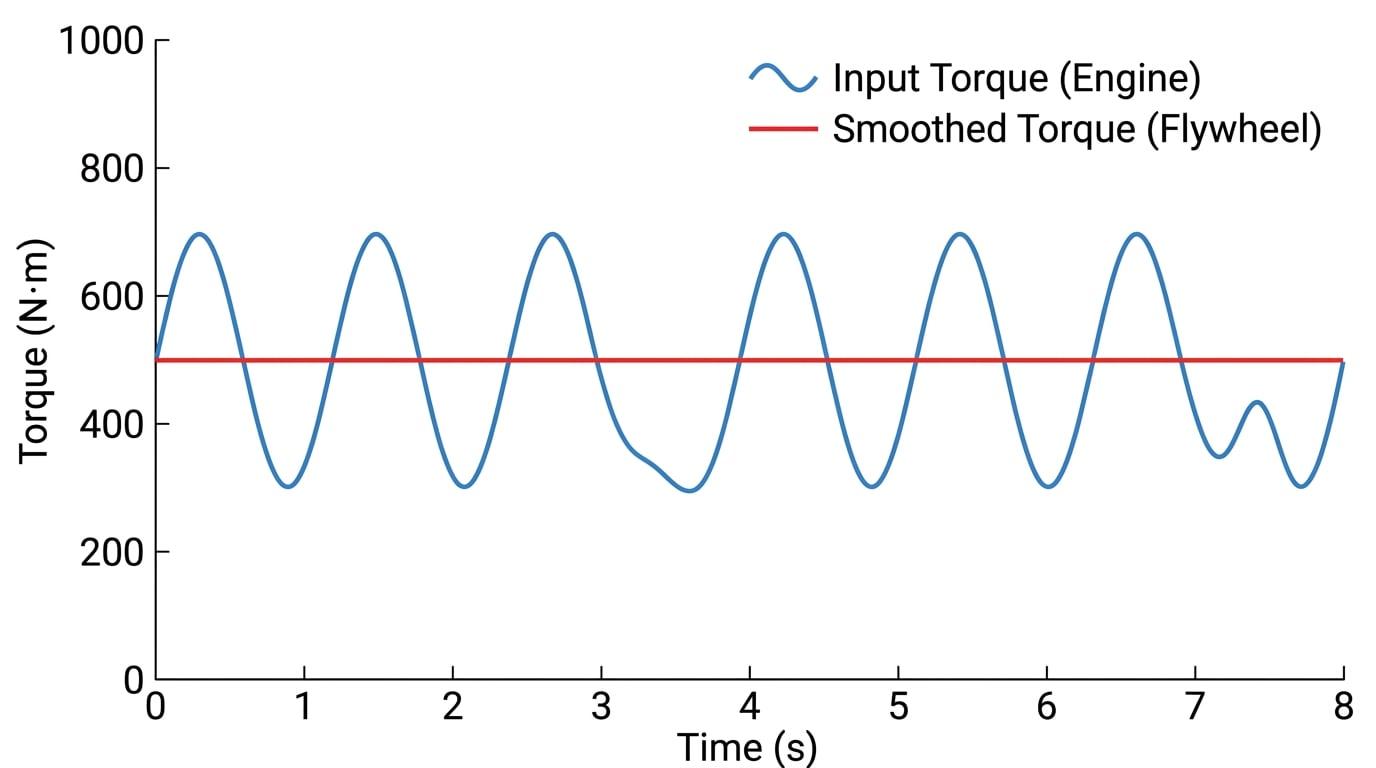
The result is that the violently fluctuating input torque from the engine is transformed into a much smoother, steadier output torque.
2. Production processes
Machines used in manufacturing, such as industrial metal punch presses, need a sudden, massive burst of power to punch a hole through thick steel. If an electric motor had to provide that force directly, it would need to be gigantic.
Instead, a small electric motor slowly spins up a large flywheel between punches. When the punch engages, the flywheel connects to the punch tool, rapidly dumping a huge amount of its stored rotational kinetic energy in a fraction of a second. The flywheel slows down, the hole is punched, and the small motor spends the next few seconds spinning the flywheel back up to speed for the next punch.
3. Storing energy in vehicles
Many modern buses, trains, and race cars use Kinetic Energy Recovery Systems (KERS). When the vehicle brakes, rather than wasting the kinetic energy as heat in the brake pads, the wheels are connected to a flywheel.
- Braking: The vehicle's forward kinetic energy is transferred into the flywheel, spinning it up. The vehicle slows down, and the flywheel stores the energy.
- Accelerating: When the light turns green, the driver accelerates. The spinning flywheel is connected back to the drivetrain, releasing its rotational kinetic energy to help push the vehicle forward, saving fuel.
Let's look at an exam-style question involving a punch press transferring energy.
Energy transfer in a punch press
An industrial punch press uses a flywheel with a moment of inertia of 60 kg m260 \text{ kg m}^260 kg m2. The flywheel is initially spinning at 15 rad s−115 \text{ rad s}^{-1}15 rad s−1. The machine engages the punch, which requires 1800 J1800 \text{ J}1800 J of energy to pierce a metal sheet. All this energy is supplied by the flywheel. Calculate the angular speed of the flywheel immediately after the punch.
- Calculate the initial rotational kinetic energy of the flywheel before the punch:
- Determine the final energy. The flywheel loses 1800 J1800 \text{ J}1800 J to the punch:
- Set up the rotational kinetic energy equation for the final state to find the new angular speed (ωfinal\omega_{\text{final}}ωfinal):
- Rearrange and solve for ωfinal\omega_{\text{final}}ωfinal:
Calculating the change in energy
When calculating the energy lost or gained by a flywheel that changes speed from ω1\omega_1ω1 to ω2\omega_2ω2, you must not subtract the speeds first and then square them.
Correct: Calculate the energies separately and subtract them.
ΔEk=12Iω12−12Iω22=12I(ω12−ω22) \Delta E_k = \frac{1}{2} I \omega_1^2 - \frac{1}{2} I \omega_2^2 = \frac{1}{2} I (\omega_1^2 - \omega_2^2) ΔEk=21Iω12−21Iω22=21I(ω12−ω22)Incorrect: Subtracting the angular speeds first.
ΔEk≠12I(ω1−ω2)2 \Delta E_k \neq \frac{1}{2} I (\omega_1 - \omega_2)^2 ΔEk=21I(ω1−ω2)2In the exam
- Watch out for RPM: AQA rarely gives you the speed in rad s−1\text{rad s}^{-1}rad s−1 straight away. If you are given revolutions per minute (rev min−1^{-1}−1 or rpm), you must convert it first: multiply by 2π2\pi2π to get radians, and divide by 606060 to get seconds.
- Energy conservation: Treat flywheel problems as conservation of energy questions. Ek (initial)±Work Done=Ek (final)E_{k\text{ (initial)}} \pm \text{Work Done} = E_{k\text{ (final)}}Ek (initial)±Work Done=Ek (final).
- Written questions: If asked why a flywheel is useful, use the phrase "smooths out fluctuations in torque" rather than just saying "makes it smoother". Reference the absorption of energy when torque is high and the release of energy when torque is low.
Check yourself
- What are the two variables that determine the rotational kinetic energy of a spinning object?
- Why does making the outer rim of a flywheel heavier allow it to store more energy than making the central hub heavier?
- How does a flywheel act to smooth the output of a 4-stroke engine?
- What prevents engineers from spinning a flywheel at infinite speeds to store infinite energy?