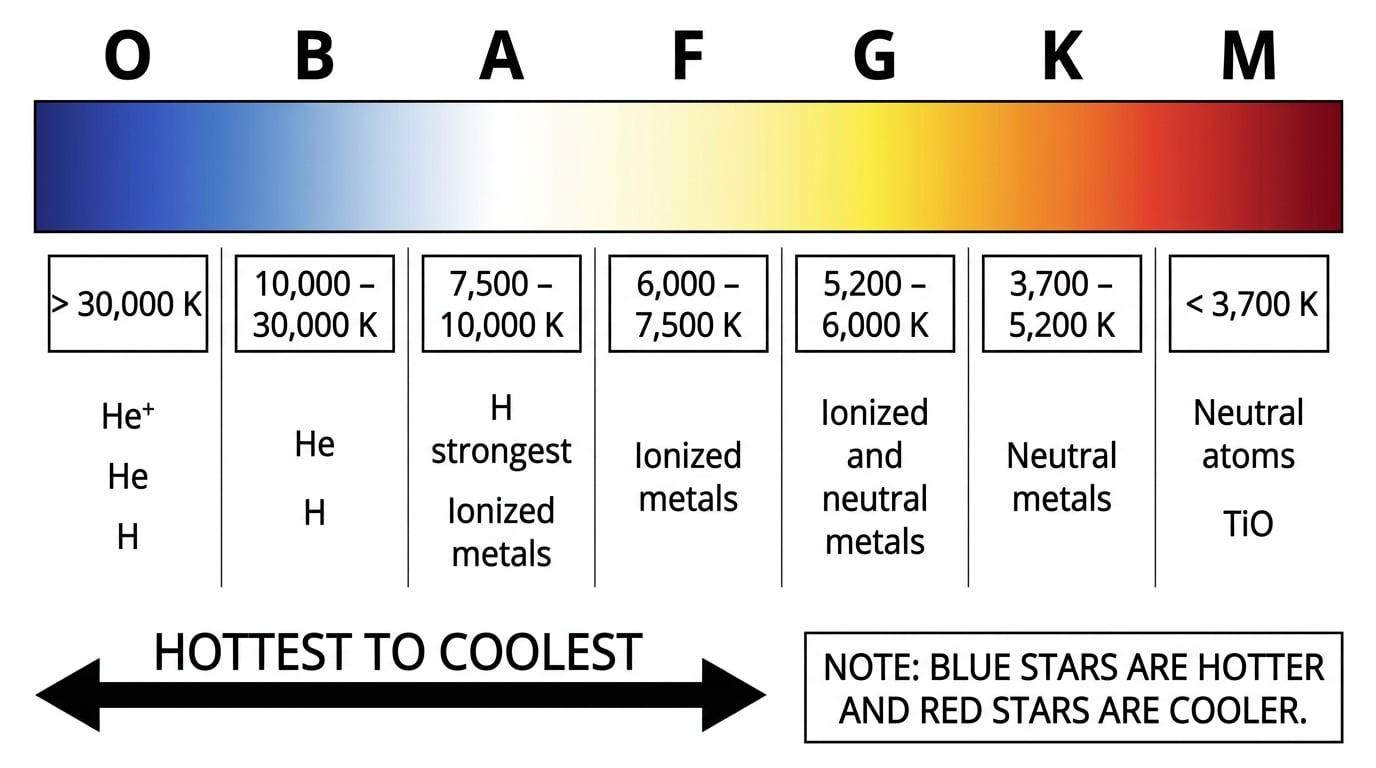
Welcome to stellar classification! By analyzing the light from a star, astrophysicists can determine its temperature, its colour, and the chemical elements in its atmosphere, all without ever leaving Earth.
What you'll learn in this topic:
- The standard OBAFGKM spectral sequence and how it links a star's temperature to its colour.
- How to read prominent absorption lines in a star's spectrum.
- The physics of the Hydrogen Balmer series and why its strength is so heavily dependent on a star's surface temperature.
1. The OBAFGKM Spectral Sequence
In the late 19th and early 20th centuries, astronomers at Harvard University sorted thousands of stars into categories based on the patterns of dark absorption lines in their spectra. They eventually realized that these differences weren't primarily due to stars having different chemical compositions, but rather different surface temperatures.
Spectral Class
A classification system for stars based on their surface temperature, which dictates their intrinsic colour and the prominent absorption lines present in their spectrum.
The modern sequence consists of seven main classes ordered from hottest to coolest: O, B, A, F, G, K, M.
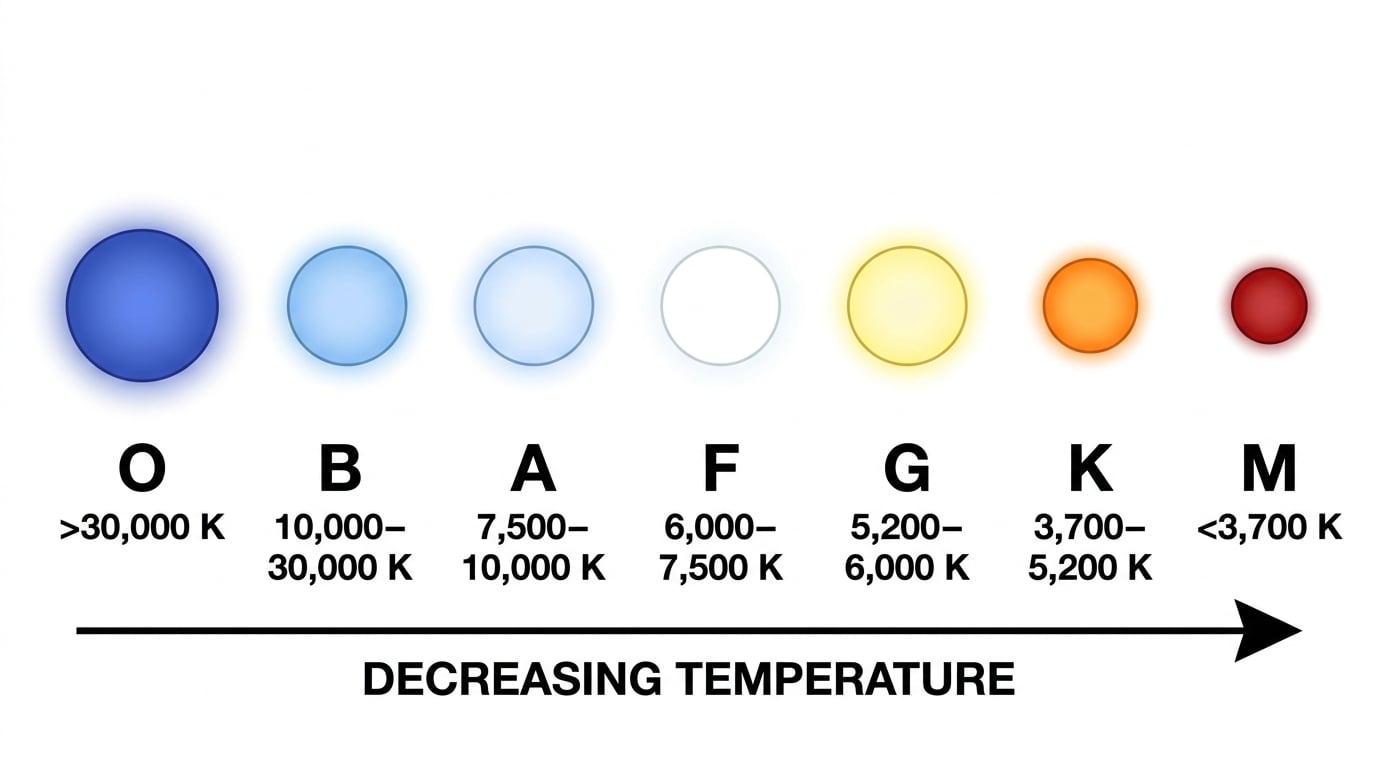
You must know the intrinsic colour, temperature range, and prominent absorption lines for each class. Here is the data you are expected to recall for the AQA exam:
| Spectral Class | Intrinsic Colour | Temperature / K | Prominent Absorption Lines |
|---|---|---|---|
| O | Blue | 25 000 – 50 000 | He+\text{He}^{+}He+, He, H |
| B | Blue | 11 000 – 25 000 | He, H |
| A | Blue-white | 7 500 – 11 000 | H (strongest), ionized metals |
| F | White | 6 000 – 7 500 | ionized metals |
| G | Yellow-white | 5 000 – 6 000 | ionized & neutral metals |
| K | Orange | 3 500 – 5 000 | neutral metals |
| M | Red | <3500< 3500<3500 | neutral atoms, TiO |
Remembering the Sequence
The classic mnemonic for remembering the order of the classes from hottest to coolest is: "Oh Be A Fine Girl/Guy Kiss Me".
Notice how the intrinsic colour shifts from blue at high temperatures to red at lower temperatures. This is a direct consequence of Wien's Displacement Law (which you met in the previous sub-topic): hotter objects emit a greater proportion of shorter-wavelength (blue) light.
Classifying a Star
A star has a surface temperature of 5 800 K. State its spectral class, intrinsic colour, and the prominent absorption lines you would expect to see in its spectrum.
- First, locate the given temperature within the ranges provided in the standard table. A temperature of 5 800 K falls neatly into the 5 000 – 6 000 K bracket.
- Therefore, the spectral class is G.
- Reading across the table for a G-class star, its intrinsic colour is yellow-white (our Sun is a G-class star!).
- The prominent absorption lines are ionized and neutral metals.
2. Absorption Spectra Recap
To understand the last column of the table ("Prominent Absorption Lines"), we need a quick reminder of how an absorption spectrum forms.
A star's dense, hot core produces a continuous spectrum of light (all visible wavelengths). As this light passes through the star's cooler, lower-density outer atmosphere, atoms in the atmosphere absorb specific wavelengths. The absorbed photons give the atoms exactly the right amount of energy to excite their electrons to higher energy levels.
When those electrons eventually fall back down, they re-emit the photons in random directions, meaning less of that specific wavelength reaches Earth. This creates sharp, dark lines (absorption lines) superimposed on the continuous spectrum.
The wavelengths absorbed depend entirely on which atoms (and ions) are present, and what energy states their electrons are currently sitting in.
3. The Hydrogen Balmer Series
The AQA specification requires you to understand the relationship between temperature and absorption spectra specifically through the lens of the Hydrogen Balmer lines.
Hydrogen is the most abundant element in the universe, so almost all stars have plenty of it in their atmospheres. However, hydrogen absorption lines only appear strongly in stars of a very specific temperature (Class A stars). Why?
Hydrogen Balmer Series
A set of absorption lines in the visible part of the spectrum that occur when an electron in a hydrogen atom is excited from the n=2n = 2n=2 energy level to a higher energy level (n=3,4,5…n = 3, 4, 5 \dotsn=3,4,5…).
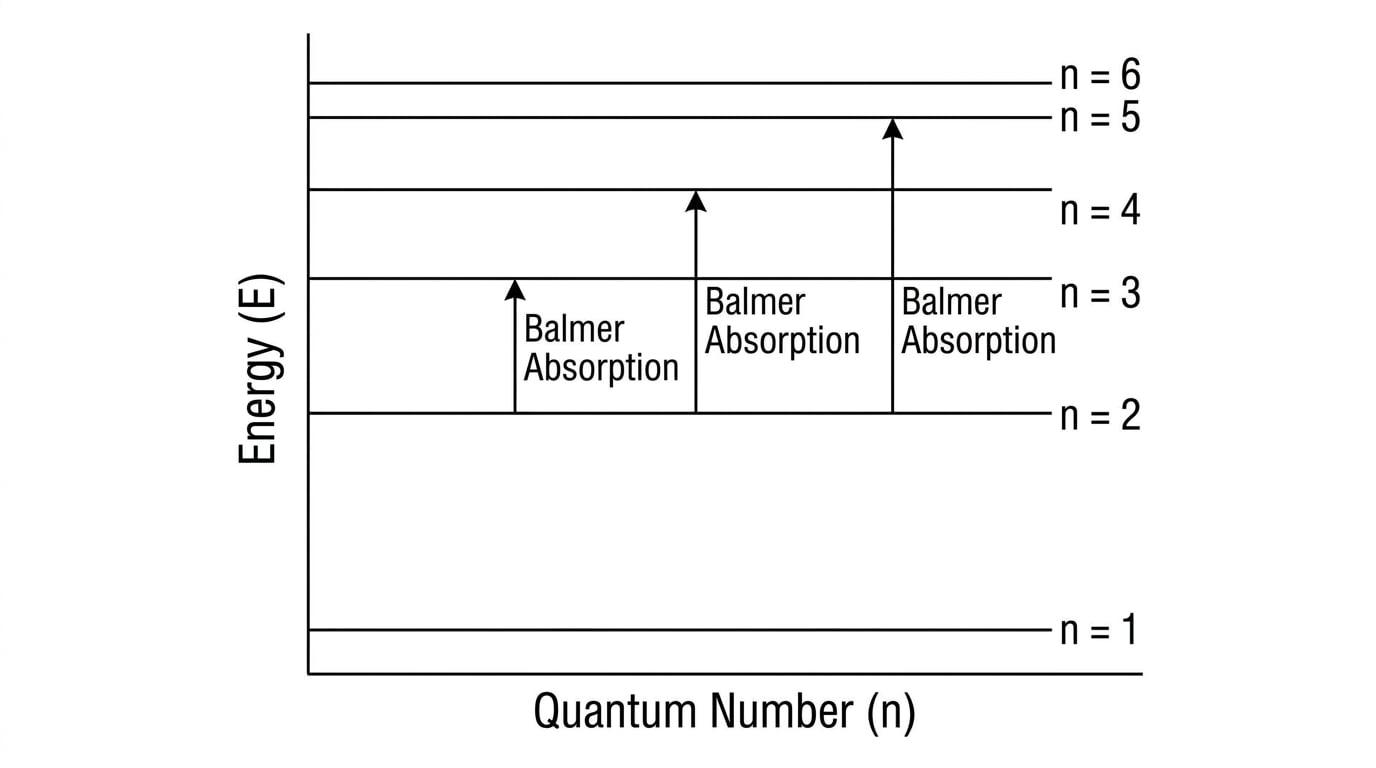
The crucial requirement: For a hydrogen atom to absorb a photon and create a Balmer line, its electron must already be in the n=2n = 2n=2 state.
- If the electron is in the ground state (n=1n = 1n=1), it requires an ultraviolet photon to excite it (the Lyman series), not visible light.
- If the electron is in n=3n = 3n=3 or higher, the energy gaps are too small, requiring infrared photons (the Paschen series).
So, for strong Balmer lines to appear in a star's visible spectrum, there must be a large population of hydrogen atoms with their electrons sitting patiently in the n=2n = 2n=2 state.
Temperature controls the energy states
The temperature of the star's atmosphere dictates how much thermal (kinetic) energy the atoms have. This thermal energy, transferred through collisions, determines which energy level the electrons are bumped into before they absorb any photons from the core.
4. How Temperature Affects Balmer Lines
Let's look at why Balmer lines are strongest in Class A stars and weaker everywhere else. This is a very common long-answer exam question.
Cool Stars (Classes F, G, K, M)
In stars cooler than about 7 500 K, the atmosphere does not have enough thermal energy.
- Collisions between atoms are low-energy.
- Almost all hydrogen electrons remain stuck in their lowest possible energy state, the ground state (n=1n = 1n=1).
- Because very few electrons are in the n=2n = 2n=2 state, very few visible-light photons can be absorbed.
- Result: Very weak Balmer absorption lines.
Ideal Temperature (Class A: 7 500 K – 11 000 K)
This is the "Goldilocks" zone for Hydrogen Balmer lines.
- The thermal energy from collisions is just right. It is high enough to excite a large proportion of the hydrogen electrons out of the ground state and into the n=2n = 2n=2 state.
- The energy is not so high that it knocks the electrons completely out of the atom.
- With an abundance of atoms in the n=2n = 2n=2 state waiting to absorb visible light, maximum absorption occurs.
- Result: The strongest Balmer absorption lines.
Hot Stars (Classes O, B)
In stars hotter than 11 000 K, the atmosphere has too much thermal energy.
- High-energy collisions violently bump electrons up into n=3,n=4n = 3, n = 4n=3,n=4, or even ionize the atom entirely (stripping the electron away).
- Because the electrons bypass the n=2n = 2n=2 state, there is nothing there to absorb the visible light photons.
- Result: Weak Balmer absorption lines (but you will see lines for ionized elements like He+\text{He}^{+}He+ instead!).
Confusing abundance with absorption strength
Students often assume that because Class O stars are very hot, they must have strong hydrogen lines. Or, they assume Class M stars have weak hydrogen lines because they "don't contain much hydrogen". Both are wrong. Almost all stars are mostly hydrogen! The strength of the Balmer lines is purely a measure of the temperature-dependent energy states of that hydrogen, not how much hydrogen is present.
Explaining Balmer Line Strength
Explain why the Hydrogen Balmer absorption lines are much weaker in the spectrum of an O-class star compared to an A-class star. (3 marks)
- State the temperature difference: An O-class star is much hotter than an A-class star (greater than 25 000 K compared to 7 500 – 11 000 K).
- State the condition for Balmer lines: To produce Balmer absorption lines, hydrogen atoms must have their electrons in the n=2n = 2n=2 state.
- Explain the effect of high temperature: In the extremely hot atmosphere of an O-class star, collisions have so much kinetic energy that most hydrogen atoms are excited to higher levels (n>2n > 2n>2) or are completely ionized. Therefore, very few are in the n=2n = 2n=2 state to absorb Balmer photons, leading to weaker lines.
In the exam
- Memorise the table: You are expected to recall the OBAFGKM letters, the colours, the temperature bounds, and the key prominent lines. Flashcards are highly recommended here.
- Be specific with your "nnn" values: When discussing Balmer lines, explicitly write "n=2n = 2n=2". Vague phrases like "a higher energy state" will lose marks. You must state that absorption originates from the n=2n = 2n=2 state.
- Use the word "Ionization": For very hot stars (O and B), explicitly mention that hydrogen is likely ionized. This immediately explains why there are no electrons available in n=2n = 2n=2.
- Distinguish neutral from ionized metals: Notice in the table that cooler stars (K, M) show neutral metals, while hotter stars (A, F) show ionized metals. This is again due to the increasing thermal energy stripping electrons away.
Check yourself
- Can you list the 7 spectral classes in order from hottest to coolest?
- What temperature range corresponds to a star with strong Hydrogen Balmer lines, and what is its spectral class?
- Why do cool M-class stars have extremely weak Hydrogen Balmer lines despite being composed mostly of hydrogen?
- Which spectral class is characterized by the presence of He+\text{He}^{+}He+ lines, and why?