

What you'll learn:
- Why physicists model stars as "black bodies".
- How to use Wien's displacement law to find a star's surface temperature from its colour.
- How to link a star's power output (luminosity), temperature, and size using Stefan's law.
- Why stars look dim from Earth, and the assumptions we make when using the inverse square law.
Stars as black bodies
To classify a star, physicists need to know its surface temperature. We cannot stick a thermometer into a star, so we have to analyze the light it emits. To do this mathematically, we model stars as black bodies.
Black body
A perfect black body is an object that absorbs all electromagnetic radiation that falls on it. Because it is a perfect absorber, it is also a perfect emitter of radiation.
Stars are not completely perfect black bodies (their outer atmospheres absorb some specific wavelengths, creating absorption lines), but they are incredibly close. For A-level Physics, you must assume that a star acts as a perfect black body.
Black-body curves and Wien's displacement law
If you measure the intensity of the light emitted by a black body across different wavelengths, you get a characteristic "hill-shaped" graph called a black-body curve.
The shape of this curve depends entirely on the object's surface temperature.
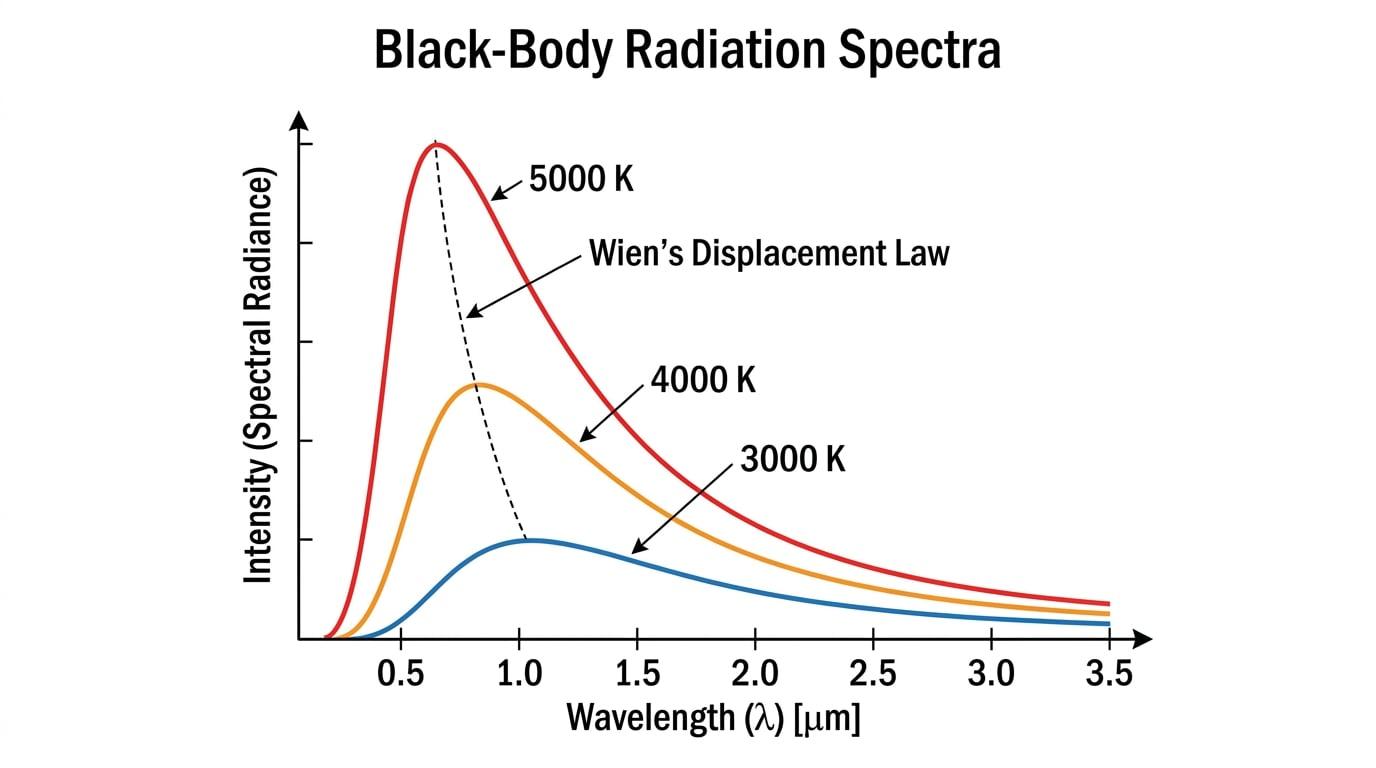
Notice two key features as the temperature of the black body increases:
- The overall intensity (the area under the curve) increases dramatically.
- The peak of the curve shifts to the left, towards a shorter wavelength.
This shift in the peak is described by Wien's displacement law, which states that the peak wavelength is inversely proportional to the absolute temperature.
λmaxT=2.9×10⁻³ m K \lambda_{\max} T = 2.9 \times 10^{-3} \text{ m K} λmaxT=2.9×10⁻³ m KWhere:
- λmax\lambda_{\max}λmax is the peak wavelength in metres (m).
- TTT is the absolute surface temperature in Kelvin (K).
- 2.9×10⁻³ m K2.9 \times 10^{-3} \text{ m K}2.9×10⁻³ m K is Wien's constant (given in your data booklet).
Misinterpreting the peak wavelength
The symbol λmax\lambda_{\max}λmax does not mean "the maximum wavelength emitted". It means "the wavelength at which maximum intensity occurs".
Estimating surface temperature using Wien's law
The peak wavelength of the radiation emitted by the Sun is approximately 500 nm. Calculate the estimated surface temperature of the Sun.
- Convert the peak wavelength from nanometres into metres:
- State Wien's displacement law and rearrange it to make temperature TTT the subject:
- Substitute the values to find the temperature:
Stefan's Law (Luminosity and Power)
Wien's law tells us about the colour and temperature of a star. But what about the total energy it kicks out?
The total power output of a star (how many Joules of energy it radiates per second) is also called its luminosity. According to Stefan's law, the power output of a black body is proportional to its surface area and proportional to the fourth power of its absolute temperature.
P=σAT4 P = \sigma A T^4 P=σAT4Where:
- PPP is the power output (luminosity) in Watts (W).
- σ\sigmaσ is the Stefan-Boltzmann constant, 5.67×10⁻⁸ W m−2 K−45.67 \times 10^{-8} \text{ W m}^{-2} \text{ K}^{-4}5.67×10⁻⁸ W m−2 K−4 (given in your data booklet).
- AAA is the surface area of the star in square metres (m2\text{m}^2m2).
- TTT is the absolute surface temperature in Kelvin (K).
Because we assume stars are spherical, we can replace the surface area AAA with the formula for the surface area of a sphere (4πr24 \pi r^24πr2), where rrr is the radius of the star.
P=σ4πr2T4 P = \sigma 4 \pi r^2 T^4 P=σ4πr2T4Comparing stars
Stefan's law is incredibly powerful because it links three key properties: Power (PPP), size (rrr), and temperature (TTT). If you spot a star that has a very low surface temperature (it is cool and red) but a massive power output, Stefan's law tells you that its radius rrr must be gigantic. This is how physicists deduce the existence of Red Supergiants!
Comparing the size of two stars
Star X has twice the absolute surface temperature of the Sun, but the same total power output. Calculate the radius of Star X in terms of the solar radius, R⊙R_{\odot}R⊙.
- Write out Stefan's law for both the Sun and Star X using the spherical area formula:
- Substitute the given conditions (PX=P⊙P_X = P_{\odot}PX=P⊙ and TX=2T⊙T_X = 2T_{\odot}TX=2T⊙) into the equation for Star X:
- Expand the temperature term (remembering to apply the power of 4 to the number 2 as well):
- Equate the two expressions for P⊙P_{\odot}P⊙:
- Cancel out the common terms on both sides (444, π\piπ, σ\sigmaσ, and T⊙4T_{\odot}^4T⊙4):
- Rearrange to find RXR_XRX and square root both sides:
The Inverse Square Law
A star might have a colossal power output, but if it is very far away, it will only look like a faint pinprick in the night sky. The amount of power that actually reaches a square metre of Earth is called the intensity (or sometimes radiant flux).
As light leaves a star, it spreads out evenly in all directions, covering the surface of an ever-expanding imaginary sphere.
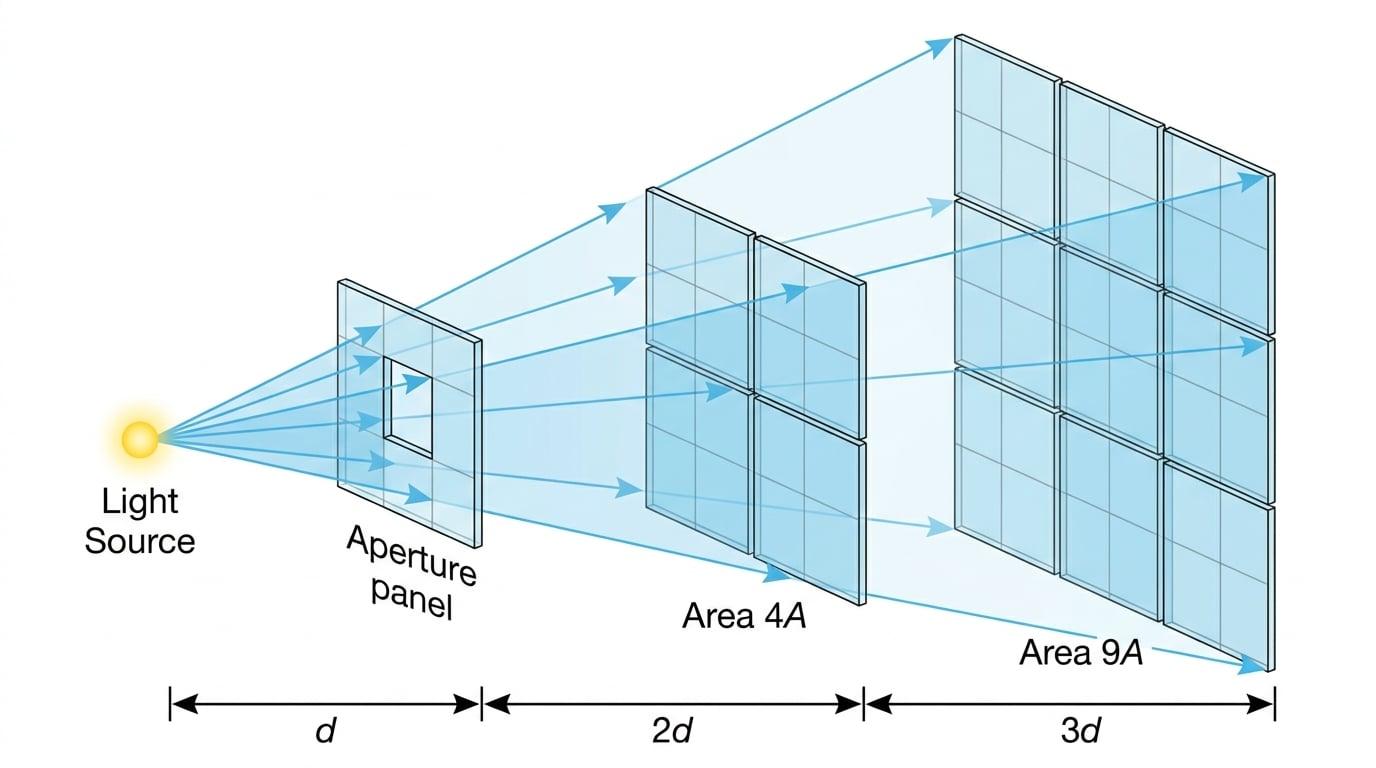
Because the area of this sphere grows with the square of the distance (A=4πd2A = 4 \pi d^2A=4πd2), the intensity of the light drops off with the square of the distance. This is the inverse square law.
I=P4πd2 I = \frac{P}{4 \pi d^2} I=4πd2PWhere:
- III is the intensity at Earth in Watts per square metre (W m−2\text{W m}^{-2}W m−2).
- PPP is the power output of the star in Watts (W).
- ddd is the distance from the star to Earth in metres (m).
Assumptions in the inverse square law
When applying this formula in exam questions, you must assume:
- The star acts as a point source of light.
- The radiation spreads out isotropically (evenly in all directions).
- No light is absorbed or scattered by interstellar dust or gas in the vacuum of space.
Calculating distance using the inverse square law
The star Sirius A has a total power output of 9.8×1026 W9.8 \times 10^{26} \text{ W}9.8×1026 W. The intensity of the radiation reaching Earth from Sirius A is 1.2×10⁻⁷ W m−21.2 \times 10^{-7} \text{ W m}^{-2}1.2×10⁻⁷ W m−2. Calculate the distance from Earth to Sirius A.
- State the inverse square law:
- Rearrange the formula to make distance ddd the subject:
- Substitute the given values into the equation:
- Calculate the final answer:
In the exam
- Check your units constantly. Wien's law requires λmax\lambda_{\max}λmax in metres, but graphs often label the axis in nanometres (nm) or micrometres (μ\muμm).
- When comparing two stars using Stefan's law, write out the equations as a ratio (e.g., P1P2\frac{P_1}{P_2}P2P1) to quickly cancel out constants like 444, π\piπ, and σ\sigmaσ.
- If an exam question asks "State the assumptions made when calculating the distance to this star", remember the phrase "no absorption by interstellar dust". This is a highly reliable mark-winner.
Check yourself
- What happens to the peak wavelength of a black body as its temperature increases?
- How is the power output of a star related to its absolute temperature?
- Why do physicists use the formula 4πr24 \pi r^24πr2 when using Stefan's law for stars?
- What are the three key assumptions made when using the inverse square law for starlight?
