

What you'll learn in this topic:
- How a photodiode operates in photo-conductive mode (reverse bias).
- How to interpret photodiode characteristic curves (I-V graphs) and spectral response curves.
- How photodiodes are used as fast-acting detectors in optical systems.
- How pairing a photodiode with a scintillator allows us to detect high-energy atomic particles.
The Photodiode and Photo-conductive Mode
You already know that standard diodes only allow current to flow in one direction (forward bias). If you connect them the "wrong way" round (reverse bias), they block the current almost entirely.
A photodiode is a special type of semiconductor diode designed specifically to take advantage of this reverse-bias behaviour when exposed to light.
Photodiode
A discrete semiconductor device that converts incoming light (photons) into an electrical current.
When we use a photodiode to measure light intensity or detect light pulses, we operate it in photo-conductive mode. This simply means we connect the photodiode in reverse bias within a circuit.
In complete darkness, the reverse-biased photodiode blocks almost all current. However, a tiny leakage current still flows, known as the dark current.
When light hits the P-N junction of the photodiode, the photons transfer their energy to electrons in the semiconductor. If the photons have enough energy, they free these electrons, creating electron-hole pairs. Because the diode is in reverse bias, the built-in electric field instantly sweeps these free charges away, creating a measurable current.
The Golden Rule of Photodiodes
In photo-conductive mode (reverse bias), the current flowing through the photodiode is directly proportional to the intensity of the light hitting it.
Characteristic Curves (I-V Graphs)
To fully understand a photodiode, you need to look at its characteristic curve—a graph of current against voltage.
Because we operate photodiodes in reverse bias, the interesting part of the graph is in the third quadrant (negative voltage, negative current).
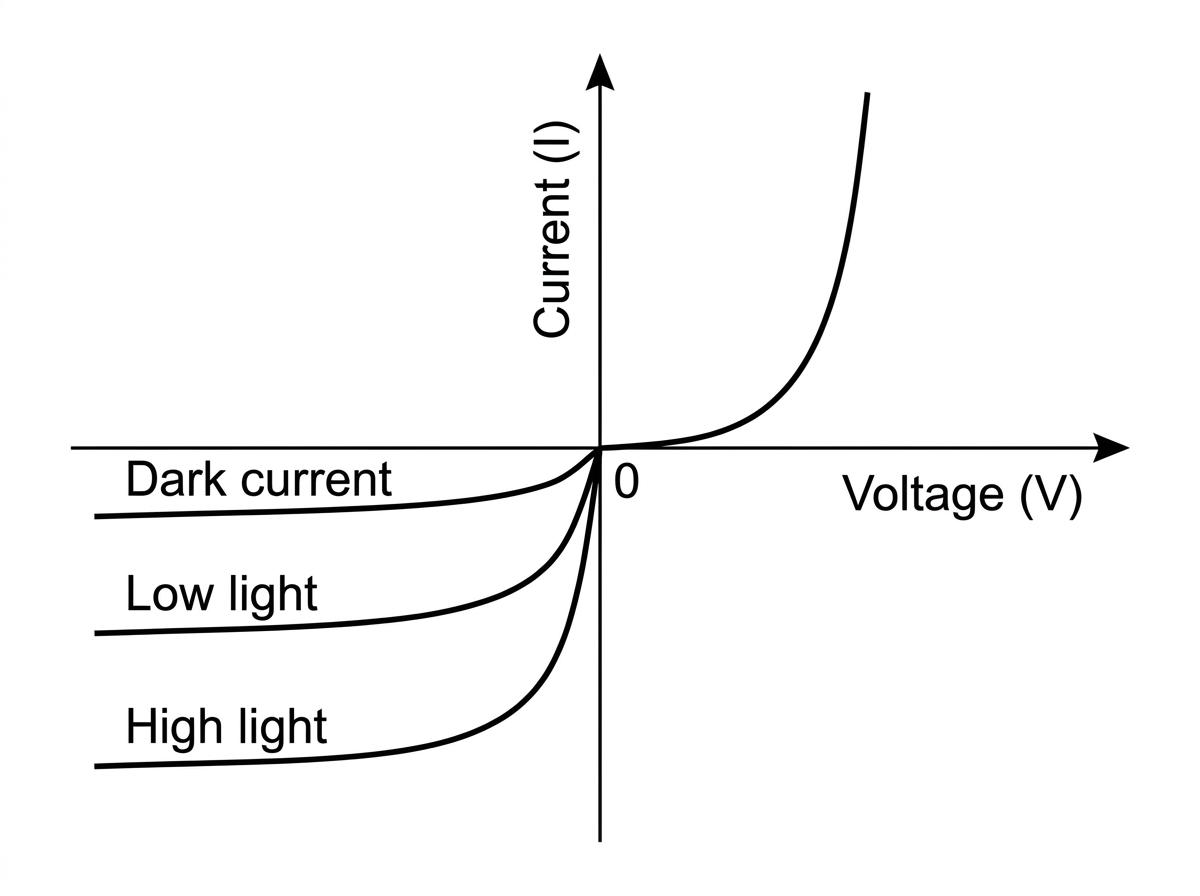
Notice the following key features:
- The y-axis: Represents the reverse current (often called the photocurrent). In reality, this is usually in microamps (μA\mu\text{A}μA) or milliamps (mA\text{mA}mA).
- Dark Current: The top line shows the tiny current that flows when there is zero illumination.
- Spacing of the lines: As light intensity (illuminance) increases, the reverse current increases. For a constant reverse voltage, doubling the light intensity will roughly double the photocurrent.
Forgetting the Bias
Students often confuse LEDs, solar cells, and photodiodes. Remember: LEDs are operated in forward bias, but photodiodes used as detectors are operated in reverse bias (photo-conductive mode).
Spectral Response Curves
Not all light is equal. A photodiode does not react to all wavelengths of light with the same sensitivity. The energy of an incoming photon is given by E=hcλE = \frac{hc}{\lambda}E=λhc. If a photon's wavelength λ\lambdaλ is too long (and thus its energy is too low), it won't have enough energy to free an electron in the semiconductor, meaning zero current is produced.
A spectral response curve shows how the sensitivity of the photodiode changes with the wavelength of the incident light. The y-axis is usually given as responsivity, measured in Amperes per Watt (A W−1\text{A W}^{-1}A W−1). This tells you how much current is produced for every watt of light power hitting the detector.
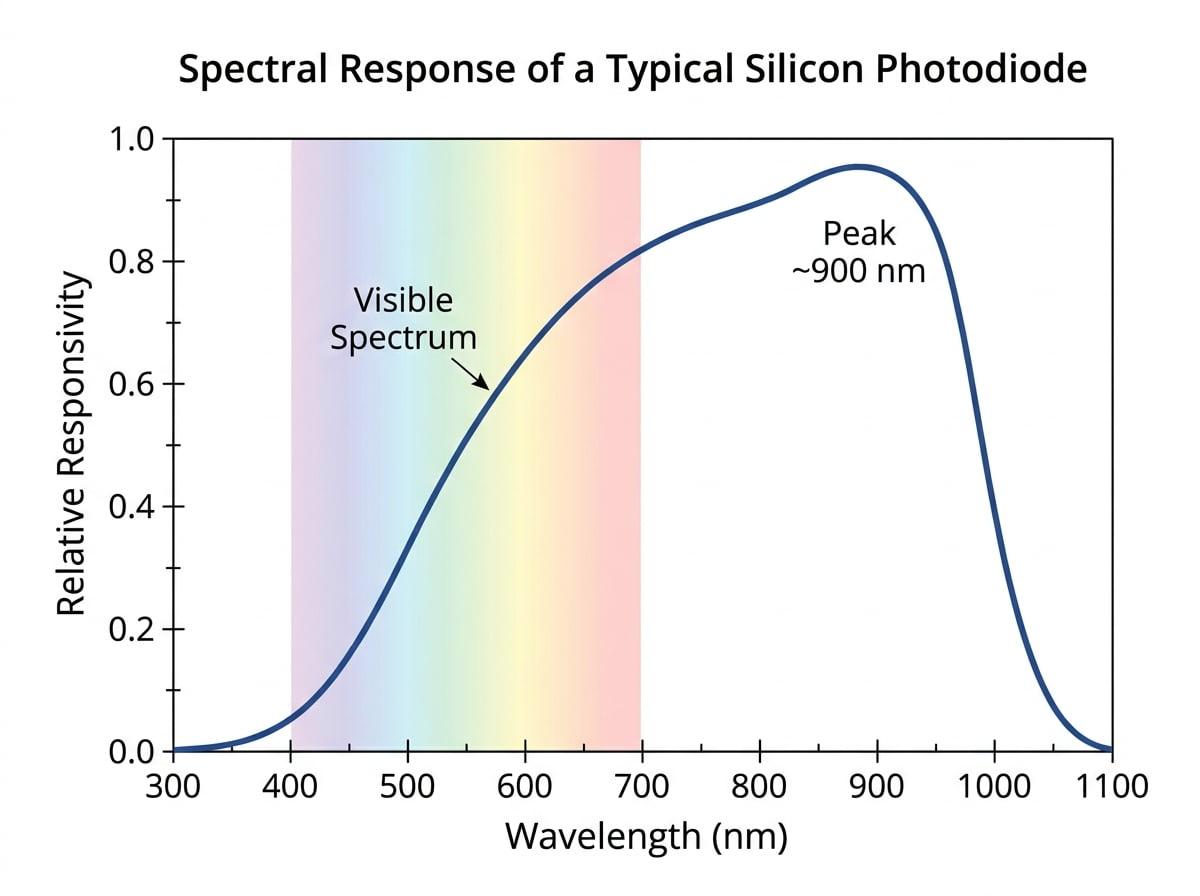
For a typical silicon photodiode:
- It does not respond to far-infrared light (wavelengths longer than roughly 1100 nm1100 \text{ nm}1100 nm) because the photons lack the energy to free electrons.
- The peak sensitivity is usually in the near-infrared region (around 900 nm900 \text{ nm}900 nm).
- Sensitivity drops off for ultraviolet light because high-energy photons are absorbed too close to the surface of the semiconductor, before they can reach the active junction.
Calculating Photocurrent from a Spectral Response Curve
A silicon photodiode is exposed to a laser beam of wavelength 900 nm900 \text{ nm}900 nm. The power of the laser beam hitting the photodiode is 2.5 mW2.5 \text{ mW}2.5 mW. At this wavelength, the photodiode has a responsivity of 0.60 A W−10.60 \text{ A W}^{-1}0.60 A W−1.
Calculate the expected photocurrent, assuming dark current is negligible.
- Identify the incident power PPP in standard SI units (Watts):
- Use the definition of responsivity RRR to find the current III. Responsivity is the current produced per unit of incident power (R=IPR = \frac{I}{P}R=PI). Rearranging for current gives:
- Substitute the values into the equation:
- Calculate the final current:
So, the photocurrent is 1.5 mA1.5 \text{ mA}1.5 mA.
Use in Optical Systems
Because photodiodes react to changes in light intensity almost instantaneously, they are fantastic detectors in optical systems.
Common uses include:
- Fibre-optic communications: Pulses of infrared light travel down an optical fibre. A photodiode at the receiving end converts these incredibly fast light flashes back into high-speed electrical signals.
- Remote controls: When you press a button on your TV remote, it flashes an infrared LED. A photodiode on your TV detects these specific flashes and converts them into an electrical signal the TV's processor can decode.
Why Reverse Bias?
You might wonder why we don't just use a photodiode like a mini solar panel without any battery attached (photovoltaic mode). Applying a reverse bias (photo-conductive mode) widens the "depletion zone" inside the diode. This significantly decreases the time it takes for the electrons to be swept away, allowing the photodiode to react to high-speed optical pulses much faster.
Detecting Atomic Particles (Scintillators)
Photodiodes are great at detecting visible and infrared light, but what if we want to detect high-energy atomic particles (like alpha or beta particles) or gamma radiation?
These particles carry so much energy that they often pass straight through a thin semiconductor without depositing their energy usefully, or they damage the delicate crystal structure.
The solution is to use a scintillator.
Scintillator
A material (often a dense crystal or special plastic) that absorbs high-energy particles or radiation and re-emits the energy as brief flashes of visible light.
By coupling a scintillator block directly to a photodiode, we create a highly effective particle detector.
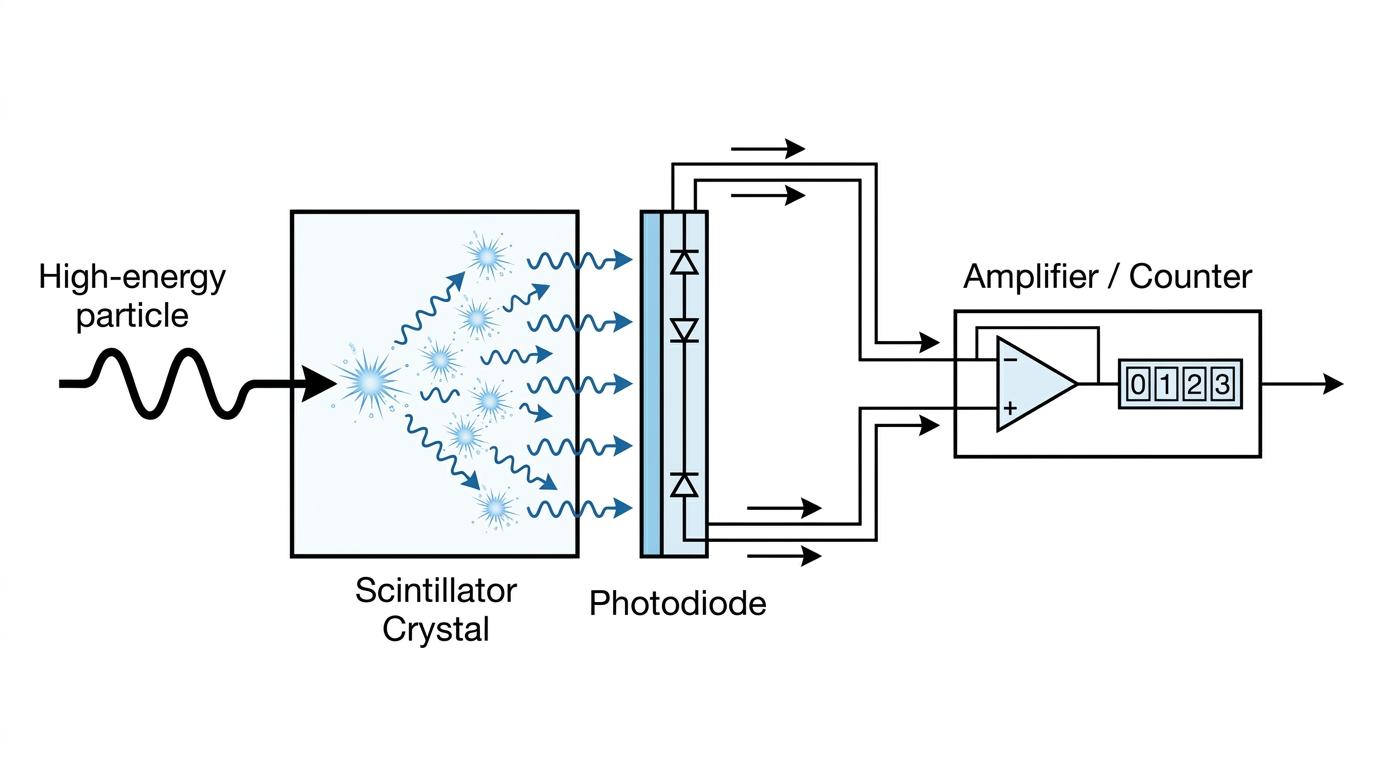
Here is the step-by-step process of how this combined detector works:
- An invisible, high-energy atomic particle enters the scintillator crystal.
- The particle collides with atoms in the crystal, exciting them. As they de-excite, they release their energy as flashes of visible light photons (scintillation).
- These visible photons travel out of the crystal and hit the attached photodiode.
- The photodiode absorbs the visible photons and generates a pulse of electric current.
- This current pulse is passed to an amplifier and a counter to record the detection of the original particle.
This method is incredibly useful in medical imaging (like PET scanners) and nuclear physics experiments. The amount of light produced in the scintillator—and therefore the size of the current pulse from the photodiode—is often proportional to the energy of the original incoming particle, allowing physicists to not only count particles but also measure their energies.
In the exam
- Check the mode: If an AQA question asks about a photodiode as a detector, explicitly state it must be connected in reverse bias (photo-conductive mode).
- Read axes carefully: On spectral response graphs, check if the wavelength axis is in nm\text{nm}nm or μm\mu\text{m}μm. Responsivity might be in A W−1\text{A W}^{-1}A W−1 or sometimes given as a relative percentage.
- Explain the chain for scintillators: If asked how a particle is detected using this setup, break it down clearly: Particle →\to→ Scintillator →\to→ Visible Light →\to→ Photodiode →\to→ Electrical Signal. Don't skip the intermediate "visible light" step!
Check yourself
- Can you explain why a photodiode is operated in reverse bias rather than forward bias?
- What does the term "dark current" refer to on an I-V characteristic curve?
- Why does the spectral response curve of a silicon photodiode drop to zero at very long wavelengths?
- How does a scintillator enable a photodiode to detect an alpha particle?
