Example
Calculating RPM from an Oscilloscope Trace
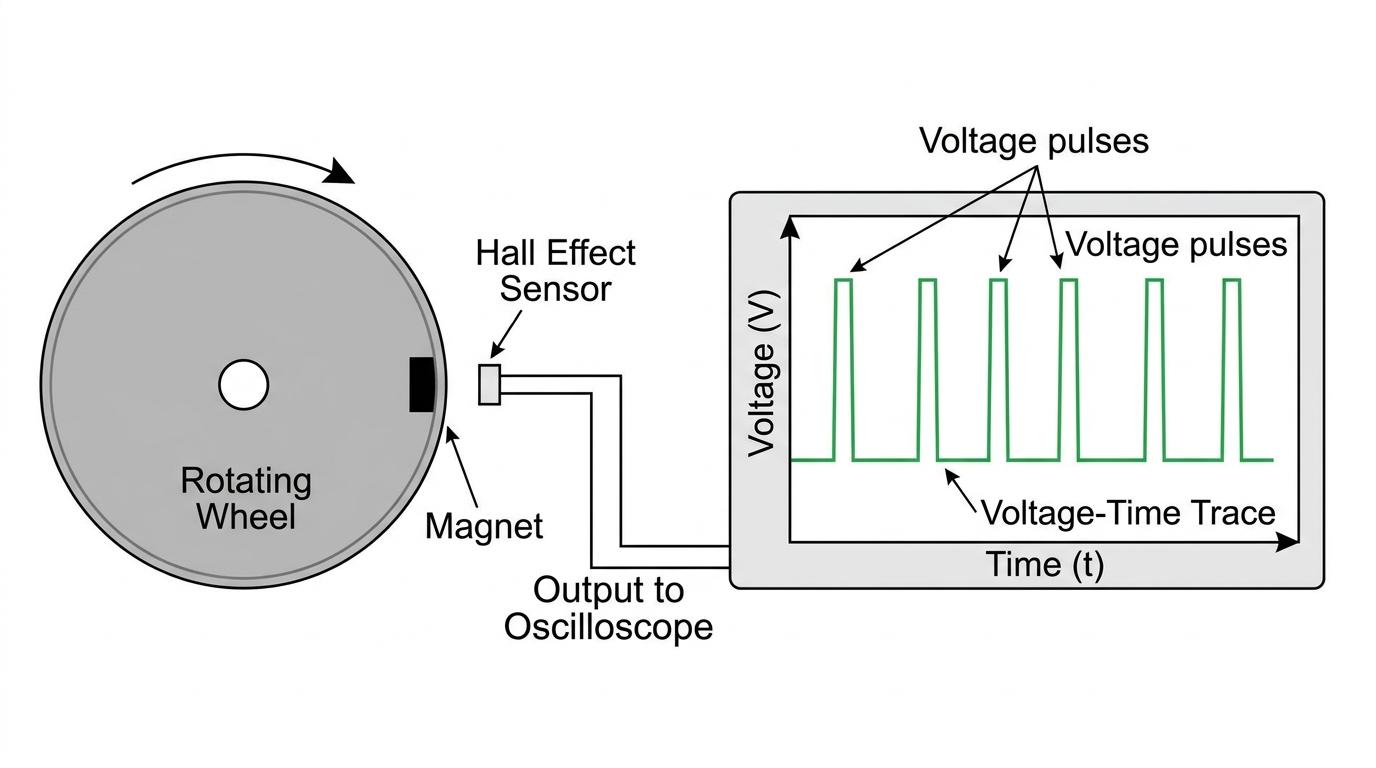
A tachometer setup is used to measure the spin speed of a motor shaft. The Hall effect sensor's output is connected to an oscilloscope. The timebase of the oscilloscope is set to 20 ms per division.
The screen shows that the voltage pulses are spaced exactly 4.5 divisions apart. Calculate the rotational speed of the shaft in revolutions per minute (RPM).
- Calculate the time period (TTT) for one full rotation. This is the time between one pulse and the next.
- Convert the time period into standard SI units (seconds).
- Calculate the frequency (fff) of rotation. Frequency is the number of revolutions per second (Hz).
- Convert the frequency (revolutions per second) into RPM (revolutions per minute) by multiplying by 60.
Tip
From Hz to RPM
To convert from Hertz (revolutions per second) to RPM (revolutions per minute), always multiply by 60. If you are given RPM and need to find standard frequency, divide by 60.
Exam technique
In the exam
- Read the context carefully: AQA loves to bury Hall effect sensors inside a larger synoptic context (e.g., inside an MRI machine, or attached to a spinning bicycle wheel). Identify whether it is being used to measure an angle (attitude) or a speed (tachometer).
- Don't overcomplicate it: The specification explicitly says principles of operation are not required. Do not waste time trying to explain electron drift or Lorentz forces unless a different part of the question explicitly directs you to the underlying magnetic field theory. Treat the sensor as a device that turns a magnetic field into a voltage.
- Check your units in graphical questions: If you are reading pulses off a graph or oscilloscope trace, always check the axis labels. Time is usually given in milliseconds (ms) or microseconds (μs\mu\text{s}μs). Always convert to seconds before calculating frequency.
Self review
Check yourself
- Can you describe the difference between altitude and attitude?
- If the distance between a magnet and a Hall effect sensor doubles, what happens to the voltage output, and why?
- How many voltage pulses will a single-magnet tachometer produce if a wheel spins at 120 RPM?