

Welcome to the cornerstone of classical mechanics! Whether you are looking at a rocket launching into space or a book sitting quietly on a desk, the forces involved and the resulting motion are entirely governed by three fundamental rules formulated by Sir Isaac Newton.
What you'll learn:
- How to state and apply Newton's three laws of motion.
- How to use the equation F=maF = maF=ma to solve problems involving constant mass.
- How to draw and interpret free-body diagrams to find resultant forces.
- How to identify genuine Newton's third law force pairs (and spot the fakes!).
The foundation: Newton's First Law
Before we look at how things accelerate, we need to look at how they behave when left alone.
Resultant Force
The resultant force (often written as ΣF\Sigma FΣF) is the single vector force that has the exact same effect as all the individual forces acting on an object combined.
Newton's First Law tells us what happens when this resultant force is exactly zero.
Newton's First Law: An object will remain at rest, or continue to move at a constant velocity, unless acted upon by a resultant force.
This means that "constant velocity" and "stationary" are essentially the same state mechanically: they both mean the forces are perfectly balanced. If a car is cruising down the motorway at a steady 70 mph, the driving force from the engine is exactly balanced by the resistive forces (air resistance and friction). There is no resultant force.
Zero resultant force means zero acceleration
If forces are balanced, acceleration is zero. If you see the phrases "constant velocity", "steady speed in a straight line", or "stationary" in an exam question, immediately write down that the resultant force is zero.
The core equation: Newton's Second Law
If the forces aren't balanced, the object's velocity will change. It will accelerate.
Newton's Second Law: The acceleration of an object is proportional to the resultant force acting on it and inversely proportional to its mass.
For situations where the mass of the object is constant (which applies to almost all A-Level mechanics problems, unless you are dealing with rockets burning fuel), we write this as a famous equation:
F=ma F = ma F=maWhere:
- FFF is the resultant force in newtons (N).
- mmm is the mass in kilograms (kg).
- aaa is the acceleration in metres per second squared (m s−2\text{m s}^{-2}m s−2).
F is always the resultant force
A very common trap is to plug just any force into F=maF = maF=ma. The FFF in this equation strictly means the overall resultant force acting in the direction of motion. If there are multiple forces, you must combine them first.
Free-body diagrams
To correctly find the resultant force, you should draw a free-body diagram. This is a simplified sketch showing only the object in question and the forces acting directly on it.
We usually draw the object as a simple box or a dot. The forces are drawn as arrows pointing away from the centre of the object.
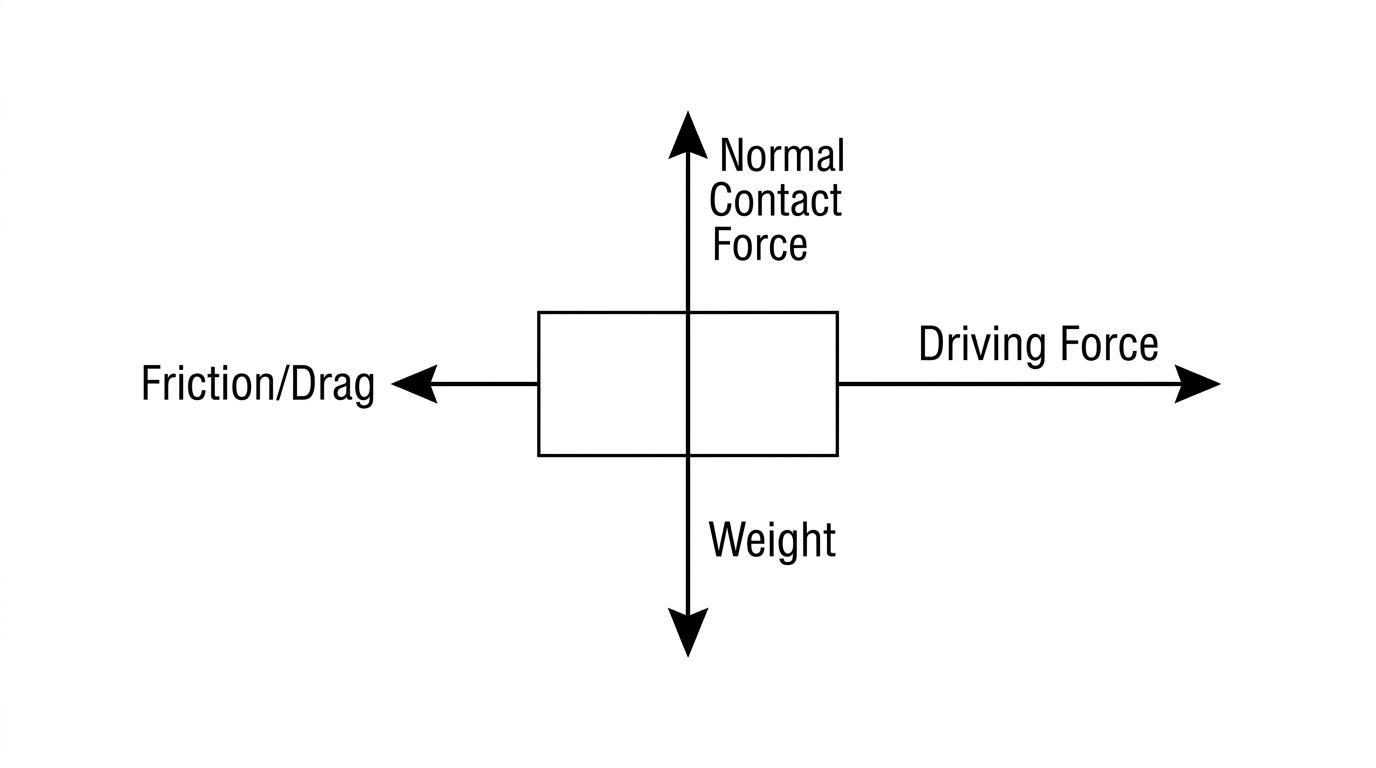
In the diagram above, the vertical forces (Weight and Normal Contact Force) balance out, so there is no vertical acceleration. Horizontally, the Driving Force is larger than the Friction, creating a resultant force to the right. Therefore, the car accelerates to the right.
Applying Newton's Second Law
A car of mass 1200 kg is travelling along a straight horizontal road. The car's engine produces a constant driving force of 3500 N. The total resistive forces (drag and friction) acting on the car are 800 N. Calculate the acceleration of the car.
- Calculate the resultant force (FFF). The forces act in opposite directions, so we subtract the resistive force from the driving force to find the overall forward pull:
- State Newton's Second Law.
- Rearrange to make acceleration (aaa) the subject.
- Substitute the values and calculate.
Action and reaction: Newton's Third Law
Newton's Third Law is often poorly understood. You have probably heard the phrase: "Every action has an equal and opposite reaction." While catchy, this phrasing can be dangerous in physics exams because it leaves out crucial details.
Newton's Third Law: If body A exerts a force on body B, then body B exerts a force of the same type, equal in magnitude and opposite in direction, on body A.
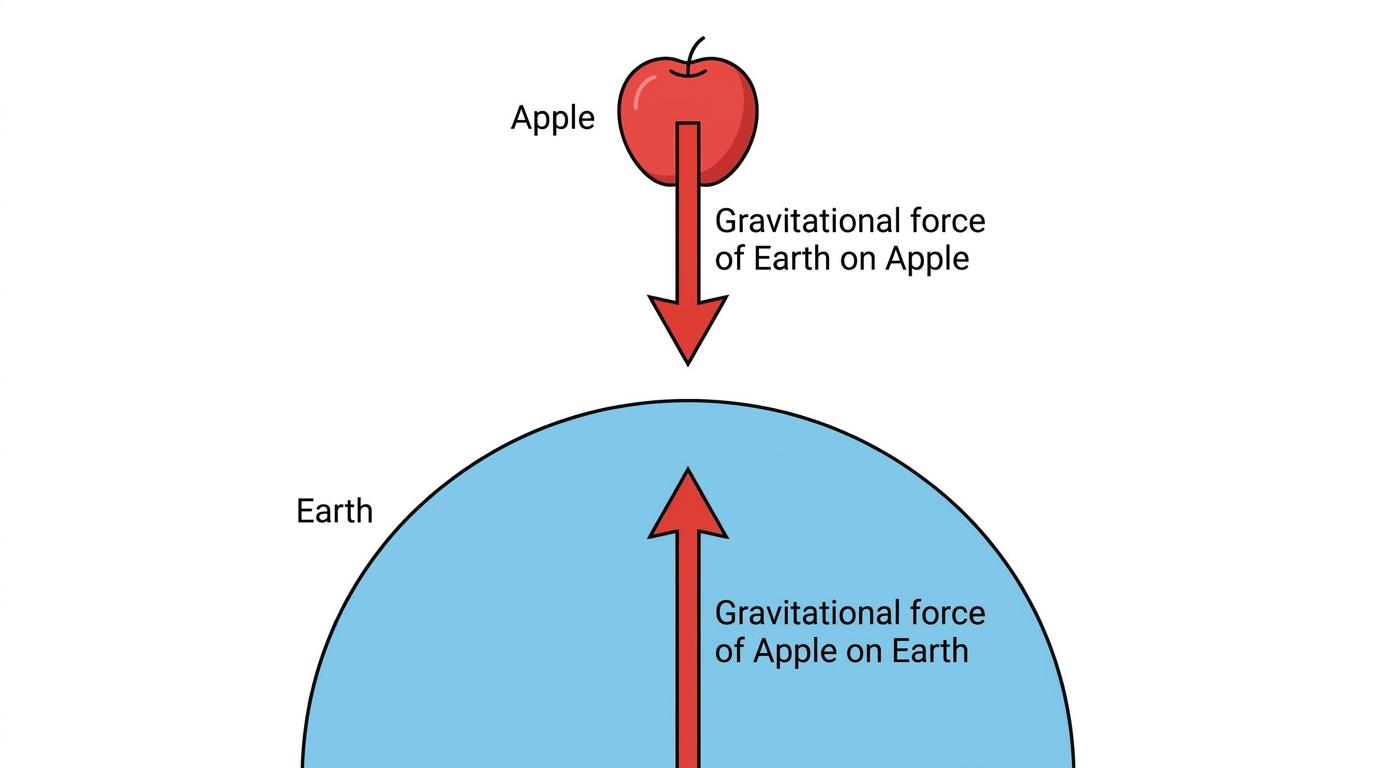
For two forces to be a genuine "Newton's Third Law pair", they must meet four strict criteria:
- They must act on two different bodies.
- They must be strictly equal in magnitude (size).
- They must act in opposite directions.
- They must be forces of the same type (e.g., both gravitational, or both electrostatic, or both contact forces).
The book on the table trap
Imagine a book resting on a table. The Weight of the book acts downwards. The Normal Contact Force from the table pushes upwards. They are equal and opposite, so they are a Third Law pair, right? Wrong.
They act on the same body (the book) and are different types of force (one is gravitational, one is an electrostatic contact force). They are equal simply because of Newton's First Law (the book is in equilibrium).
The true Third Law pair to the book's Weight (Earth pulling down on book) is the book pulling up on the Earth with an equal gravitational force!
Verifying Newton's Second Law in the lab
You will likely carry out a core practical to verify F=maF = maF=ma. This is usually done using a trolley on a track, pulled by a falling mass hanging over a pulley.
By keeping the total mass of the system (mmm) constant, you can vary the pulling force (FFF) by moving small slotted masses from the trolley to the weight hanger. You then use light gates or a ticker-timer to measure the resulting acceleration (aaa).
When you plot a graph of Acceleration against Resultant Force, you should get a straight line passing through the origin. This proves that a∝Fa \propto Fa∝F, verifying Newton's Second Law.
Compensating for friction
In this experiment, you should slightly tilt the track until the trolley moves at a constant velocity when given a gentle push. This ensures the component of gravity down the slope perfectly cancels out the friction in the wheels. Now, the only resultant force will be the tension from the hanging string!
In the exam
- Always draw a quick sketch. Even if the question doesn't specifically ask for a free-body diagram, sketching the object and the forces prevents you from forgetting resistive forces or weight components.
- State your assumptions. If a question asks you to find a driving force from a constant speed, explicitly write "constant speed ⇒\Rightarrow⇒ zero acceleration ⇒\Rightarrow⇒ forces balanced". AQA mark schemes often award a specific mark just for stating F=0F=0F=0 or a=0a=0a=0.
- Check the nature of the forces. If asked to identify a Newton's Third Law pair, rigidly check the four criteria. If they are different types of force (e.g., weight and contact force), it's a trap.
Check yourself
- Can you explain the difference between a system with zero resultant force and a system with a constant non-zero resultant force?
- When calculating F=maF=maF=ma, why must you subtract frictional forces from the driving force?
- What is the Newton's Third Law pair to the forward push a swimmer's hand exerts on the water?
- Why do we tilt the runway when verifying Newton's Second Law with a trolley?
