

What you'll learn:
- Why horizontal and vertical motions act completely independently of each other.
- How to use the 'suvat' equations of uniform acceleration to find the range, maximum height, and time of flight for a projectile.
- The qualitative effects of friction, drag, and lift on moving objects.
- Why falling objects reach a terminal speed and how air resistance changes a projectile's path.
The Golden Rule of Projectiles
A projectile is any object that has been thrown, dropped, or fired, and is now moving freely through the air.
Projectile
A projectile is an object upon which the only force acting is gravity (assuming air resistance is negligible).
The most important concept in projectile motion is that horizontal and vertical motions are completely independent.
Why? Because forces only cause acceleration in their own direction. Gravity acts strictly downwards. Therefore, gravity only changes the vertical velocity of the object. It has absolutely zero effect on the horizontal velocity.
Independence of components
If we ignore air resistance:
- Horizontal motion: Moves at a constant velocity (acceleration ax=0a_x = 0ax=0).
- Vertical motion: Experiences uniform acceleration downwards due to gravity (ay=−9.81 m s−2a_y = -9.81 \text{ m s}^{-2}ay=−9.81 m s−2).
This means we can break any 2D projectile problem into two separate 1D problems. We solve the horizontal part, we solve the vertical part, and the only thing that connects them is time.
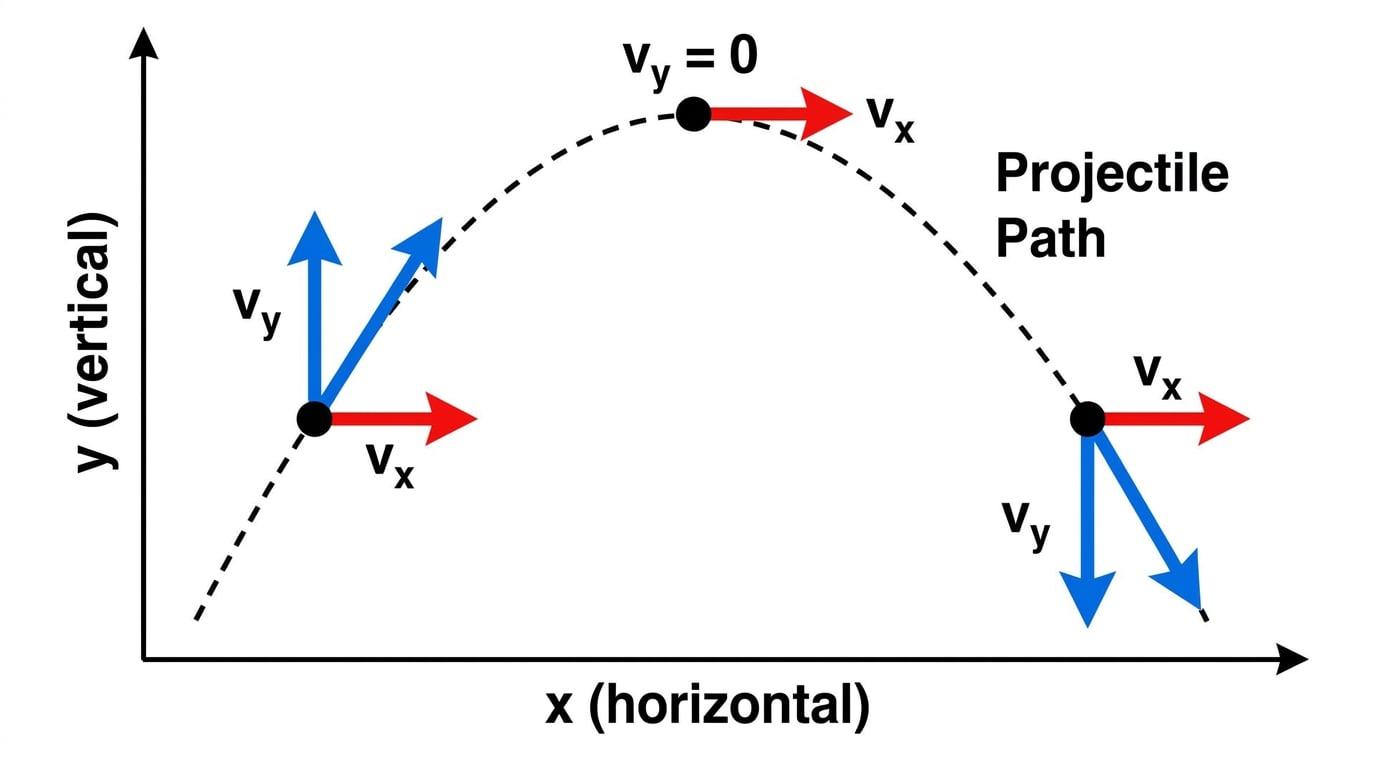
Notice in the diagram above how the red horizontal vector (vxv_xvx) stays exactly the same length throughout the flight, while the blue vertical vector (vyv_yvy) shrinks to zero at the peak and then grows downwards.
Setting Up the Equations
To solve projectile problems, we use the equations of uniform acceleration (the "suvat" equations). Because the motion is independent, we create two separate lists of variables: one for the horizontal (xxx) direction, and one for the vertical (yyy) direction.
If a projectile is launched with an initial velocity uuu at an angle θ\thetaθ to the horizontal, we must resolve this initial velocity into its components:
ux=ucosθuy=usinθ\begin{aligned} u_x &= u \cos \theta \\ u_y &= u \sin \theta \end{aligned}uxuy=ucosθ=usinθForgetting to resolve
A classic error is plugging the total initial speed uuu directly into a vertical suvat equation. Always use usinθu \sin \thetausinθ for the vertical initial velocity and ucosθu \cos \thetaucosθ for the horizontal!
Horizontal Launch (The Cliff Problem)
Let's start with a simpler case: an object fired purely horizontally. In this scenario, the initial vertical velocity is zero.
Worked Example: Horizontal Launch
A ball is kicked horizontally off a 20 metre high cliff with an initial speed of 15 m s−115 \text{ m s}^{-1}15 m s−1. Assuming no air resistance, calculate how far from the base of the cliff the ball lands. (g=9.81 m s−2g = 9.81 \text{ m s}^{-2}g=9.81 m s−2)
-
Set up the vertical yyy variables: We need to find the time of flight ttt. Let downwards be positive. sy=20 ms_y = 20 \text{ m}sy=20 m uy=0 m s−1u_y = 0 \text{ m s}^{-1}uy=0 m s−1 (launched horizontally) vy=?v_y = ?vy=? ay=9.81 m s−2a_y = 9.81 \text{ m s}^{-2}ay=9.81 m s−2 t=?t = ?t=?
-
Calculate the time of flight ttt: Use s=ut+12at2s = ut + \frac{1}{2}at^2s=ut+21at2.
-
Set up the horizontal xxx variables: Now use the time ttt to find the horizontal distance sxs_xsx. sx=?s_x = ?sx=? ux=15 m s−1u_x = 15 \text{ m s}^{-1}ux=15 m s−1 ax=0 m s−2a_x = 0 \text{ m s}^{-2}ax=0 m s−2 t=2.02 st = 2.02 \text{ s}t=2.02 s
-
Calculate horizontal distance: Because ax=0a_x = 0ax=0, the suvat equation simplifies to just distance = speed ×\times× time.
Angled Launch
When an object is launched at an angle, the vertical velocity goes from positive (upwards), through zero at the maximum height, to negative (downwards). You must be very careful with your sign convention. Usually, it is easiest to set "upwards" as positive.
Worked Example: Angled Launch
A golf ball is hit from level ground with an initial velocity of 40 m s−140 \text{ m s}^{-1}40 m s−1 at an angle of 30∘30^\circ30∘ to the horizontal. Calculate the maximum height reached by the ball.
- Resolve the initial vertical velocity:
-
Set up the vertical yyy variables for the journey to the peak: Set upwards as positive. At the maximum height, the vertical velocity is zero. sy=?s_y = ?sy=? (this is the max height) uy=20 m s−1u_y = 20 \text{ m s}^{-1}uy=20 m s−1 vy=0 m s−1v_y = 0 \text{ m s}^{-1}vy=0 m s−1 ay=−9.81 m s−2a_y = -9.81 \text{ m s}^{-2}ay=−9.81 m s−2 (gravity acts downwards)
-
Calculate the maximum height: Use v2=u2+2asv^2 = u^2 + 2asv2=u2+2as.
Symmetry of flight
If a projectile lands at the exact same height it was launched from (like a golf ball on a flat field), the motion is perfectly symmetrical. The time it takes to reach the maximum height is exactly half the total time of flight.
Friction, Drag, and Lift
In the real world, objects do not move in perfect vacuums. Fluids (gases and liquids) exert forces on objects moving through them.
- Friction: A force that opposes motion between two solid surfaces in contact. (AQA notes that the distinction between static friction—preventing sliding—and dynamic friction—during sliding—will not be tested, so just treat it generally as a resistive force).
- Drag (Air Resistance): A frictional force exerted by a fluid opposing the motion of an object.
- Lift: An upward force generated by a fluid flowing past an object (like an airplane wing), acting perpendicular to the fluid flow.
Terminal Speed
When an object falls through the air, it initially accelerates at ggg because gravity is the only significant force. However, air resistance increases as speed increases.
As the object speeds up, the drag force pointing upwards gets larger. Eventually, the drag force becomes exactly equal and opposite to the object's weight.
Weight=Drag \text{Weight} = \text{Drag} Weight=DragAt this point, the resultant force is zero. According to Newton's First Law, the object will no longer accelerate. It has reached its maximum, constant falling velocity, known as terminal speed.
Factors Affecting Maximum Speed of a Vehicle
This same logic applies to a car driving horizontally. The car's engine provides a forward driving force. As the car speeds up, air resistance increases. The car will reach its maximum speed when the forward driving force is completely balanced by the total resistive forces (air resistance plus rolling friction from the tyres).
To increase the maximum speed of a vehicle, you must either:
- Increase the maximum engine force.
- Reduce the air resistance (e.g., by making the car more aerodynamic).
Air Resistance and Trajectories
If we factor air resistance back into our projectile motion, the perfect symmetry of the parabolic path is destroyed. Air resistance acts in the exact opposite direction to the object's motion at every point, slowing down both the horizontal and vertical components of velocity.
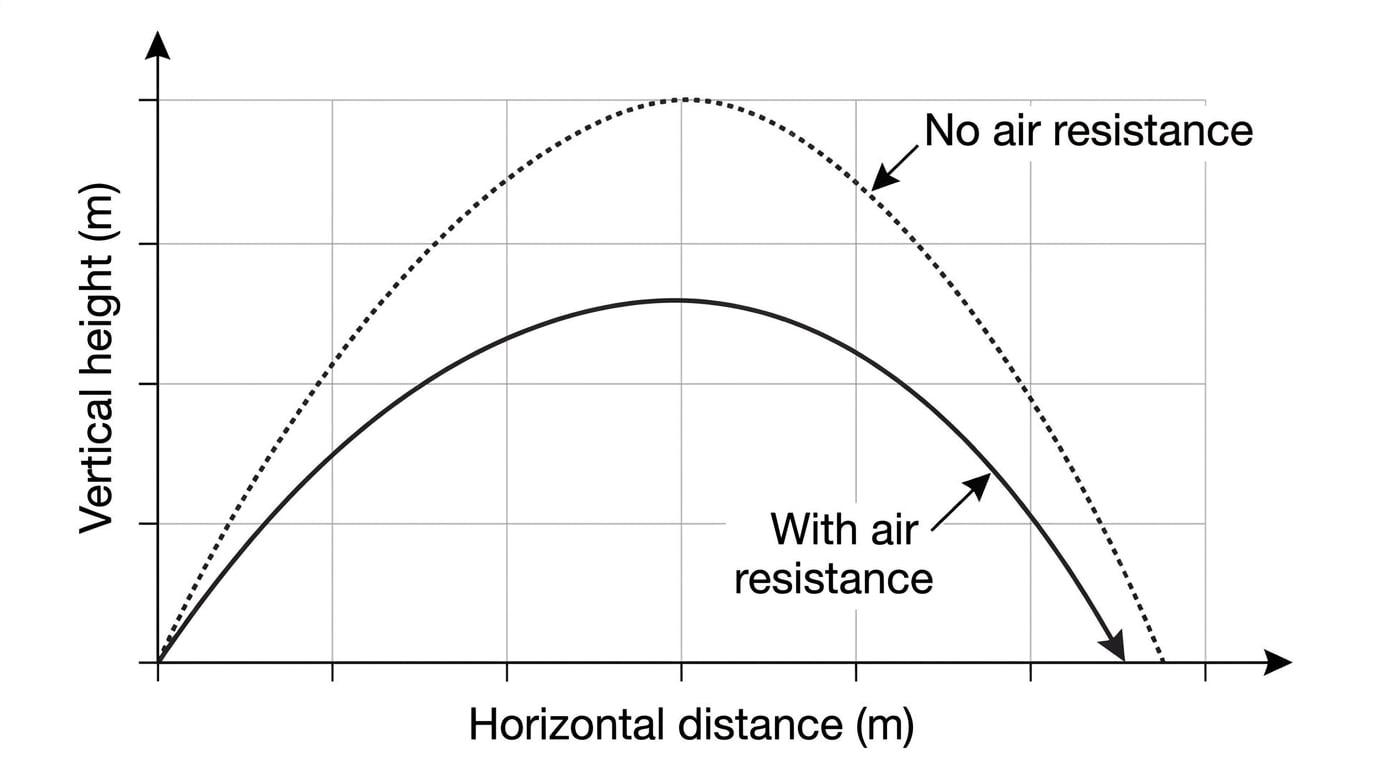
Qualitatively, air resistance changes a projectile's path in three main ways:
- Lower maximum height: The upwards vertical velocity is reduced more quickly.
- Shorter range: The horizontal velocity is constantly decreasing, rather than staying constant.
- Asymmetric shape: The object spends longer coming down than going up, and drops more steeply at the end of its flight.
Don't use suvat with air resistance
The equations of uniform acceleration ("suvat") only work when acceleration is constant. Because air resistance changes with speed, the acceleration is constantly changing. You will only ever be asked to describe the effects of air resistance qualitatively (in words) at A-Level.
In the exam
- Draw a quick sketch: Label the initial velocity vector, the angle, and the height.
- Split the initial velocity: Immediately calculate ux=ucosθu_x = u \cos \thetaux=ucosθ and uy=usinθu_y = u \sin \thetauy=usinθ. Write them down clearly.
- Establish a sign convention: State clearly (even just with a little arrow) whether up or down is positive, and stick to it! If up is positive, a=−9.81 m s−2a = -9.81 \text{ m s}^{-2}a=−9.81 m s−2.
- Find ttt first: Time is almost always the key that unlocks the second half of the problem. Find the time of flight using the vertical data, then carry it over to the horizontal data.
Check yourself
- What is the vertical acceleration of a projectile at its maximum height?
- If a ball is thrown upwards at an angle, why is its speed at the highest point not zero?
- Why does a skydiver eventually stop accelerating downwards?
- How does air resistance affect the time it takes for a projectile to reach its peak compared to the time it takes to fall back down?

