

Welcome to the topic of Momentum! You already know that a heavy truck is much harder to stop than a bicycle moving at the same speed. Momentum is the physics concept that puts a number to that idea.
What you'll learn:
- How to calculate momentum and use it to solve 1D collision and explosion problems.
- The difference between elastic and inelastic collisions.
- How force relates to the rate of change of momentum (Newton's Second Law in disguise!).
- How to use impulse and force–time graphs to understand car safety features like crumple zones.
What is Momentum?
Momentum is a property of any moving object. It depends on two things: how much "stuff" is moving (mass) and how fast it is going (velocity).
Momentum
Linear momentum (ppp) of an object is defined as the product of its mass (mmm) and its velocity (vvv).
p=m×v\begin{aligned} p &= m \times v \end{aligned}p=m×vWhere:
- ppp is momentum in kilogram metres per second (kg m s−1\text{kg m s}^{-1}kg m s−1)
- mmm is mass in kilograms (kg\text{kg}kg)
- vvv is velocity in metres per second (m s−1\text{m s}^{-1}m s−1)
Forgetting the vector nature
Velocity is a vector (it has a direction), which means momentum is also a vector. Always assign a positive direction to your problem (e.g., "right is positive"). If an object is moving to the left, its velocity—and therefore its momentum—must be negative.
Conservation of Linear Momentum
When two objects crash into each other, their individual speeds and directions change, but the total momentum of the system remains exactly the same, provided no external forces get involved.
The Principle of Conservation of Momentum
In a closed system (where no external forces act), the total linear momentum before an event is equal to the total linear momentum after the event.
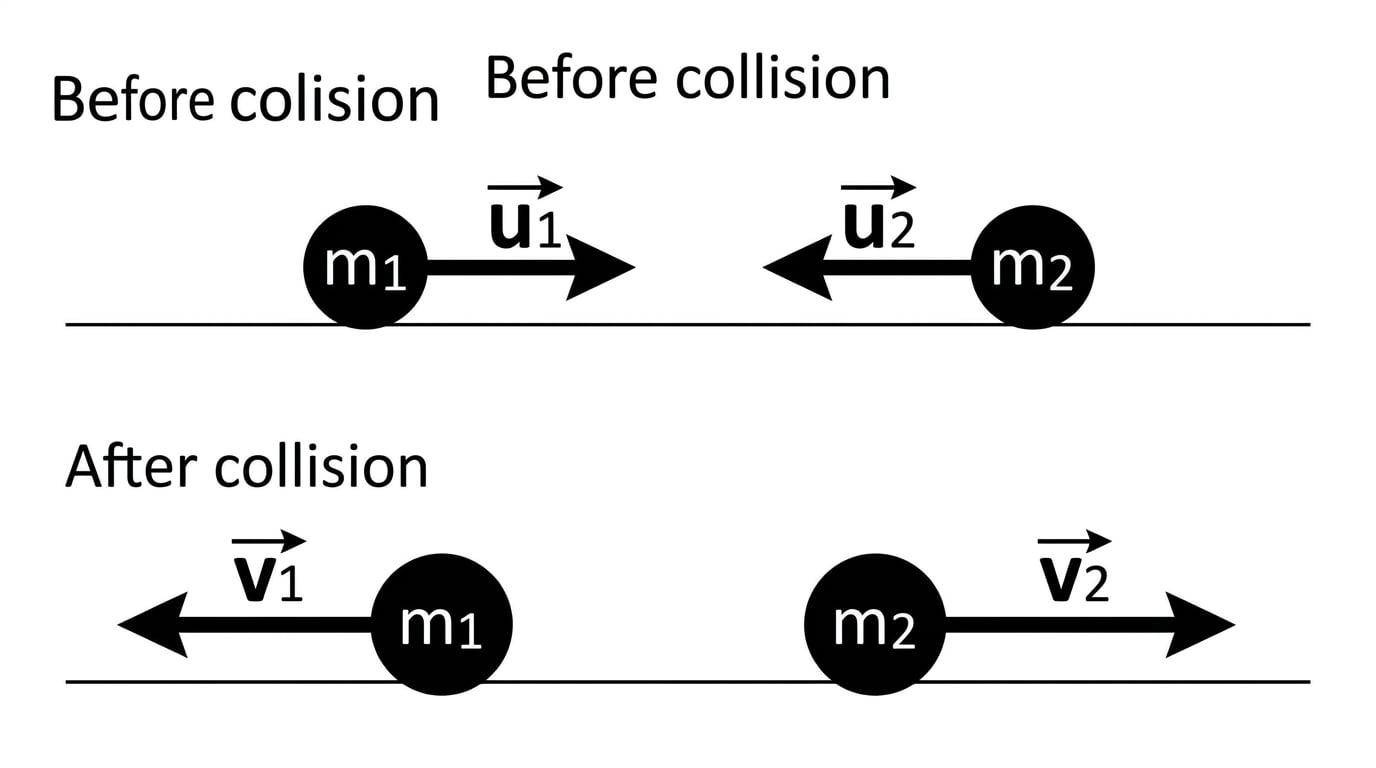
If we have two objects with masses m1m_1m1 and m2m_2m2, initial velocities u1u_1u1 and u2u_2u2, and final velocities v1v_1v1 and v2v_2v2, we can write this principle as:
m1u1+m2u2=m1v1+m2v2\begin{aligned} m_1 u_1 + m_2 u_2 &= m_1 v_1 + m_2 v_2 \end{aligned}m1u1+m2u2=m1v1+m2v2Let's see how this works in a classic AQA-style question where two objects collide and stick together.
Collision where objects stick together
A railway truck of mass 2500 kg2500\text{ kg}2500 kg is travelling at 3.0 m s−13.0\text{ m s}^{-1}3.0 m s−1. It collides with a stationary truck of mass 1500 kg1500\text{ kg}1500 kg. They couple together on impact. Calculate the velocity of the trucks immediately after the collision.
- Define the system and assign a positive direction. Let the original direction of motion be positive. Let m1=2500 kgm_1 = 2500\text{ kg}m1=2500 kg, u1=3.0 m s−1u_1 = 3.0\text{ m s}^{-1}u1=3.0 m s−1, m2=1500 kgm_2 = 1500\text{ kg}m2=1500 kg, and u2=0 m s−1u_2 = 0\text{ m s}^{-1}u2=0 m s−1.
- Calculate the total initial momentum of the system: pinitial=m1u1+m2u2pinitial=(2500×3.0)+(1500×0)pinitial=7500 kg m s−1\begin{aligned} p_{\text{initial}} &= m_1 u_1 + m_2 u_2 \\ p_{\text{initial}} &= (2500 \times 3.0) + (1500 \times 0) \\ p_{\text{initial}} &= 7500\text{ kg m s}^{-1} \end{aligned}pinitialpinitialpinitial=m1u1+m2u2=(2500×3.0)+(1500×0)=7500 kg m s−1
- State the total final momentum. Because the trucks couple together, they form a single combined mass (m1+m2)(m_1 + m_2)(m1+m2) moving at a shared final velocity vvv. pfinal=(2500+1500)×vpfinal=4000v\begin{aligned} p_{\text{final}} &= (2500 + 1500) \times v \\ p_{\text{final}} &= 4000v \end{aligned}pfinalpfinal=(2500+1500)×v=4000v
- Apply the conservation of momentum (pinitial=pfinalp_{\text{initial}} = p_{\text{final}}pinitial=pfinal) and solve for vvv: 7500=4000vv=75004000v=1.875 m s−1\begin{aligned} 7500 &= 4000v \\ v &= \frac{7500}{4000} \\ v &= 1.875\text{ m s}^{-1} \end{aligned}7500vv=4000v=40007500=1.875 m s−1
- Round to appropriate significant figures (usually matching the given data, so 1.9 m s−11.9\text{ m s}^{-1}1.9 m s−1 in the same direction).
Explosions
Conservation of momentum doesn't just apply to things crashing together; it also applies to things flying apart! In an explosion (like a gun firing a bullet, or a stationary astronaut throwing a spanner), the initial momentum is usually zero.
Because total momentum must be conserved, the pieces must fly off in opposite directions so their positive and negative momenta cancel out to zero.
Elastic and Inelastic Collisions
While momentum is always conserved in a closed system, kinetic energy behaves differently. Depending on what happens to the kinetic energy, we classify collisions into two types.
Elastic and Inelastic
- Elastic collision: Kinetic energy is conserved. The total kinetic energy before the collision exactly equals the total kinetic energy after. (This is rare in real life, mostly happening at the atomic level).
- Inelastic collision: Kinetic energy is NOT conserved. Some kinetic energy is transferred to other stores, such as thermal energy or sound, or used to permanently deform the objects.
Proving a collision is inelastic
Using the railway trucks from the previous example (initial: 2500 kg2500\text{ kg}2500 kg at 3.0 m s−13.0\text{ m s}^{-1}3.0 m s−1, final: 4000 kg4000\text{ kg}4000 kg combined at 1.875 m s−11.875\text{ m s}^{-1}1.875 m s−1), show whether the collision was elastic or inelastic.
- Calculate the total initial kinetic energy (Ek=12mv2E_k = \frac{1}{2}mv^2Ek=21mv2): Ek(initial)=12×2500×(3.0)2+0Ek(initial)=11250 J\begin{aligned} E_{k(\text{initial})} &= \frac{1}{2} \times 2500 \times (3.0)^2 + 0 \\ E_{k(\text{initial})} &= 11250\text{ J} \end{aligned}Ek(initial)Ek(initial)=21×2500×(3.0)2+0=11250 J
- Calculate the total final kinetic energy: Ek(final)=12×4000×(1.875)2Ek(final)=7031.25 J\begin{aligned} E_{k(\text{final})} &= \frac{1}{2} \times 4000 \times (1.875)^2 \\ E_{k(\text{final})} &= 7031.25\text{ J} \end{aligned}Ek(final)Ek(final)=21×4000×(1.875)2=7031.25 J
- Compare the two values and state your conclusion. Since 11250 J≠7031.25 J11250\text{ J} \neq 7031.25\text{ J}11250 J=7031.25 J, kinetic energy is lost to the surroundings. Therefore, the collision is inelastic.
Force and Rate of Change of Momentum
When you learned Newton's Second Law at GCSE, you were taught F=maF = maF=ma. But Isaac Newton actually wrote it differently. He said that force is the rate of change of momentum.
If an object's momentum changes over a period of time, a force must be acting on it. The faster the momentum changes, the larger the force.
F=Δ(mv)Δt\begin{aligned} F &= \frac{\Delta (mv)}{\Delta t} \end{aligned}F=ΔtΔ(mv)Where:
- FFF is the average force acting (N\text{N}N)
- Δ(mv)\Delta(mv)Δ(mv) is the change in momentum (kg m s−1\text{kg m s}^{-1}kg m s−1)
- Δt\Delta tΔt is the time taken for the change (s\text{s}s)
Where does F=ma come from?
If mass is constant, we can pull mmm out of the change brackets: Δ(mv)=mΔv\Delta(mv) = m\Delta vΔ(mv)=mΔv. So the equation becomes F=mΔvΔtF = m \frac{\Delta v}{\Delta t}F=mΔtΔv. Since ΔvΔt\frac{\Delta v}{\Delta t}ΔtΔv is acceleration (aaa), we get back to F=maF = maF=ma! The momentum version is just more powerful because it can also handle situations where mass changes (like a rocket burning fuel).
Impulse
If we rearrange the formula above by multiplying both sides by Δt\Delta tΔt, we get:
FΔt=Δ(mv)\begin{aligned} F \Delta t &= \Delta (mv) \end{aligned}FΔt=Δ(mv)The product of force and time (FΔtF \Delta tFΔt) is called impulse. Therefore, Impulse = Change in momentum.
Because of this, you'll sometimes see momentum given in units of Newton seconds (N s\text{N s}N s). This is exactly equivalent to kg m s−1\text{kg m s}^{-1}kg m s−1.
Force–Time Graphs
In real life, forces during impacts (like a football being kicked) are rarely constant. They start at zero, peak quickly as the object compresses, and fall back to zero as the object flies away.
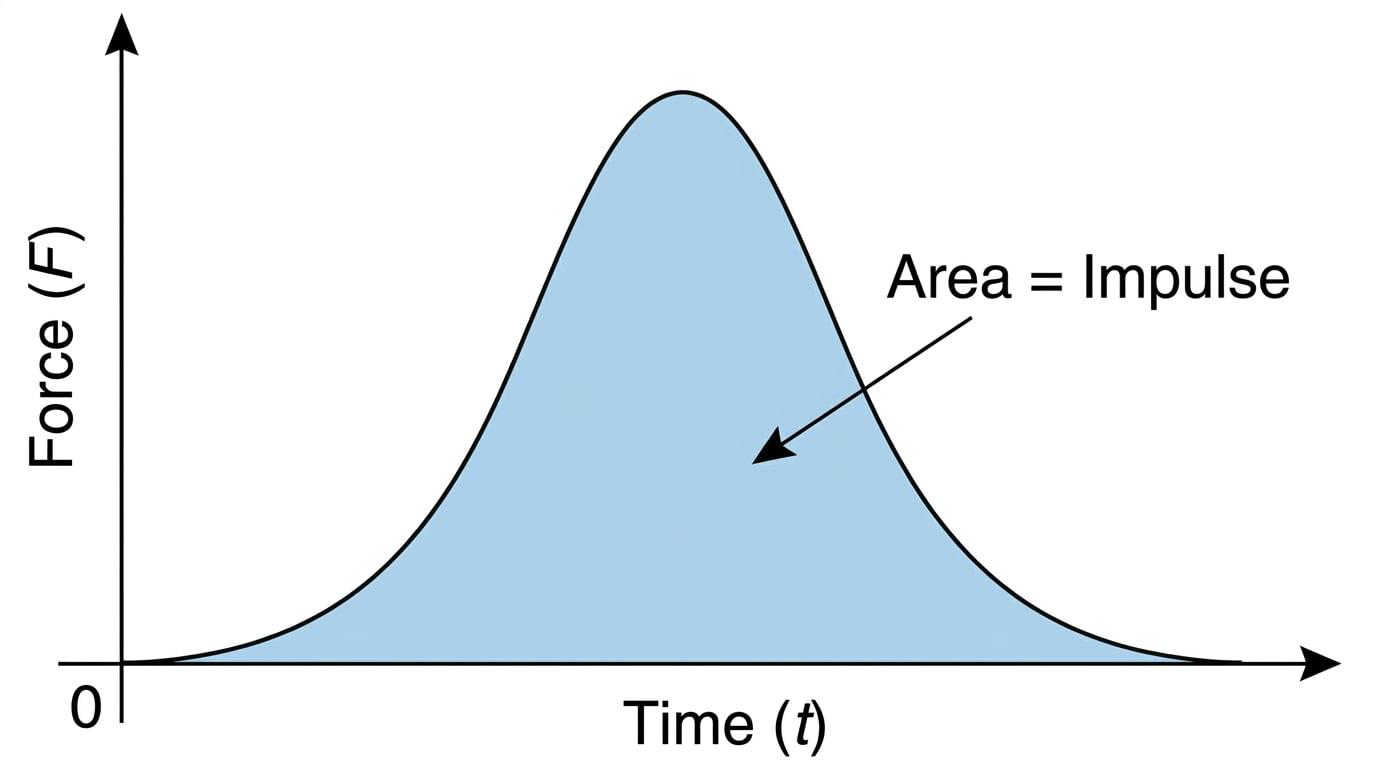
Area under a Force-Time Graph
The area under a force–time graph represents the impulse (and therefore the change in momentum).
Estimating force from a graph
A tennis ball of mass 0.060 kg0.060\text{ kg}0.060 kg is struck by a racket. A force-time graph shows the impact forms a rough triangle with a base (time) of 0.008 s0.008\text{ s}0.008 s and a peak force of 450 N450\text{ N}450 N. The ball starts from rest. Calculate its final velocity.
- Calculate the area under the force-time graph (area of a triangle = 12×base×height\frac{1}{2} \times \text{base} \times \text{height}21×base×height) to find the impulse. Impulse=12×0.008×450Impulse=1.8 N s\begin{aligned} \text{Impulse} &= \frac{1}{2} \times 0.008 \times 450 \\ \text{Impulse} &= 1.8\text{ N s} \end{aligned}ImpulseImpulse=21×0.008×450=1.8 N s
- Equate the impulse to the change in momentum (Δp=mv−mu\Delta p = mv - muΔp=mv−mu). Since the ball started from rest, u=0u = 0u=0, so Δp=mv\Delta p = mvΔp=mv. 1.8=0.060×v\begin{aligned} 1.8 &= 0.060 \times v \end{aligned}1.8=0.060×v
- Solve for the final velocity vvv: v=1.80.060v=30 m s−1\begin{aligned} v &= \frac{1.8}{0.060} \\ v &= 30\text{ m s}^{-1} \end{aligned}vv=0.0601.8=30 m s−1
Real-World Applications: Contact Times and Safety
The equation F=Δ(mv)ΔtF = \frac{\Delta(mv)}{\Delta t}F=ΔtΔ(mv) is incredibly important for engineers, particularly when designing transport systems and packaging.
If a car crashes at 30 mph30\text{ mph}30 mph, the driver's change in momentum (Δ(mv)\Delta(mv)Δ(mv)) to reach 0 mph0\text{ mph}0 mph is fixed. You cannot change the initial mass or the velocity. However, you can change the impact force (FFF) by increasing the contact time (Δt\Delta tΔt).
If you make the collision take ten times longer, the average force experienced by the occupants is ten times smaller. This appreciation of momentum conservation is a key issue in ethical transport design.
Catching a water balloon
If someone throws a water balloon at you, you naturally move your hands backward as you catch it. You are increasing Δt\Delta tΔt (the time it takes to stop the balloon). Because F=ΔpΔtF = \frac{\Delta p}{\Delta t}F=ΔtΔp and Δp\Delta pΔp is fixed, increasing Δt\Delta tΔt decreases the force FFF, meaning the balloon doesn't burst in your hands!
Engineering features that increase Δt\Delta tΔt:
- Crumple zones in cars: The front of the car is designed to deform slowly on impact.
- Airbags: They slow down the driver's head gradually, rather than it hitting a hard steering wheel instantly.
- Seatbelts: They stretch slightly, increasing the time taken for the passenger to stop.
- Packaging: Bubble wrap and polystyrene compress to extend the contact time if a parcel is dropped.
In the exam
- Draw a quick sketch: Always sketch "before" and "after" diagrams for collisions. Draw arrows indicating the direction of travel and write down the velocities with their correct signs (+ or -).
- Watch your signs: If an object rebounds off a wall, its final velocity has the opposite sign to its initial velocity. The change in momentum is mv−m(−u)=m(v+u)mv - m(-u) = m(v+u)mv−m(−u)=m(v+u). A very common trap!
- Count the shapes: If asked to find the area under a curve on a force-time graph, count the grid squares carefully. Figure out what one tiny square represents in terms of impulse (e.g., 1 N×0.01 s=0.01 N s1\text{ N} \times 0.01\text{ s} = 0.01\text{ N s}1 N×0.01 s=0.01 N s).
- State the obvious for safety questions: If a 2-mark question asks why an airbag is safer, explicitly state: "Increases impact time" (1 mark) "which reduces the rate of change of momentum / reduces the impact force" (1 mark).
Check yourself
- Can you state the definition of linear momentum and its SI unit?
- What is the difference between an elastic and an inelastic collision?
- How do you calculate impulse from a force-time graph?
- Why do modern cars have crumple zones, explained using the formula for the rate of change of momentum?
