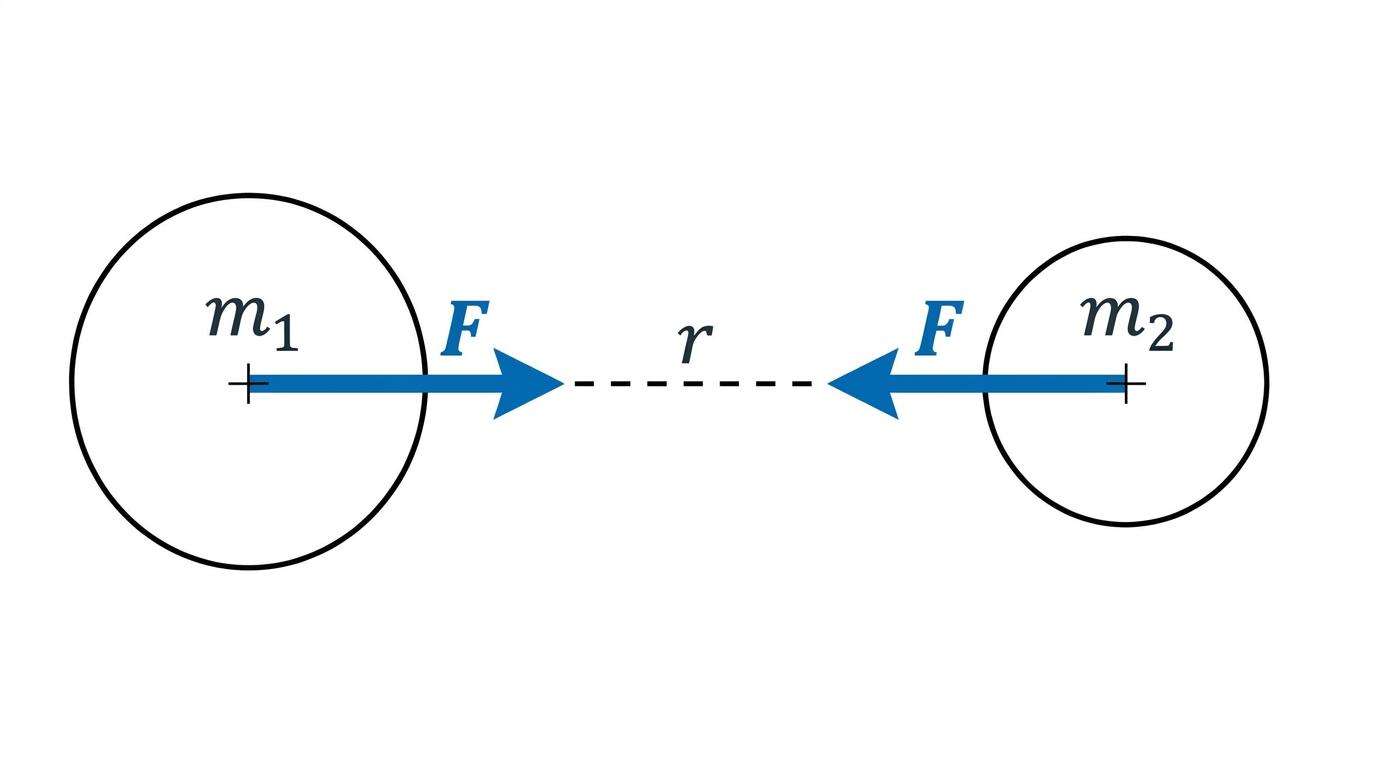
Welcome to the start of gravitational fields! Up until now, you've mostly thought of gravity as "the thing that pulls objects down towards the Earth". In this topic, we zoom out to look at the bigger picture of how gravity governs the entire universe.
What you'll learn:
- Why gravity is considered a universal attractive force.
- How to use Newton's Law of Gravitation to calculate the exact force between two masses.
- How the inverse-square law means that gravitational force drops off rapidly as you move further away.
1. Gravity is Universal
Gravity doesn't just pull apples down from trees; it acts between every single piece of matter in the universe. If an object has mass, it creates a gravitational pull.
Universal attractive force
Gravity acts between all matter in the universe. It is strictly an attractive force — masses only ever pull towards each other; they never repel.
Right now, there is a gravitational force of attraction pulling you towards your computer, towards the person in the next room, and even towards the distant stars. We don't notice these forces because, compared to other fundamental forces like electromagnetism, gravity is incredibly weak. You only really feel it when at least one of the objects is staggeringly huge (like a planet).
Point masses
To make the maths manageable, physicists treat objects as point masses. A point mass is a theoretical object where all of its mass is concentrated at a single, infinitely small point.
Real objects (like planets or stars) are obviously not infinitely small. Luckily, Isaac Newton proved mathematically that any uniform spherical object behaves exactly as if all of its mass is concentrated at its very centre.
2. Newton's Law of Gravitation
Newton figured out that the gravitational force between two objects depends on just two things:
- How massive the objects are.
- How far apart they are.
This relationship is written mathematically as Newton's Law of Gravitation:
F=Gm1m2r2 F = \frac{G m_1 m_2}{r^2} F=r2Gm1m2Where:
- FFF is the magnitude of the gravitational force in newtons (N).
- GGG is the gravitational constant, which is always 6.67×10⁻¹¹ N m2 kg−26.67 \times 10^{-11} \text{ N m}^2 \text{ kg}^{-2}6.67×10⁻¹¹ N m2 kg−2 (this is given on your AQA data sheet).
- m1m_1m1 and m2m_2m2 are the masses of the two interacting objects in kilograms (kg).
- rrr is the distance between the centres of the two masses in metres (m).
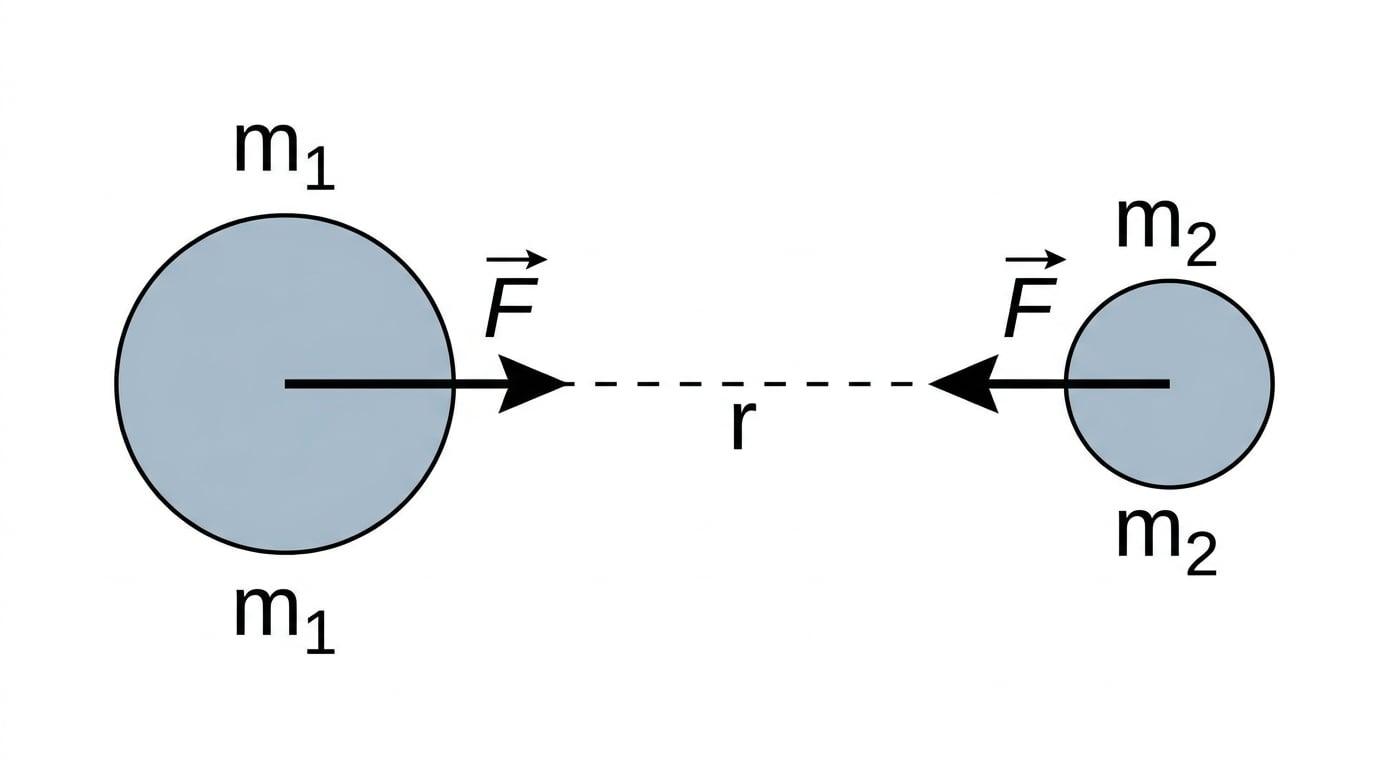
Newton's Third Law still applies!
Because gravity is an interaction between two masses, the force is equal and opposite. The Earth pulls on you with a force of about 700 N, which means you are also pulling up on the Earth with exactly 700 N of force!
Let's test this equation out by seeing just how small everyday gravitational forces are.
Estimating force between everyday objects
Two students, each with a mass of 70 kg, are sitting on a bench. The distance between their centres of mass is 1.5 m. Calculate the gravitational force of attraction between them.
- First, identify the values needed for the equation: m1=70 kgm_1 = 70 \text{ kg}m1=70 kg, m2=70 kgm_2 = 70 \text{ kg}m2=70 kg, r=1.5 mr = 1.5 \text{ m}r=1.5 m, and G=6.67×10⁻¹¹ N m2 kg−2G = 6.67 \times 10^{-11} \text{ N m}^2 \text{ kg}^{-2}G=6.67×10⁻¹¹ N m2 kg−2.
- Substitute these values into Newton's law:
- Calculate the numerator:
- Divide by r2r^2r2 to find the final force:
This force is roughly equal to the weight of a grain of dust—no wonder they don't feel themselves sliding together!
Dealing with planets and orbits
When dealing with satellites or planets, the trickiest part of using the equation is getting the distance rrr right.
Using the altitude instead of the total radius
The distance rrr in the equation must always be measured from the centre of the first mass to the centre of the second mass. If a satellite is orbiting Earth, you cannot just use its height above the ground. You must add the Earth's radius to the satellite's altitude.
Satellite in orbit
A satellite of mass 1200 kg is in orbit at an altitude of 400 km above the Earth's surface. The mass of the Earth is 5.97×1024 kg5.97 \times 10^{24} \text{ kg}5.97×1024 kg and its radius is 6400 km. Calculate the gravitational force exerted by the Earth on the satellite.
- Convert all distances to metres and find the total distance from the Earth's centre:
- Substitute the values into the equation:
- Expand with the known constants:
- Calculate the result carefully on your calculator (use the fraction button if you have one):
- Round to an appropriate number of significant figures (usually 2 or 3 in physics):
3. The Inverse-Square Law
Take another look at the denominator of Newton's law: r2r^2r2.
Because the distance rrr is squared and on the bottom of the fraction, gravitational force is an inverse-square law. We can write this mathematically as:
F∝1r2 F \propto \frac{1}{r^2} F∝r21This means that as you move further away, the gravitational pull weakens very quickly:
- If you double the distance (r×2r \times 2r×2), the force is divided by 222^222. The new force is 1/41/41/4 of the original.
- If you triple the distance (r×3r \times 3r×3), the force is divided by 323^232. The new force is 1/91/91/9 of the original.
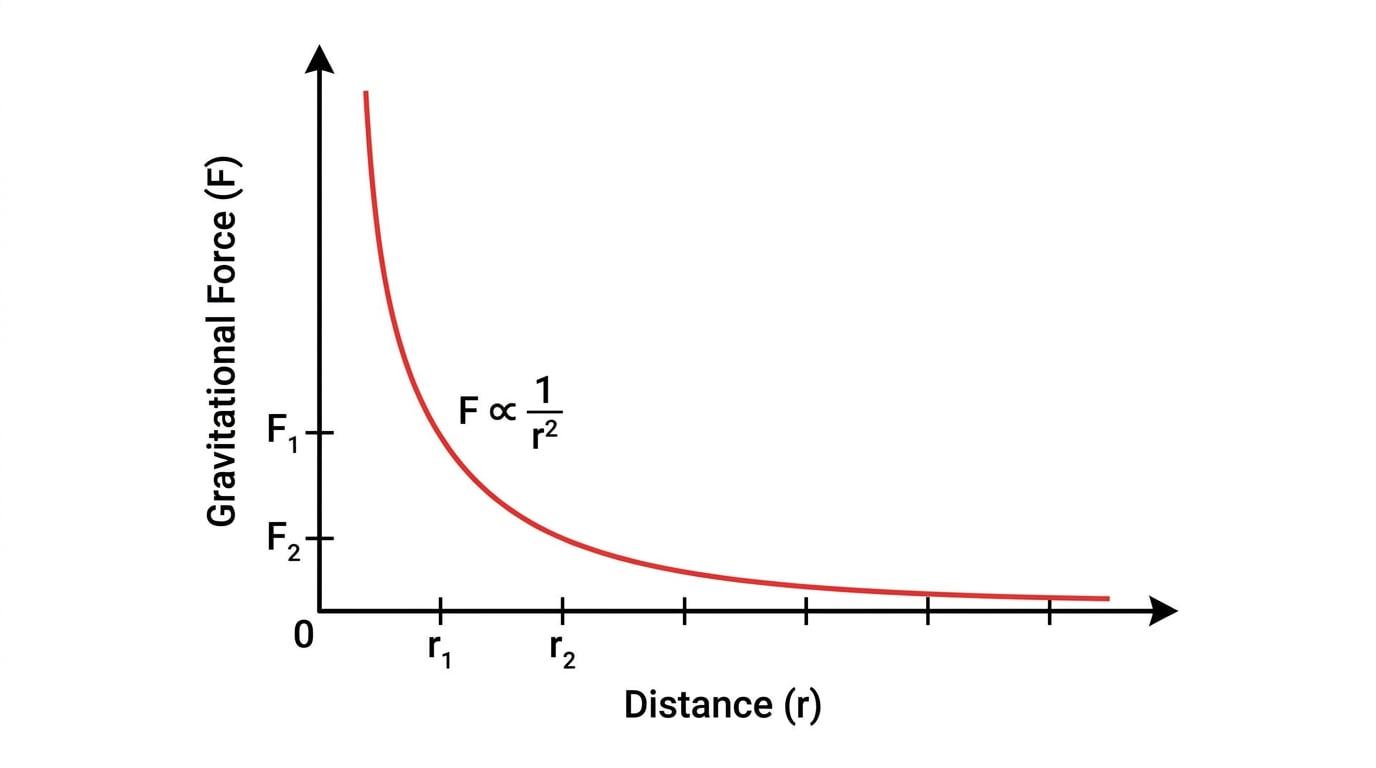
Notice how the graph gets incredibly close to the x-axis but mathematically never touches it. Gravity has an infinite range — no matter how far apart two objects are, there is always a tiny, non-zero gravitational attraction between them.
Using ratios with the inverse-square law
A space probe travelling away from Earth experiences a gravitational force of 8000 N when it is at distance ddd from the Earth's centre. Calculate the force acting on the space probe when it reaches a distance of 4d4d4d.
- Recognise that force is inversely proportional to the square of the distance (F∝1/r2F \propto 1/r^2F∝1/r2).
- Identify the factor by which the distance has changed. The distance has increased by a factor of 4.
- Apply the inverse square relationship. If distance is multiplied by 4, the force is divided by 424^242.
- Calculate the new force:
Saving time in multiple choice
AQA often puts ratio questions like the one above in Section A (the multiple-choice section). Don't waste time trying to make up fake values for GGG and the masses to plug into the full formula! Just identify the distance multiplier, square it, and divide.
In the exam
- Check your unit prefixes: Examiners love to give planetary radii in kilometres (km). Always convert them to metres (m) by multiplying by 10310^3103 before doing anything else.
- Read the diagram carefully: Does the arrow for distance rrr start at the planet's surface, or its centre? If it's the surface, you must add the radius of the planet.
- Don't forget to square rrr: It sounds obvious, but forgetting to type the little 2^22 into the calculator is the single most common reason students drop marks in calculation questions.
- Use your calculator's fraction button: Trying to type the numerator, hitting divide, and then typing the denominator in one straight line often leads to bracket errors (BIDMAS violations). Use the □□\frac{\square}{\square}□□ button.
Check yourself
- Why is gravity described as a "universal" force?
- What is meant by the term "point mass"?
- If the distance between two stars is halved, by what factor does the gravitational force between them change?
- A student calculates the force of a satellite 500 km above Earth by plugging 500,000 m directly into rrr. What crucial step have they missed?