Molecular kinetic theory model (A-level only)
What you'll learn:
- How Brownian motion provides evidence for the existence of atoms.
- The difference between empirical gas laws and the theoretical kinetic model.
- The key assumptions behind the kinetic theory of gases.
- How to derive the pressure equation pV=13Nm(crms)2pV = \frac{1}{3}Nm(c_{\text{rms}})^2pV=31Nm(crms)2 from Newtonian mechanics.
- How to link temperature to the average kinetic energy of gas molecules.
The History of Gas Laws: Empirical vs. Theoretical
Science rarely develops in a straight line. Our understanding of gases has changed significantly over time, shifting from mere observation to deep mechanical theory.
- Empirical laws: Boyle's, Charles's, and the Pressure laws were discovered by experiment. Scientists measured macroscopic properties (pressure ppp, volume VVV, temperature TTT) and found mathematical patterns. These laws are empirical—they describe what happens without explaining why it happens.
- Theoretical models: In the 18th and 19th centuries, scientists like Daniel Bernoulli and James Clerk Maxwell developed the kinetic theory of gases. This is a theoretical model based on the idea that gases are made of tiny particles in constant, random motion. It successfully explained the empirical laws using classical mechanics (Newton's laws).
Empirical vs. Theoretical
Empirical laws arise purely from experimental observation. Theoretical models arise from fundamental mathematical or physical assumptions (like Newton's laws) and attempt to explain the underlying mechanisms behind the observations.
Evidence for atoms: Brownian Motion
For a long time, atomic theory was controversial. A major piece of evidence supporting it was discovered by botanist Robert Brown in 1827. While looking at pollen grains suspended in water under a microscope, he noticed they jiggled around in a completely random, zigzag path. This became known as Brownian motion.
Why did they move? In 1905, Albert Einstein proved that this random motion was caused by millions of invisible, fast-moving water molecules constantly bombarding the large, visible pollen grains. Because the collisions are random, the forces don't perfectly balance out, resulting in a net force that kicks the pollen grain in unpredictable directions.
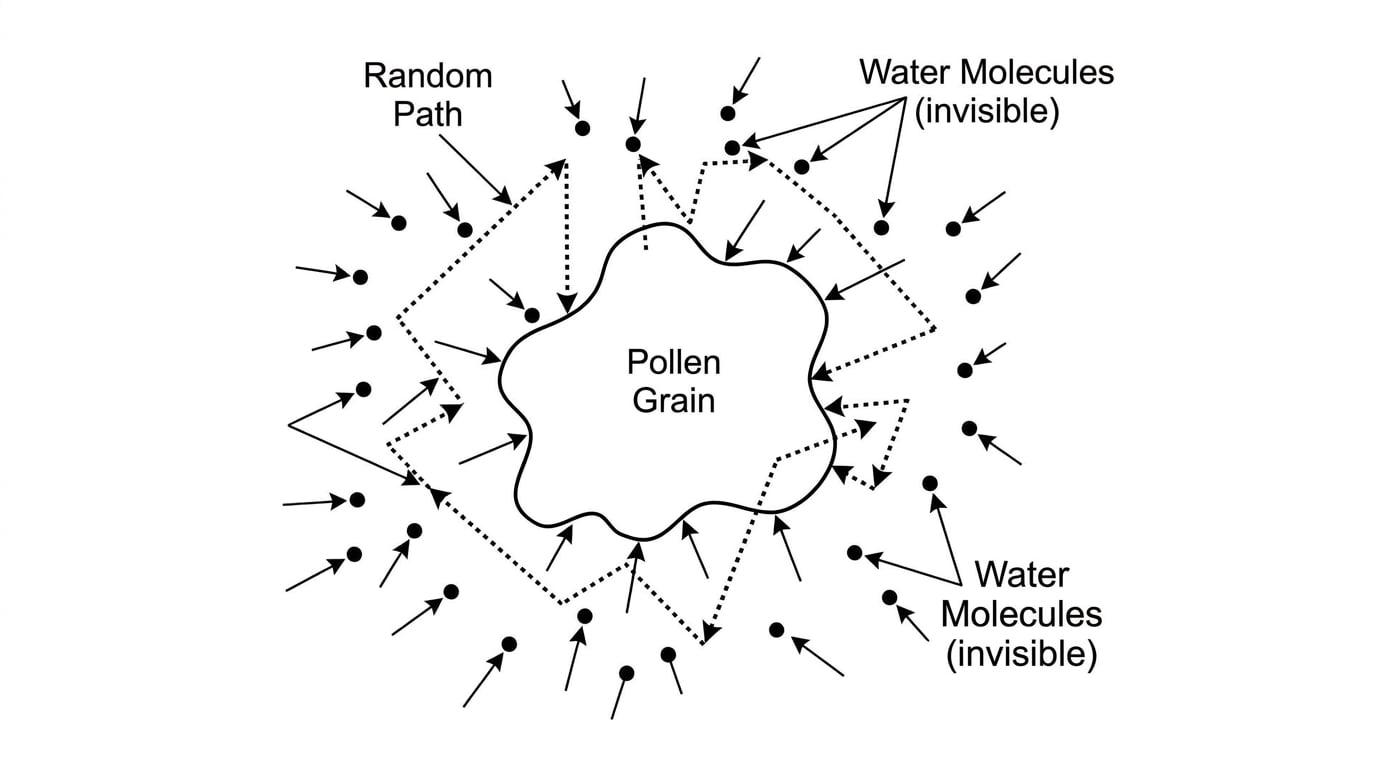
Brownian motion
The continuous, random motion of visible particles (like pollen or smoke) caused by collisions with smaller, fast-moving, invisible particles (like water or air molecules). It provides direct experimental evidence for the existence of atoms and molecules.
The Assumptions of the Kinetic Theory Model
To build a mathematical model of a gas, we have to simplify reality. We assume the gas is "ideal". For AQA, you must know the specific assumptions we make about the particles.
Mnemonic: RAVED
Use RAVED to remember the five key assumptions of an ideal gas:
- Random motion: Particles move in continuous, random motion.
- Attraction: There are no intermolecular forces of attraction between the particles (except during collisions).
- Volume: The volume of the particles themselves is negligible compared to the total volume of the container.
- Elastic: All collisions (between particles, and with the walls) are perfectly elastic (kinetic energy is conserved).
- Duration: The time taken for a collision is negligible compared to the time between collisions.
Because there are no intermolecular forces of attraction (the A in RAVED), the particles have absolutely zero electrical potential energy.
Internal Energy of an Ideal Gas
The internal energy of a substance is the sum of the randomly distributed kinetic and potential energies of its particles. Because we assume an ideal gas has no intermolecular forces, its potential energy is zero. Therefore, the internal energy of an ideal gas is entirely kinetic energy.
Deriving the Pressure Equation
We are now going to use Newtonian mechanics to prove that the pressure exerted by a gas comes from the change in momentum of particles colliding with the container walls.
You need to know how to lay out this derivation using a simple algebraic approach.
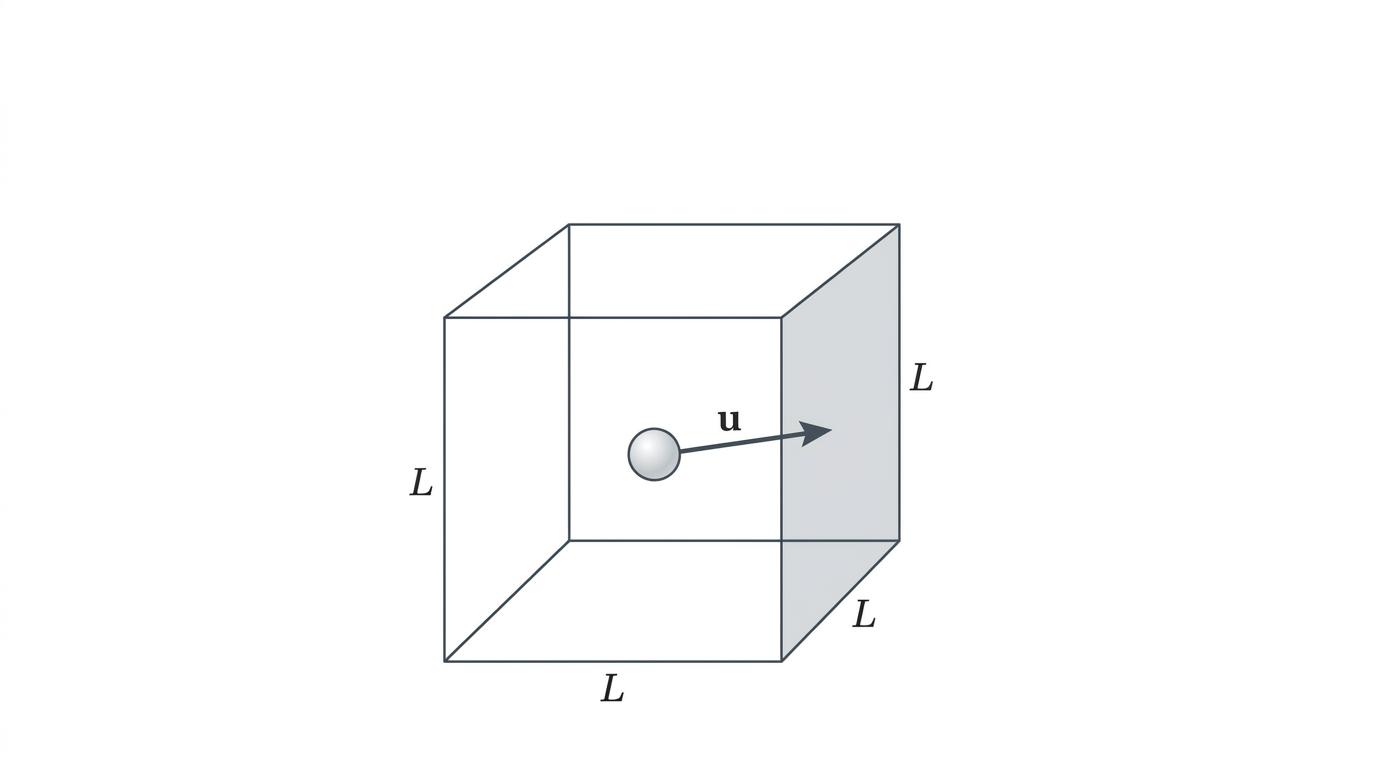
Imagine a single gas molecule of mass mmm in a cubic box of side length LLL. It is moving with velocity uuu towards one of the faces (let's say in the x-direction).
- Change in momentum (Δp\Delta pΔp): The particle hits the wall and bounces back. Because collisions are perfectly elastic, its rebound velocity is −u-u−u.
The wall therefore gains a momentum of +2mu+2mu+2mu from this collision.
- Time between collisions (ttt): The particle travels across the box and back (a total distance of 2L2L2L) before hitting the same wall again. Time is distance over speed.
- Force on the wall (FFF): By Newton's Second Law, force is the rate of change of momentum.
- Pressure on the wall (ppp): Pressure is force divided by the area of the wall (A=L2A = L^2A=L2).
Since L3L^3L3 is the volume of the cube (VVV), we get p=mu2Vp = \frac{mu^2}{V}p=Vmu2.
- Scale up to NNN particles: A real gas has NNN particles. Not all particles have the same speed. We use the mean square speed in the x-direction, which we write as u2‾\overline{u^2}u2. The total pressure is:
- Account for 3D space: The particles move randomly in three dimensions (x, y, and z) with velocities uuu, vvv, and www. By Pythagoras, a particle's actual speed ccc squared is c2=u2+v2+w2c^2 = u^2 + v^2 + w^2c2=u2+v2+w2. Because motion is totally random, the average speed in any one direction is the same: u2‾=v2‾=w2‾\overline{u^2} = \overline{v^2} = \overline{w^2}u2=v2=w2. Therefore, c2‾=3u2‾\overline{c^2} = 3\overline{u^2}c2=3u2, which means u2‾=13c2‾\overline{u^2} = \frac{1}{3}\overline{c^2}u2=31c2. Substitute this into our pressure equation:
Root Mean Square Speed
The value c2‾\overline{c^2}c2 is the mean square speed. If we square root this value, we get crmsc_{\text{rms}}crms, the root mean square speed. Therefore, c2‾=(crms)2\overline{c^2} = (c_{\text{rms}})^2c2=(crms)2.
This gives us the final kinetic theory equation provided on your formula sheet:
pV=13Nm(crms)2 pV = \frac{1}{3}Nm(c_{\text{rms}})^2 pV=31Nm(crms)2Where:
- ppp is pressure in Pa\text{Pa}Pa
- VVV is volume in m3\text{m}^3m3
- NNN is the number of molecules (not moles!)
- mmm is the mass of a single molecule in kg\text{kg}kg
- crmsc_{\text{rms}}crms is the root mean square speed in m s−1\text{m s}^{-1}m s−1
Mass in the equation
A very common mistake is confusing mmm with the total mass of the gas. In the equation pV=13Nm(crms)2pV = \frac{1}{3}Nm(c_{\text{rms}})^2pV=31Nm(crms)2, the symbol mmm is the mass of one single molecule. To find it, you often have to take the molar mass (kg mol−1\text{kg mol}^{-1}kg mol−1) and divide by Avogadro's constant (NAN_{\text{A}}NA). The expression NmNmNm together represents the total mass of the gas.
Explaining the Gas Laws with the Model
Now that we have pV=13Nm(crms)2pV = \frac{1}{3}Nm(c_{\text{rms}})^2pV=31Nm(crms)2, we can explain the empirical laws:
- Boyle's Law (constant TTT): If temperature is constant, the speeds of the particles (crmsc_{\text{rms}}crms) remain constant. If we halve the volume (VVV), the particles hit the walls twice as often. This doubles the rate of change of momentum, doubling the pressure.
- Pressure Law (constant VVV): If we increase the temperature, the particles move faster (crmsc_{\text{rms}}crms increases). They hit the walls harder and more frequently, meaning a much greater rate of change of momentum, increasing the pressure.
Average Molecular Kinetic Energy
We have two equations for pVpVpV. The empirical ideal gas equation, and the theoretical kinetic theory equation:
pV=NkT pV = NkT pV=NkT pV=13Nm(crms)2 pV = \frac{1}{3}Nm(c_{\text{rms}})^2 pV=31Nm(crms)2If we set them equal to each other, we can discover the relationship between a gas's temperature and the kinetic energy of its particles:
13Nm(crms)2=NkT \frac{1}{3}Nm(c_{\text{rms}})^2 = NkT 31Nm(crms)2=NkTCancel the NNN (number of molecules) from both sides:
13m(crms)2=kT \frac{1}{3}m(c_{\text{rms}})^2 = kT 31m(crms)2=kTWe want to find the formula for average kinetic energy, which is Ek=12mv2E_k = \frac{1}{2}mv^2Ek=21mv2. Let's manipulate our equation to get a 12\frac{1}{2}21 at the front. Multiply both sides by 32\frac{3}{2}23:
12m(crms)2=32kT \frac{1}{2}m(c_{\text{rms}})^2 = \frac{3}{2}kT 21m(crms)2=23kTThis is a beautiful and profound result: the average kinetic energy of a gas molecule depends only on the absolute temperature of the gas. It doesn't matter if it's a light helium atom or a heavy carbon dioxide molecule; if they are at the same temperature, they have the exact same average kinetic energy.
Because k=RNAk = \frac{R}{N_{\text{A}}}k=NAR (the Boltzmann constant equals the molar gas constant divided by Avogadro's constant), this is often written in three equivalent forms on your data sheet:
Average molecular kinetic energy=12m(crms)2=32kT=3RT2NA \text{Average molecular kinetic energy} = \frac{1}{2}m(c_{\text{rms}})^2 = \frac{3}{2}kT = \frac{3RT}{2N_{\text{A}}} Average molecular kinetic energy=21m(crms)2=23kT=2NA3RTTotal vs. Average Kinetic Energy
Read exam questions carefully! If they ask for the average kinetic energy of a molecule, use Ek=32kTE_k = \frac{3}{2}kTEk=23kT. If they ask for the total kinetic energy of the gas (which is also its internal energy), you must multiply that average by the total number of molecules: Total Ek=N×32kTE_k = N \times \frac{3}{2}kTEk=N×23kT.
Worked Example: Calculating molecular speed
Calculate the root mean square speed of oxygen molecules (O2\text{O}_2O2) at room temperature (293 K293 \text{ K}293 K). The molar mass of oxygen is 32×10−3 kg mol−132 \times 10^{-3} \text{ kg mol}^{-1}32×10−3 kg mol−1. k=1.38×10⁻²³ J K−1k = 1.38 \times 10^{-23} \text{ J K}^{-1}k=1.38×10⁻²³ J K−1. NA=6.02×10²³ mol−1N_{\text{A}} = 6.02 \times 10^{23} \text{ mol}^{-1}NA=6.02×10²³ mol−1.
- Calculate the mass of a single oxygen molecule (mmm). Molar mass is the mass of one mole (NAN_{\text{A}}NA molecules).
- Set up the kinetic energy equation. Equate the kinetic energy expression to the temperature expression.
- Rearrange to make (crms)2(c_{\text{rms}})^2(crms)2 the subject.
- Substitute the values and calculate.
- Square root to find crmsc_{\text{rms}}crms.
(Note: This is faster than the speed of sound in air, which makes physical sense!)
In the exam
- Watch your prefixes for mass: Molar masses in chemistry are in grams per mole (g mol−1\text{g mol}^{-1}g mol−1). In physics, you must convert this to kg mol−1\text{kg mol}^{-1}kg mol−1 before dividing by NAN_{\text{A}}NA to find mmm. For example, carbon-12 is 12×10−3 kg mol−112 \times 10^{-3} \text{ kg mol}^{-1}12×10−3 kg mol−1.
- Be specific with definitions: If asked to explain how the kinetic model accounts for a gas law, always start by stating that particles collide with the walls, resulting in a change in momentum, which exerts a force. Then link this to pressure (p=FAp = \frac{F}{A}p=AF).
- Know your derivation steps: AQA frequently sets 4 to 6-mark questions asking you to derive the pressure equation or justify the steps. Memorise the sequence: Δp→t→F→p→3D scaling\Delta p \rightarrow t \rightarrow F \rightarrow p \rightarrow \text{3D scaling}Δp→t→F→p→3D scaling.
Check yourself
- Can you list all five assumptions of the ideal gas model using the RAVED mnemonic?
- Can you explain why the internal energy of an ideal gas consists entirely of kinetic energy?
- If the absolute temperature of a gas is doubled, what happens to the average kinetic energy of its molecules? What happens to the root mean square speed (crmsc_{\text{rms}}crms)?
- Can you explain the difference between an empirical law and a theoretical model?