What you'll learn
- How to represent gravitational fields using field lines.
- The formal definition of gravitational field strength (ggg).
- How to calculate ggg in a general field and in a radial field around a planet.
- The inverse-square relationship between ggg and distance.
1. Visualising Gravitational Fields
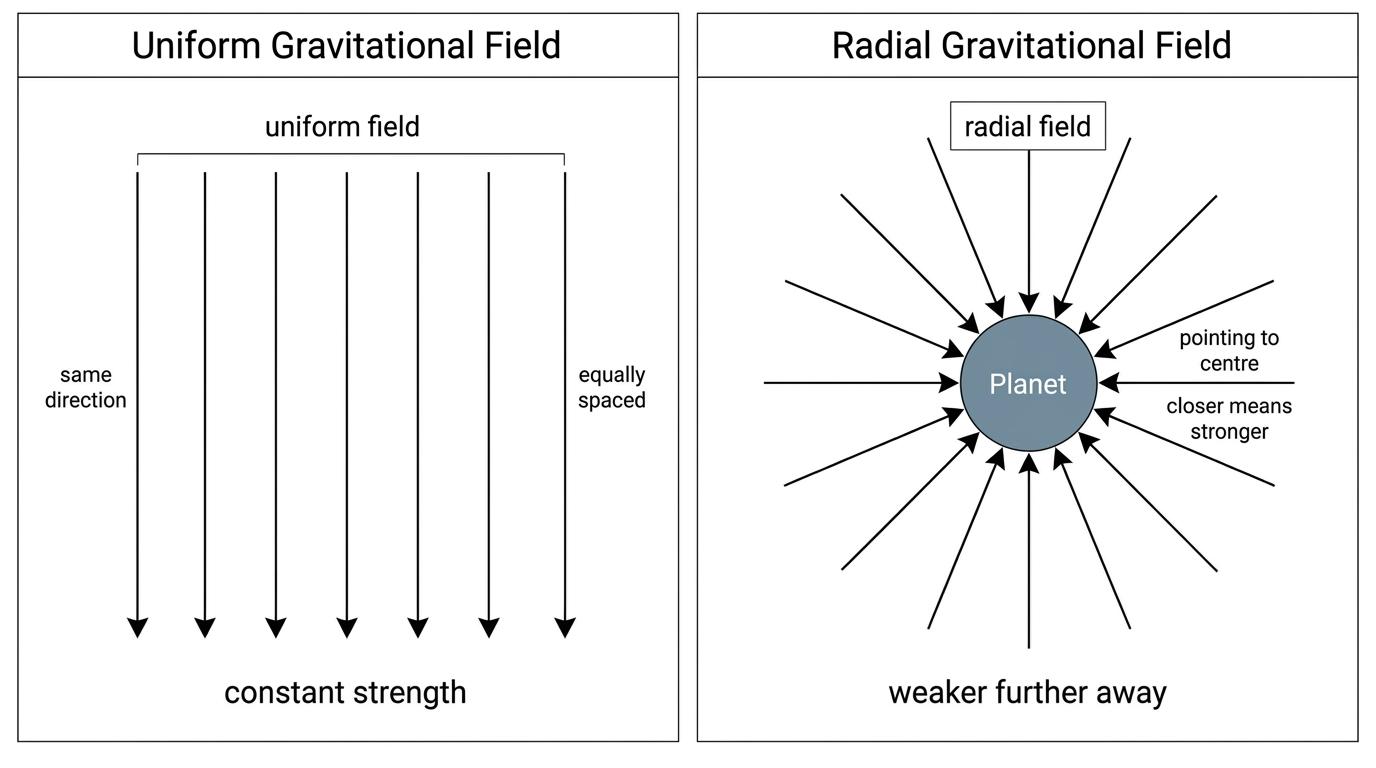
A gravitational field is a region of space where a mass experiences an attractive non-contact force. We cannot see these fields, so physicists use field lines to map them out.
Field lines tell you two crucial pieces of information about the gravitational force that a small test mass would experience:
- Direction: The arrows point in the direction of the gravitational force. Because gravity is strictly an attractive force, the arrows always point towards the mass creating the field.
- Strength: The closer the field lines are to one another, the stronger the gravitational field in that region.
There are two main types of gravitational field you need to recognize: uniform and radial.
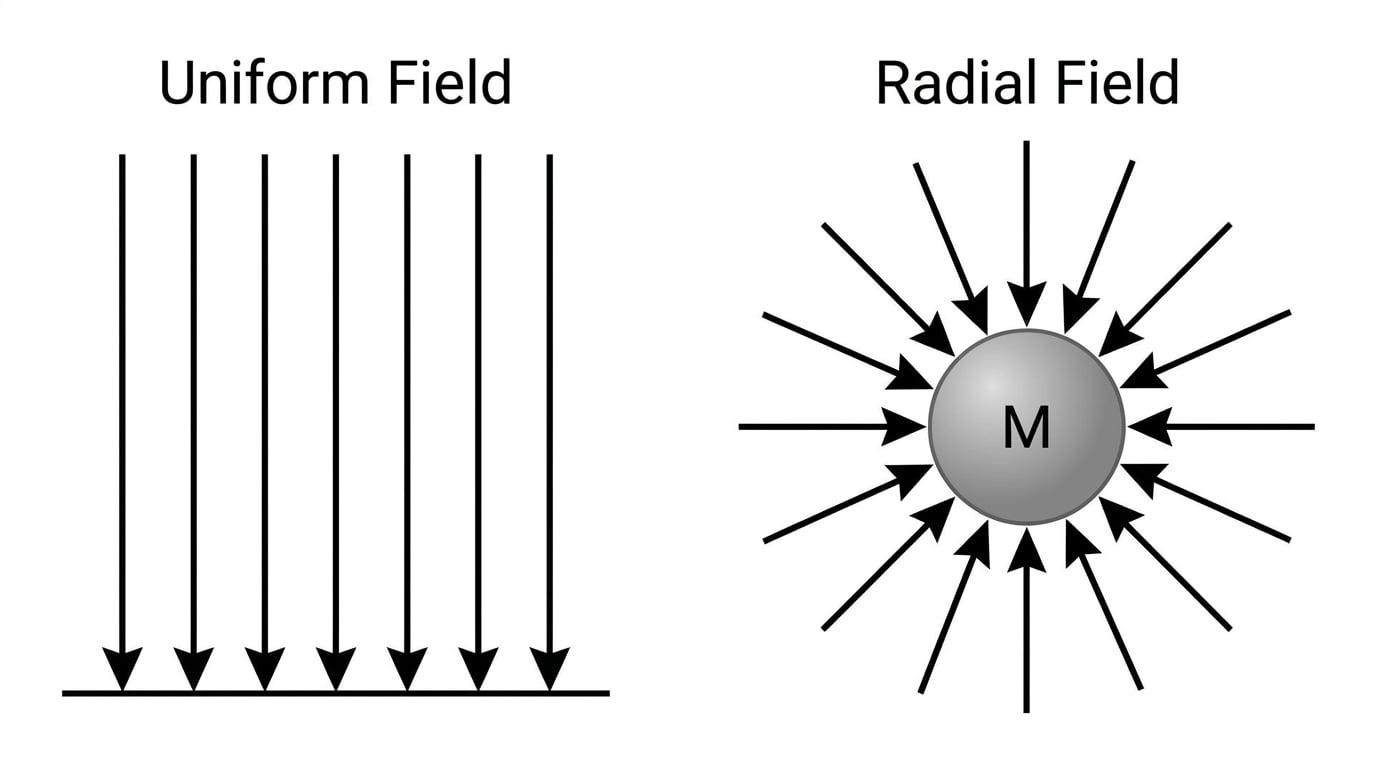
- Uniform fields: Over a very small area (like a physics lab on the surface of the Earth), the field lines are parallel and equally spaced. This means the force experienced by a mass is constant in both magnitude and direction, no matter where it is placed in the room.
- Radial fields: When you zoom out and look at an entire planet, star, or moon, the field lines point radially inwards toward its centre of mass. As you move further away, the lines spread out, indicating that the field gets weaker.
2. Gravitational Field Strength (ggg)
To do meaningful calculations, we need to quantify exactly how strong a gravitational field is.
We measure field strength by looking at the force a specific mass feels. If a heavy boulder and a light pebble are in the same field, the boulder feels a larger force, but the field itself hasn't changed. To describe the field independently of the object sitting in it, we define field strength as the force per unit mass.
Gravitational Field Strength ()
Gravitational field strength at a point is the gravitational force exerted per unit mass on a small test mass placed at that point.
g=Fmg = \frac{F}{m}g=mFWhere:
- ggg is the gravitational field strength in newtons per kilogram (N kg−1\text{N kg}^{-1}N kg−1)
- FFF is the gravitational force acting on the mass in newtons (N\text{N}N)
- mmm is the mass in kilograms (kg\text{kg}kg)
Because force is a vector, ggg is also a vector quantity. Its direction is always towards the mass creating the field.
Units of g
You might recall from GCSE or AS Physics that ggg is also the acceleration of free fall, measured in metres per second squared (m s−2\text{m s}^{-2}m s−2). Both N kg−1\text{N kg}^{-1}N kg−1 and m s−2\text{m s}^{-2}m s−2 are perfectly valid and entirely equivalent units for ggg.
Calculating g from force and mass
A satellite of mass 450 kg experiences a gravitational force of 3800 N whilst in orbit around a planet. Calculate the gravitational field strength at the position of the satellite.
- State the given values: m=450 kgm = 450 \text{ kg}m=450 kg F=3800 NF = 3800 \text{ N}F=3800 N
- State the formula:
- Substitute and solve:
3. Field Strength in a Radial Field
The formula g=Fmg = \frac{F}{m}g=mF is universal; it works for any type of field as long as you know the force on a given mass. However, we often want to find the field strength around a specific spherical object (like a planet or a star) without needing a test mass to measure the force.
We can derive an equation for radial field strength by combining our definition of ggg with Newton's Law of Gravitation.
Recall Newton's Law of Gravitation for the force between a large mass MMM and a small test mass mmm separated by a centre-to-centre distance rrr:
F=GMmr2 F = \frac{G M m}{r^2} F=r2GMmSubstitute this expression for FFF into the definition of ggg:
g=Fmg=(GMmr2)mg=GMr2\begin{aligned} g &= \frac{F}{m} \\ g &= \frac{\left( \frac{G M m}{r^2} \right)}{m} \\ g &= \frac{G M}{r^2} \end{aligned}ggg=mF=m(r2GMm)=r2GMWhat the equation tells us
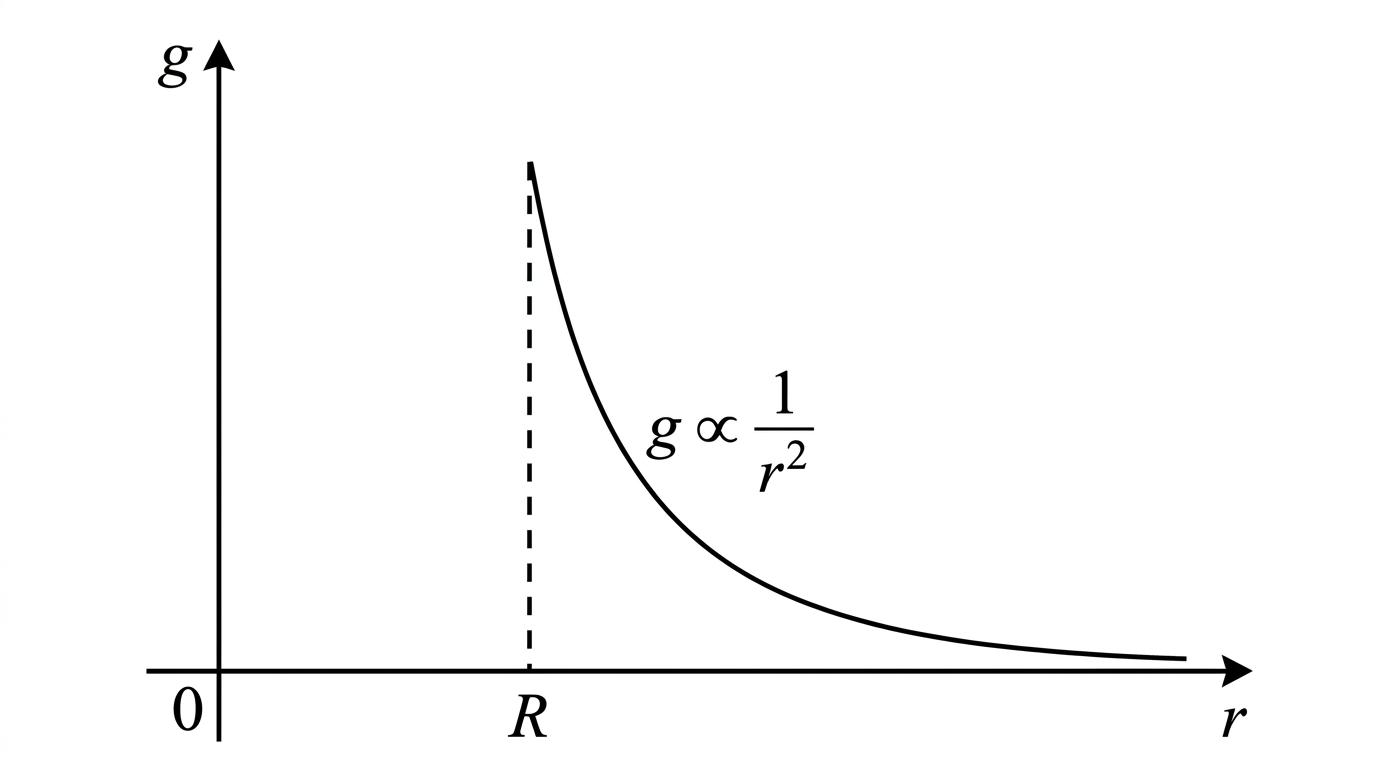
The formula g=GMr2g = \frac{G M}{r^2}g=r2GM shows that the field strength in a radial field depends only on the mass creating the field (MMM) and how far away you are from its centre (rrr). The mass of any object placed into the field (mmm) has completely cancelled out!
The Inverse Square Law
Because rrr is squared and on the bottom of the fraction, ggg follows an inverse square law.
If you double your distance from the centre of the planet (2r2r2r), the gravitational field strength becomes four times weaker (122=14\frac{1}{2^2} = \frac{1}{4}221=41). If you triple the distance, it becomes nine times weaker.
Confusing G and g
Do not confuse GGG and ggg!
- GGG is the Universal Gravitational Constant (6.67×10⁻¹¹ N m2 kg−26.67 \times 10^{-11} \text{ N m}^2 \text{ kg}^{-2}6.67×10⁻¹¹ N m2 kg−2). It is a fundamental constant of the universe and never changes.
- ggg is the gravitational field strength (in N kg−1\text{N kg}^{-1}N kg−1). It changes depending on where you are in the universe.
Dealing with Altitudes
When AQA examiners test this equation, they often give you the distance as an altitude (height above the planet's surface).
Watch your r's!
In the equation g=GMr2g = \frac{GM}{r^2}g=r2GM, the distance rrr is always measured from the centre of mass. If a question gives you the height above the surface (hhh) and the radius of the planet (RRR), you must add them together before squaring!
r=R+h r = R + h r=R+hCalculating g at an altitude
Calculate the gravitational field strength at an altitude of 400 km400 \text{ km}400 km above the surface of the Earth. (Mass of Earth = 5.97×1024 kg5.97 \times 10^{24} \text{ kg}5.97×1024 kg, Radius of Earth = 6.37×10⁶ m6.37 \times 10^6 \text{ m}6.37×10⁶ m, G=6.67×10⁻¹¹ N m2 kg−2G = 6.67 \times 10^{-11} \text{ N m}^2 \text{ kg}^{-2}G=6.67×10⁻¹¹ N m2 kg−2)
- Identify the variables and convert to standard SI units: Altitude h=400 km=400×103 mh = 400 \text{ km} = 400 \times 10^3 \text{ m}h=400 km=400×103 m Radius R=6.37×10⁶ mR = 6.37 \times 10^6 \text{ m}R=6.37×10⁶ m Mass M=5.97×1024 kgM = 5.97 \times 10^{24} \text{ kg}M=5.97×1024 kg
- Calculate the total distance from the centre of the Earth (rrr):
- Apply the radial field strength formula:
- Calculate the final value:
(Notice this is sensibly a bit less than the standard 9.81 N kg−19.81 \text{ N kg}^{-1}9.81 N kg−1 at the surface).
In the exam
- Check for standard prefixes: Distances are frequently given in km rather than m. Always ensure you convert to metres before squaring.
- Read the wording carefully: If a question says "distance from the surface", you must add the radius of the planet. If it says "orbital radius" or "distance from the centre", do not add the planet's radius.
- Use the data sheet: Values for the Earth's mass, Earth's radius, and GGG are provided in the standard AQA data booklet. Do not try to memorise them, but know exactly where to find them to save time.
- Sanity check your answers: If calculating ggg near Earth, your answer should be somewhere near 9.81. If you get something like 101510^{15}1015 or 10−510^{-5}10−5, you have likely forgotten to square rrr or messed up your standard form input on the calculator.
Check yourself
- What do the spacing and direction of gravitational field lines represent?
- What is the difference between GGG and ggg?
- If you move to a distance of 3r3r3r from the centre of a planet, by what factor does the gravitational field strength decrease?
- Why must you add the radius of a planet to an object's altitude when using g=GMr2g = \frac{GM}{r^2}g=r2GM?