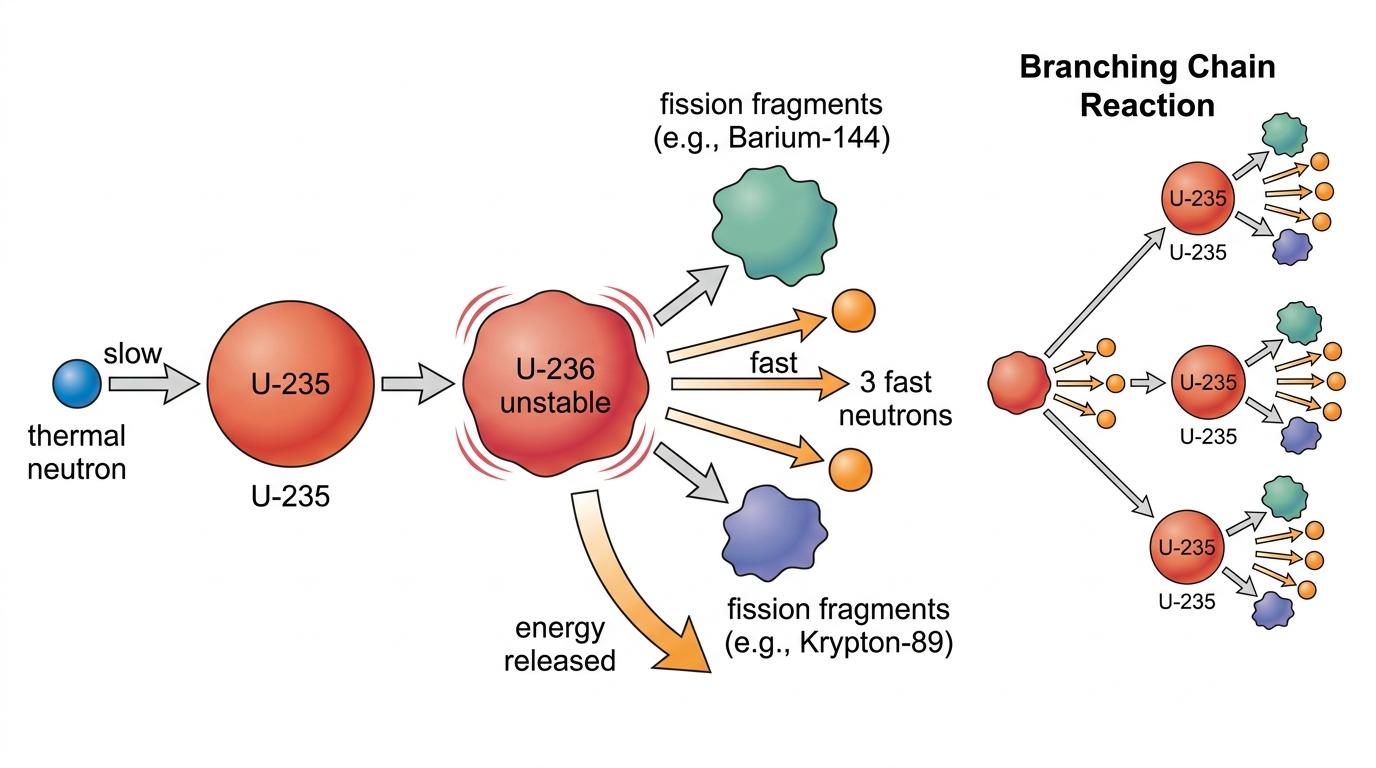
Welcome to the mechanics of nuclear power. You already know that large, unstable nuclei can split apart to become more stable. In this topic, we take control of that process.
What you'll learn:
- How firing a slow "thermal" neutron at a nucleus forces it to split (induced fission).
- How one splitting nucleus can cause a cascade of others (a chain reaction).
- The anatomy of a thermal nuclear reactor: the exact roles of the moderator, control rods, and coolant.
- Why we use a simple "elastic collision" model to explain how a moderator works.
1. Induced Fission and Thermal Neutrons
Spontaneous fission happens entirely by chance. Induced fission is deliberate: we force a heavy nucleus (like Uranium-235) to split by making it absorb an extra neutron.
When a 92235U{}^{235}_{92}\text{U}92235U nucleus absorbs a neutron, it briefly becomes 92236U{}^{236}_{92}\text{U}92236U. This new nucleus is incredibly unstable and almost immediately fractures into two smaller "daughter" nuclei (fission fragments), alongside a huge release of energy and a few stray neutrons.
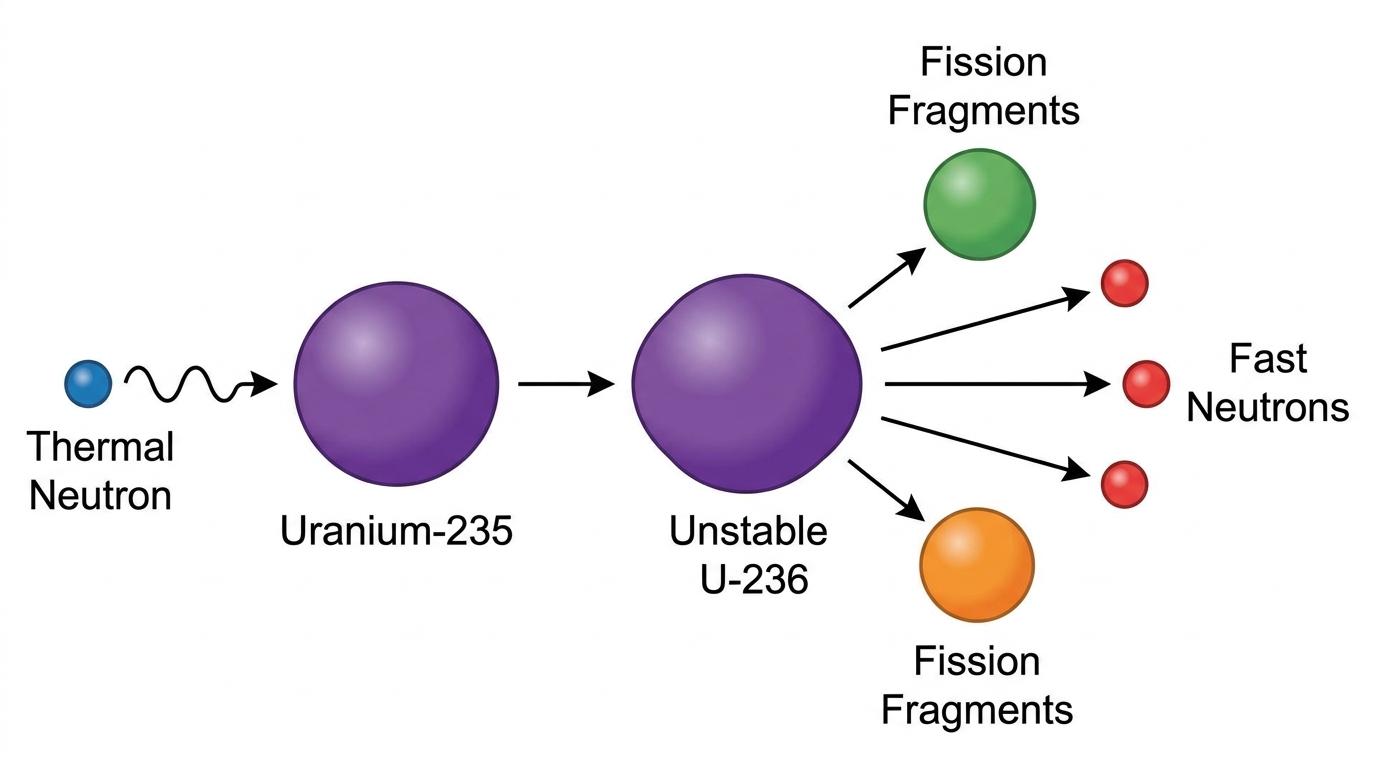
However, we cannot just fire neutrons at any speed. If a neutron is travelling too fast, it will simply bounce off the uranium nucleus rather than being absorbed by the strong nuclear force. We need thermal neutrons.
Thermal neutron
A thermal neutron is a slow-moving neutron with a kinetic energy comparable to the thermal energy of particles at room temperature (typically around 0.025 eV0.025 \text{ eV}0.025 eV or in the range of a fraction of an electronvolt).
Balancing an induced fission equation
A thermal neutron is absorbed by a 92235U{}^{235}_{92}\text{U}92235U nucleus. The nucleus undergoes fission, producing Barium-144, Krypton-89, and several fast neutrons.
Determine the number of fast neutrons produced in this specific fission event.
- Write out the unbalanced nuclear equation using standard nuclide notation. We use xxx to represent the unknown number of neutrons:
- The total proton number (ZZZ) must be conserved. Let's check: Left side: 92+0=92\text{Left side: } 92 + 0 = 92Left side: 92+0=92 Right side: 56+36+(x×0)=92\text{Right side: } 56 + 36 + (x \times 0) = 92Right side: 56+36+(x×0)=92 (Proton numbers balance perfectly).
- The total nucleon number (AAA) must be conserved. Set up an equation for the top numbers:
- Solve for xxx:
- State the final answer: 3 fast neutrons are produced.
2. Chain Reactions and Critical Mass
Look closely at the example above. We spent one thermal neutron to trigger the fission, but the reaction spat out three new neutrons.
If those three new neutrons can be slowed down to thermal speeds, they can trigger three more uranium nuclei to split. Those three fissions would produce nine neutrons, which cause nine fissions, producing twenty-seven neutrons... This is a chain reaction.
The Chain Reaction
A chain reaction occurs when the neutrons released by one fission event go on to induce further fission events. For a nuclear reactor to produce a steady supply of power, the chain reaction must be self-sustaining at a steady rate (where exactly one neutron from each fission goes on to cause another fission).
For a chain reaction to be sustained, you need a certain minimum amount of fuel. If you have a tiny lump of Uranium-235, most of the newly released neutrons will simply escape out of the surface into the air before they hit another uranium nucleus.
Critical mass
The critical mass is the minimum mass of fissile material required to sustain a steady chain reaction. At this mass, the rate of neutron production exactly equals the rate of neutron loss (through escape or non-fission absorption).
3. The Thermal Nuclear Reactor
To safely harvest the energy from fission, we build a thermal nuclear reactor. The reactor core contains several vital components that work together to maintain a steady chain reaction and extract the heat.
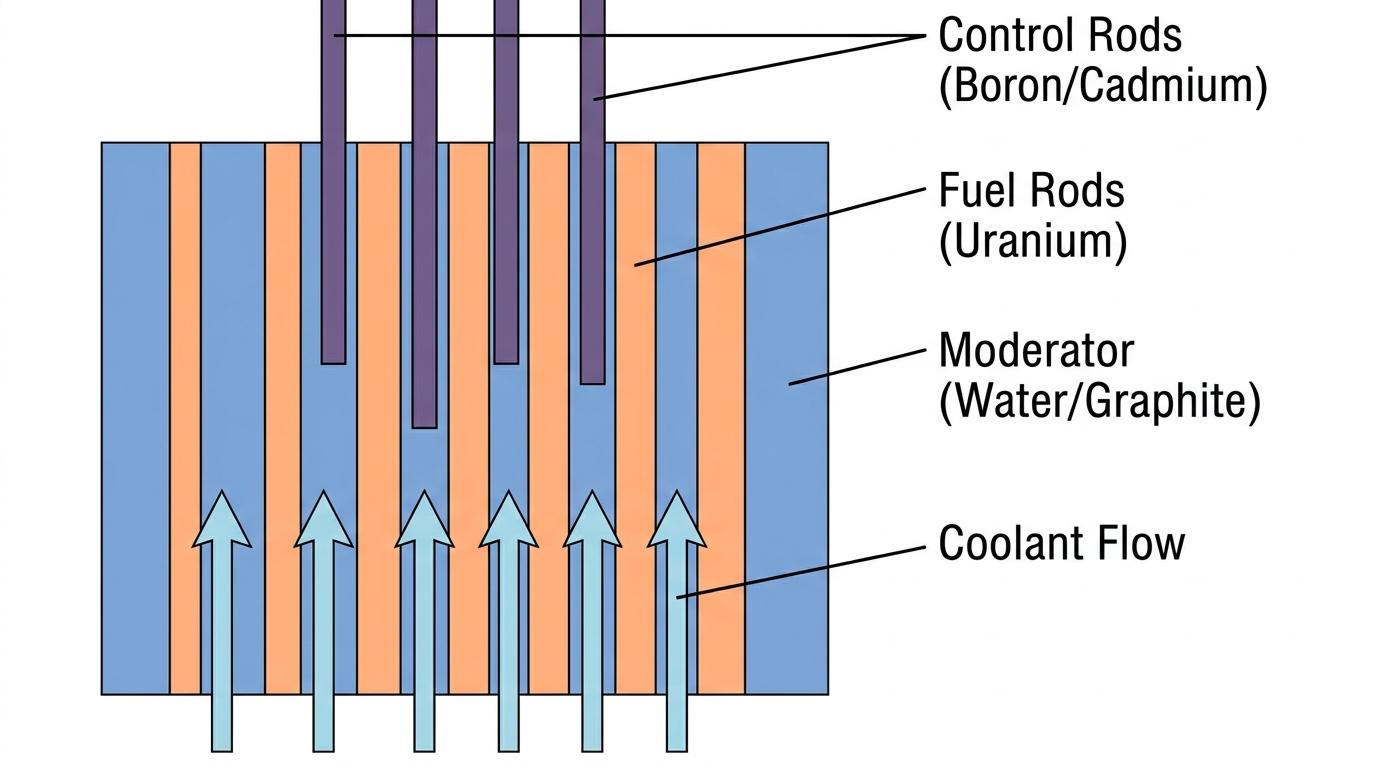
Let's break down the three main components the AQA specification requires you to know: the moderator, the control rods, and the coolant.
The Moderator
The neutrons released in fission are "fast neutrons" (kinetic energies around 1 MeV1 \text{ MeV}1 MeV to 2 MeV2 \text{ MeV}2 MeV). They are moving far too quickly to be absorbed by Uranium-235. The moderator surrounds the fuel rods and its job is to slow these fast neutrons down until they become thermal neutrons.
How does it work? (The Elastic Collision Model) The moderator relies on elastic collisions between the fast neutrons and the nuclei of the moderator material. From mechanics, you know that when a moving particle collides elastically with a stationary target, the maximum transfer of kinetic energy happens when the two particles have similar masses.
- If a neutron hits a massive Uranium-238 nucleus, it bounces off with almost all its original kinetic energy (like a ping-pong ball hitting a bowling ball).
- If a neutron hits a nucleus with a mass similar to its own (like a proton in water, or a carbon nucleus in graphite), it transfers a large fraction of its kinetic energy to the target nucleus (like a cue ball hitting an 8-ball in pool).
After about 50 collisions in water, a fast neutron loses enough energy to become a thermal neutron.
Materials used: Water (acting as both moderator and coolant), heavy water, or graphite.
Explaining moderation in an exam
Question: Explain, using physical principles, why water is an effective moderator in a thermal nuclear reactor. (3 marks)
- State the fundamental mechanism: The fast neutrons undergo elastic collisions with the nuclei of the water molecules (specifically, the hydrogen protons).
- Apply the mechanical model: Because a neutron and a proton have approximately the same mass, the neutron transfers a significant proportion of its kinetic energy to the proton during each collision.
- Conclude with the result: After multiple collisions, the neutron's kinetic energy is reduced to thermal levels, allowing it to be absorbed by Uranium-235 to induce further fission.
Control Rods
While the moderator ensures the reaction can continue, the control rods ensure it doesn't run out of control. Their function is to absorb neutrons, reducing the number of neutrons available to cause fission.
If the reaction rate is too high (reactor getting too hot), the rods are lowered deeper into the core to absorb more neutrons. If the reaction needs to speed up, the rods are raised. In an emergency, all control rods are dropped fully into the core, absorbing almost all thermal neutrons and shutting down the chain reaction entirely.
Materials used: Boron or Cadmium. These materials are chosen because they have extremely high probabilities of absorbing thermal neutrons without undergoing fission themselves.
Mixing up Moderator and Control Rods
The most common exam error in this topic is swapping the roles of these two components.
- Moderators slow down neutrons (they do NOT absorb them).
- Control rods absorb neutrons (they do NOT slow them down).
Coolant
The immense energy released by fission shows up as the kinetic energy of the fission fragments. As these fragments smash into the surrounding fuel lattice, the core heats up dramatically. The coolant is a fluid pumped through the core. Its function is to absorb this thermal energy and transfer it to a heat exchanger outside the core (where it boils water to turn turbines and generate electricity).
Materials used: Water, Carbon Dioxide gas, or liquid sodium. A good coolant must have a high specific heat capacity (to carry a lot of heat energy), a high boiling point (or be kept under high pressure), and must not readily absorb neutrons.
Why not just one material?
In many modern reactors (like Pressurised Water Reactors), normal water is used as both the moderator and the coolant. Be careful in exams: if an AQA question asks for the function of water as a coolant, focus only on heat transfer. If it asks for its function as a moderator, focus entirely on elastic collisions and slowing down neutrons.
In the exam
- Be precise with "thermal": Never just say "neutrons cause fission". Always specify thermal neutrons or slow-moving neutrons. Fast neutrons do not trigger U-235 fission efficiently.
- Key phrase for moderation: Always use the phrase "elastic collisions" when explaining how the moderator works.
- Mass matching: When explaining why a moderator material is chosen, explicitly state that maximum kinetic energy transfer occurs because the mass of the moderator nucleus is similar to the mass of the neutron.
- Distinguish components: If asked to name a material for a control rod, write "Boron" or "Cadmium". Never write "Graphite" (that is a moderator).
Check yourself
- Can you write the equation for a thermal neutron causing U-235 to split into Ba-144, Kr-89 and three neutrons?
- Why would a material made of very massive nuclei (like lead) make a terrible moderator?
- What happens to the rate of fission if the control rods are raised out of the core?
- What does the term 'critical mass' actually refer to in terms of neutron loss vs neutron production?