Exam-style question: Waste Disposal
State what high-level waste is and describe how it is safely processed and stored. (5 marks)
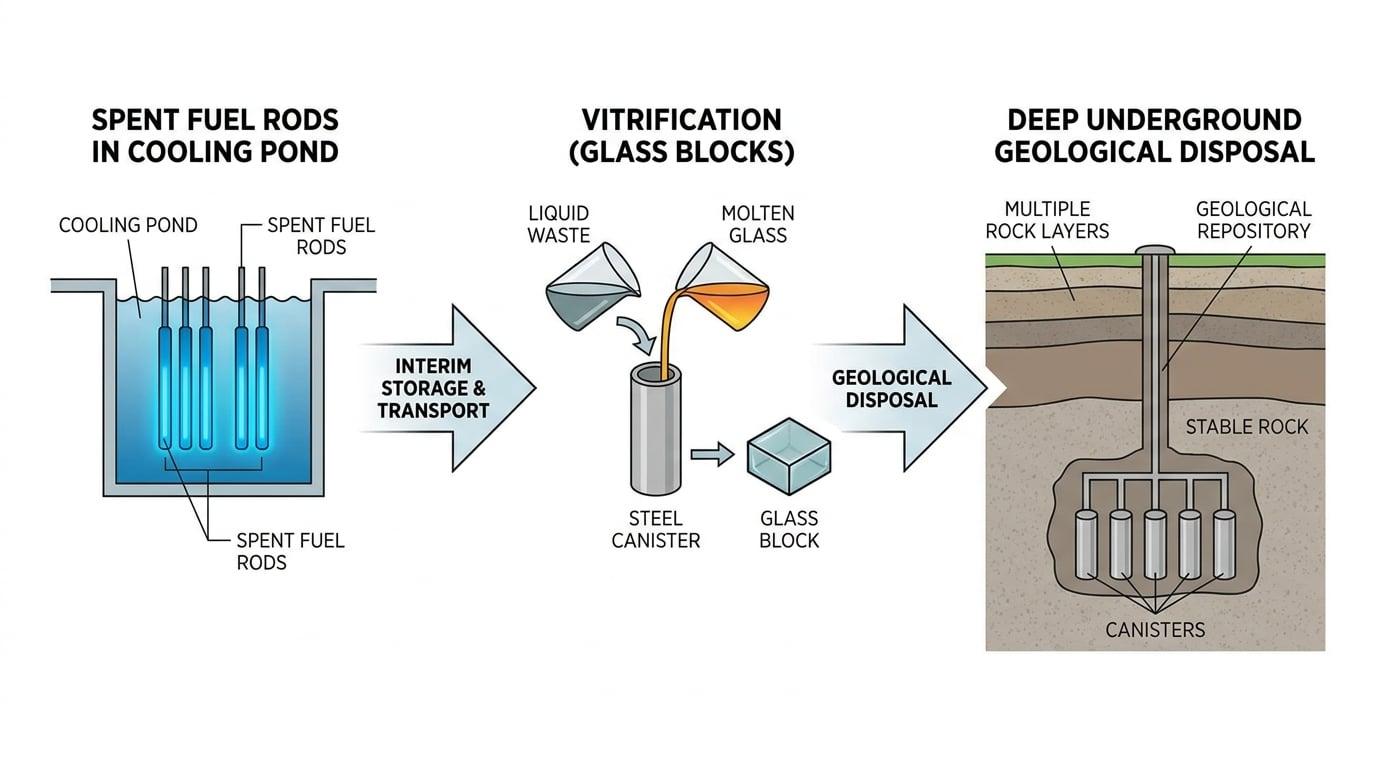
- High-level waste consists primarily of spent fuel rods from the reactor.
- It is initially highly radioactive and hot, so it is placed in cooling ponds for several years to cool down and allow the most active, short-lived isotopes to decay.
- The waste is then vitrified, meaning it is mixed with molten glass to form a solid, insoluble material.
- This glass is sealed inside thick stainless steel cylinders.
- Finally, the cylinders are stored in deep geological repositories that are geologically stable to prevent contamination of groundwater.
Confusing the types of waste
Don't guess which waste goes where! Remember that cooling ponds and vitrification are strictly for High-Level Waste (spent fuel). You don't put a scientist's slightly radioactive lab coat (Low-Level Waste) into a cooling pond.
Balancing the Risks and Benefits
Nuclear energy is highly controversial. AQA expects you to be able to evaluate the pros and cons of nuclear power in longer written answers. Society has to balance the immense benefits against the severe risks.
The Benefits
- High energy density: A single kilogram of Uranium-235 produces roughly 2×10¹³ J2 \times 10^{13} \text{ J}2×10¹³ J of energy, equivalent to burning millions of kilograms of coal. This means relatively little fuel needs to be mined and transported.
- No greenhouse gases: Unlike fossil fuels, nuclear fission produces no carbon dioxide or sulfur dioxide during operation. It is a crucial tool in fighting climate change.
- Reliable base-load power: Unlike wind or solar power, which depend on the weather, nuclear power provides continuous, uninterrupted energy day and night.
The Risks
- Catastrophic accidents: Although extremely rare, a core meltdown (like Chernobyl or Fukushima) can release massive amounts of radioactive material into the atmosphere, causing long-term health effects (cancer, mutations) and forcing the evacuation of entire cities.
- Waste management: High-level waste remains hazardous for thousands of years. It represents a major long-term burden on future generations to maintain these deep geological sites.
- Proliferation: The technology and materials used (especially plutonium produced in the reactor) could potentially be diverted to create nuclear weapons.
Structure your argument
If a 6-mark question asks you to "Discuss the risks and benefits of nuclear power", spend 3 marks on the benefits (high energy density, continuous power, no greenhouse gases) and 3 marks on the risks (long-term waste storage, potential for severe accidents, high decommissioning costs). Do not just focus on one side.
In the exam
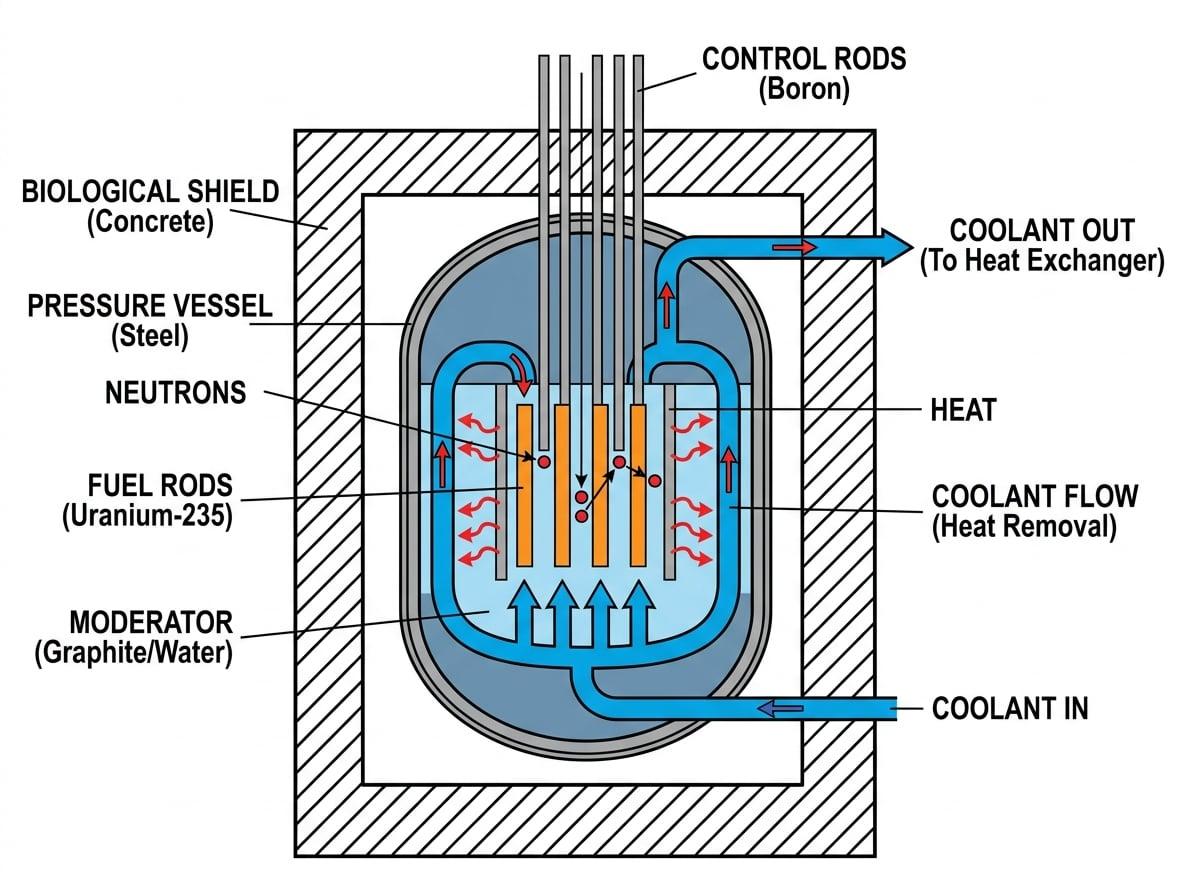
- Be precise with materials: If asked what the biological shield is made of, say "thick concrete", not just "metal". Control rods are "boron" or "cadmium", not "lead".
- Explain the 'why' in storage: When describing deep geological storage, explicitly mention why we put it there: to prevent groundwater contamination and avoid seismic activity.
- Link activity to storage time: Remember that isotopes with short half-lives are highly active (give off a lot of radiation quickly and heat up), which is why they need the cooling pond first. The long-half-life isotopes are less active but require the deep, permanent geological storage.
Check yourself
- Can you name the fail-safe mechanism used for emergency reactor shut-downs?
- Why do spent fuel rods need to sit in a cooling pond for years before being vitrified?
- What is vitrification, and why is it important for storing HLW?
- Can you list two benefits and two risks of using nuclear power to generate electricity?