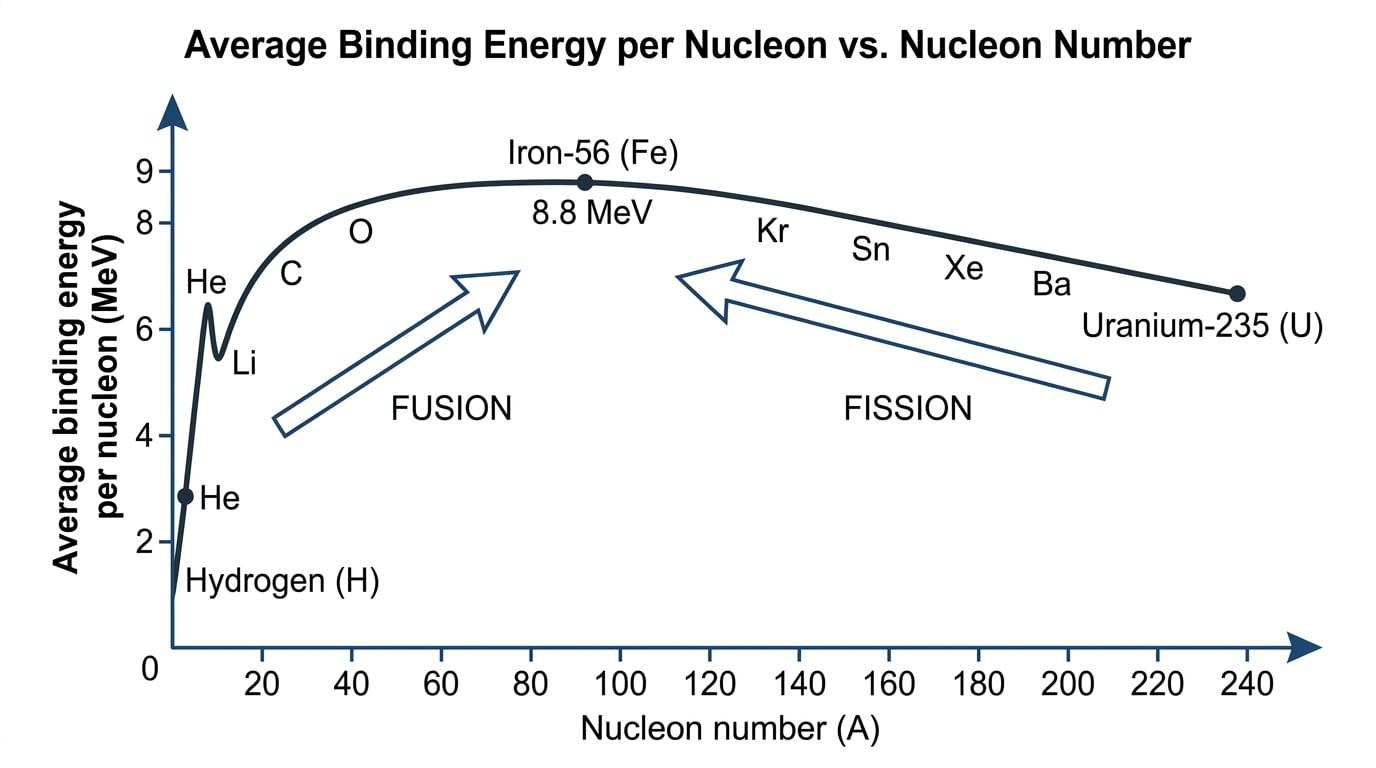
Notice the key features of this graph:
- It rises steeply for low values of AAA (light elements like hydrogen and helium).
- It peaks at Iron-56 (Fe-56), which has the highest binding energy per nucleon (about 8.8 MeV8.8 \text{ MeV}8.8 MeV) and is therefore the most stable nucleus in nature.
- It slowly drops off for heavy elements (like uranium).
Fission and Fusion
This single graph explains both nuclear fission and nuclear fusion. In physics, systems naturally want to move to a lower energy, more stable state (higher up on this graph).
- Nuclear Fusion: Two light nuclei (left of iron) join together to form a heavier nucleus. The new nucleus is closer to the iron peak, so it has a higher binding energy per nucleon.
- Nuclear Fission: A large, unstable nucleus (right of iron) splits into two smaller nuclei. The smaller nuclei are closer to the iron peak, so they also have a higher binding energy per nucleon.
In both processes, the products are more tightly bound than the reactants. Because the binding energy increases, energy is released to the surroundings.
Calculating Energy Released in Reactions
You will often be asked to calculate the energy released during a specific fission or fusion reaction. There are two ways to do this, depending on what data the question gives you:
Method 1: Using masses (most common) Energy released is the energy equivalent of the difference between the total mass of the reactants and the total mass of the products.
Energy released=(Total mass of reactants−Total mass of products)×c2 \text{Energy released} = (\text{Total mass of reactants} - \text{Total mass of products}) \times c^2 Energy released=(Total mass of reactants−Total mass of products)×c2(Or multiply the mass difference in u\text{u}u by 931.5931.5931.5 to get MeV\text{MeV}MeV.)
Method 2: Using binding energies Energy released is the difference between the total binding energy of the products and the total binding energy of the reactants.
Energy released=Total binding energy of products−Total binding energy of reactants \text{Energy released} = \text{Total binding energy of products} - \text{Total binding energy of reactants} Energy released=Total binding energy of products−Total binding energy of reactantsGetting the subtraction backwards
When using masses, it's Reactants - Products (because mass is lost to release energy).
When using binding energies, it's Products - Reactants (because the final state is more tightly bound, so binding energy has increased).
Calculating energy released in a fission reaction
Uranium-235 can undergo fission when it absorbs a slow-moving neutron, producing barium-144, krypton-89, and three fast neutrons:
92235U+01n→56144Ba+3689Kr+3(01n) _{92}^{235}\text{U} + _{0}^{1}\text{n} \to _{56}^{144}\text{Ba} + _{36}^{89}\text{Kr} + 3\left(_{0}^{1}\text{n}\right) 92235U+01n→56144Ba+3689Kr+3(01n)Calculate the energy released in MeV\text{MeV}MeV. (Given masses: U-235 = 235.0439 u235.0439 \text{ u}235.0439 u, n = 1.0087 u1.0087 \text{ u}1.0087 u, Ba-144 = 143.9229 u143.9229 \text{ u}143.9229 u, Kr-89 = 88.9176 u88.9176 \text{ u}88.9176 u)
- Calculate the total mass of the reactants (the left side of the equation).
- Calculate the total mass of the products (the right side of the equation). Note there are 3 neutrons produced!
- Find the change in mass (Δm\Delta mΔm).
- Convert this mass difference into energy in MeV\text{MeV}MeV.
Physics Informing Society
The AQA specification explicitly requires you to appreciate that knowledge of the physics of nuclear energy allows society to make informed decisions.
Understanding E=mc2E=mc^2E=mc2 and the binding energy curve explains why nuclear power stations have such an incredibly high energy density compared to fossil fuels, producing vast amounts of electricity without emitting greenhouse gases. However, our understanding of radioactive decay and nuclear physics also informs us about the hazards of long-lived nuclear waste and the risks of meltdowns.
Society must weigh these scientifically quantified risks against the benefits (low-carbon energy) when deciding whether to build new nuclear power plants.
In the exam
- Watch your units! Always check whether the question wants the final answer in J\text{J}J or MeV\text{MeV}MeV. If you need Joules, you must convert the mass defect into kg\text{kg}kg and use E=mc2E=mc^2E=mc2, or find the energy in MeV\text{MeV}MeV first and then multiply by 1.60×10−131.60 \times 10^{-13}1.60×10⁻¹³ (since 1 eV=1.6×10⁻¹⁹ J1 \text{ eV} = 1.6 \times 10^{-19} \text{ J}1 eV=1.6×10⁻¹⁹ J, so 1 MeV=1.6×10⁻¹³ J1 \text{ MeV} = 1.6 \times 10^{-13} \text{ J}1 MeV=1.6×10⁻¹³ J).
- Keep all decimal places: Nuclear mass calculations involve tiny differences between very similar numbers. Do not round any numbers until the very last step, otherwise your mass defect will be totally wrong.
- Don't forget the original neutron: In fission reactions, remember to include the mass of the incident neutron on the reactant side, and multiply the mass of the product neutrons by however many are released (e.g., 3×mn3 \times m_n3×mn).
Check yourself
- Can you define what an atomic mass unit (u\text{u}u) is?
- What is the difference between mass defect and binding energy?
- On the binding energy per nucleon graph, which element sits at the peak, and what does this mean about its stability?
- Why do both fission and fusion release energy despite being opposite processes?