Gravitational potential (A-level only)
Welcome to gravitational potential! You already know that masses exert attractive forces on one another. Now, we are going to look at the energy involved in moving masses through these gravitational fields.
What you'll learn:
- What gravitational potential is and why it always has a negative value.
- How to calculate the work done when moving a mass between different points in space.
- How to interpret equipotential surfaces.
- How to link gravitational field strength (ggg) and potential (VVV) using equations and graphs.
Defining Gravitational Potential
If you lift a book off the floor, you do work against Earth's gravity, and the book gains gravitational potential energy. To make comparisons easier in physics, we often want to know the energy per unit mass at a specific point in space, regardless of whether we are putting a 1 kg1\text{ kg}1 kg book or a 1000 kg1000\text{ kg}1000 kg satellite there.
Gravitational potential ()
The gravitational potential at a point in a gravitational field is the work done per unit mass to move a small object from infinity to that point.
The unit of gravitational potential is joules per kilogram (J kg−1\text{J kg}^{-1}J kg−1).
Why infinity? And why is it negative?
In A-level Physics, we set the "zero point" of gravitational potential at an infinite distance away from the mass creating the field. At infinity, the gravitational pull is zero.
Because gravity is an attractive force, if you place a mass at infinity and let go, it will naturally fall towards the planet. As it falls, it speeds up, converting gravitational potential energy into kinetic energy.
The negative sign
If gravitational potential starts at zero (at infinity) and the object loses potential energy as it falls toward the planet, the potential must become negative.
Therefore, the gravitational potential at any point in space is always negative. It only reaches zero at an infinite distance.
The formula for a radial field
For a spherical mass (like a planet or star), the field is radial. The gravitational potential VVV at a distance rrr from the centre of a mass MMM is given by:
V=−GMr V = -\frac{GM}{r} V=−rGMWhere:
- VVV is the gravitational potential in J kg−1\text{J kg}^{-1}J kg−1
- GGG is the gravitational constant (6.67×10⁻¹¹ N m2 kg−26.67 \times 10^{-11}\text{ N m}^{2}\text{ kg}^{-2}6.67×10⁻¹¹ N m2 kg−2)
- MMM is the mass creating the field in kg\text{kg}kg
- rrr is the distance from the centre of the mass to the point in m\text{m}m
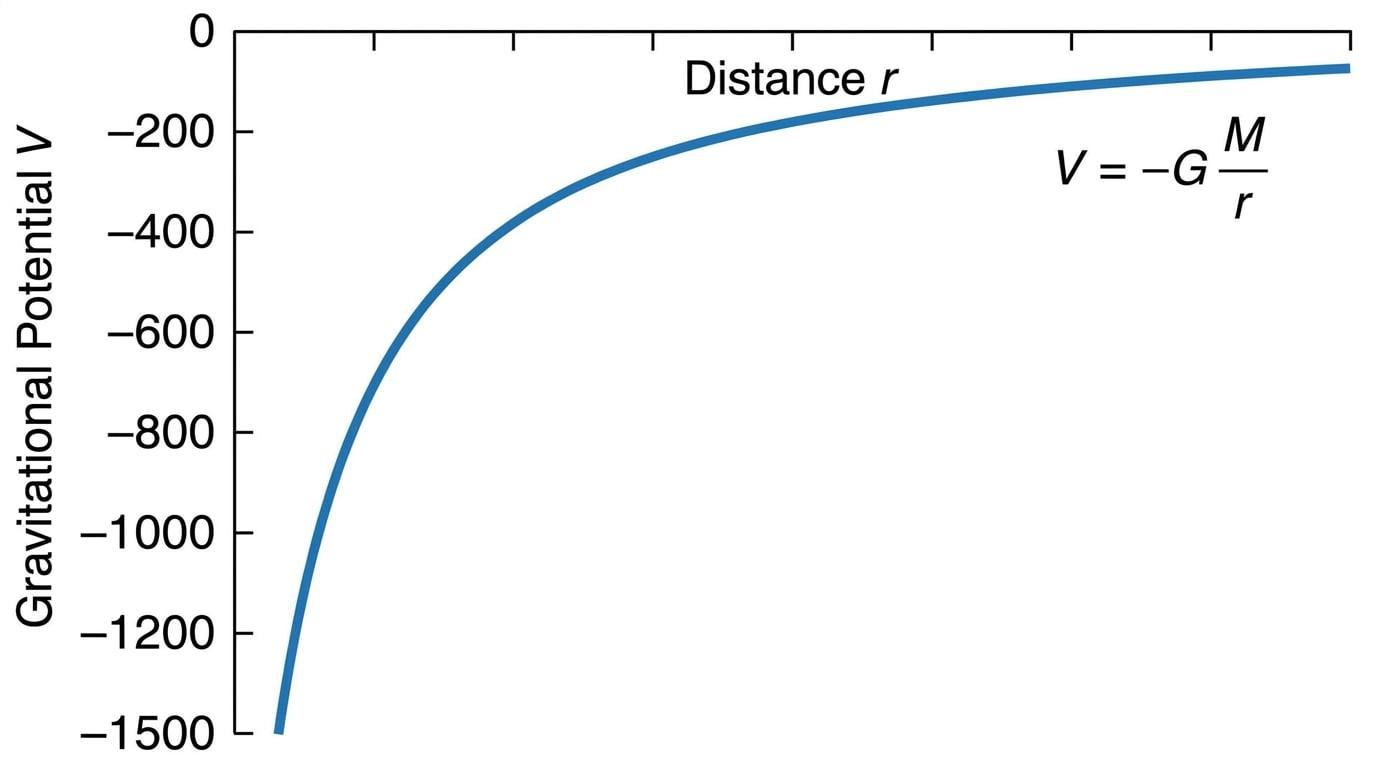
Notice the shape of the graph: it is a −1r-\frac{1}{r}−r1 curve. It starts at a large negative value at the planet's surface and curves gently upwards, getting closer and closer to zero as rrr approaches infinity.
Forgetting the negative sign
When writing the formula or calculating a value for VVV, students frequently drop the negative sign. A positive gravitational potential implies a repulsive force, which does not exist in standard gravitational physics! Always include the negative.
Work Done and Potential Difference
If you want to move a satellite from a low orbit to a higher orbit, you need to do work (provide energy) against the planet's gravitational pull.
Just like electrical potential difference drives circuits, gravitational potential difference (ΔV\Delta VΔV) tells us how much energy is needed to move 1 kg1\text{ kg}1 kg of mass between two points in a field.
To find the total work done (ΔW\Delta WΔW) in moving an object of mass mmm, we multiply the object's mass by the potential difference:
ΔW=mΔV \Delta W = m \Delta V ΔW=mΔVWhere:
- ΔW\Delta WΔW is the work done in J\text{J}J
- mmm is the mass of the object being moved in kg\text{kg}kg
- ΔV\Delta VΔV is the change in gravitational potential in J kg−1\text{J kg}^{-1}J kg−1 (where ΔV=Vfinal−Vinitial\Delta V = V_{\text{final}} - V_{\text{initial}}ΔV=Vfinal−Vinitial)
Calculating work done to change orbit
A satellite of mass 1200 kg1200\text{ kg}1200 kg is initially in orbit at a distance of 8.0×10⁶ m8.0 \times 10^{6}\text{ m}8.0×10⁶ m from the centre of the Earth. Calculate the work done to move it to a higher orbit at a distance of 2.4×10⁷ m2.4 \times 10^{7}\text{ m}2.4×10⁷ m. (Mass of Earth = 5.97×1024 kg5.97 \times 10^{24}\text{ kg}5.97×1024 kg, G=6.67×10⁻¹¹ N m2 kg−2G = 6.67 \times 10^{-11}\text{ N m}^{2}\text{ kg}^{-2}G=6.67×10⁻¹¹ N m2 kg−2)
- Calculate the initial potential (V1V_{1}V1):
- Calculate the final potential (V2V_{2}V2):
- Find the potential difference (ΔV\Delta VΔV):
- Calculate the work done (ΔW\Delta WΔW):
Equipotential Surfaces
Think of reading a map with contour lines. If you walk along a contour line, you don't go uphill or downhill; your height stays exactly the same, so your gravitational potential energy doesn't change.
An equipotential surface is the 3D equivalent of a contour line. It is a surface made up of points that all have the exact same gravitational potential.
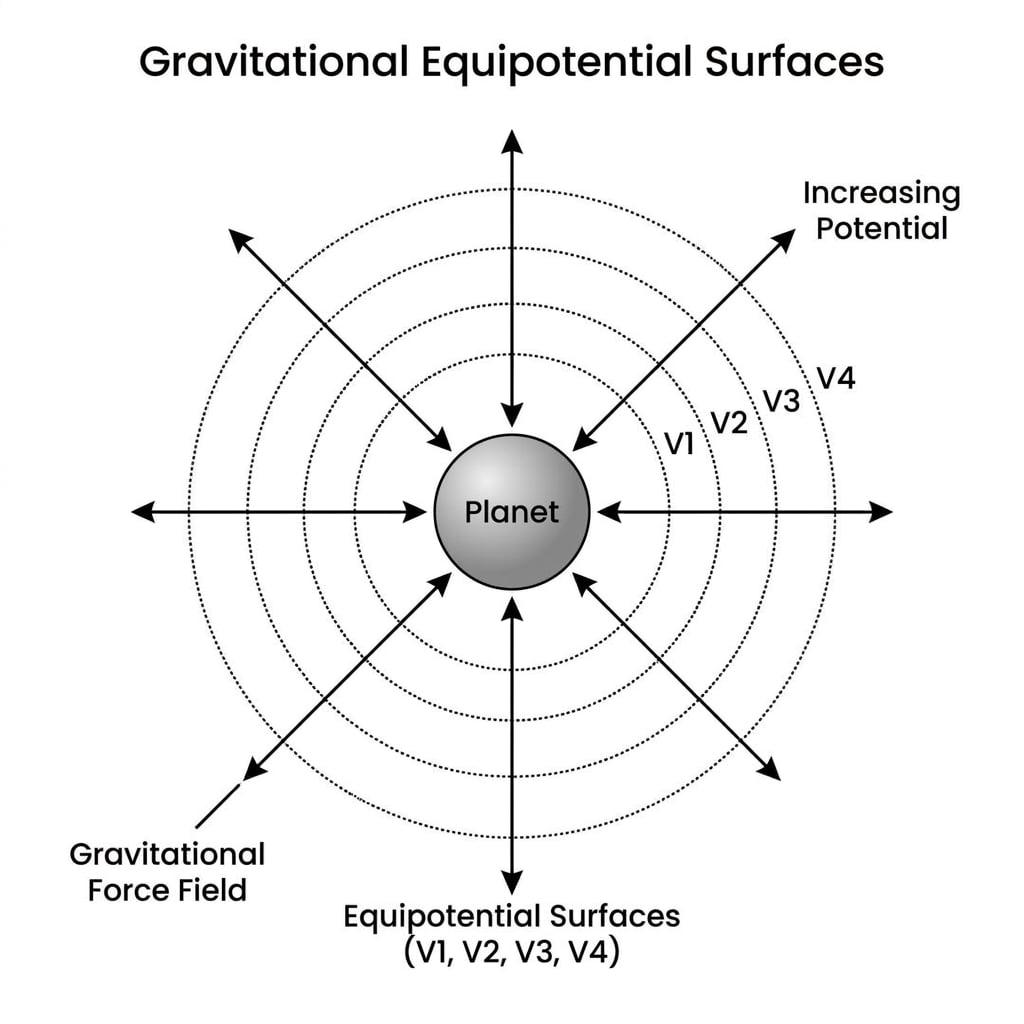
For a spherical planet, the equipotential surfaces are concentric spheres. As you move further away from the planet, the equipotential lines get further apart for the same change in ΔV\Delta VΔV (because the field gets weaker).
Moving on an equipotential
Because the potential VVV is identical everywhere on an equipotential surface, the potential difference ΔV\Delta VΔV between any two points on that surface is zero.
Since ΔW=mΔV\Delta W = m\Delta VΔW=mΔV, no work is done when moving a mass along an equipotential surface.
Linking ggg and VVV
Gravitational field strength (ggg) and gravitational potential (VVV) are intimately connected. VVV tells you about the energy at a point, while ggg tells you about the force at a point.
The relationship between them is given by the potential gradient:
g=−ΔVΔr g = -\frac{\Delta V}{\Delta r} g=−ΔrΔVUnderstanding the gradient sign
The gradient of a VVV against rrr graph is ΔVΔr\frac{\Delta V}{\Delta r}ΔrΔV. Because VVV becomes less negative (increases) as rrr increases, the gradient is positive. However, gravitational field strength ggg acts inwards towards the mass (the opposite direction to increasing rrr). The negative sign in the equation correctly flips the positive gradient into an inward-pointing field strength vector.
Graphical Relationships
You need to be completely comfortable flipping between graphs of ggg and VVV.
1. Finding ggg from a VVV against rrr graph As the equation g=−ΔVΔrg = -\frac{\Delta V}{\Delta r}g=−ΔrΔV suggests, the gravitational field strength at a specific distance is the negative gradient of the VVV against rrr graph at that point. You can find this by drawing a tangent to the curve.
2. Finding ΔV\Delta VΔV from a ggg against rrr graph If we rearrange the equation to ΔV=−gΔr\Delta V = -g \Delta rΔV=−gΔr, we can see a relationship for the area. The area under a graph of ggg against rrr represents the change in gravitational potential (ΔV\Delta VΔV).
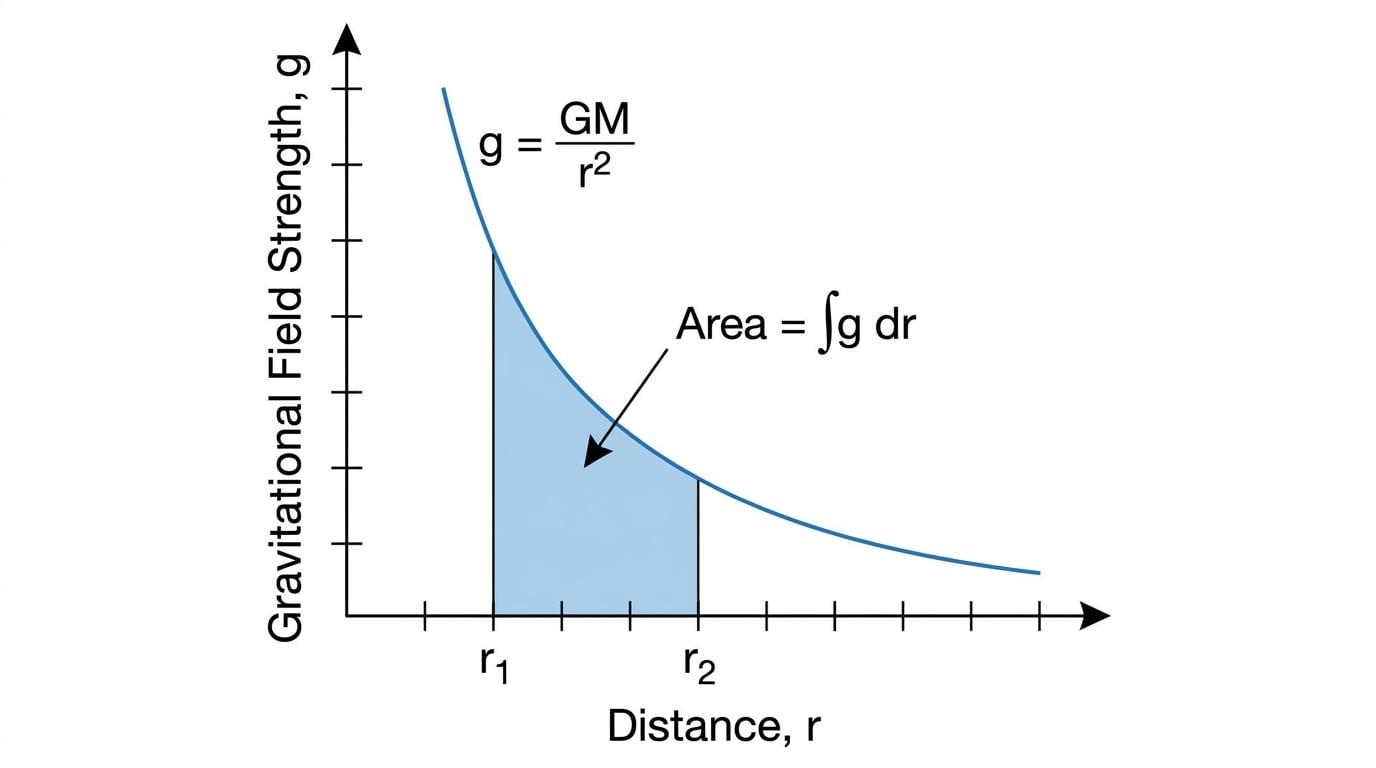
If an exam question gives you a graph of ggg against rrr and asks for the work done to move a mass between two distances, you must:
- Count squares to find the area under the curve between those two distances (this gives you ΔV\Delta VΔV).
- Multiply that area by the mass being moved to find ΔW\Delta WΔW.
Watch the axes!
Exam questions love to plot these graphs with unexpected multipliers on the axes, such as r×106 mr \times 10^{6}\text{ m}r×106 m or V×107 J kg−1V \times 10^{7}\text{ J kg}^{-1}V×107 J kg−1. Always check the axis labels carefully before calculating a gradient or an area.
In the exam
- Be rigorous with signs: When calculating ΔV\Delta VΔV, write out the subtraction with brackets, e.g., ΔV=(−20)−(−50)=+30\Delta V = (-20) - (-50) = +30ΔV=(−20)−(−50)=+30. Sign errors are the most common reason for dropping marks in this topic.
- Counting squares: If asked to find ΔV\Delta VΔV from the area under a ggg against rrr curve, estimate partial squares systematically. State the value of "one square" in your working (e.g., "1 square = 0.1×1060.1 \times 10^{6}0.1×106").
- Equipotentials and field lines: Remember that equipotential surfaces and gravitational field lines always intersect at exactly 90∘90^{\circ}90∘.
Check yourself
- Can you explain why gravitational potential values are always negative?
- Do you know the formula connecting work done, mass, and potential difference?
- If a satellite remains in a perfectly circular orbit, why is the work done by gravity zero?
- How do you find the gravitational field strength from a graph of gravitational potential against distance?