Key Idea
Signal Regeneration
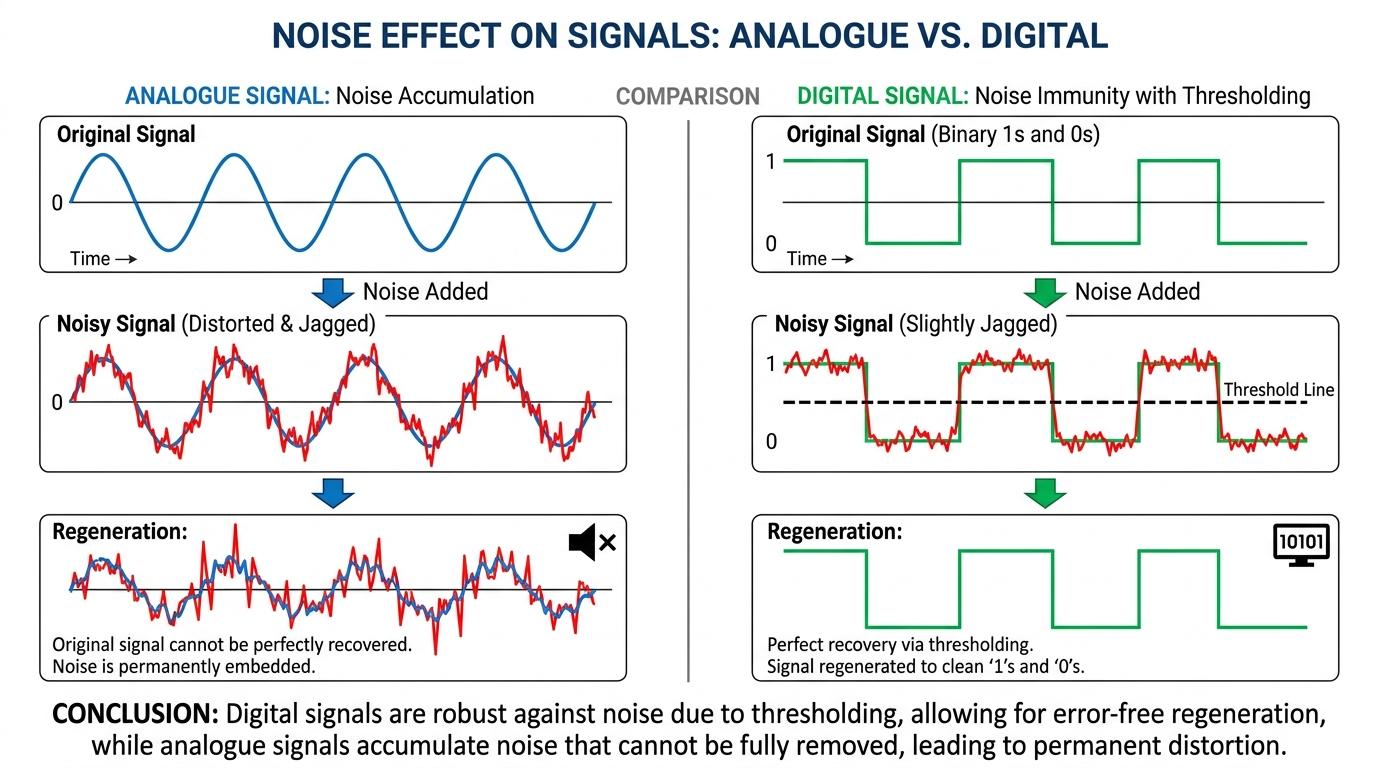
Because a digital signal relies on discrete levels, it can be passed through a regenerator rather than a simple amplifier. The regenerator perfectly reads the noisy 1s and 0s and outputs a brand new, perfectly clean set of 1s and 0s. The original data is recovered, and the noise is completely eliminated.
Advantages and Disadvantages of Digital Sampling
Advantages:
- Perfect recovery from noise (signals can be sent infinitely far without loss of quality if regenerated often enough).
- Easily stored on computers, flash drives, and hard disks.
- Digital data can be easily encrypted for security or compressed to save space.
Disadvantages:
- Requires extra hardware (Analogue-to-Digital and Digital-to-Analogue Converters).
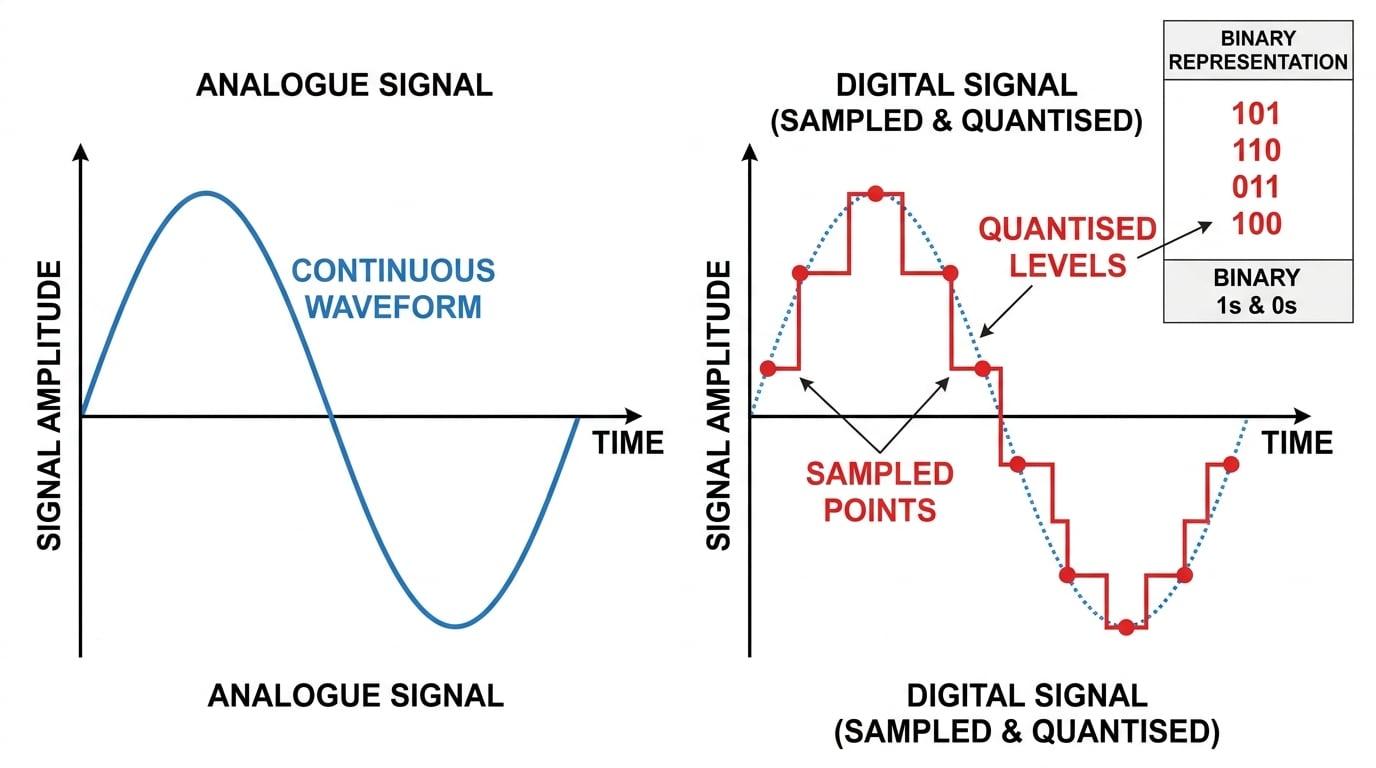
- The discrete nature of sampling and quantisation means there is an inherent loss of the "infinite" detail of the original continuous wave (quantisation error).
- Transmitting high-quality digital audio/video requires very high bandwidth compared to sending the raw analogue signal.
Exam technique
In the exam
- When asked about the advantages of digital signals, do not just say "they are clearer". You must explicitly mention that noise can be eliminated because the signal can be perfectly regenerated back to its original state using threshold levels.
- If asked how to improve the quality of a digital recording, specify two distinct points: increasing the sampling rate (samples per second) and increasing the number of bits per sample (quantisation levels).
- Watch out for units in bit rate calculations! Pay attention to whether the question asks for the answer in bits, bytes, kilobits, or megabytes. Divide bits by 8 to get bytes.
Self review
Check yourself
- What is the difference between sampling and quantisation in Pulse Code Modulation?
- If an ADC uses 3 bits per sample, how many distinct voltage levels can it assign?
- Why is it impossible to perfectly remove noise from an analogue signal once it has been picked up?
- If you double the sampling rate of a recording, what happens to the size of the resulting digital file?