What you'll learn:
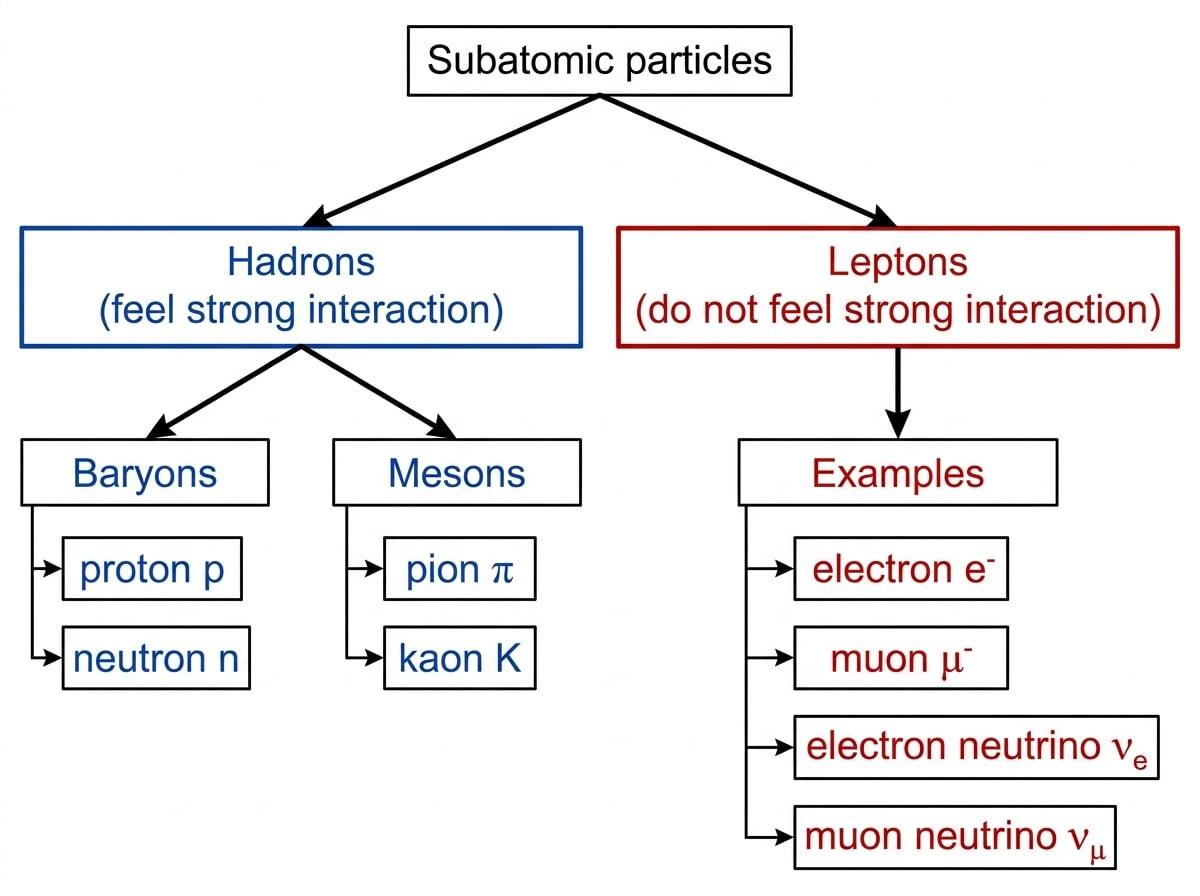
- How to divide all particles into two major families: hadrons and leptons.
- The difference between baryons and mesons.
- The specific roles of the pion, kaon, and muon.
- How to predict whether a particle interaction can actually happen by checking the conservation of baryon number, lepton number, and strangeness.
The Great Divide: Hadrons vs. Leptons
When physicists first started smashing particles together, they discovered hundreds of new particles. To make sense of this "particle zoo", they grouped them based on how they interact with the fundamental forces of nature.
The biggest dividing line in particle physics is the strong nuclear force (the force that holds the nucleus together). Every particle in the universe either "feels" this force or is completely blind to it.
Hadrons and Leptons
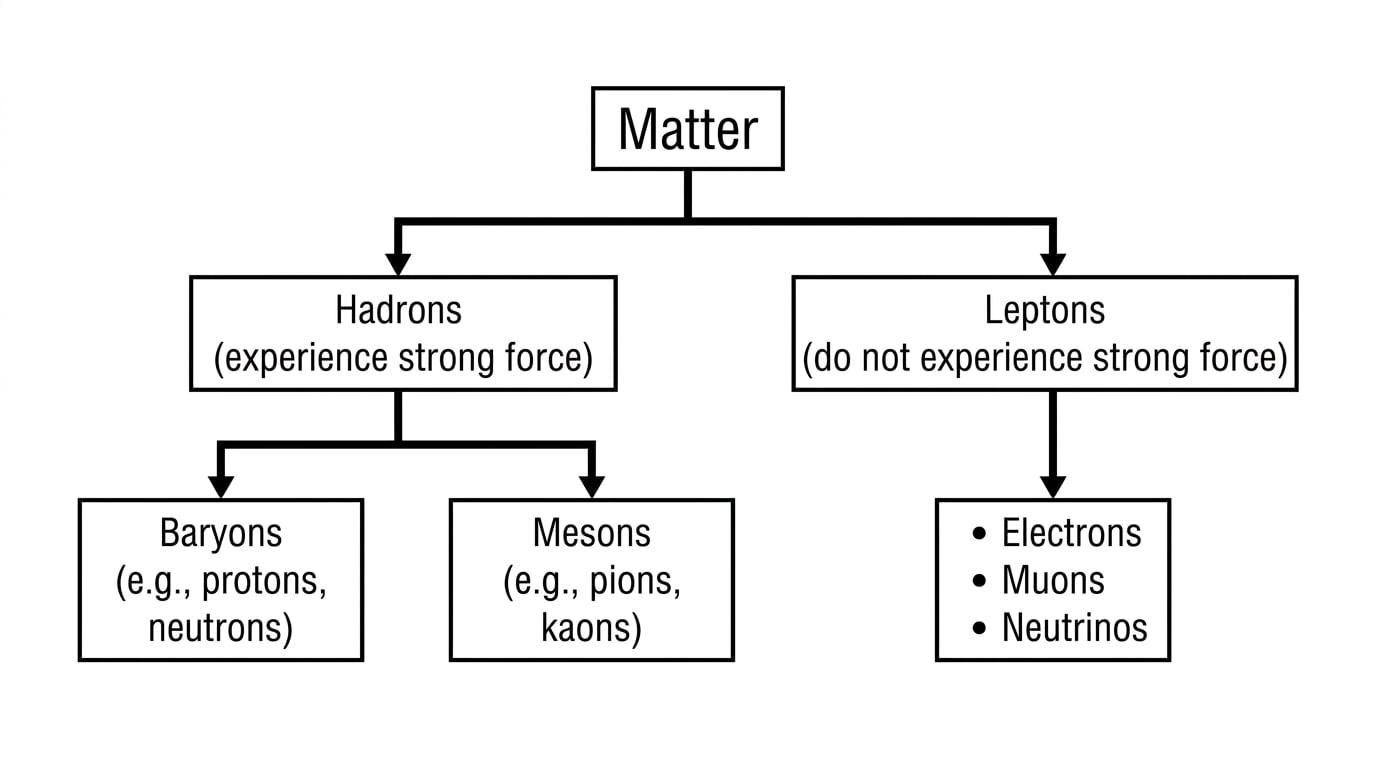
- Hadrons are particles that can feel the strong nuclear force.
- Leptons are fundamental particles that cannot feel the strong nuclear force.
Hadrons: Baryons and Mesons
Hadrons are the heavyweights of the particle world. Because there are so many of them, we split them into two further sub-categories based on their mass and internal structure (which you'll learn about when we look at quarks). These two sub-categories are baryons and mesons.
1. Baryons
Baryons are the heaviest hadrons. The two you already know perfectly are the proton and the neutron. Every baryon has a corresponding anti-baryon (like the antiproton and antineutron).
A crucial rule of the universe is that the proton is the only stable baryon. This means that if you leave any other baryon alone for long enough, it will eventually decay into a proton (either directly or through a chain of decays). For example, a free neutron decays into a proton in about 15 minutes!
2. Mesons
Mesons are generally lighter than baryons. The AQA specification requires you to know about two specific types of mesons:
- Pions (π\piπ): These are the lightest mesons. The pion acts as the exchange particle of the strong nuclear force. When protons and neutrons bind together in a nucleus, they do so by tossing pions back and forth between them.
- Kaons (KKK): These are heavier mesons. They are unstable and decay into pions.
Baryon Number ()
To keep track of baryons during particle interactions, physicists assign them a quantum number called the baryon number, represented by the symbol BBB.
- All baryons have B=+1B = +1B=+1.
- All anti-baryons have B=−1B = -1B=−1.
- Everything else (mesons, leptons, photons) has B=0B = 0B=0.
In any interaction, the total baryon number before must equal the total baryon number after. If it doesn't, the interaction is completely impossible.
Checking Baryon Number Conservation
A student suggests that two protons could collide at high speeds to produce two protons, a neutron, and a positive pion, according to the equation:
p+p→p+p+n+π+ \begin{aligned} p + p \to p + p + n + \pi^+ \end{aligned} p+p→p+p+n+π+Determine whether this interaction can occur by checking the conservation of baryon number.
- Write down the baryon number (BBB) for every particle involved. Protons and neutrons are baryons (B=+1B = +1B=+1). Pions are mesons, not baryons (B=0B = 0B=0).
- Calculate the total baryon number on the left-hand side (LHS). We have two protons:
- Calculate the total baryon number on the right-hand side (RHS). We have two protons, one neutron, and one pion:
- Compare the two sides. Since +2≠+3+2 \neq +3+2=+3, baryon number is not conserved. This interaction is physically impossible.
Leptons: The Fundamental Lightweights
Unlike hadrons, leptons do not feel the strong nuclear force at all. As far as we know, leptons are truly fundamental—they have no internal structure and cannot be broken down into anything smaller.
You need to know about three specific leptons (and their antiparticles):
- The Electron (e−e^-e−): The familiar, stable particle orbiting the nucleus.
- The Muon (μ−\mu^-μ−): You can think of the muon as a "heavy electron". Because it is heavier, it is unstable. It eventually decays into an electron.
- The Neutrinos (νe\nu_eνe and νμ\nu_\muνμ): These are incredibly light, uncharged particles that rarely interact with anything. There is a specific electron-neutrino (νe\nu_eνe) associated with the electron, and a specific muon-neutrino (νμ\nu_\muνμ) associated with the muon.
Conservation of Lepton Number
Just like baryon number, lepton number must be conserved. However, there is a catch! The universe treats the "electron family" and the "muon family" as strictly separate. You must conserve the electron lepton number (LeL_eLe) and the muon lepton number (LμL_\muLμ) independently.
Assigning Lepton Numbers
- Is it an electron or an electron-neutrino? Then Le=+1L_e = +1Le=+1.
- Is it a positron or an anti-electron-neutrino? Then Le=−1L_e = -1Le=−1.
- Is it a muon or a muon-neutrino? Then Lμ=+1L_\mu = +1Lμ=+1.
- Is it an anti-muon or an anti-muon-neutrino? Then Lμ=−1L_\mu = -1Lμ=−1.
- Is it a hadron? Then both Le=0L_e = 0Le=0 and Lμ=0L_\mu = 0Lμ=0.
Checking Lepton Number in Muon Decay
A muon decays into an electron, an anti-electron neutrino, and a muon neutrino:
μ−→e−+νˉe+νμ \begin{aligned} \mu^- \to e^- + \bar{\nu}_e + \nu_\mu \end{aligned} μ−→e−+νˉe+νμShow that both muon lepton number (LμL_\muLμ) and electron lepton number (LeL_eLe) are conserved.
- First, let's check the muon lepton number (LμL_\muLμ).
- On the LHS, the muon (μ−\mu^-μ−) has Lμ=+1L_\mu = +1Lμ=+1.
- On the RHS, the e−e^-e− and νˉe\bar{\nu}_eνˉe are in the electron family, so they have Lμ=0L_\mu = 0Lμ=0. The νμ\nu_\muνμ is a standard muon neutrino, so Lμ=+1L_\mu = +1Lμ=+1.
- LHS Lμ=+1L_\mu = +1Lμ=+1, RHS Lμ=+1L_\mu = +1Lμ=+1. Muon lepton number is conserved.
- Now, let's check the electron lepton number (LeL_eLe).
- On the LHS, the muon is not in the electron family, so Le=0L_e = 0Le=0.
- On the RHS, the electron (e−e^-e−) has Le=+1L_e = +1Le=+1. The anti-electron neutrino (νˉe\bar{\nu}_eνˉe) is an antiparticle, so Le=−1L_e = -1Le=−1. The muon neutrino has Le=0L_e = 0Le=0.
- Calculate the RHS total: Le=(+1)+(−1)+0=0L_e = (+1) + (-1) + 0 = 0Le=(+1)+(−1)+0=0.
- LHS Le=0L_e = 0Le=0, RHS Le=0L_e = 0Le=0. Electron lepton number is conserved. The decay is permitted!
Strange Particles
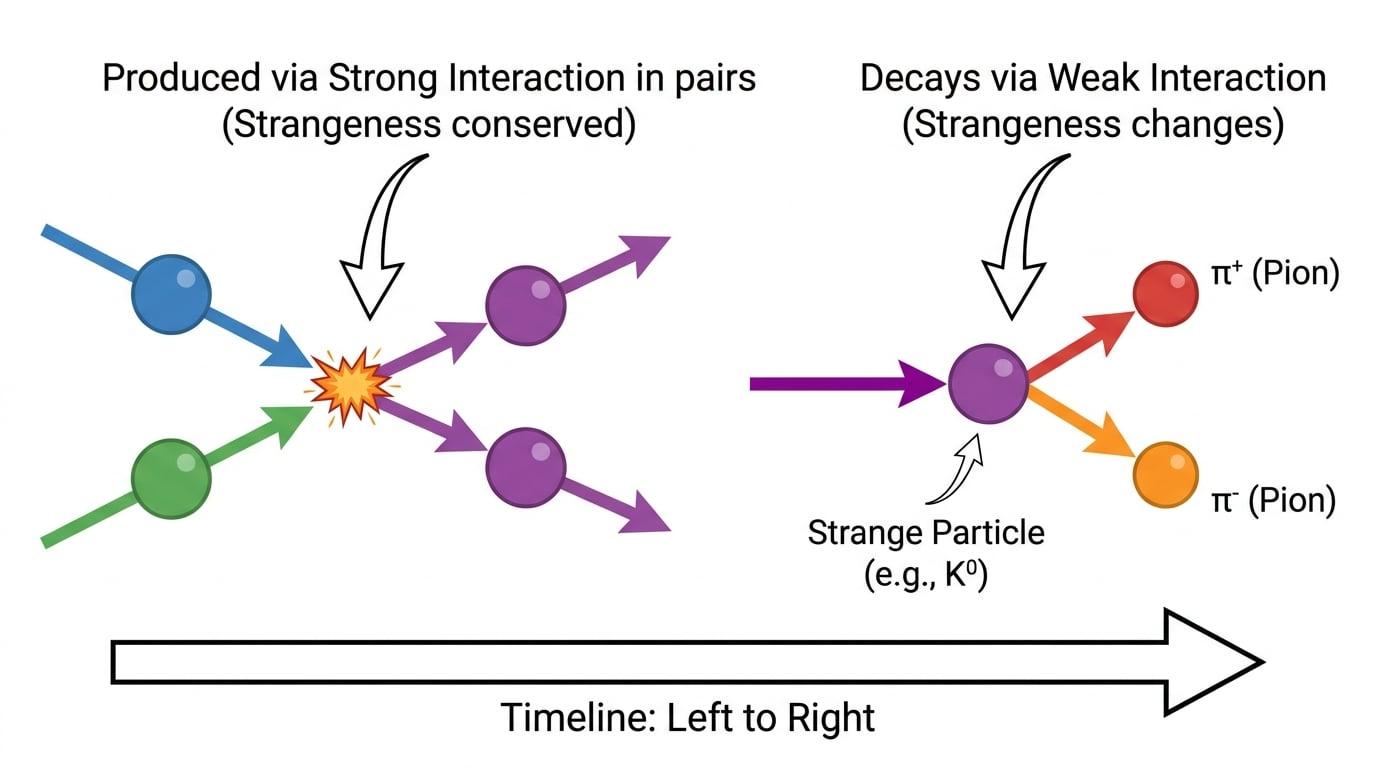
In the mid-20th century, scientists studying cosmic ray showers in cloud chambers noticed a new particle. It was produced very quickly in high-energy collisions, but it decayed much more slowly than expected. Because of this unexpectedly long lifespan, physicists named them strange particles. The kaon (KKK) is the classic example of a strange particle.
We now understand why they act this way, and it involves two different fundamental forces:
- Strange particles are produced through the strong interaction.
- Strange particles decay through the weak interaction.
The Strangeness Quantum Number (sss)
To explain this behaviour, physicists invented a new quantum number called strangeness (sss).
The rule is that the strong interaction conserves strangeness, but the weak interaction does not.
Because normal matter (like protons and neutrons) has a strangeness of 0, creating strange particles via the strong interaction means the total strangeness must remain 0. The only way to do this is to create strange particles in pairs—one particle with a positive strangeness, and one with a negative strangeness.
When a strange particle eventually decays, it has to do so via the weak interaction. In a weak interaction, strangeness can change by 0, +1 or -1.
Strangeness Conservation in Particle Production
A negative pion (π−\pi^-π−) collides with a proton (ppp) via the strong interaction to produce a neutral kaon (K0K^0K0) and a Lambda particle (Λ0\Lambda^0Λ0).
π−+p→K0+Λ0 \begin{aligned} \pi^- + p \to K^0 + \Lambda^0 \end{aligned} π−+p→K0+Λ0Pions and protons are not strange particles. The K0K^0K0 has a strangeness s=+1s = +1s=+1. Determine the strangeness of the Λ0\Lambda^0Λ0 particle.
- Identify the interaction type. The question states this is a production via the strong interaction, meaning strangeness must be perfectly conserved.
- Calculate the total strangeness on the LHS. Neither the pion nor the proton is strange, so:
- Set up the RHS equation. The K0K^0K0 has s=+1s = +1s=+1. Let the strangeness of the Λ0\Lambda^0Λ0 be sΛs_\LambdasΛ.
- Equate LHS and RHS to find sΛs_\LambdasΛ:
- The Lambda particle has a strangeness of -1. (This illustrates that strange particles are created in pairs to conserve overall strangeness!)
Confusing the forces in Strangeness
A very common exam error is forgetting which force does what. Remember:
- Strong = Fast = Production = Conserves strangeness.
- Weak = Slow = Decay = Does not conserve strangeness.
Big Science and Collaboration
Particle physics today isn't done by a single scientist looking through a microscope. Studying these interactions requires accelerating particles to enormous speeds and colliding them, simulating the high-energy environments of cosmic rays.
Facilities like CERN require the collaborative efforts of large teams of scientists and engineers. Building a 27 km particle accelerator (the Large Hadron Collider) and processing the petabytes of data it generates is impossible for one person. Teams from all over the world must peer-review data, validate computer simulations, and confirm findings before new knowledge is accepted by the scientific community.
In the exam
- When asked to check if a reaction is possible, always check Charge (QQQ), Baryon number (BBB), and Lepton number (LLL) (checking LeL_eLe and LμL_\muLμ separately). If any of these are not conserved, the reaction is impossible.
- If asked what the exchange particle for the strong nuclear force is, answer pion. If asked what a kaon decays into, answer pions. If asked what a muon decays into, answer an electron (plus neutrinos).
- If an exam question mentions a particle with an unusually long lifetime, or mentions particles created in pairs, you should immediately think of strange particles and the strangeness quantum number.
Check yourself
- What is the fundamental difference between a hadron and a lepton?
- What is the only stable baryon?
- Why must you check electron lepton number and muon lepton number separately?
- Which fundamental force is responsible for the production of strange particles, and which is responsible for their decay?