

Welcome to the world inside the nucleus! By now, you know that protons and neutrons are not the smallest particles in the universe. In this section, you'll learn exactly what they are made of.
What you'll learn:
- The properties of the three lightest quarks: up, down, and strange.
- How quarks combine to build baryons (like protons) and mesons (like pions and kaons).
- What happens to quarks during the radioactive decay of a neutron.
Meet the Quarks
In particle physics, we divide particles into two main groups: hadrons (which feel the strong nuclear force) and leptons (which don't). While leptons, like the electron, are fundamental, hadrons are not. They are made of smaller building blocks called quarks.
Fundamental particle
A fundamental particle is a particle that has no internal structure; it cannot be broken down into anything smaller. Quarks and leptons are fundamental, but protons and neutrons are not.
There are six types (or "flavours") of quarks in total, but for AQA A-Level Physics, you only need to know about three: up (uuu), down (ddd), and strange (sss).
Each quark has three important properties that you must memorize: charge (measured relative to the elementary charge, eee), baryon number, and strangeness.
| Quark | Symbol | Charge / e | Baryon number | Strangeness |
|---|---|---|---|---|
| Up | u | +2/3 | +1/3 | 0 |
| Down | d | -1/3 | +1/3 | 0 |
| Strange | s | -1/3 | +1/3 | -1 |
Notice that quarks are the only particles you will ever meet that have fractional charges. You will never find a single quark floating around on its own to display this fractional charge; they are always trapped inside hadrons in combinations that result in whole-number charges.
Antiquarks
Just like every particle has an antiparticle, every quark has an antiquark. Antiquarks have the exact same mass as their corresponding quarks, but all their other properties (charge, baryon number, and strangeness) are reversed in sign. We write them with a line over the letter (e.g., anti-up is uˉ\bar{u}uˉ).
| Antiquark | Symbol | Charge / e | Baryon number | Strangeness |
|---|---|---|---|---|
| Anti-up | anti-u | -2/3 | -1/3 | 0 |
| Anti-down | anti-d | +1/3 | -1/3 | 0 |
| Anti-strange | anti-s | +1/3 | -1/3 | +1 |
Strangeness of the strange quark
It is very easy to assume that the strange quark has a strangeness of +1+1+1. It does not! The strange quark (sss) has a strangeness of −1-1−1. It is the anti-strange quark (sˉ\bar{s}sˉ) that has a strangeness of +1+1+1.
Building Baryons
Hadrons are split into two families based on their quark structure: baryons and mesons.
Quark combinations
- Baryons are always made of exactly three quarks (qqqqqqqqq).
- Antibaryons are always made of exactly three antiquarks (qˉqˉqˉ\bar{q}\bar{q}\bar{q}qˉqˉqˉ).
- Mesons are always made of a quark and an antiquark pair (qqˉq\bar{q}qqˉ).
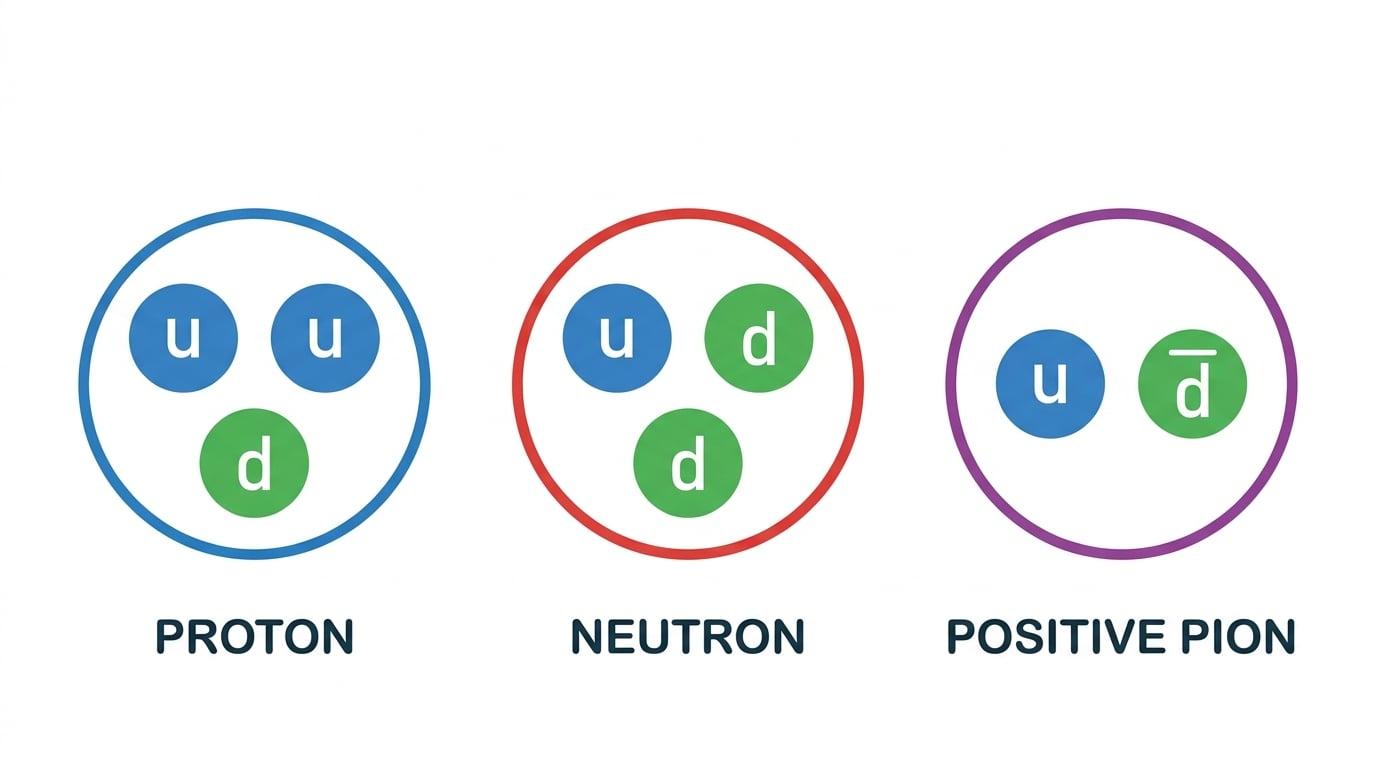
Let's look at the only two baryons you need to know the structure of: the proton and the neutron.
The Proton: The proton is made of two up quarks and one down quark (uuduuduud). Let's check the properties to prove this works:
- Charge: (+23)+(+23)+(−13)=+1(+\frac{2}{3}) + (+\frac{2}{3}) + (-\frac{1}{3}) = +1(+32)+(+32)+(−31)=+1
- Baryon number: (+13)+(+13)+(+13)=+1(+\frac{1}{3}) + (+\frac{1}{3}) + (+\frac{1}{3}) = +1(+31)+(+31)+(+31)=+1
The Neutron: The neutron is made of one up quark and two down quarks (udduddudd).
- Charge: (+23)+(−13)+(−13)=0(+\frac{2}{3}) + (-\frac{1}{3}) + (-\frac{1}{3}) = 0(+32)+(−31)+(−31)=0
- Baryon number: (+13)+(+13)+(+13)=+1(+\frac{1}{3}) + (+\frac{1}{3}) + (+\frac{1}{3}) = +1(+31)+(+31)+(+31)=+1
Deducing the quark structure of an antiproton
What is the quark structure of an antiproton, and what is its charge?
- Identify that an antiproton is an antibaryon, meaning it must be made of three antiquarks.
- Recall the structure of a normal proton: it is uuduuduud.
- Replace every quark with its corresponding antiquark to find the antiproton structure: uˉuˉdˉ\bar{u}\bar{u}\bar{d}uˉuˉdˉ.
- Calculate the charge by adding the charges of the individual antiquarks:
- State the final answer: The structure is uˉuˉdˉ\bar{u}\bar{u}\bar{d}uˉuˉdˉ and the charge is −1e-1e−1e.
Building Mesons
Mesons are hadrons consisting of a quark-antiquark pair. Because a quark has a baryon number of +13+\frac{1}{3}+31 and an antiquark has −13-\frac{1}{3}−31, all mesons have a total baryon number of 000.
You need to know two families of mesons: Pions (π\piπ) and Kaons (KKK).
Pions
Pions are the lightest mesons. They contain only up and down quarks/antiquarks, meaning they have a strangeness of 000.
- π+\pi^+π+ (Positive Pion): Must have a charge of +1+1+1. Made of udˉu\bar{d}udˉ. Charge = (+23)+(+13)=+1(+\frac{2}{3}) + (+\frac{1}{3}) = +1(+32)+(+31)=+1.
- π−\pi^-π− (Negative Pion): Must have a charge of −1-1−1. Made of duˉd\bar{u}duˉ. Charge = (−13)+(−23)=−1(-\frac{1}{3}) + (-\frac{2}{3}) = -1(−31)+(−32)=−1.
- π0\pi^0π0 (Neutral Pion): Must have a charge of 000. Can be uuˉu\bar{u}uuˉ or ddˉd\bar{d}ddˉ.
Kaons
Kaons are heavier and, crucially, they possess strangeness. This means every kaon must contain either a strange quark or an anti-strange quark.
Finding meson structures
Don't memorize all the meson structures blindly! Just remember their charge and strangeness, then use a process of elimination. If a meson has strangeness +1+1+1, it must contain an sˉ\bar{s}sˉ antiquark. If its total charge is 000, the other quark must perfectly cancel the sˉ\bar{s}sˉ charge.
Deducing the structure of a K-minus meson
Determine the quark structure of the K−K^-K− meson. The K−K^-K− has a strangeness of −1-1−1 and a charge of −1-1−1.
- Look at the strangeness. A strangeness of −1-1−1 means the meson must contain a strange quark (sss), not an anti-strange quark.
- Check the charge of the strange quark: the sss quark has a charge of −13-\frac{1}{3}−31.
- We need a total charge of −1-1−1. Let the charge of the unknown antiquark be xxx.
- Identify which antiquark has a charge of −23-\frac{2}{3}−32. Looking at our table, it is the anti-up quark (uˉ\bar{u}uˉ).
- Combine them: The structure of the K−K^-K− is suˉs\bar{u}suˉ.
Following this logic, you can figure out the others:
- K+K^+K+: Strangeness +1+1+1, charge +1+1+1. Must be usˉu\bar{s}usˉ.
- K0K^0K0: Strangeness +1+1+1, charge 000. Must be dsˉd\bar{s}dsˉ.
- Kˉ0\bar{K}^0Kˉ0: Strangeness −1-1−1, charge 000. Must be sdˉs\bar{d}sdˉ.
Neutron Decay (Beta-minus decay)
You have previously learned about beta-minus (β−\beta^-β−) decay, where a neutron in an unstable nucleus turns into a proton, emitting an electron (e−e^-e−) and an electron antineutrino (νˉe\bar{\nu}_eνˉe).
Now that we know neutrons and protons are made of quarks, we can look "under the hood" to see what is actually happening.
The neutron (udduddudd) turns into a proton (uuduuduud). Two of the quarks are identical before and after. The only real change is that a down quark has turned into an up quark.
We can write the quark-level equation for beta-minus decay as:
d→u+e−+νˉe d \to u + e^- + \bar{\nu}_e d→u+e−+νˉe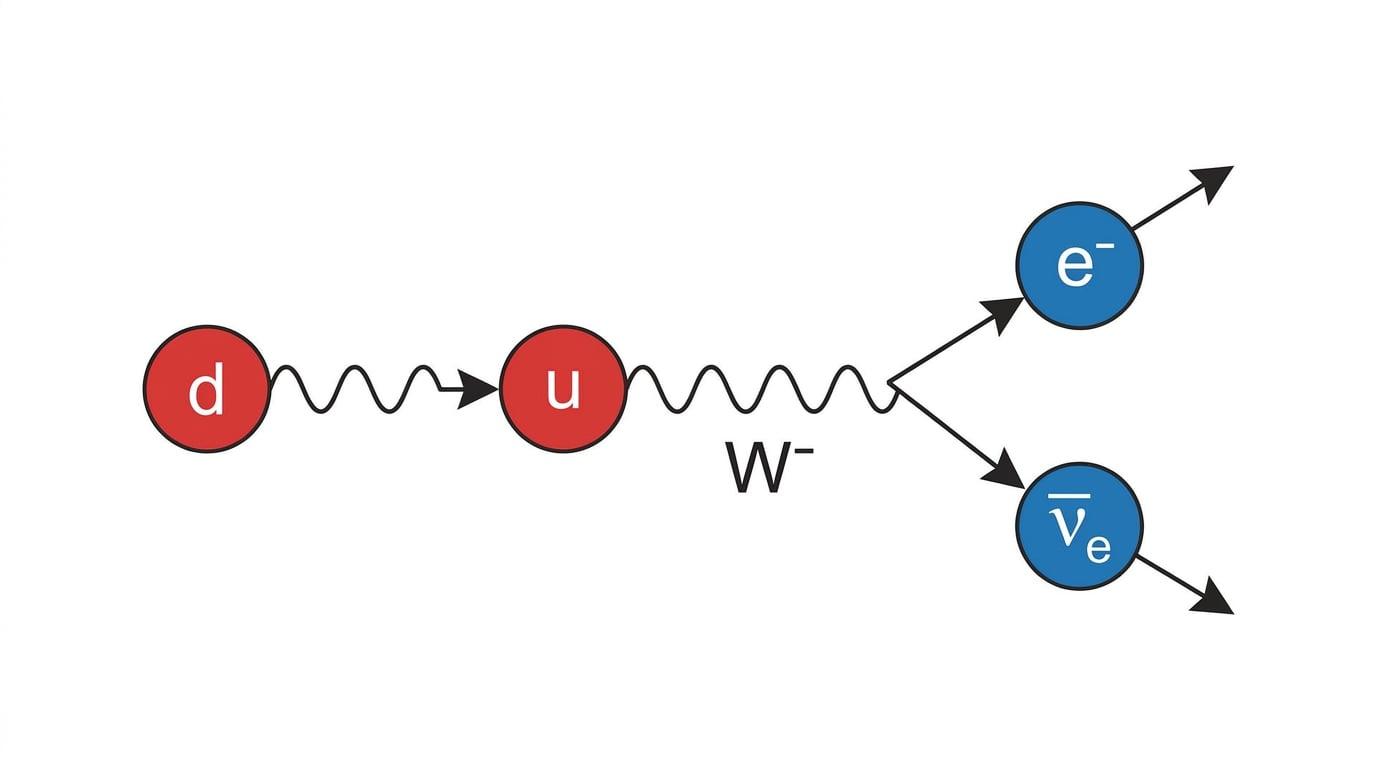
In beta-plus (β+\beta^+β+) decay, the opposite happens: a proton turns into a neutron, meaning an up quark turns into a down quark.
u→d+e++νe u \to d + e^+ + \nu_e u→d+e++νeWhenever weak interactions (like beta decay) happen, quark flavour changes. This is the only fundamental force capable of changing one type of quark into another!
Conserving properties in beta-minus decay
Show mathematically that electric charge is conserved in the quark-level beta-minus decay equation: d→u+e−+νˉed \to u + e^- + \bar{\nu}_ed→u+e−+νˉe.
- Identify the charge of the particle on the left-hand side. The down quark (ddd) has a charge of −13e-\frac{1}{3}e−31e.
- Identify the charges of the particles on the right-hand side.
- Up quark (uuu) = +23e+\frac{2}{3}e+32e
- Electron (e−e^-e−) = −1e-1e−1e
- Electron antineutrino (νˉe\bar{\nu}_eνˉe) = 000 (neutrinos are neutral).
- Sum the charges on the right-hand side:
- Compare both sides. Since −13e=−13e-\frac{1}{3}e = -\frac{1}{3}e−31e=−31e, charge is perfectly conserved during the decay.
In the exam
- Don't panic if you forget the tables: The charges, baryon numbers, and strangeness of the uuu, ddd, and sss quarks are provided on the AQA Physics data sheet! Your job is knowing how to combine them.
- Double-check the bar: When writing an antiquark, make sure the line over the letter is completely clear. A messy dˉ\bar{d}dˉ that looks like a ddd will lose you the mark.
- Prove your answers: If a question asks "Show that the quark composition of a proton is uuduuduud", write out the individual fractions for charge and baryon number and show them adding up to 111. Don't just write "it works".
- Neutrino vs Antineutrino: In beta-minus decay (d→ud \to ud→u), an antineutrino is emitted. In beta-plus decay (u→du \to du→d), a normal neutrino is emitted.
Check yourself
- Can you state the quark composition of a proton and a neutron?
- Can you explain why a meson can never have a baryon number of 111 or −1-1−1?
- If a strange particle has a strangeness of +1+1+1, does it contain a strange quark or an anti-strange quark?
- What specific quark change is responsible for beta-plus decay?
