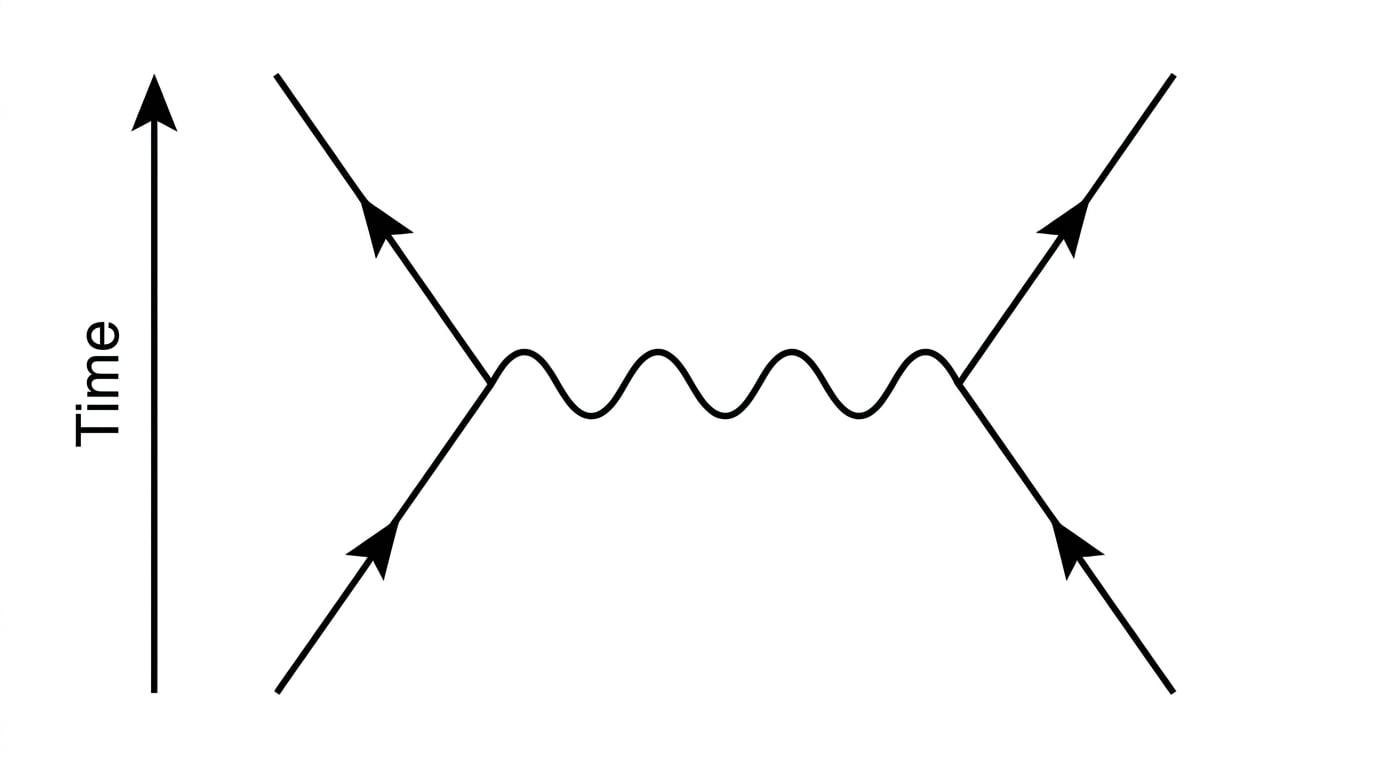
Example: Electromagnetic repulsion
If two electrons approach each other, they exchange a virtual photon and bounce away. The diagram would look exactly like the structure above: two e−e^-e− lines entering from the bottom, a wavy γ\gammaγ line connecting them, and two e−e^-e− lines exiting at the top. Because the photon has no charge, the electrons remain electrons.
Weak interactions you MUST memorise
The weak interaction is special because it can change one type of particle into another. You are required to know four specific weak interactions, their equations, and their Feynman diagrams.
1. β−\beta^-β− decay (Beta minus)
A neutron in a nucleus decays into a proton, an electron, and an electron antineutrino. Equation: n→p+e−+νˉen \to p + e^- + \bar{\nu}_en→p+e−+νˉe Exchange particle: W−W^-W−
How to draw it: A straight line for a neutron (nnn) enters from the bottom. It turns into a proton (ppp) line continuing upwards. At the turning point, a wavy line carrying W−W^-W− shoots off to the right. The W−W^-W− then splits into an electron (e−e^-e−) and an antineutrino (νˉe\bar{\nu}_eνˉe).
2. β+\beta^+β+ decay (Beta plus)
A proton in a nucleus decays into a neutron, a positron, and an electron neutrino. Equation: p→n+e++νep \to n + e^+ + \nu_ep→n+e++νe Exchange particle: W+W^+W+
How to draw it: A proton (ppp) enters from the bottom and becomes a neutron (nnn). It emits a W+W^+W+ to the right, which then decays into a positron (e+e^+e+) and a neutrino (νe\nu_eνe).
Balancing Charge at Nodes
You can always figure out if it's a W+W^+W+ or W−W^-W− by looking at the charge before and after a node. In β−\beta^-β− decay, a neutral neutron (charge 0) becomes a positive proton (charge +1). To balance this, it must emit something with a -1 charge. So, 0→+1+−10 \to +1 + -10→+1+−1. That means the exchange particle must be the W−W^-W−.
3. Electron capture
Sometimes, a proton-rich nucleus will "reach out" and capture one of its own inner-shell electrons. The proton interacts with the electron to form a neutron and a neutrino. Equation: p+e−→n+νep + e^- \to n + \nu_ep+e−→n+νe Exchange particle: W+W^+W+
How to draw it: A proton and an electron both enter from the bottom. The proton "acts" first, emitting a W+W^+W+ which travels across to hit the electron line. The proton becomes a neutron, and the electron absorbs the W+W^+W+ to become a neutrino.
4. Electron-proton collision
This has the exact same start and end particles as electron capture, but it happens when a high-speed electron is fired at a proton from the outside. Equation: p+e−→n+νep + e^- \to n + \nu_ep+e−→n+νe Exchange particle: W−W^-W−
How to draw it: Because the electron is the fast incoming particle, it "acts" first. The electron emits a W−W^-W− which travels across to hit the proton. The electron becomes a neutrino, and the proton absorbs the W−W^-W− to become a neutron.
Electron capture vs Collision
Students frequently lose marks by confusing the Feynman diagrams for electron capture and electron-proton collisions. For electron capture, the W+W^+W+ goes from the proton to the electron. For a collision, the W−W^-W− goes from the electron to the proton. Always check your arrows on the wavy line!
Determining the exchange particle in an interaction
A student is trying to draw the Feynman diagram for an electron-proton collision, where an electron collides with a proton. How can they prove the exchange particle must be a W−W^-W−?
- Identify the starting particles and which one acts first. In a collision, the external electron acts first, so the first node will be on the electron's line.
- Write the change happening at the electron's node: e−→νe+exchange particlee^- \to \nu_e + \text{exchange particle}e−→νe+exchange particle.
- Check the charge on both sides of this node. The electron has a charge of −1-1−1. The neutrino has a charge of 000.
- Balance the charge: −1=0+q-1 = 0 + q−1=0+q. Therefore, the charge qqq of the exchange particle must be −1-1−1.
- The weak exchange particle with a −1-1−1 charge is the W−W^-W−.
Time axis labels
In the exam, always label your axes on a Feynman diagram if they aren't already drawn for you. Drawing a quick arrow labelled "Time" up the y-axis tells the examiner exactly how to read your incoming and outgoing lines.
In the exam
When tackling particle interaction questions, keep these steps in mind:
- Identify the force involved. If particles change type (e.g., proton to neutron), it's the weak interaction. If they just deflect each other, it's usually electromagnetic.
- If drawing a diagram, ensure all particles have an arrow head indicating their forward movement in time.
- Wavy lines must be used for the exchange particle. A straight line for a WWW boson will lose marks.
- Always label the wavy line with the exact exchange particle, including its charge symbol (W+W^+W+ or W−W^-W−, not just WWW).
- Double-check your charge conservation at every single junction in your diagram.
Check yourself
- What is the exchange particle for the electromagnetic interaction?
- Why do we use W+W^+W+ and W−W^-W− bosons instead of virtual photons for beta decay?
- In electron capture, does the exchange particle travel from the proton to the electron, or the electron to the proton?
- What three things must be conserved at every node in a Feynman diagram?