Absolute magnitude, M (A-level only)
Welcome to the world of stellar classification! In the previous topics, you learned about apparent magnitude—how bright a star looks from Earth. But looks can be deceiving. In this note, we will level the playing field and figure out how bright stars actually are.
What you'll learn:
- The standard units astronomers use for massive distances: the light year and the parsec.
- Why apparent magnitude isn't enough to compare stars fairly.
- The definition of absolute magnitude (MMM) and the 10-parsec rule.
- How to use the distance modulus equation to calculate astronomical distances.
Astronomical Distances: The ly and the pc
Space is unimaginably vast. Measuring the distance to a star in metres (or even kilometres) is like measuring the distance from London to New York in millimetres—the numbers just become too large to handle.
Astronomers use two main units for distance:
- The Light Year (ly): The distance that electromagnetic radiation travels in a vacuum in one year.
- The Parsec (pc): This is the unit preferred by professional astronomers (and by the AQA examiners for this topic).
The Parsec (pc)
A parsec is the distance from which a radius of 1 Astronomical Unit (AU) subtends an angle of 1 arcsecond.
For the purposes of stellar magnitudes, you just need to know it is a unit of distance, and that 1 pc≈3.26 ly1 \text{ pc} \approx 3.26 \text{ ly}1 pc≈3.26 ly.
The Problem with Apparent Magnitude (mmm)
Remember that apparent magnitude (mmm) is a measure of how bright a star appears to an observer on Earth. The Hipparcos scale works backwards: a lower number means a brighter star.
If Star A has m=1m = 1m=1 and Star B has m=5m = 5m=5, Star A looks much brighter in our night sky. But is Star A actually emitting more light? We have no idea!
- Star A might be a tiny, dim star that just happens to be right next door to our solar system.
- Star B might be a colossal, brilliant supergiant that is thousands of parsecs away.
To compare the true, intrinsic brightness (luminosity) of stars, we need a fair test. We need to measure them all from the same distance.
The Solution: Absolute Magnitude (MMM)
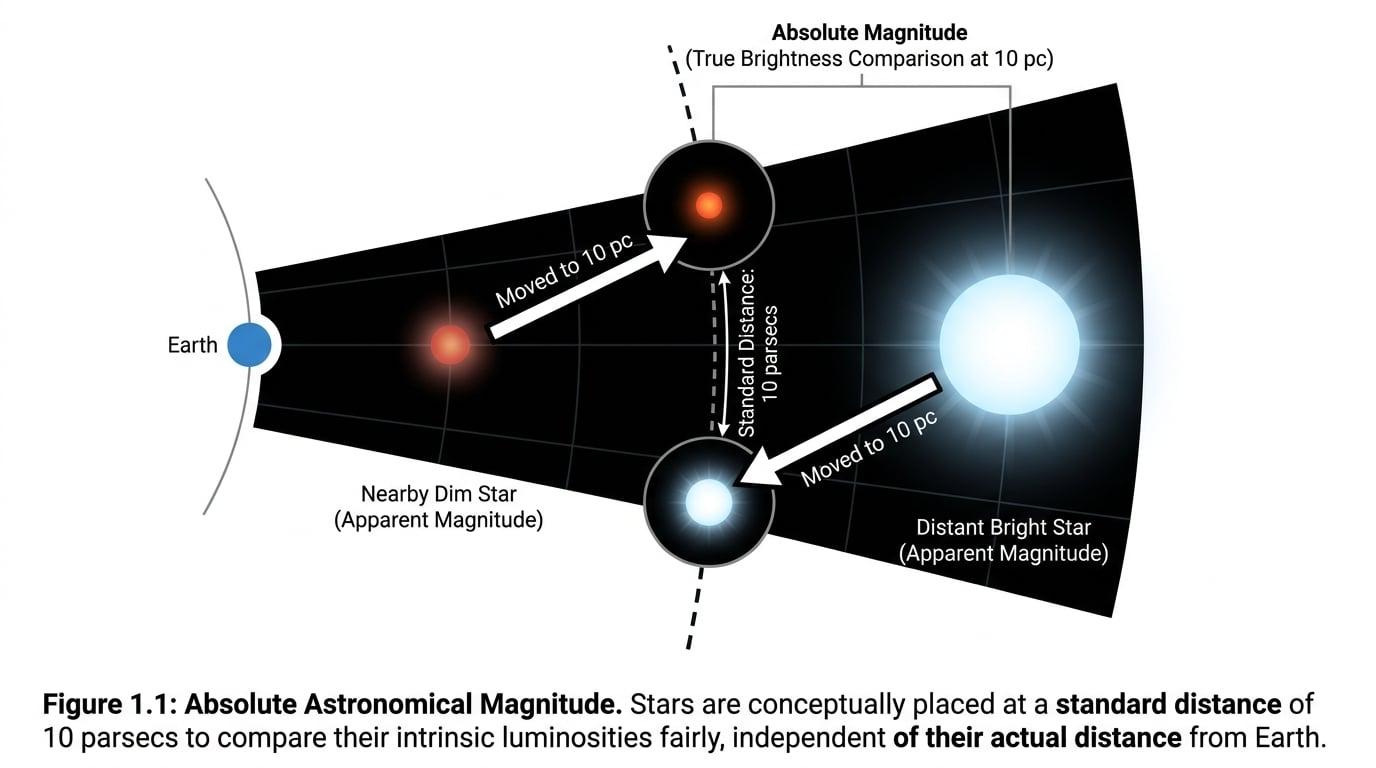
Imagine if we could magically pluck every star from the sky and place them all at exactly the same distance from Earth. If they were all lined up at this "standard distance", the star that looks the brightest would truly be the brightest.
Astronomers chose 10 parsecs as this standard distance.
Absolute Magnitude, M
The absolute magnitude (MMM) of a star is the apparent magnitude it would have if it were placed exactly 10 parsecs away from the observer.
Notice the notation: Lowercase mmm is for apparent (what we see). Uppercase MMM is for absolute (the true brightness).
Comparing m and M
- If m=Mm = Mm=M, the star is exactly 10 pc away.
- If m<Mm < Mm<M (meaning mmm is a lower, brighter number), the star looks brighter than it really is. It must be closer than 10 pc.
- If m>Mm > Mm>M (meaning mmm is a higher, dimmer number), the star looks dimmer than it really is. It must be further than 10 pc.
The Distance Modulus Equation
We can link apparent magnitude (mmm), absolute magnitude (MMM), and distance (ddd) mathematically. Because the magnitude scale is logarithmic (a difference of 1 magnitude corresponds to a brightness ratio of roughly 2.51), the equation linking them involves logarithms.
This is the distance modulus equation, and it is given on your AQA data sheet:
m−M=5log(d10) m - M = 5 \log \left( \frac{d}{10} \right) m−M=5log(10d)Where:
- mmm = apparent magnitude
- MMM = absolute magnitude
- ddd = distance to the star in parsecs (pc)
- log\loglog means the logarithm to base 10 (log10\log_{10}log10)
The term (m−M)(m - M)(m−M) is often called the distance modulus.
Watch your units!
The equation absolutely requires the distance ddd to be in parsecs. If an exam question gives you the distance in light years, you must convert it to parsecs first!
Since 1 pc≈3.26 ly1 \text{ pc} \approx 3.26 \text{ ly}1 pc≈3.26 ly, you divide the distance in light years by 3.263.263.26 to get parsecs.
Using the Equation: Finding MMM
Let's look at how AQA might test you on calculating the absolute magnitude of a known star.
Example 1: Calculating Absolute Magnitude
Sirius is the brightest star in our night sky, with an apparent magnitude of −1.46-1.46−1.46. It is located at a distance of 2.64 pc2.64 \text{ pc}2.64 pc from Earth. Calculate the absolute magnitude of Sirius.
- State the given values: m=−1.46m = -1.46m=−1.46 d=2.64 pcd = 2.64 \text{ pc}d=2.64 pc
- Write down the distance modulus equation:
- Rearrange to make MMM the subject: Subtract MMM from both sides and subtract the log term:
- Substitute the values and calculate:
Make sure you use log10\log_{10}log10 on your calculator!
M=−1.46−5(−0.578) M = -1.46 - 5 (-0.578) M=−1.46−5(−0.578) M=−1.46+2.89 M = -1.46 + 2.89 M=−1.46+2.89 M=1.43 M = 1.43 M=1.43Sirius has an absolute magnitude of +1.43+1.43+1.43. Notice that MMM is a higher number than mmm. This makes sense: Sirius is closer than 10 pc, so if we pushed it back to the 10 pc standard distance, it would look dimmer!
Using the Equation: Finding Distance
This is the most common way AQA tests this equation. You will be given mmm and MMM and asked to find how far away the star is. This requires you to carefully "undo" the base-10 logarithm.
Example 2: Calculating Distance
A star has an apparent magnitude of 5.05.05.0 and an absolute magnitude of −2.5-2.5−2.5. Calculate the distance to the star in parsecs.
- State the given values: m=5.0m = 5.0m=5.0 M=−2.5M = -2.5M=−2.5
- Substitute into the equation:
- Divide by 5:
- Remove the logarithm (inverse log): To undo log10\log_{10}log10, we raise 10 to the power of both sides:
- Multiply by 10 to find ddd:
Using the wrong log button
When rearranging to find ddd, many students accidentally use the exponential function exe^xex instead of 10x10^x10x. Remember, the equation uses log\loglog (base 10), not ln\lnln (natural log). To undo it, you must use 10x10^x10x.
In the exam
- Check the signs: Magnitudes can be negative (e.g. −1.46-1.46−1.46). When substituting into m−Mm - Mm−M, be extremely careful with double negatives, as in
5.0 - (-2.5). - Check the distance unit: If the question gives you ddd in light years, divide by 3.263.263.26 to get parsecs before putting it into the formula. If it asks for the final answer in light years, calculate ddd in parsecs first, then multiply by 3.263.263.26 at the very end.
- Use the sanity check: Look at your final answer. If d>10 pcd > 10 \text{ pc}d>10 pc, then the star must have a higher (more positive) apparent magnitude mmm than its absolute magnitude MMM. If d<10 pcd < 10 \text{ pc}d<10 pc, the reverse is true.
- Don't round too early: Keep the full values in your calculator during the logarithmic steps to avoid compounding rounding errors.
Check yourself
- What distance (in parsecs) is used as the standard reference distance for absolute magnitude?
- A star has m=4.2m = 4.2m=4.2 and M=4.2M = 4.2M=4.2. Without doing any calculations, what is the distance to the star?
- A star has m=1.0m = 1.0m=1.0 and M=−3.0M = -3.0M=−3.0. Is this star closer or further away than 10 parsecs?