Classification by luminosity (A-level only)
What you'll learn:
- The difference between subjective brightness and objective intensity.
- How the ancient Hipparcos scale formed the basis of modern stellar classification.
- Why apparent magnitude is a "backwards" logarithmic scale.
- How to calculate the exact ratio of intensity between two stars using their apparent magnitudes.
Brightness vs. Intensity
When you look up at the night sky, some stars clearly look more brilliant than others. In everyday language, we call this "brightness". However, in physics, we must be careful with our definitions, as different observers might perceive the exact same star differently.
Brightness vs Intensity
- Brightness is a subjective scale of measurement. It depends on how the human eye (or a specific camera sensor) perceives the light, which can vary based on the colour of the light or the observer's eyesight.
- Intensity is an objective measurement. It is the radiant power arriving per unit area at the observer, measured in watts per square metre (W m−2\text{W m}^{-2}W m−2).
Because brightness is subjective, astronomers need a standardized, numerical way to compare the intensity of light arriving at Earth. This brings us to the concept of apparent magnitude.
The Hipparcos Scale
Over two thousand years ago, the Greek astronomer Hipparchus catalogued the stars visible to the naked eye. He ranked them into six classes:
- Magnitude 1: The brightest stars in the sky.
- Magnitude 6: The dimmest stars he could just barely see.
This historical system is the foundation of the modern magnitude scale. Because Hipparchus was essentially ranking stars (1st place, 2nd place, etc.), the scale feels "backwards" to modern physicists: a smaller number means a brighter star.
The Limit of Naked Eye Vision
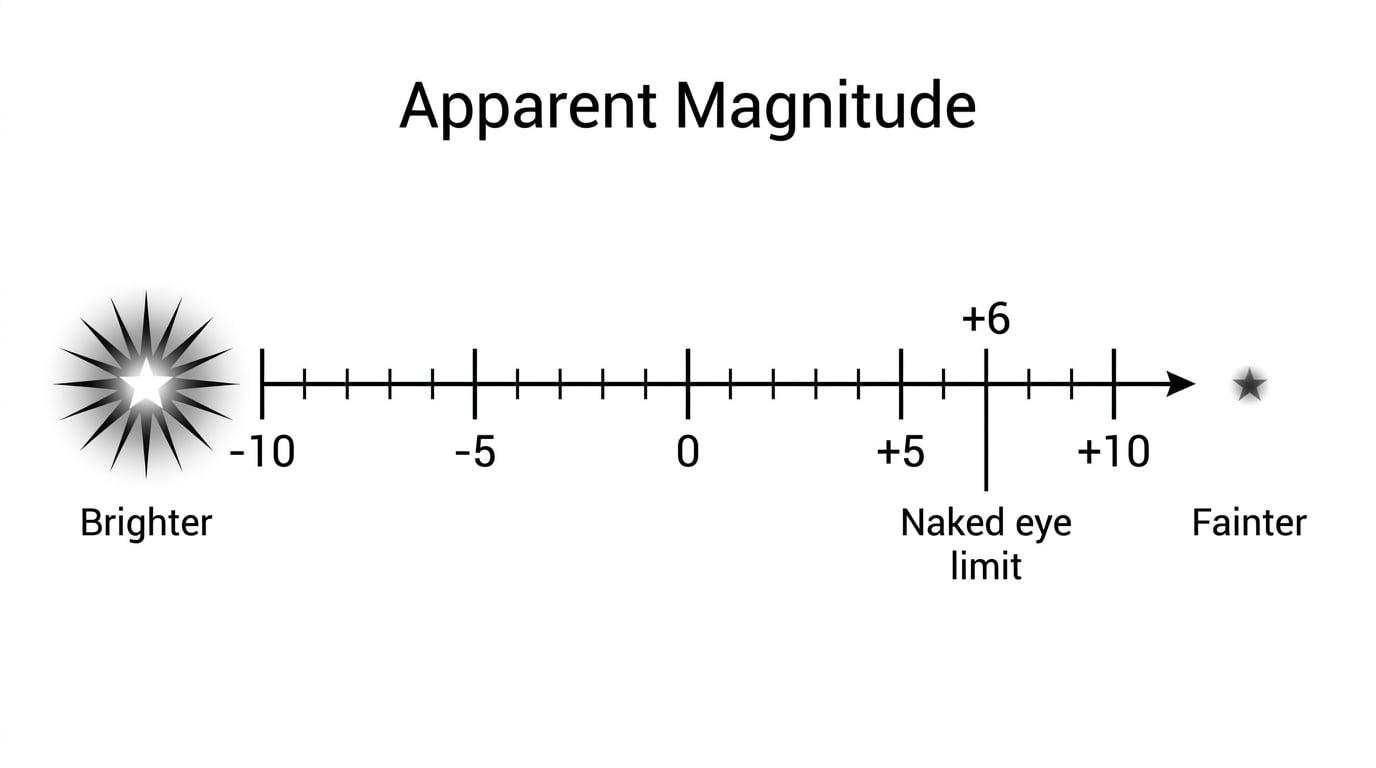
Under perfect, perfectly dark conditions, the dimmest visible stars to the naked human eye have a magnitude of 6. Anything with a magnitude greater than 6 requires binoculars or a telescope to see.
Apparent Magnitude, mmm
With the invention of telescopes and electronic sensors, astronomers realized they needed to expand the Hipparcos scale. They formalised it into the apparent magnitude scale, denoted by the lowercase letter mmm. Apparent magnitude describes how bright a star appears from Earth.
Modern apparent magnitude extends the scale in both directions:
- Negative numbers are used for objects brighter than magnitude 0. For example, Sirius, the brightest star in the night sky, has m≈−1.5m \approx -1.5m≈−1.5. The Sun is overwhelmingly bright from Earth, with m≈−26.7m \approx -26.7m≈−26.7.
- Large positive numbers are used for extremely faint objects. The Hubble and James Webb Space Telescopes can detect galaxies with an apparent magnitude of +30+30+30 or more!
Getting the scale backwards
It is incredibly easy to see a magnitude of +5+5+5 and think it is brighter than a magnitude of +1+1+1. Always remind yourself: it is a ranking system. First place is better (brighter) than fifth place. Negative numbers are the brightest of all!
The Mathematics of the Magnitude Scale
When astronomers formalised the Hipparcos scale, they discovered that human vision is roughly logarithmic. What Hipparchus perceived as equal steps in brightness were actually equal multipliers of intensity.
They defined the modern scale such that a difference of exactly 5 on the magnitude scale corresponds to exactly a factor of 100 in intensity.
Since 5 steps equal a factor of 100, a single step of 1 on the magnitude scale corresponds to an intensity ratio of 1005\sqrt[5]{100}5100.
1005≈2.512 \sqrt[5]{100} \approx 2.512 5100≈2.512The 2.51 Ratio
A difference of 111 on the magnitude scale is equal to an intensity ratio of roughly 2.512.512.51.
If Star A is 1 magnitude lower (brighter) than Star B, Star A is 2.512.512.51 times more intense.
Calculating Intensity Ratios
To find out exactly how many times brighter one star is compared to another, we compare their apparent magnitudes. The ratio of their intensities, I1I2\frac{I_1}{I_2}I2I1, where I1I_1I1 is the brighter star, can be found using:
I1I2=2.51Δm \frac{I_1}{I_2} = 2.51^{\Delta m} I2I1=2.51ΔmHere, Δm\Delta mΔm is the positive difference between the two apparent magnitudes (Δm=m2−m1\Delta m = m_2 - m_1Δm=m2−m1).
Calculating intensity from magnitudes
The star Aldebaran has an apparent magnitude of 0.850.850.85. The star Polaris has an apparent magnitude of 1.971.971.97. Calculate how many times more intense the light reaching Earth from Aldebaran is compared to Polaris.
- Identify which star is brighter to ensure you set the ratio up correctly. Aldebaran has a smaller apparent magnitude (0.85<1.970.85 < 1.970.85<1.97), so Aldebaran is the brighter star.
- Calculate the positive magnitude difference, Δm\Delta mΔm.
- Use the intensity ratio formula with the base of 2.512.512.51.
- Calculate the final value.
Therefore, the intensity of Aldebaran is 2.82.82.8 times greater than that of Polaris.
Sometimes, an AQA question will give you the intensity ratio and ask you to work backwards to find the magnitude of a star. You can use logarithms for this, or simply use trial and improvement on your calculator if you forget the log rules.
Working backwards to find magnitude
Star X has an apparent magnitude of 4.04.04.0. Star Y is 404040 times more intense than Star X. Calculate the apparent magnitude of Star Y.
- Recognise that because Star Y is more intense, its apparent magnitude must be a smaller number than Star X.
- Set up the intensity ratio formula, where Δm\Delta mΔm is the difference in magnitude.
- Take the logarithm of both sides to solve for Δm\Delta mΔm.
- Rearrange and calculate Δm\Delta mΔm.
- Apply the difference to Star X's magnitude. Since Star Y is brighter, we subtract the difference.
The apparent magnitude of Star Y is 0.00.00.0.
Quick sanity checks
If you are in an exam and a star is roughly 2.52.52.5 times brighter, its magnitude drops by 111. If it's roughly 666 times brighter (2.5122.51^22.512), it drops by 222. If it's roughly 161616 times brighter (2.5132.51^32.513), it drops by 333. And if it's exactly 100100100 times brighter, it drops by exactly 555! Keeping these anchors in your head helps spot calculation errors.
In the exam
- AQA almost always uses the rounded value of 2.512.512.51. Use 2.512.512.51 in your calculations rather than 2.5122.5122.512 or the exact 5th root of 100, unless the question specifically guides you otherwise.
- Watch out for negative numbers when calculating Δm\Delta mΔm. The difference between m=−1m = -1m=−1 and m=3m = 3m=3 is 444, not 222! A simple number line sketch on your exam paper can prevent this.
- Always do a "common sense" check at the end of a magnitude calculation. Ask yourself: "Did the star get brighter? Then the magnitude number should have gone down."
Check yourself
- Can you explain why brightness is considered subjective but intensity is objective?
- What is the apparent magnitude of the dimmest star visible to the naked human eye?
- If Star P has m=2m = 2m=2 and Star Q has m=−3m = -3m=−3, which star appears brighter from Earth, and by exactly how many magnitudes?
- Without a calculator, roughly how many times more intense is a star of magnitude 1 compared to a star of magnitude 6?