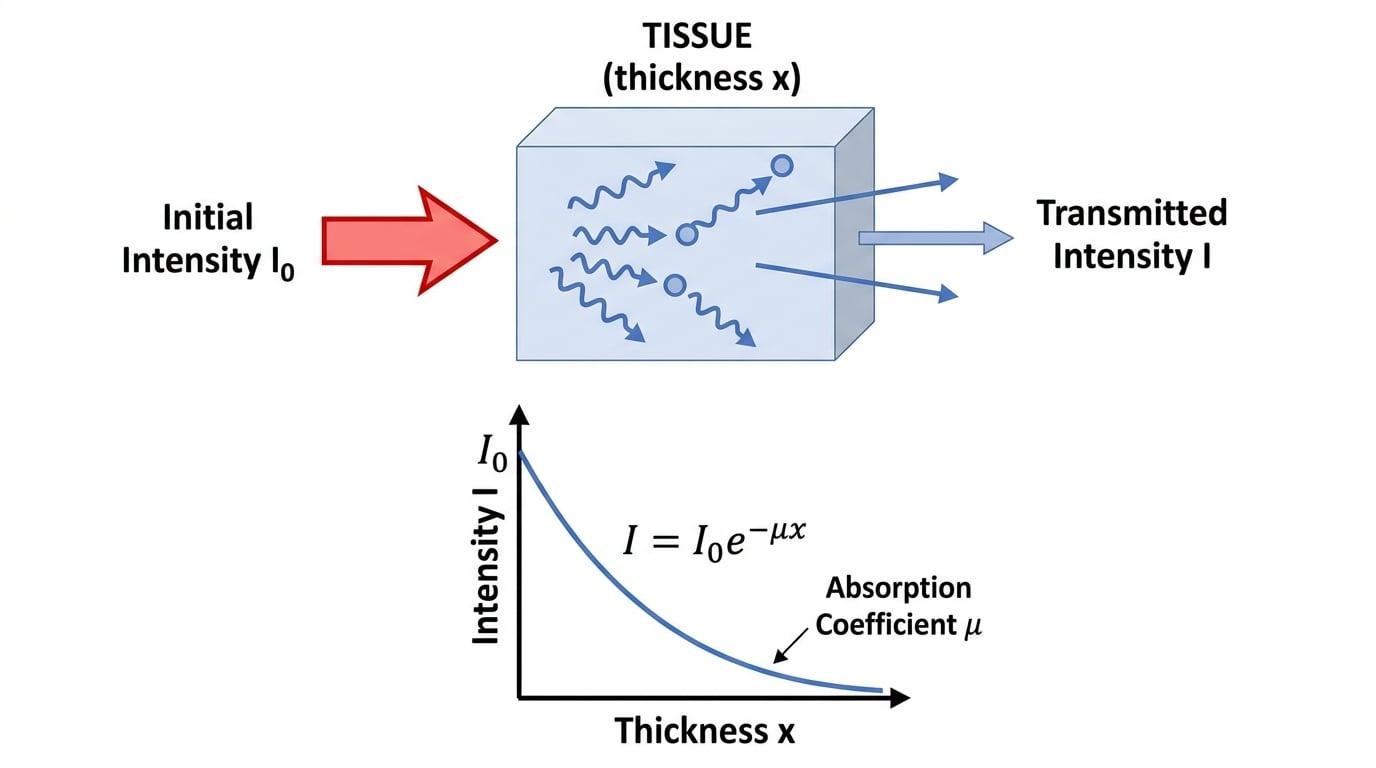
Welcome to the physics of medical imaging! When you look at an X-ray scan, you are looking at shadows. To understand how these shadows are formed, we need to look at how X-rays are absorbed as they travel through the body.
In this topic, you will learn:
- What "exponential attenuation" means.
- How to calculate the reduction in X-ray intensity using the linear and mass attenuation coefficients.
- How to calculate the half-value thickness of a material.
- Why different tissues (like bone and muscle) absorb X-rays differently, allowing us to see inside the body.
Exponential Attenuation
When a beam of X-rays passes through matter, some X-ray photons pass straight through, but many are absorbed or scattered by the atoms in the material. This reduction in the energy of the beam is called attenuation.
Intensity
Intensity (III) is the power per unit area of the X-ray beam, measured in watts per square metre (W m−2\text{W m}^{-2}W m−2).
X-ray attenuation is a random process, much like radioactive decay. In any given tiny slice of material, a constant fraction of the remaining X-ray photons will be absorbed. Because the rate of absorption is proportional to the current intensity, the intensity of the X-ray beam decays exponentially as it travels deeper into the material.
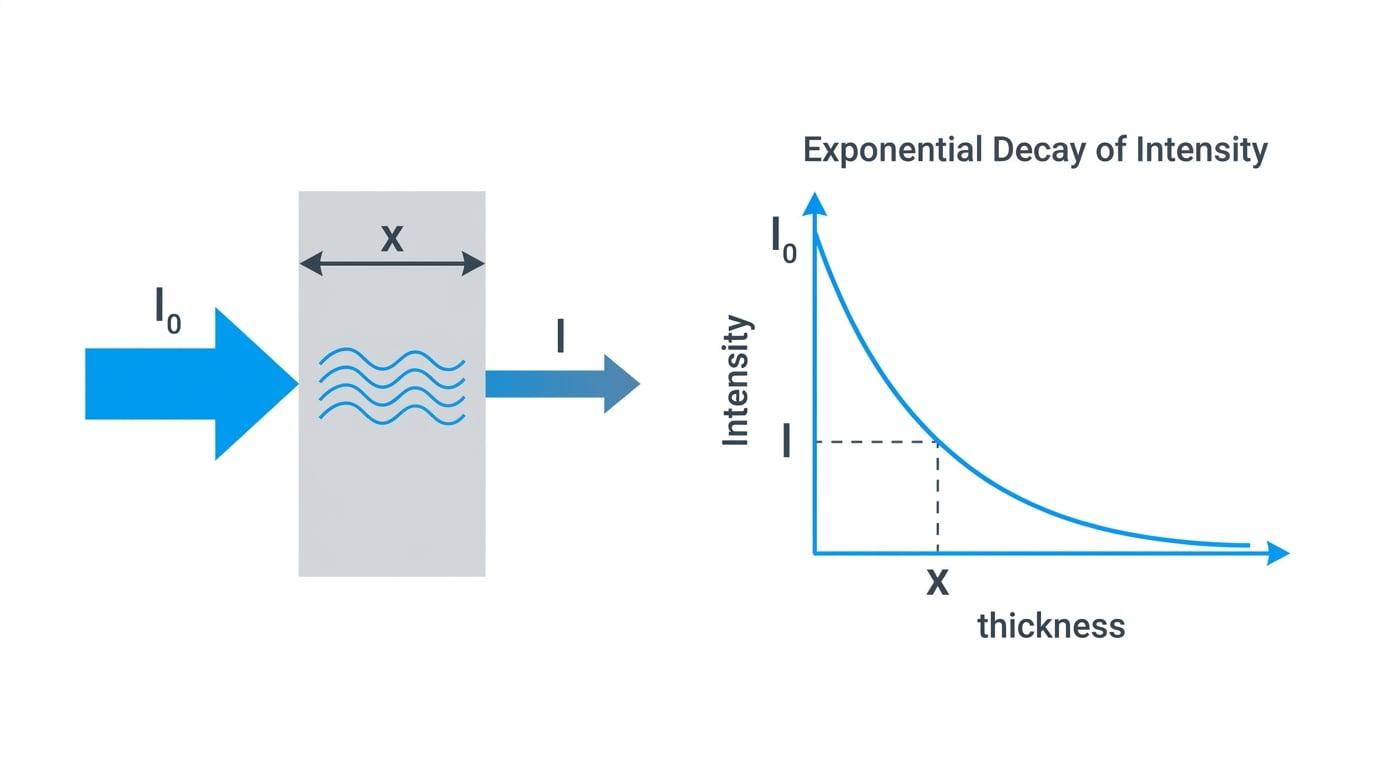
The Attenuation Equation
The exponential decay of X-ray intensity is described by the following formula:
I=I0e−μx I = I_0 e^{-\mu x} I=I0e−μxWhere:
- III is the transmitted intensity of the beam.
- I0I_0I0 is the initial intensity of the beam before it enters the material.
- μ\muμ is the linear attenuation coefficient of the material.
- xxx is the thickness of the material the beam has passed through.
Linear Attenuation Coefficient ()
The linear attenuation coefficient represents the fraction of X-rays absorbed per unit thickness of a specific material. Its SI unit is m−1\text{m}^{-1}m−1 (though you will often see it in mm−1\text{mm}^{-1}mm−1 or cm−1\text{cm}^{-1}cm−1).
Mismatched Units
The product μx\mu xμx in the exponent must be dimensionless (it cannot have any units). If the thickness xxx is given in centimetres (cm\text{cm}cm), your linear attenuation coefficient μ\muμ must be in cm−1\text{cm}^{-1}cm−1. Always check they match before pressing buttons on your calculator!
Calculating transmitted intensity
An X-ray beam with an initial intensity of 450 W m−2450 \text{ W m}^{-2}450 W m−2 passes through 15 mm15 \text{ mm}15 mm of soft tissue. The linear attenuation coefficient of the tissue is 0.030 mm−10.030 \text{ mm}^{-1}0.030 mm−1. Calculate the intensity of the transmitted beam.
- Identify the known values: I0=450 W m−2I_0 = 450 \text{ W m}^{-2}I0=450 W m−2 μ=0.030 mm−1\mu = 0.030 \text{ mm}^{-1}μ=0.030 mm−1 x=15 mmx = 15 \text{ mm}x=15 mm
- Check the units of μ\muμ and xxx match. Both are in millimetres, so we can use them directly.
- Substitute the values into the attenuation equation:
- Calculate the exponent first: −(0.030×15)=−0.45-(0.030 \times 15) = -0.45−(0.030×15)=−0.45
- Find the final intensity:
Half-Value Thickness
Because X-rays decay exponentially, there is no single thickness that stops all the X-rays. Instead, we often measure how much material is needed to halve the intensity.
Half-Value Thickness
The half-value thickness (x1/2x_{1/2}x1/2) is the thickness of a given material required to reduce the intensity of an X-ray beam to exactly half of its initial value.
This is mathematically identical to the concept of half-life in radioactivity. If you add one half-value thickness, the intensity halves. If you add a second, it halves again (down to a quarter), and so on.
You can calculate the half-value thickness using the linear attenuation coefficient. At the half-value thickness, I=0.5I0I = 0.5 I_0I=0.5I0. Plugging this into our attenuation equation:
0.5I0=I0e−μx1/2 0.5 I_0 = I_0 e^{-\mu x_{1/2}} 0.5I0=I0e−μx1/2 0.5=e−μx1/2 0.5 = e^{-\mu x_{1/2}} 0.5=e−μx1/2 ln(0.5)=−μx1/2 \ln(0.5) = -\mu x_{1/2} ln(0.5)=−μx1/2 −ln(2)=−μx1/2 -\ln(2) = -\mu x_{1/2} −ln(2)=−μx1/2Which gives us the useful relationship:
x1/2=ln(2)μ x_{1/2} = \frac{\ln(2)}{\mu} x1/2=μln(2)Quick Powers of Two
If a question asks for the transmitted intensity after 333 half-value thicknesses, you don't always need the full exponential equation. Just halve the intensity 333 times: I=I0×(12)3=18I0I = I_0 \times \left(\frac{1}{2}\right)^3 = \frac{1}{8} I_0I=I0×(21)3=81I0.
Mass Attenuation Coefficient
The linear attenuation coefficient (μ\muμ) is useful, but it has a flaw: it depends heavily on the density of the material. For example, liquid water and water vapour are made of the exact same molecules, but liquid water will absorb far more X-rays per centimetre simply because the molecules are packed tighter together.
To get a measurement that describes how well the substance itself absorbs X-rays, regardless of its physical state or density, we use the mass attenuation coefficient (μm\mu_mμm).
μm=μρ \mu_m = \frac{\mu}{\rho} μm=ρμWhere:
- μm\mu_mμm is the mass attenuation coefficient in m2 kg−1\text{m}^2\text{ kg}^{-1}m2 kg−1.
- μ\muμ is the linear attenuation coefficient in m−1\text{m}^{-1}m−1.
- ρ\rhoρ is the density of the material in kg m−3\text{kg m}^{-3}kg m−3.
Why use the mass attenuation coefficient?
The mass attenuation coefficient depends only on the atomic number (ZZZ) of the atoms in the material and the energy of the X-ray photons. It removes density from the equation, giving a true measure of the material's atomic stopping power.
Using the mass attenuation coefficient
The mass attenuation coefficient of a specific grade of bone for a 50 keV50 \text{ keV}50 keV X-ray beam is 0.024 m2 kg−10.024 \text{ m}^2\text{ kg}^{-1}0.024 m2 kg−1. The density of this bone is 1850 kg m−31850 \text{ kg m}^{-3}1850 kg m−3. Calculate the percentage of X-rays transmitted through a 4.0 cm4.0 \text{ cm}4.0 cm thickness of this bone.
- Identify the known values: μm=0.024 m2 kg−1\mu_m = 0.024 \text{ m}^2\text{ kg}^{-1}μm=0.024 m2 kg−1 ρ=1850 kg m−3\rho = 1850 \text{ kg m}^{-3}ρ=1850 kg m−3 x=4.0 cm=0.040 mx = 4.0 \text{ cm} = 0.040 \text{ m}x=4.0 cm=0.040 m
- Calculate the linear attenuation coefficient (μ\muμ) by rearranging μm=μρ\mu_m = \frac{\mu}{\rho}μm=ρμ:
- Set up the ratio for the percentage transmitted using the exponential equation:
- Substitute the values of μ\muμ and xxx (ensure both are in metres):
- Convert the decimal to a percentage: 0.169×100=16.9%0.169 \times 100 = 16.9\%0.169×100=16.9% transmission.
Differential Tissue Absorption
X-ray images are essentially shadowgraphs. The detector (like a digital sensor or photographic film) behind the patient turns black where X-rays hit it, and remains white where X-rays are blocked.
For an image to be useful, there must be contrast — a visible difference between different types of tissue. This relies on differential tissue absorption.
How much a tissue absorbs X-rays depends heavily on two things:
- Density (ρ\rhoρ): Denser tissues pack more atoms into the same space.
- Atomic Number (ZZZ): The linear attenuation coefficient is roughly proportional to the cube of the atomic number (Z3Z^3Z3) of the elements making up the tissue.
Bone vs Soft Tissue: Soft tissue (like muscle, fat, and organs) is mostly composed of elements with low atomic numbers, such as hydrogen (Z=1Z=1Z=1), carbon (Z=6Z=6Z=6), and oxygen (Z=8Z=8Z=8).
Bone, on the other hand, contains a large amount of calcium (Z=20Z=20Z=20) and phosphorus (Z=15Z=15Z=15). Because attenuation scales dramatically with atomic number, bone has a vastly higher attenuation coefficient than soft tissue. Bone is also significantly denser.
As a result, bone absorbs almost all the X-rays that hit it, casting a sharp "shadow" that leaves the X-ray film bright white. Soft tissue absorbs very few X-rays, letting them pass through to turn the film dark grey or black. This differential absorption is what gives X-ray images their diagnostic power!
In the exam
- Watch your units: Examiners love to give μm\mu_mμm in cm2 g−1\text{cm}^2\text{ g}^{-1}cm2 g−1 but density in kg m−3\text{kg m}^{-3}kg m−3, or thickness xxx in mm\text{mm}mm while μ\muμ is in cm−1\text{cm}^{-1}cm−1. Always convert everything to standard SI units (m\text{m}m, kg\text{kg}kg) or ensure they match perfectly before multiplying.
- Rearranging with natural logs: If you are asked to find the thickness xxx, you will need to isolate the exponent. Divide by I0I_0I0 first, then take the natural logarithm (ln\lnln) of both sides. ln(II0)=−μx\ln\left(\frac{I}{I_0}\right) = -\mu xln(I0I)=−μx
- Intensity vs Number of Photons: The equation I=I0e−μxI = I_0 e^{-\mu x}I=I0e−μx works for intensity, but you can also use it for the number of X-ray photons: N=N0e−μxN = N_0 e^{-\mu x}N=N0e−μx.
- Differential absorption explanations: If asked why bone is clearly visible against muscle, mention both the higher density and the higher atomic number (calcium) of bone, and state that this leads to a higher attenuation coefficient.
Check yourself
- Can you write down the equation for exponential attenuation and define every term?
- How is the mass attenuation coefficient calculated from the linear attenuation coefficient?
- If a material has a half-value thickness of 2 cm2 \text{ cm}2 cm, what fraction of the original X-ray intensity remains after 6 cm6 \text{ cm}6 cm?
- Why do bones appear white on an X-ray image while lungs appear black?