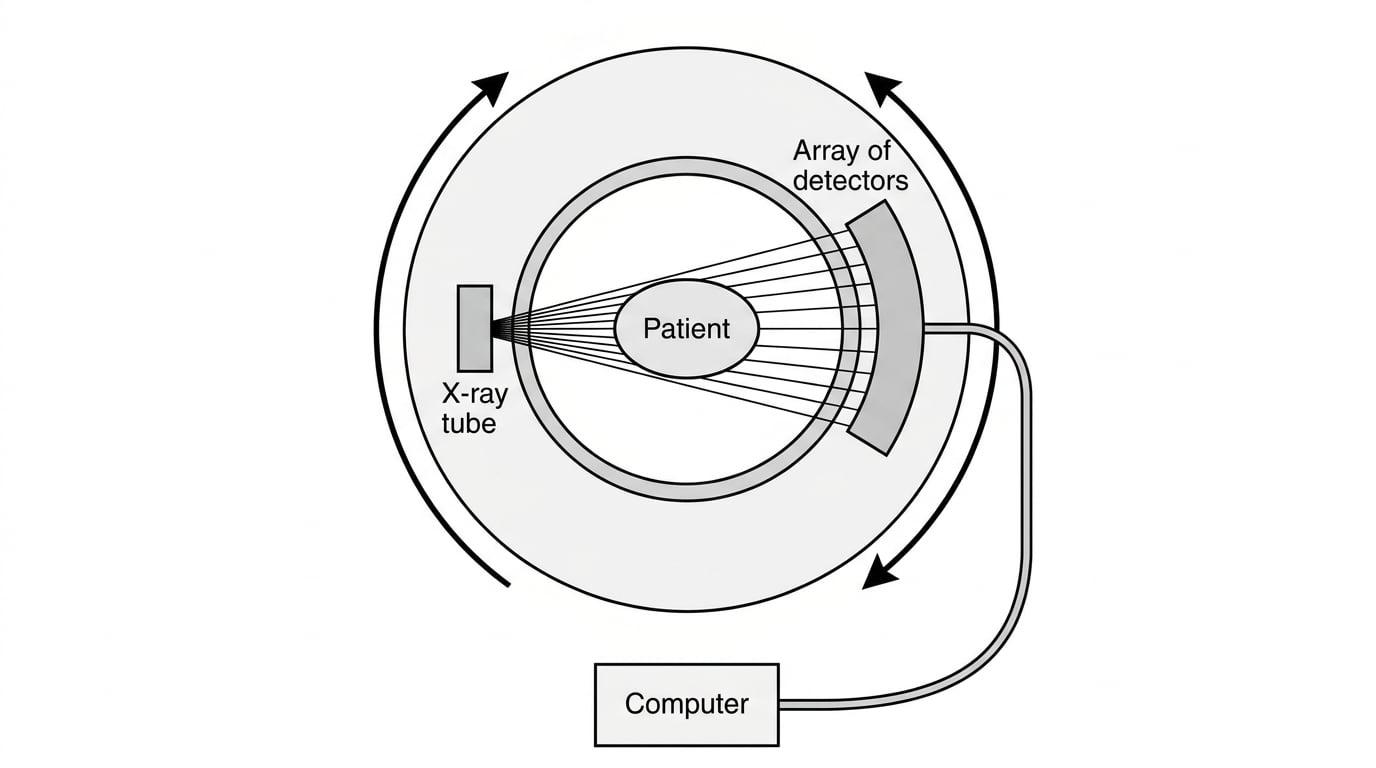
Buzzwords for the Exam
If you are asked to describe a CT scanner, always hit these four phrases: rotates, narrow monochromatic beam, array of detectors, and computer processes signals.
Worked Example: Explaining the Process
Question: Outline the basic principles of operation of a CT scanner. (4 marks)
Step-by-step solution:
- State the movement: An X-ray tube rotates around the patient.
- Describe the beam: The tube produces a narrow, monochromatic X-ray beam.
- State the detection method: The X-rays pass through the patient and are detected by an array of detectors opposite the tube.
- Describe the image formation: A computer processes the signals from the detectors to produce a cross-sectional visual image.
Comparing CT Scans with Conventional X-rays
AQA requires you to compare CT scans against standard 2D X-rays across three specific categories: Image Resolution, Cost, and Safety.
Image Resolution (Advantage)
CT scans have significantly better image resolution and contrast. Because conventional X-rays compress 3D structures into a 2D image, tissues can hide behind bone. A CT scan creates independent slices, completely removing overlapping shadows. Furthermore, CT is much better at distinguishing between different types of soft tissue that have very similar attenuation coefficients (like a tumour hidden inside healthy brain tissue).
Cost (Disadvantage)
CT scanners are massively more expensive than conventional X-ray machines. This includes the upfront cost to buy the machine, the reinforced rooms required to house them, the regular maintenance required for rotating heavy machinery, and the powerful computers needed to process the data. They also require highly trained radiographers to operate them.
Safety (Disadvantage)
A CT scan involves taking thousands of X-ray snapshots. Because of this, the patient receives a significantly higher dose of ionizing radiation compared to a single conventional X-ray. Higher doses of ionizing radiation carry a statistically greater risk of causing mutations in DNA, which can lead to cancer. Therefore, CT scans are only used when the clinical benefit heavily outweighs the risk.
Summary of Comparisons
- Resolution: CT is better (shows 3D depth, resolves soft tissues).
- Cost: CT is worse (very expensive machinery and computing).
- Safety: CT is worse (much higher radiation dose).
Worked Example: Evaluating Imaging Techniques
Question: A patient with a suspected simple bone fracture in their arm is sent for imaging. State and explain whether a conventional X-ray or a CT scan is more appropriate. (3 marks)
Step-by-step solution:
- State the choice: A conventional X-ray is more appropriate.
- Give a safety justification: A CT scan delivers a much higher dose of ionizing radiation to the patient, which is unnecessary for a simple fracture.
- Give a secondary justification (cost or resolution): Conventional X-rays are cheaper and quicker, and their image resolution is perfectly adequate for distinguishing high-density bone from soft tissue to spot a fracture.
Confusing 'Dose' with 'Energy'
Do not say that a CT scan uses "higher energy X-rays" than a standard X-ray. The energy of the individual X-ray photons might be similar. The safety issue is the dose—the sheer number of X-ray photons the patient is exposed to because the machine takes thousands of images during its rotation.
In the exam
- Be precise with "monochromatic": In reality, true monochromatic beams are hard to make and CTs use heavy filtering, but for AQA, you must use the word monochromatic to describe the beam.
- Link the computer to the image: Don't just say "a computer is used". Say "a computer processes the signals from the detectors to produce a visual image."
- Contrast clearly: When asked for a disadvantage of CT, always write it as a comparison. Say "Higher radiation dose than a conventional X-ray", not just "high radiation".
Check yourself
- Can you list the four main components/principles of a CT scanner mentioned in the specification?
- Why is the X-ray beam made to be narrow and monochromatic?
- What is the primary safety concern with CT scanners compared to conventional X-rays?
- In what situation does the superior image resolution of a CT scanner justify its higher cost and radiation dose?