Question 75
Figure 1 below shows the shape ABCDABCDABCD. The sector ABC ABC\,ABC is a sector of a circle with centre A A\,A and radius 7 cm, and the angle BAC BAC\,BAC is 0.6 radians. The angle BAD BAD\,BAD is a right angle, AB=7AB = 7AB=7 cm and AD=5AD = 5AD=5 cm.
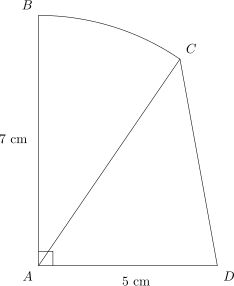
a.[1]
Find the length of the arc BCBCBC.
b.[2]
Calculate the area of the sector ABCABCABC.
c.[1]
Find the size of the angle CADCADCAD, in radians.
d.[3]
Find the total area of the shape ABCDABCDABCD, giving your answer to three significant figures.
3.5 Trigonometry (A-level only) Questions
223 exam-style questions on WJEC A Level Maths 3.5 Trigonometry (A-level only), covering 3.5.1 Trigonometry (A-level only), 3.5.2 Trigonometry (A-level only), 3.5.3 Trigonometry (A-level only), 3.5.4 Trigonometry (A-level only), 3.5.5 Trigonometry (A-level only), 3.5.6 Trigonometry (A-level only), 3.5.7 Trigonometry (A-level only), and 3.5.8 Trigonometry (A-level only). Each one has a worked solution and a mark scheme showing where the marks go.