Question 51
A landscape garden feature is designed using two identical sectors of a circle, ORP ORP\,ORP and OQSOQSOQS, and a central rhombus-shaped flower bed OSTROSTROSTR, as shown in the layout. The points PPP, OOO, and Q Q\,Q lie on a straight stone boundary of length 12 metres, such that O O\,O is the midpoint of PQPQPQ. The radii OR OR\,OR and OS OS\,OS form two sides of the rhombus, and the angle ∠ROS \angle ROS\,∠ROS is denoted by θ \theta\,θ radians.
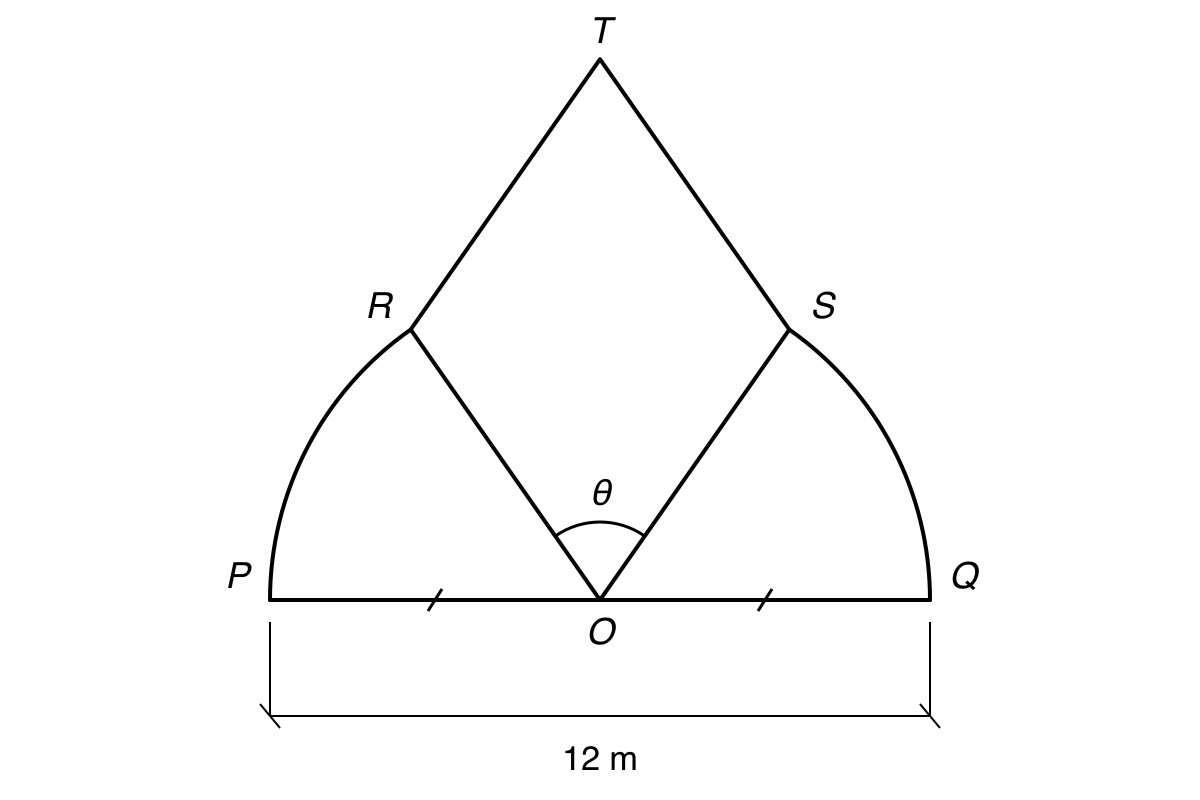
a.[4]
Show that the total area of the garden feature, A A\,A square metres, is given by
A=18(π−θ+2sinθ) A = 18(\pi - \theta + 2\sin\theta) A=18(π−θ+2sinθ)bi.[5]
Use calculus to show that the maximum value of A A\,A occurs when θ=π3\displaystyle \theta = \frac{\pi}{3}θ=3π. Fully justify that this value of θ \theta\,θ gives a maximum.
bii.[2]
Determine the exact maximum value of AAA.
c.[2]
Without further calculation, state how your answers to parts (b)(i) and (b)(ii) would change if the total boundary length PQ PQ\,PQ were increased to 24 metres.
1.5 Trigonometry Questions
317 exam-style questions on OCR A Level Maths 1.5 Trigonometry, covering 1.5.1 Definitions for all arguments, 1.5.2 Sine and cosine rules, 1.5.3 Area of a triangle, 1.5.4 Radian measure (A-level only), 1.5.5 Small angle approximations (A-level only), 1.5.6 Graphs of basic trigonometric functions, 1.5.7 Exact values in radians (A-level only), 1.5.8 Reciprocal and inverse trigonometric ratios (A-level only), 1.5.9 Graphs of reciprocal and inverse functions (A-level only), 1.5.10 Trigonometric identities, 1.5.11 Further trigonometric identities (A-level only), 1.5.12 Double angle and compound angle formulae (A-level only), 1.5.13 Geometrical proofs of formulae (A-level only), 1.5.14 Harmonic form Rcos / Rsin (A-level only), 1.5.15 Trigonometric equations, 1.5.16 Proof involving trigonometric functions (A-level only), and 1.5.17 Trigonometric functions in context. Each one has a worked solution and a mark scheme showing where the marks go.