Question 21
A brick of weight 10 N lies on a rough plane inclined at an angle of 30° 30°\,30° to the horizontal. A force of magnitude 12 N acts horizontally on the brick, rather than parallel to the plane, in the vertical plane containing a line of greatest slope. The brick is in equilibrium, on the point of slipping up the plane.
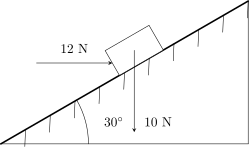
a.[5]
Find the coefficient of friction between the brick and the plane.
b.[2]
The 12 N force is now removed. Determine whether or not the brick moves.
3.4 Forces Questions
87 exam-style questions on OCR (MEI) A Level Maths 3.4 Forces, covering 3.4.1 Language relating to forces, 3.4.2 Acceleration due to gravity, 3.4.3 Identify forces and draw force diagrams, 3.4.4 Resultant of concurrent forces, 3.4.5 Equilibrium of a particle, 3.4.6 Resolve a force into components (A-level only), 3.4.7 Equilibrium condition for resultant zero (A-level only), 3.4.8 Forces in equilibrium sum to zero (A-level only), 3.4.9 Equations for a particle in equilibrium (A-level only), 3.4.10 Frictional force and normal contact force (A-level only), 3.4.11 Model friction with F ≤ μR (A-level only), and 3.4.12 Apply Newton's Laws to friction problems (A-level only). Each one has a worked solution and a mark scheme showing where the marks go.