Question 9
In this question use g=9.8g = 9.8g=9.8 m s−2^{-2}−2.
A ladder AB AB\,AB has length 5 m and mass 10 kg. The end A A\,A rests on rough horizontal ground and the ladder rests in limiting equilibrium against a fixed smooth horizontal rail at the point CCC, where AC=4AC = 4AC=4 m.
The vertical plane containing AB AB\,AB is perpendicular to the rail. The ladder is inclined to the horizontal at an angle α\alphaα, where tanα=125\displaystyle \tan\alpha = \frac{12}{5}tanα=512. The ladder is modelled as a uniform rod, and the coefficient of friction between the ladder and the ground is μ\muμ.
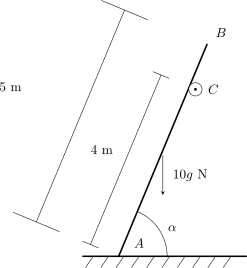
Using this model, find the value of μ\muμ.
3.4 Forces Questions
87 exam-style questions on OCR (MEI) A Level Maths 3.4 Forces, covering 3.4.1 Language relating to forces, 3.4.2 Acceleration due to gravity, 3.4.3 Identify forces and draw force diagrams, 3.4.4 Resultant of concurrent forces, 3.4.5 Equilibrium of a particle, 3.4.6 Resolve a force into components (A-level only), 3.4.7 Equilibrium condition for resultant zero (A-level only), 3.4.8 Forces in equilibrium sum to zero (A-level only), 3.4.9 Equations for a particle in equilibrium (A-level only), 3.4.10 Frictional force and normal contact force (A-level only), 3.4.11 Model friction with F ≤ μR (A-level only), and 3.4.12 Apply Newton's Laws to friction problems (A-level only). Each one has a worked solution and a mark scheme showing where the marks go.