3.2 Kinematics
123456789101112131415161718192021222324252627282930313233343536373839404142434445464748495051525354555657585960616263646566676869707172737475767778798081828384858687888990919293949596979899100101102103104105106107108109110111112113114115116117118119120121122123124125126127128129130131132133134135136137138139140141142143144145
Question 109
In this question use g=9.8g = 9.8g=9.8 m s−2^{-2}−2.
A ball, modelled as a particle, is projected from a point O O\,O on horizontal ground with speed 20 m s−1^{-1}−1 at an angle of 40° 40°\,40° above the horizontal. Air resistance is modelled as negligible.
A vertical wall of height 5 m stands on the same horizontal ground, at a distance of 12 m from OOO, in the vertical plane of the ball's motion.
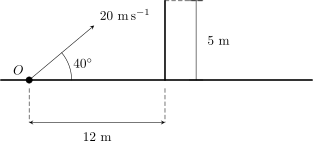
Determine whether the ball passes over the wall.
3.2 Kinematics Questions
260 exam-style questions on OCR A Level Maths 3.2 Kinematics, covering 3.2.1 Language of kinematics, 3.2.2 Graphs in kinematics, 3.2.3 Displacement-time and velocity-time graphs, 3.2.4 Constant acceleration formulae, 3.2.5 Constant acceleration in two dimensions (A-level only), 3.2.6 Non-uniform acceleration in one dimension (A-level only), 3.2.7 Non-uniform acceleration in two dimensions (A-level only), 3.2.8 Motion under gravity using vectors (A-level only), and 3.2.9 Projectiles (A-level only). Each one has a worked solution and a mark scheme showing where the marks go.