Question 48
A brick of weight 10 N lies on a rough plane inclined at an angle of 30° 30°\,30° to the horizontal. A force of magnitude 12 N acts on the brick up a line of greatest slope. The brick is in equilibrium, on the point of slipping up the plane.
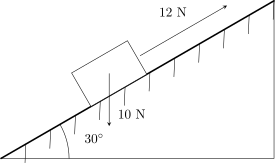
a.[4]
Find the coefficient of friction between the brick and the plane.
b.[2]
The 12 N force is now removed. Determine whether or not the brick moves.
3.3 Forces and Newton's Laws Questions
139 exam-style questions on OCR A Level Maths 3.3 Forces and Newton's Laws, covering 3.3.1 Concept and vector nature of a force, 3.3.2 Newton's first law, 3.3.3 Newton's second law in a straight line, 3.3.4 Newton's second law with vectors (A-level only), 3.3.5 Newton's second law with resolved forces (A-level only), 3.3.6 Weight, 3.3.7 Gravitational acceleration, 3.3.8 Newton's third law, 3.3.9 Normal reaction force, 3.3.10 Smooth contact model, 3.3.11 Equilibrium with connected particles and pulleys, 3.3.12 Newton's third law with resolved forces (A-level only), 3.3.13 Equilibrium by resolving (A-level only), 3.3.14 Equilibrium of forces in two dimensions using vectors (A-level only), 3.3.15 Resolving forces for advanced problems (A-level only), 3.3.16 Resultant forces and components (A-level only), 3.3.17 Dynamics of a particle in a plane (A-level only), 3.3.18 Concept of a frictional force (A-level only), 3.3.19 Contact force components (A-level only), 3.3.20 Coefficient of friction (A-level only), 3.3.21 Static and limiting equilibrium on a rough surface (A-level only), 3.3.22 Motion of a body on a rough surface (A-level only), and 3.3 Forces and Newton's Laws. Each one has a worked solution and a mark scheme showing where the marks go.